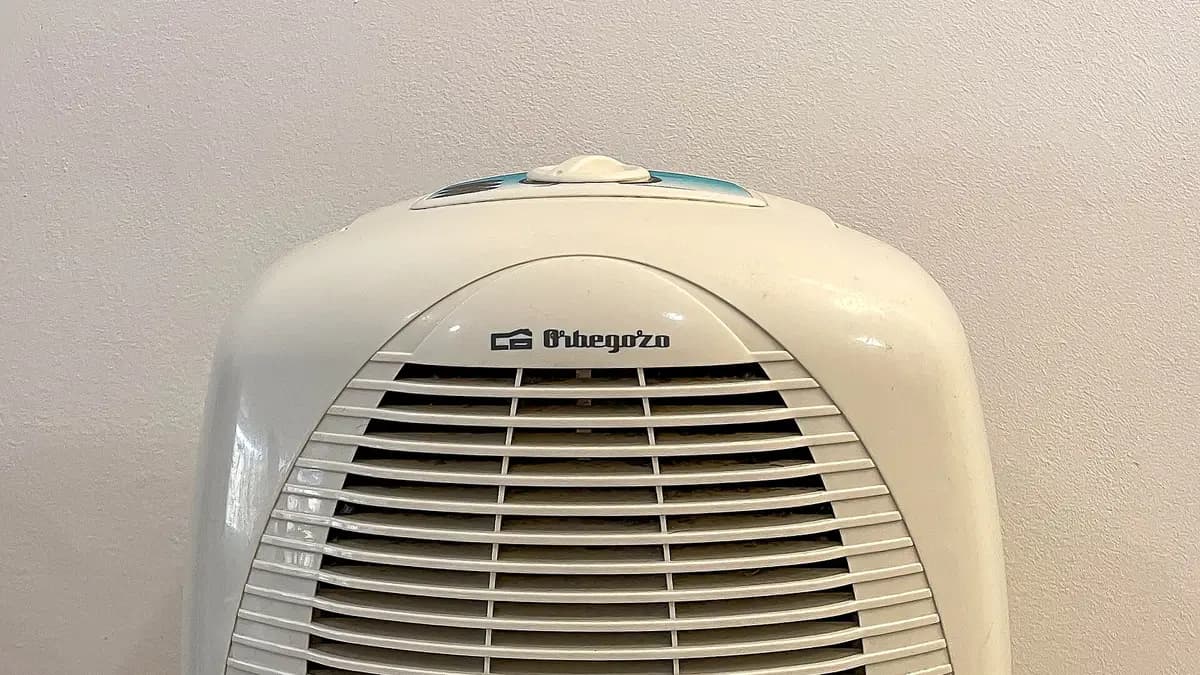
A home dehumidifier rated at 12 litres a day, like the Kendal KD-PD12R sold in Chile, draws about 190 W. With electricity at CLP 255.27 per kWh (CGE's price in cities such as Rancagua and Concepción since October 2026), that is about CLP 49 an hour and some CLP 11,600 a month if it runs eight hours a day. Larger 20 to 50-litre units cost between CLP 27,000 and CLP 48,000 a month with the same use.
In a rainy season like this October, indoor humidity shows up as fogged windows, mould stains and laundry that never dries. Here is how much a dehumidifier uses by capacity, what it costs to run in pesos, which type to choose and which alternatives cost less.
How much electricity a dehumidifier uses
Consumption depends mainly on capacity, which manufacturers state in litres per day. Higher capacity means a more powerful compressor. These are real specs for compressor units of different sizes:
| Model | Capacity | Power | Cost per hour (CLP 255.27/kWh) | Spec source |
|---|---|---|---|---|
| Kendal KD-PD12R | 12 L/day | 190 W | CLP 49 | Sodimac / Falabella |
| Midea DF20 | 20 L/day | 440 W | CLP 112 | PcComponentes |
| Trotec TTK 66 E | 24 L/day | 440 W | CLP 112 | Galaxus |
| Trotec TTK 90 E | 30 L/day | 500 W | CLP 128 | Galaxus |
| Trotec TTK 127 E | 50 L/day | 780 W | CLP 199 | Orotech |
This is maximum power, with the compressor running. Most units have a humidistat: when the room reaches the set humidity, the compressor switches off and only the fan runs, which uses far less. Real consumption is therefore usually lower than power multiplied by hours switched on.
How to work out any dehumidifier's consumption
Find the wattage on the label or spec sheet, divide by 1,000 and multiply by hours of use to get kWh. Then multiply by the kWh price on your bill. A 440 W unit running five hours uses 2.2 kWh, about CLP 562 at CLP 255.27 per kWh. Your district's price may differ: we calculated it in the price per kWh by city and utility.
Monthly running cost of a dehumidifier in pesos
This is the cost of a 30-day month with the compressor running for all the hours shown. It is the most expensive scenario; with a humidistat, the cost falls:
| Unit power | 4 hours a day | 8 hours a day | 12 hours a day |
|---|---|---|---|
| 190 W (12 L/day) | CLP 5,820 | CLP 11,640 | CLP 17,460 |
| 440 W (20-24 L/day) | CLP 13,480 | CLP 26,960 | CLP 40,430 |
| 500 W (30 L/day) | CLP 15,320 | CLP 30,630 | CLP 45,950 |
| 780 W (50 L/day) | CLP 23,890 | CLP 47,790 | CLP 71,680 |
For a flat with winter condensation problems, a 12-litre unit used at night in the bedroom is usually enough, at CLP 6,000 to CLP 12,000 a month. Units of 30 to 50 litres are for large houses, storerooms, basements or rooms after a flood.
Which dehumidifier to choose by efficiency
To compare the efficiency of two dehumidifiers, look at how many litres of water they remove per kWh. It is the metric used by the US ENERGY STAR programme, which requires at least 1.57 litres per kWh for portable units of up to 25 pints a day (about 12 litres), according to its Version 5.0 specification. Using the specs in the table above, this is each unit's nominal performance:
| Model | Litres per day | kWh over 24 hours | Litres per kWh (nominal) |
|---|---|---|---|
| Kendal KD-PD12R | 12 | 4.56 | 2.6 |
| Midea DF20 | 20 | 10.56 | 1.9 |
| Trotec TTK 66 E | 24 | 10.56 | 2.3 |
| Trotec TTK 90 E | 30 | 12.0 | 2.5 |
| Trotec TTK 127 E | 50 | 18.72 | 2.7 |
This is our own calculation using each spec sheet's maximum capacity and power, not a lab measurement. It is useful for comparison, with an important caveat: manufacturers measure capacity in hot, humid conditions, usually around 30 °C and 80% relative humidity. In a cold winter room at 12 to 15 °C, a compressor dehumidifier removes much less water per day than the figure on the box.
Compressor, desiccant or Peltier: the three types
- Compressor: works like a fridge, cooling the air so the water condenses. It is the most efficient in mild rooms and the most common. It loses performance in cold spaces.
- Desiccant (rotor): traps moisture in an absorbent material that is then dried with heat. It works better than a compressor unit in cold rooms, but usually uses more electricity per litre and warms the air.
- Peltier or thermoelectric: mini units with tanks of about 500 ml. They draw little power but remove very little water a day: fine for a wardrobe or small bathroom, not a room.
- Plug-free absorbers: bags or tubs with salts such as calcium chloride. They use no electricity, but their capacity is minimal and they need refilling.
In Chilean shops, a 12-litre compressor unit such as the Kendal KD-PD12R was listed at CLP 179,990 at Falabella in October 2026, and 500 ml mini units from about CLP 30,990. Efficiency labels matter for every appliance; we compare running costs of another humidity-related appliance in the energy-efficient clothes dryer guide.
How to use it and spend less
The US Environmental Protection Agency (EPA) recommends keeping indoor humidity below 60%, ideally between 30% and 50%, to prevent mould, according to its guide to mould and moisture. There is no need to go lower: every extra point of dryness costs electricity. Keys to spending less:
- Set the humidistat between 45% and 55%, not at the minimum.
- Close doors and windows in the room while it runs: if humid outside air comes in, the unit never finishes.
- Use it where the problem is (bedroom, bathroom, wardrobe), not in the whole house at once.
- Clean the filter every few weeks: a clogged filter reduces airflow and performance.
- Place it about 20 cm from the wall so air circulates through the inlet and outlet.
A good indicator is a digital hygrometer, which is cheap and shows the room's real humidity. If it reads below 50% without the unit, there is no need to switch it on.
Other solutions for damp at home
A dehumidifier treats the symptom by taking water out of the air. But damp in a Chilean home in winter has causes worth checking first, because some can be fixed for free:
| Solution | Running cost | When it makes sense |
|---|---|---|
| Ventilate 10 to 15 minutes a day | CLP 0 | Always; it comes first |
| 12-litre dehumidifier | ~CLP 49 an hour | Rooms with persistent condensation |
| Air conditioner in dry mode | Depends on unit power | If a split unit is already installed |
| Electric heating or heat pump instead of kerosene | Depends on equipment | Homes heated with indoor combustion |
| Salt absorbers | Periodic refills | Wardrobes and small spaces |
Kerosene heaters, widely used in Chile, are a major source of damp: burning the fuel releases water vapour inside the house. That is why condensation tends to be worse in homes heated with kerosene. We compare costs in kerosene heater running costs.
If you have a split air conditioner, dry mode lowers humidity without cooling much. It uses about as much as an air conditioner at low power, so it usually costs more than a small dehumidifier, but it avoids buying another appliance. Split consumption is covered in how much electricity an air conditioner uses.
What to do with the water from a dehumidifier
The water in the tank is condensate, but it is not drinkable: it passes over the coil and through the tank, which can collect dust and bacteria. It can be used to water ornamental plants or for the toilet cistern. If the unit has a continuous drain outlet, connecting a hose avoids emptying it by hand and stops it shutting off when the tank is full.
When it is worth buying one
A 12-litre dehumidifier costs about CLP 180,000 and CLP 6,000 to CLP 12,000 a month to run in the rainy season. It is worth it when humidity persists despite ventilation, when mould stains appear on walls or curtains, or when laundry hung indoors takes days to dry. In those cases the cost is low compared with damage to furniture, clothes and the health of the occupants.
It does not make sense for a one-off problem that ventilation fixes, or to buy an oversized unit: a 50-litre unit in a bedroom costs four times as much as a 12-litre one with no real improvement. Nor does it replace fixing leaks, roof drips or leaking pipes, which cause many persistent damp problems.
Do you sell climate control or energy efficiency equipment? Reach Energía Futura's readers.
See advertising optionsFrequently asked questions
How much electricity does a dehumidifier use?
A 12-litre unit draws about 190 W: about CLP 49 an hour at CLP 255.27 per kWh. A 20 to 24-litre unit draws about 440 W, around CLP 112 an hour.
Is it better to leave it on all night?
Yes, if it has a humidistat: it switches off when it reaches the set humidity. Without one, use a timer.
What humidity should a house have?
The EPA recommends below 60%, ideally between 30% and 50%.
Does a dehumidifier work in a cold room?
Compressor units perform worse below about 15 °C. For cold rooms a desiccant unit usually works better, although it uses more power.
Does a dehumidifier heat the room?
It warms the air slightly, because the compressor gives off heat, but it is not a heater.