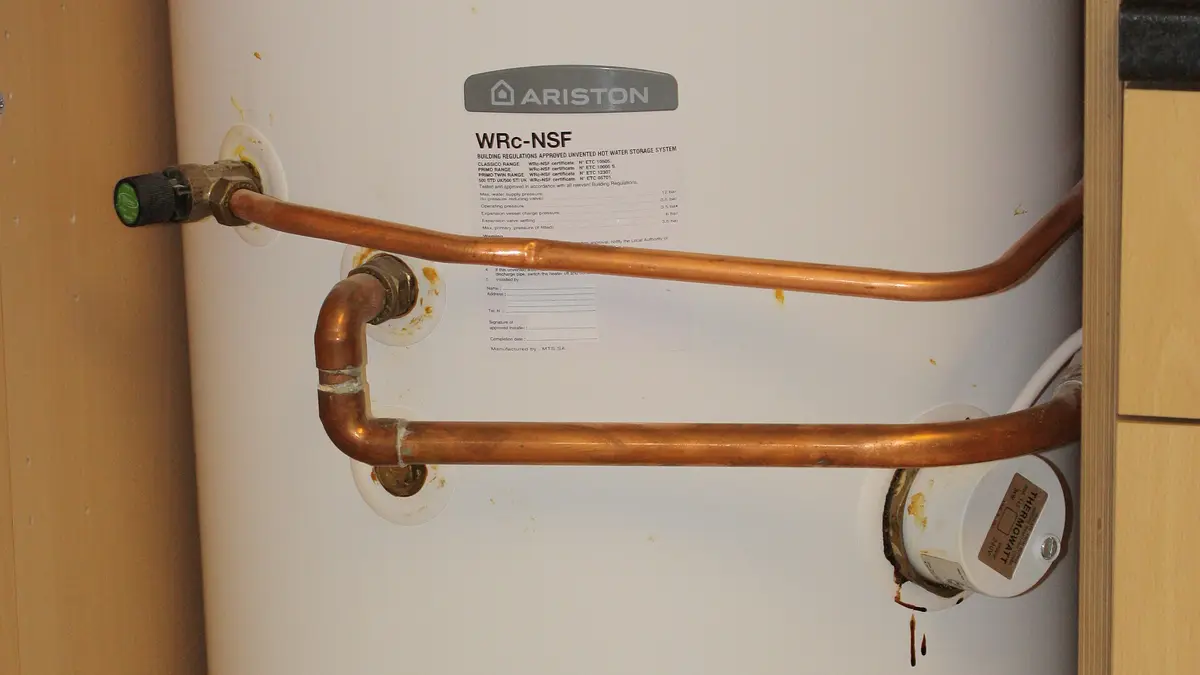
An electric water heater (called a *termo* in Chile) is one of the simplest ways to get hot water in a house or flat without gas, but also one of the appliances that weighs most on the power bill. An 80-litre tank needs about 4.5 kWh to heat up completely, and for a family of four the cost can approach CLP 75,000 a month.
In this guide we calculate how much an electric water heater uses depending on its size, what it costs in pesos at current residential rates, what models cost in Chilean stores and which size suits each household. All calculations use a kWh price of CLP 255.27 (BT1 residential rate including VAT) from CGE's tariff schedule in force since October 1, 2026 for cities such as Rancagua, Talca and Concepción. Elsewhere the price varies, as shown in our table of the price per kWh by city and utility.
How much electricity an electric water heater uses by size
A water heater's consumption depends not on its power rating but on how much water it heats and by how many degrees. The physics is simple: heating one litre of water by one degree takes 1.163 Wh. If water enters from the mains at 12 °C and the heater takes it to 60 °C, each litre needs about 56 Wh. The power rating (usually 1,500 W) only determines how long it takes.
| Tank size | Energy to heat a full tank (12 °C to 60 °C) | Time at 1,500 W | Cost to heat it fully |
|---|---|---|---|
| 30 litres | 1.7 kWh | 1 h 7 min | CLP 428 |
| 50 litres | 2.8 kWh | 1 h 52 min | CLP 713 |
| 80 litres | 4.5 kWh | 3 h | CLP 1,140 |
| 100 litres | 5.6 kWh | 3 h 43 min | CLP 1,425 |
| 120 litres | 6.7 kWh | 4 h 28 min | CLP 1,710 |
| 150 litres | 8.4 kWh | 5 h 35 min | CLP 2,138 |
In winter, mains water is colder and consumption rises. If it comes in at 8 °C instead of 12 °C, heating an 80-litre tank goes from 4.5 to 4.8 kWh, 8% more. That is why homes with electric water heaters usually see higher bills in the cold months, even when they use the same amount of water.
Standby losses: the hidden consumption
Besides heating the water you use, the heater spends energy keeping it hot. Water in the tank slowly cools through the insulation, and the element switches on to recover the temperature even if no one opens a tap. According to Endesa, these standby losses are usually between 1 and 2 kWh every 24 hours, and they are reported in each model's data sheet as heat loss.
With an average of 1.5 kWh a day, losses add up to 45 kWh a month, about CLP 11,500 just for keeping the heater on. It is a good argument for choosing a well-insulated model and for not buying a bigger tank than you need.
How much an electric water heater costs per month in pesos
To estimate the monthly cost we assume an 8-minute shower at a flow of 8 litres per minute at 40 °C, the usual shower temperature. That is 64 litres of warm water, of which about 37 litres come from the heater and the rest is mixed cold water. Energy per shower is 2.08 kWh, or about CLP 532 per shower. Standby losses come on top.
| People in the household (one daily shower each) | Heater consumption per month | Cost per month (at CLP 255.27/kWh) |
|---|---|---|
| 1 person | 107 kWh | CLP 27,400 |
| 2 people | 170 kWh | CLP 43,400 |
| 3 people | 233 kWh | CLP 59,400 |
| 4 people | 295 kWh | CLP 75,300 |
| 5 people | 358 kWh | CLP 91,300 |
This is a reference calculation: it excludes hot water for the kitchen and washbasin and assumes 8-minute showers. For comparison, Chile's National Energy Commission uses 180 kWh a month as its typical household consumption, as we explain in how much electricity a house uses in Chile. An electric water heater in a family of four can, on its own, more than double that bill.
Electric water heater prices in Chile
We checked the electric water heater listing at Sodimac on October 17, 2026. Published prices, including offers, fell into these ranges:
| Size | Price published at Sodimac (October 17, 2026) | Usual power |
|---|---|---|
| 30 litres | CLP 109,990 to 139,990 | 1,500 W |
| 50 litres | CLP 119,990 to 159,990 | 1,500 to 1,700 W |
| 80 litres | CLP 139,990 to 189,990 | 1,500 to 1,700 W |
| 100 litres | CLP 149,990 to 266,990 | 1,500 to 1,700 W |
| 120 litres | CLP 189,990 to 239,990 | 1,500 to 1,700 W |
| 150 litres | CLP 219,990 to 389,990 | 1,500 to 2,200 W |
| 200 litres (floor-standing) | CLP 499,990 | 3,000 W |
Installation comes on top and must be done by an SEC-licensed electrician, because a 1,500 W heater draws about 7 amps at 220 volts and should have its own circuit with residual-current protection.
What size to choose for your household
The rule of thumb is to allow 35 to 40 litres of heated water for each back-to-back shower. Manufacturers state how many showers each model covers; in the listing we reviewed, a 100-litre heater is sold for 2 to 3 showers, a 120-litre one for 3 showers and a 150-litre one for 4 to 5 showers.
- 30 litres: one person or a guest bathroom. It recovers quickly but is not enough for two showers in a row.
- 50 litres: one or two people with short showers.
- 80 litres: two to three people. The most common size in flats.
- 100 to 120 litres: families of three to four.
- 150 litres or more: four or five people, or homes with two bathrooms used at the same time.
A tank that is too large wastes more on standby losses; one that is too small forces you to wait between showers. If household members shower at different times, a slightly smaller heater that recovers between uses may be enough.
How to cut consumption and the bill
- Shorter showers: going from 8 to 5 minutes saves about 94 kWh a month for a family of four, close to CLP 24,000 (our calculation).
- Low-flow shower head: an efficient head reduces litres per minute without changing how the shower feels.
- The right temperature: do not turn it to maximum, but do not set it too low either; the World Health Organization recommends storing hot water at 60 °C or more to prevent Legionella.
- Insulation: a well-insulated heater or a thermal jacket reduces standby losses.
- Maintenance: limescale on the element makes it heat worse; check and replace the magnesium anode as the manual says.
- Timers, with caveats: on the BT1 rate a kWh costs the same at any hour, so a timer only saves the losses during the hours the heater is off.
When buying, check the label and data sheet: heat loss in kWh per 24 hours is the figure that separates an efficient heater from one that leaks heat.
Alternatives for heating water with less electricity
If the bill gets too high, some technologies heat the same water with less electricity. Heat pump water heaters extract heat from the air and, according to manufacturers, can deliver close to three times the energy they consume, which would cut the cost to around a third. Another option is pairing the heater with solar panels, which produce by day the electricity the heater uses; we explain how to size one in our home solar kit guide.
| Hot water option | Electricity per 8-minute shower | Cost per shower (at CLP 255.27/kWh) |
|---|---|---|
| Electric water heater with element | 2.08 kWh | CLP 532 |
| Heat pump water heater (efficiency of 3, reference) | 0.69 kWh | CLP 177 |
| Electric heater with solar panels (daytime) | Depends on generation | Close to CLP 0 in sunny hours |
Do you sell water heaters, heat pumps or solar systems? Reach Energía Futura readers looking to lower their power bill.
See advertising optionsFrequently asked questions
How much electricity does an 80-litre electric water heater use?
About 4.5 kWh to heat a full tank from 12 °C to 60 °C, plus 1 to 2 kWh a day in standby losses. At CLP 255.27 per kWh, heating it fully costs about CLP 1,140.
How much does an electric water heater add to the power bill?
For a family of four with one 8-minute shower each per day, about 295 kWh a month, close to CLP 75,000. For a person living alone, about CLP 27,400.
Should I switch off the water heater at night?
It only saves the standby losses for those hours. On the BT1 rate, energy costs the same day and night, so the saving is moderate.
What size of water heater for 4 people?
100 to 120 litres if they shower back to back; 80 litres may be enough if showers are short and at different times.