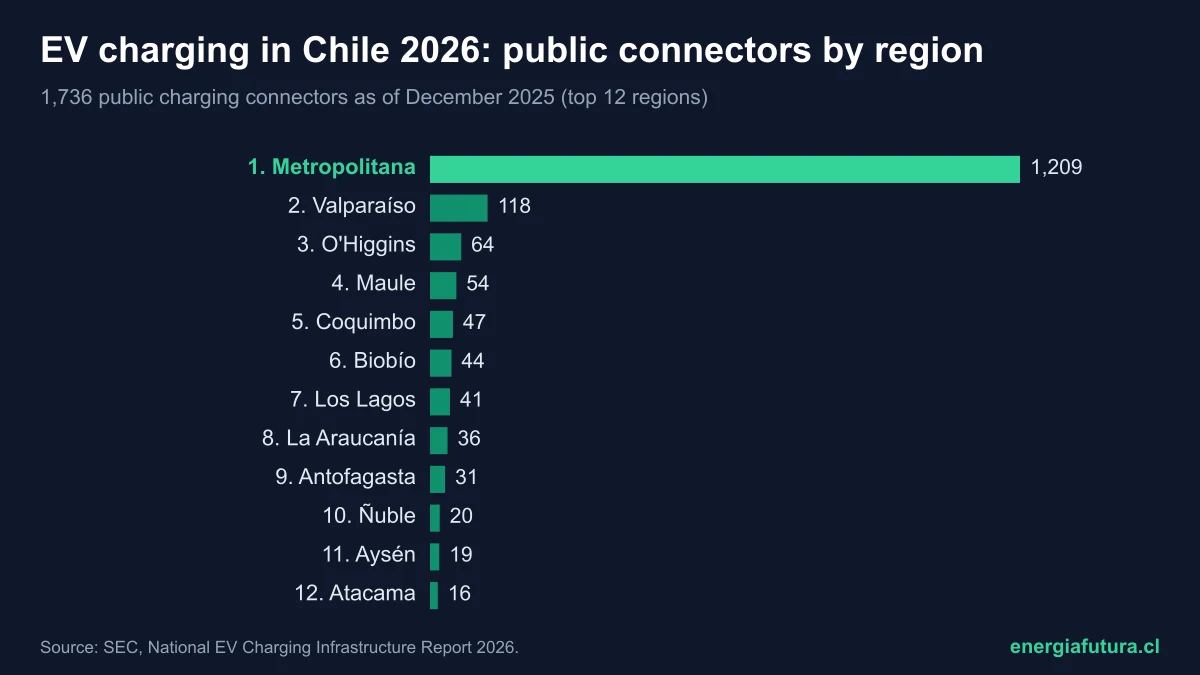
Chile has 4,015 private EV chargers in homes and buildings, 76.5% of all chargers in the country, according to the SEC's National EV Charging Infrastructure Report 2026, with data to December 2025. More and more of them are in condominium car parks, where the project is no longer just an electrical one: it is also a decision for the whole community.
For a building manager or a board there are four pieces: what the SEC's technical standard RIC No. 15 requires, the TE6 declaration that a licensed installer must sign, how each charger's energy is metered and billed, and what Condominium Law 21,442 says about the quorums needed to approve the works. This guide covers all four.
View the data as a table
| Minimum power per space in EV-ready buildings | 3.7 kW |
| Maximum RCD sensitivity | 30 mA |
| Quorum for building works on common property | 66% |
| Private chargers in Chile (2025) | 4,015 |
What RIC No. 15 requires for chargers in condominiums and apartment buildings
RIC No. 15, «Electric vehicle charging infrastructure», is the SEC technical standard that governs every charging installation, public or private. Its 2024 version has a chapter on buildings and housing complexes (section 14.2) and defines two levels for buildings designed with chargers in mind:
| Level | Requirement | Minimum power |
|---|---|---|
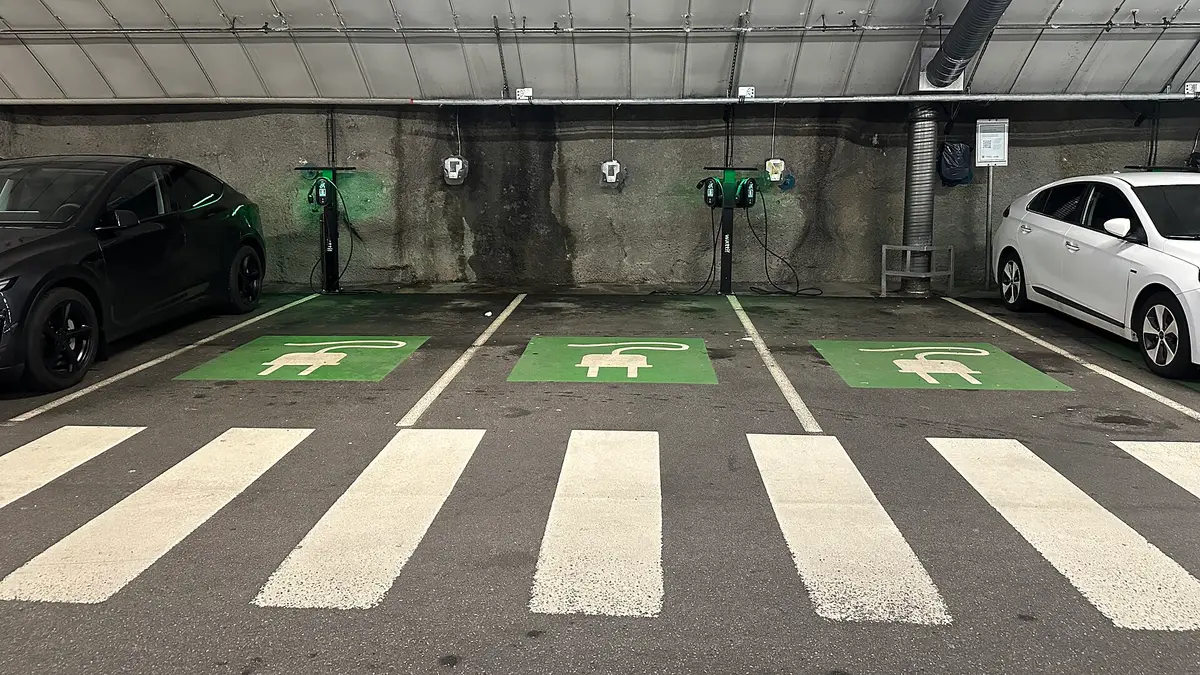
| EV-ready | A charging point (PCS) or a charger (SAVE) in 100% of underground parking spaces | SAVE of 3.7 kW or more |
| Semi-ready | A PCS or SAVE in at least 50% of underground parking spaces | SAVE of 3.7 kW or more |
| Both levels | Measure separately the consumption of each PCS or SAVE | — |
Source: SEC, Technical Standard RIC No. 15, 2024 version, sections 14.2.1.1 to 14.2.1.3. A PCS is a simple charging point (a fixed socket) and a SAVE is a dedicated electric vehicle supply system, that is, a charger.
For any building, new or existing, the standard sets other rules a board should know when it receives a proposal:
- Remote power management: the power of chargers in buildings «must be able to be managed» through a load management system (SGC) and a remote service-entrance protection system (SPA) (section 14.2.7).
- Manager's authorisation: if the chargers are connected to the common services supply, before they are energised the building manager must authorise them, stating how much energy and power they will add to those services (section 7.3).
- If the supply falls short: when the chargers plus the other common loads exceed its capacity and the connection is not upgraded, a load management system that prevents exceeding it is mandatory (section 7.3).
- Residual current protection: each charger circuit needs at least a type A RCD of 30 mA or less (section 12.5).
- Charging mode: modes 2, 3 and 4 are allowed in buildings; mode 1 (an ordinary socket with no control) is not allowed for cars (sections 6.1.1 and 14.2.3).
The standard also allows feeders to be sized with a demand factor below 1 when there is a load management system, because not every car charges at full power at the same time. For private charging above 10 kW that factor can drop to 0.5, and from 120 kW, to 0.3.
| Private charging (homes and buildings) | Up to 10 kW | 1 |
| Private charging (homes and buildings) | 10-120 kW | 0,5-1 |
| Private charging (homes and buildings) | From 120 kW | 0,3-1 |
| Public charging | Up to 20 kW | 1 |
| Public charging | 20-150 kW | 0,6-1 |
| Public charging | From 150 kW | 0,5-1 |
The TE6 declaration: who files it and what it includes
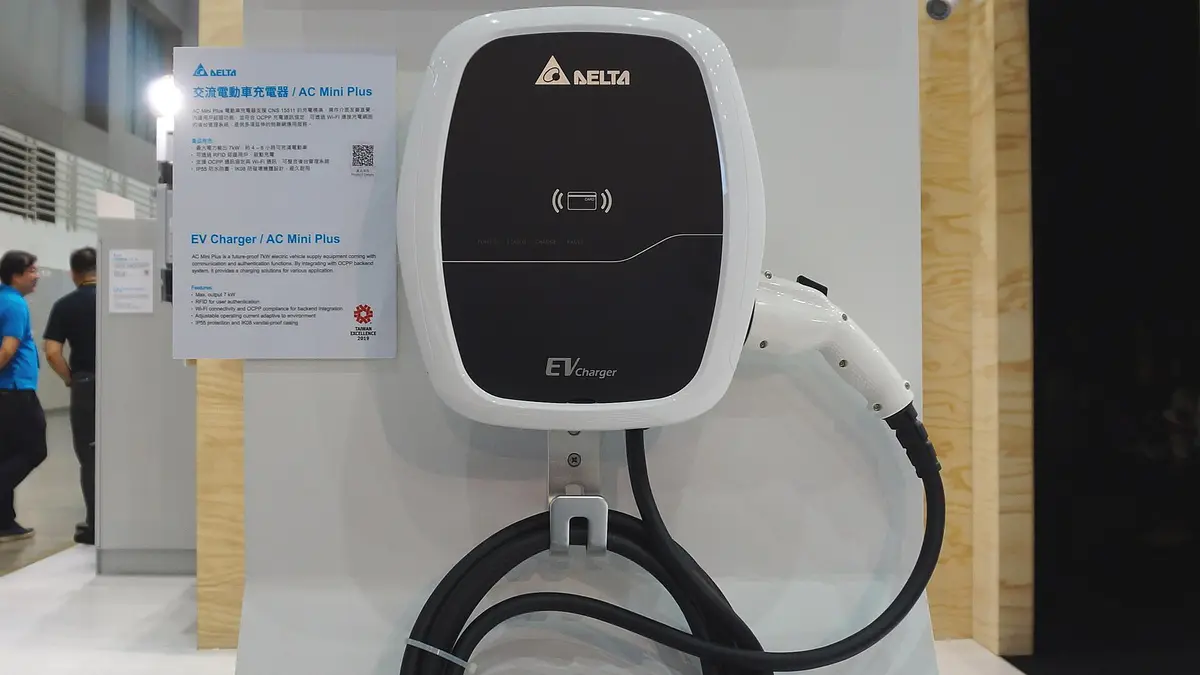
Every charger, public or private, must be declared to the SEC with the TE6, in force since December 2018. It is filed by a licensed electrical installer, who certifies that the installation was designed, built and inspected to standard. For alternating current charging a class A, B, C or D licence is valid, depending on power; for direct current, only class A or B. The companies that offer this service are listed in our guide to EV charger companies in Chile.
The SEC's Technical Instruction RIC No. 15.1/2026, from January 2026, sets what must be submitted: the project, an explanatory report when declared private charging exceeds 10 kW, an initial verification report with tests and measurements, and a photo report of the equipment. A building with several identical chargers can declare a multiple installation, with photos and identification of each one.
| TE6 document | When it is required |
|---|---|
| Electrical project (drawings and load schedule) | Always |
| Explanatory report | Private charging above 10 kW; always for public charging or medium-voltage connections |
| Initial verification report | Always |
| Photo report | Always; for multiple installations, photos of each charger |
| Charger user manual | Public charging only |
Source: SEC, General Technical Instruction RIC No. 15.1/2026, sections 7.2 to 7.6.
Does your company install or manage chargers in buildings? Reach the building managers and boards who read Energía Futura.
See advertising formatsHow charger consumption is metered and shared in condominiums
This is the question that sparks most arguments at an owners' meeting: who pays for the electricity. RIC No. 15 requires the consumption of each charger in EV-ready buildings to be measured separately, and defines a charger metering unit, which cannot sit inside the supply connection's meter. In practice there are four set-ups:
| Set-up | How it works | Who pays for the energy | Pros and cons |
|---|---|---|---|
| From the apartment's own supply | A circuit runs from the unit's meter to its parking space | The owner, on their electricity bill | Simple to bill; may need long cable runs |
| From common services with a meter per charger | Chargers hang off the common supply and each has its own meter | The community, which then bills each user | One single works; needs the manager's authorisation and load management |
| Operator service | A company installs, meters with its software and bills through an app | The user, to the operator; the operator reimburses the energy | No impact on service charges; contract with a third party |
| Dedicated supply | A second connection just for charging, in exceptional cases | The connection holder | Separates consumption; costlier and not always allowed |
Source: Energía Futura, based on sections 7.2 to 7.8 and 14.2 of RIC No. 15 and offers published by operators. The standard allows the supply boxes and meters of buildings with underground car parks to be concentrated, distributed or mixed, on each floor or at each charger's parking space.
In the operator set-up, companies such as Copec Voltex, CHASS or ElectroChile offer to meter and bill each user with their software. Copec Voltex, for example, says each user pays for charging in its app and the company reimburses the energy to the community, with no impact on service charges. How those platforms work, and the protocol they use, is explained in our guide to charger management software and OCPP.
For residents, charging in the building costs almost the same as in a house: with CGE's kWh at CLP 255.27 in October 2026, 40 kWh costs about CLP 10,211, against CLP 17,560 at Enel X Way or CLP 19,800 at a CLP 495 Copec Voltex fast charger. Public network rates are broken down in our guide to Copec Voltex.
View the data as a table
| Chargers | |
|---|---|
| Metropolitana | 2,873 |
| Valparaíso | 313 |
| Biobío | 171 |
| Los Lagos | 114 |
| O'Higgins | 100 |
| Antofagasta | 88 |
| La Araucanía | 73 |
| Atacama | 69 |
| Coquimbo | 61 |
| Maule | 48 |
| Ñuble | 39 |
| Los Ríos | 28 |
What the Condominium Law says about chargers in condominiums
Law 21,442 does not mention chargers, but its rules on common property define how a project is approved. Article 14 lists the matters that can only be dealt with at an extraordinary meeting of owners, and the table in article 15 sets two quorum levels, according to the Ministry of Housing's guide and the text of the law:
| Type of meeting | Quorum to meet | Quorum to approve | Matters that may affect a charging project |
|---|---|---|---|
| Ordinary | 33% of the rights | Absolute majority of those present | Reports and management decisions |
| Extraordinary, absolute majority | 50% plus one of the rights | 50% plus one of the rights | Alterations to common property; extraordinary spending above six months of service charges in 12 months |
| Extraordinary, reinforced majority | 66% of the rights | 66% of the rights | Construction on common property and changes of use; exclusive use rights; leasing or assigning common property; amending the bylaws on certain matters |
Source: Law 21,442, articles 14 and 15 (quorum table). Which quorum applies depends on how the works are classified: running conduits along a common wall is not the same as building a new electrical room, assigning exclusive charging spaces or granting an operator a concession over a common area. It is worth checking the condominium bylaws, which may regulate these matters, and getting legal advice before calling the meeting.
- Before the meeting: ask two or three suppliers for a feasibility study with the spare capacity of the common supply.
- In the notice: describe the works, their cost, who pays and the billing set-up, because extraordinary meetings can only deal with items included in the notice.
- If the community pays: check whether the cost exceeds six months of service charges within 12 months.
- If an operator is involved: put in writing who maintains the equipment, the contract term and what happens to the infrastructure when it ends.
- At the end: require the registered TE6 and keep the project documents.
- December 2018The TE6 declaration beginsEvery charger, public or private, is declared to the SEC.
- April 2022Condominium Law 21,442Sets 50%-plus-one and 66% quorums depending on the matter.
- 2024New version of RIC No. 15Defines EV-ready and semi-ready buildings and requires remote power management.
- January 2026Technical instruction RIC No. 15.1/2026Sets how projects are filed for commissioning.
Frequently asked questions
Can I install a charger in my apartment's parking space?
Yes, but it depends on the building's electrical installation and, if the common supply is used or common property is altered, on authorisation from the manager and the owners' meeting.
What quorum is needed to approve chargers in a condominium?
Alterations to common property need an extraordinary meeting with an absolute majority (50% plus one of the rights); construction on common property or assigning exclusive use needs a reinforced 66% majority.
Who pays for the charger's electricity?
It depends on the set-up: the owner on their bill, if connected to their own supply; or the user, through the charger's meter or an operator's app, if connected to common services.
What is the TE6?
It is the declaration of a charger installation to the SEC, mandatory since December 2018, signed by a licensed electrical installer.
What is an EV-ready building?
Under RIC No. 15, one with a charging point or charger of at least 3.7 kW in 100% of its underground parking spaces; a semi-ready one, in at least 50%.
How much does charging in the building cost?
The same as the residential kWh if metered without a mark-up: about CLP 10,211 for 40 kWh at CGE's October 2026 rate.