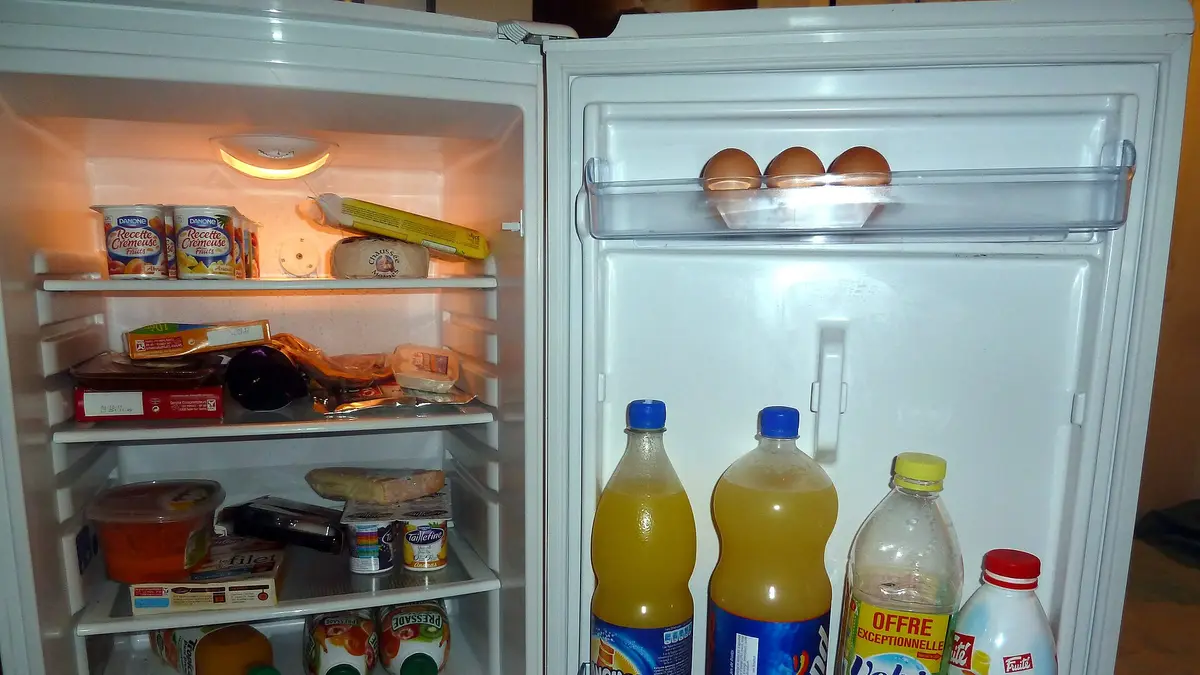
A household refrigerator generally uses between 25 and 60 kWh a month, depending on its size, age and efficiency. With the residential kWh at CLP 255.27 (CGE's price in municipalities such as Rancagua or Concepción since October 2026), that means between CLP 6,400 and CLP 15,300 a month on the electricity bill.
A real example: the Samsung RT43K6631SL refrigerator, with 438 liters and automatic defrost, declares on its energy efficiency label for Chile a consumption of 36.2 kWh a month, about CLP 9,240 a month. Here we explain how many watts a refrigerator uses and how to calculate yours.
How much a refrigerator costs per month in pesos
The key figure is on the label: in Chile, refrigerator labels report consumption in kWh per month. Multiplied by your municipality's kWh price, it gives the monthly cost:
| Label consumption | Cost per month (at CLP 255.27/kWh) | Cost per year |
|---|---|---|
| 25 kWh/month | ~CLP 6,380 | ~CLP 76,600 |
| 30 kWh/month | ~CLP 7,660 | ~CLP 91,900 |
| 36.2 kWh/month (438 L Samsung) | ~CLP 9,240 | ~CLP 110,900 |
| 45 kWh/month | ~CLP 11,490 | ~CLP 137,800 |
| 60 kWh/month | ~CLP 15,320 | ~CLP 183,800 |
The kWh price changes by municipality: in CGE's areas it ranges from CLP 240.83 to CLP 285.56. You can check yours in the price per kWh by city and utility.
How many watts a refrigerator uses
This is the most common confusion. A refrigerator does not draw its rated power all day: the compressor switches on and off depending on the internal temperature. When running, a household refrigerator typically uses between 100 and 300 watts; when the compressor stops, it uses almost nothing.
| Concept | What it means | Typical value |
|---|---|---|
| Running power | What the compressor draws when it is on | 100 to 300 W |
| Starting power | The momentary peak when the compressor starts | Several times normal power |
| Real average power | Monthly consumption spread over all hours | 35 to 85 W (25 to 60 kWh/month) |
| Label consumption | Energy measured in a standard test | kWh/month |
That is why the power on the rating plate is no use for calculating the bill. An example: a 150 W compressor that runs 40% of the time uses 150 × 24 × 0.4 = 1.44 kWh a day, about 43 kWh a month. If the same unit runs 25% of the time, it drops to 27 kWh.
Consumption by size
Chile's consumer agency Sernac classifies refrigerators by capacity: 300 liters is a small unit, 360 liters medium and 440 liters large, according to its buying guide. More liters mean more volume to cool, although a large, efficient unit can use less than a small, old one.
| Type of refrigerator | Indicative consumption range | Indicative monthly cost |
|---|---|---|
| Minibar | 10 to 25 kWh/month | CLP 2,550 to 6,380 |
| Small (up to 300 L), efficient | 20 to 30 kWh/month | CLP 5,100 to 7,660 |
| Medium to large (360 to 440 L), efficient No Frost | 30 to 45 kWh/month | CLP 7,660 to 11,490 |
| Side by side or French door (over 500 L) | 45 to 70 kWh/month | CLP 11,490 to 17,870 |
| Old refrigerator (over 10 years) | 40 to 60 kWh/month or more | CLP 10,210 to 15,320 |
The ranges are indicative and useful for comparison. A model's exact consumption is the one on its label. For an old class B or C refrigerator, industry estimates put consumption at 500 to 700 kWh a year (42 to 58 kWh a month), compared with 200 to 300 kWh a year for a modern, efficient one with an inverter compressor, according to País Circular.
Inverter technology: how much less it uses
A conventional refrigerator turns the compressor on at full power and off when it reaches the temperature; an inverter refrigerator regulates the compressor's speed and runs more continuously at low power. It avoids start-ups and temperature swings, which is why it usually uses less for the same volume.
The exact difference depends on the model, so the right comparison is always between labels: two refrigerators of the same volume, one at 28 kWh/month and another at 40 kWh/month, differ by 12 kWh a month, about CLP 36,800 a year with kWh at CLP 255.27.
How much the refrigerator weighs on the electricity bill
In a household using 180 kWh a month, the consumption the CNE uses as its typical home, a 36.2 kWh refrigerator accounts for 20% of the bill. An old one at 55 kWh reaches 31%. That is why it is usually the biggest consumer in homes without electric heating, as we show in how much electricity a house uses in Chile per month.
| Replacing a refrigerator | Consumption | Cost per year (at CLP 255.27/kWh) |
|---|---|---|
| Old refrigerator | 55 kWh/month | ~CLP 168,500 |
| New efficient refrigerator | 30 kWh/month | ~CLP 91,900 |
| Estimated annual saving | 25 kWh/month | ~CLP 76,600 |
With that saving, the price difference between an efficient model and a less efficient one can be recovered in a few years, because the refrigerator runs 24 hours a day, 365 days a year.
How to read the energy efficiency label
The energy efficiency label is mandatory for refrigerators in Chile. It shows the brand and model, the efficiency class (from A, the most efficient, downwards), the consumption in kWh per month, the volume in liters and the defrost system. The label of the Samsung in our example adds an energy saving of 61% compared with the reference.
The label is changing: since January 1, 2026, manufacturers and importers must use the new E2.0 label, with a different methodology and new classification ranges, and from October 31, 2026 all products in physical and online stores must display it, according to the Ministry of Energy. During the transition, the same model may have an old and a new label; both are valid.
Do you sell efficient appliances? Reach households that compare consumption before buying at Energía Futura.
See advertising optionsHow to measure real consumption at home
- With the label: if you still have it or can find the model online, the kWh/month figure is the most reliable.
- With a plug-in meter: connect it between the socket and the refrigerator for at least 24 hours (ideally a week) and multiply the result.
- With the house meter: switch everything else off for a few hours and see how far it moves. It is less precise, but useful as a reference.
- With the rating plate: it only gives nominal power, not real consumption. Use it to size a generator or backup, not to calculate the bill.
The rating plate does matter for backup power: the compressor's starting peak is what determines the size of portable power station or inverter you need to keep the refrigerator running during an outage, as we explain in which emergency solar kit to choose for a power outage.
How to lower consumption
- Keep it away from the wall and from heat: leave space behind it so it can dissipate heat, and keep it away from the stove and the sun.
- Set the temperature: in general, about 4 °C in the fridge and -18 °C in the freezer is enough.
- Check the door seals: if a sheet of paper slides out with the door closed, the seal is worn.
- Don't store hot food: let it cool to room temperature first.
- Open it less often and for less time.
- Clean the condenser (the grille at the back or bottom) once or twice a year.
- Defrost non-No Frost models when the ice exceeds a few millimeters.
Frequently asked questions about refrigerator consumption
How many watts does a refrigerator use?
Between 100 and 300 watts while the compressor is running. Since it switches on and off, the real average is about 35 to 85 watts.
How many kWh does a refrigerator use per month?
Generally between 25 and 60 kWh a month. The exact figure is on its energy efficiency label.
How much does it cost in pesos to keep a refrigerator running?
Between about CLP 6,400 and CLP 15,300 a month with kWh at CLP 255.27. A 36.2 kWh/month model costs about CLP 9,240.
Why does the refrigerator's plate show more watts than it uses?
Because the plate shows the compressor's power when it runs, and the compressor is off for much of the day. Real consumption is measured in kWh per month, the figure on the label.
How much does a minibar use?
Generally between 10 and 25 kWh a month, between about CLP 2,550 and CLP 6,380 with kWh at CLP 255.27. Check the model's label.
Is it worth replacing an old refrigerator?
If it is more than 10 years old and uses about 55 kWh a month, an efficient one at 30 kWh can save about CLP 76,000 a year.