A pool heat pump delivers between 4 and 6 kWh of heat for every kWh of electricity it uses, according to manufacturers' data. For a 30 m³ pool, a unit with about 6 to 7 kW of heating output draws around 1.2 kW of electricity: about CLP 306 an hour at CLP 255.27 per kWh (CGE's price in cities such as Rancagua and Concepción since October 2026).
Raising that pool's water by 8 °C, from 18 to 26 °C, costs about CLP 14,000 in electricity with a heat pump, compared with more than CLP 71,000 with a resistance heater. Here is the calculation, the monthly cost of keeping the temperature, what size to choose and how a cover cuts the bill.
How a pool heat pump works
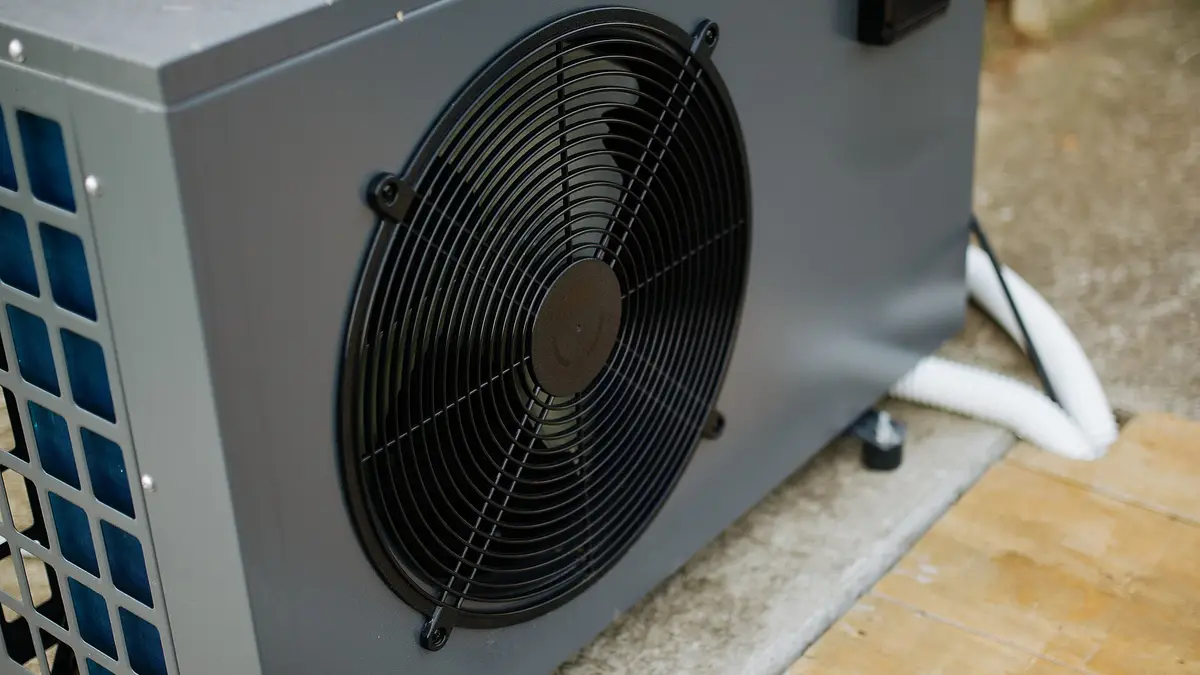
A heat pump does not create heat by burning fuel or through a resistance: it extracts heat from the outside air with a refrigerant circuit, like an air conditioner in reverse, and transfers it to the pool water. That is why it delivers more heat than the electricity it consumes. The ratio is called COP (coefficient of performance): a COP of 5 means 5 kWh of heat for each kWh of electricity.
The US Department of Energy says pool heat pumps usually have a COP between 3 and 7, and perform better the milder the air, according to its Energy Saver guide. Below about 7 to 10 °C, performance drops sharply. The principle is the same as heat-pump space heating, which we compare with other heaters in the low-consumption electric heater guide.
How much power a pool heat pump uses
Consumption depends on the unit's output and the air temperature. These are real specs for residential pool units:
| Unit | Heat delivered | Electricity used | COP | Test conditions |
|---|---|---|---|---|
| Zodiac Z200 (smallest model) | 6.7 kW | 1.2 kW | ~5.6 | Air 28 °C, water 28 °C, 80% humidity |
| Zodiac Z200 (smallest model) | 4.8 kW | ~1.0 kW | ~4.8 | Air 15 °C |
| Midea MSC-70D2N8-A | 7.16 kW | Not in summary sheet | High | Air 27 °C, water 28 °C, 80% |
| Midea MSC-70D2N8-A | 5.30 kW | — | — | Air 15 °C, 70% |
| Kripsol I-Komfort RC 700 | 5.5 kW | — | 8.02 (declared maximum) | Favourable conditions |
The data come from Zodiac's spec sheet and sheets published by distributor AutoSolar. The lesson is clear: the same unit delivers about 30% less heat with air at 15 °C than at 28 °C. In central Chile, spring and autumn nights are often in that range, so it is best to run the unit in the warmest hours of the day.

What heating a pool with a heat pump costs
Heating one cubic metre of water by 1 °C takes 1.163 kWh of heat (a physical property of water). A 30 m³ pool therefore needs about 35 kWh of heat per degree. That gives the cost of the initial heat-up, not counting losses while heating:
| Pool | Heat to raise 8 °C (18 to 26 °C) | Electricity with heat pump (COP 5) | Cost with heat pump | Cost with electric resistance (COP 1) |
|---|---|---|---|---|
| 20 m³ | 186 kWh | 37 kWh | CLP 9,500 | CLP 47,500 |
| 30 m³ | 279 kWh | 56 kWh | CLP 14,250 | CLP 71,240 |
| 50 m³ | 465 kWh | 93 kWh | CLP 23,740 | CLP 118,700 |
This is our own calculation at CLP 255.27 per kWh. A unit delivering 6.7 kW would need about 42 hours of operation to raise a 30 m³ pool by 8 °C, not counting losses, so the initial heat-up takes several days at the start of the season. What matters most afterwards is keeping the temperature, because an uncovered pool loses heat every night.
Monthly cost of keeping the pool warm
Losses depend on wind, shade, night temperatures and above all whether the pool has a cover. As a reference, this is the cost of running a unit drawing 1.2 kW for different hours a day over 30 days:
| Hours of operation per day | kWh per month | Monthly cost (CLP 255.27/kWh) |
|---|---|---|
| 4 hours (with cover, mild weather) | 144 kWh | CLP 36,760 |
| 6 hours | 216 kWh | CLP 55,140 |
| 8 hours (no cover) | 288 kWh | CLP 73,520 |
With a thermal cover, the unit runs fewer hours to hold the same temperature. To put it in perspective, an average Chilean home uses around 180 to 200 kWh a month, as we calculated in how much electricity a house uses in Chile. Heating a pool can double that.
What size of pool heat pump to choose
A rule of thumb used by distributors is to divide the pool volume in cubic metres by 5 if it has a cover, or by 4 if not, to get heating output in kW, according to AutoSolar:
| Pool volume | With cover (volume ÷ 5) | Without cover (volume ÷ 4) |
|---|---|---|
| 20 m³ | 4 kW | 5 kW |
| 30 m³ | 6 kW | 7.5 kW |
| 40 m³ | 8 kW | 10 kW |
| 60 m³ | 12 kW | 15 kW |
It is an approximation. A pool in a windy, shaded spot or in an area with cold nights needs more output; an indoor pool needs less. An undersized unit runs all day without reaching the temperature; an oversized one costs more than necessary.
What a pool heat pump costs in Chile
Prices vary widely by brand, output and whether the unit is inverter. As a reference, in October 2026 the Paris store listed the Dunner Ecopower Ultra Inverter 12, for pools up to 55 m³, at CLP 3,575,000, and the 14 version, up to 70 m³, at CLP 3,858,000. Platform Cronoshare estimates CLP 1,000,000 to over CLP 5,000,000 for the unit and CLP 300,000 to CLP 700,000 for installation, according to its cost guide.
Other ways to heat a pool
A heat pump is not the only way to heat a pool. These are the alternatives and how they compare on running cost:
- Heat pump: low running cost (COP 4 to 6) and temperature control; high investment and lower output in cold air.
- Electric resistance: cheap unit, but about five times more expensive to run (COP 1).
- Solar pool collectors: almost zero running cost; they depend on the sun and do not heat on cloudy days.
- Gas heater: heats quickly, with medium to high running costs and emissions.
- Solar cover alone: zero cost; gains a few degrees from the sun and retains heat, but does not control temperature.
An increasingly common option is to pair the heat pump with rooftop solar panels: the pump runs during the day, when the air is milder and the panels generate, so much of the consumption comes from the roof. What a home solar system costs is covered in the home solar kit guide.
How to spend less on pool heating
The most effective measure is not the unit but the cover. The US Department of Energy estimates that a pool cover can cut heating costs by 50% to 70%, because most heat is lost through evaporation at the surface, according to its guide to swimming pool covers. Other keys:
- Cover the pool every night and when not in use.
- Run the unit in the warmest hours, from midday to afternoon, when its COP is highest.
- Do not overheat: every extra degree increases losses. 26 to 28 °C is usually enough.
- Choose an inverter unit, which adjusts its output instead of cycling on and off.
- Shelter the pool from wind with fences or plants: wind speeds up evaporation.
Do you sell heat pumps, solar collectors or pool equipment? Reach Energía Futura's readers.
See advertising optionsFrequently asked questions
How much electricity does a pool heat pump use?
A unit for 30 m³ draws about 1.2 kW: about CLP 306 an hour at CLP 255.27 per kWh.
What size do I need for a 30 m³ pool?
About 6 kW of heating output with a cover and 7.5 kW without, using the rule of dividing the volume by 5 or 4.
Does a heat pump work in winter?
Yes, but it performs much worse in cold air. Below about 10 °C, the cost of keeping the pool warm rises considerably.
How long does it take to heat the pool?
A 6.7 kW unit needs about 42 hours of operation to raise a 30 m³ pool by 8 °C, not counting losses, so it is done over several days.