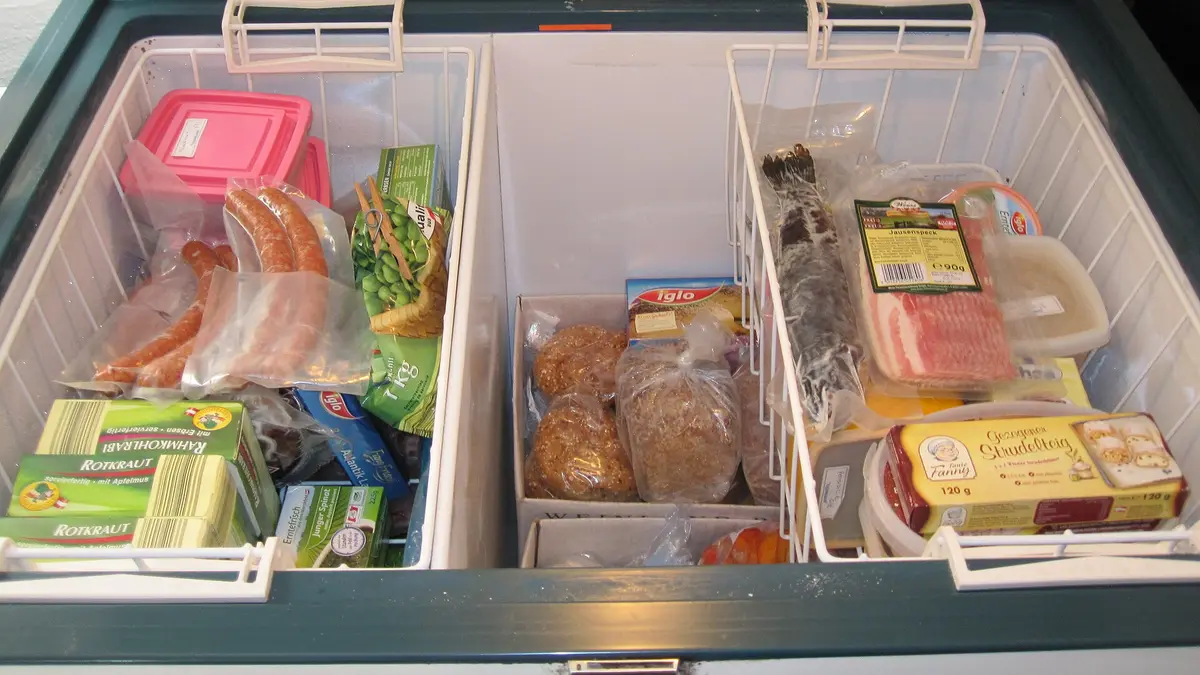
A freezer of about 100 liters uses between 12 and 18 kWh a month according to its label, between CLP 3,000 and 4,600 with electricity at CLP 255.27 per kWh (CGE's BT1 residential rate in Chile since October 2026). A 290-liter unit, such as the Mademsa M300D chest freezer, lists 24 kWh a month: about CLP 6,100 a month and CLP 73,500 a year. That is less than many people expect for an appliance that runs day and night.
The question comes at a good time: from 31 October 2026, every refrigerator and freezer sold in Chile, in physical and online stores, must display the new energy efficiency label, as reported by BioBioChile. This guide calculates how much a freezer costs in Chilean pesos by size and type, and explains what to look for on the label before buying.
How much electricity a freezer uses according to its label
In Chile, the freezer label states consumption in kWh per month, which is the annual consumption measured in the laboratory divided by 12. That is the figure for calculating the bill, not the compressor's power rating. These are the consumption figures listed for models sold by Chilean retailers:
| Model | Type | Capacity | Label consumption | Class | Monthly cost | Yearly cost |
|---|---|---|---|---|---|---|
| Libero LFV-100I | Upright, manual defrost | 85 L | 11.79 kWh/month | E | CLP 3,010 | CLP 36,100 |
| Mademsa M100DI (inverter) | Chest | 98 L | 14.0 kWh/month | C | CLP 3,570 | CLP 42,900 |
| Mademsa MFH-1000B131CN | Chest | 99 L | 14.17 kWh/month | A+ | CLP 3,620 | CLP 43,400 |
| Mademsa H100 | Chest, direct cooling | 97 L | 18.0 kWh/month | E | CLP 4,590 | CLP 55,100 |
| Libero LFV-290NFI | Upright, frost-free | 204 L | 19.23 kWh/month | C | CLP 4,910 | CLP 58,900 |
| Mademsa M300D | Chest, direct cooling | 290 L | 24 kWh/month | E | CLP 6,130 | CLP 73,500 |
| Libero LFV-360NFI | Upright, frost-free | 274 L | 24.57 kWh/month | E | CLP 6,270 | CLP 75,300 |
Consumption and classes from the spec sheets at Libero, SoloTodo and Paris, checked on 27 October 2026. Cost calculated by Energía Futura with electricity at CLP 255.27 per kWh, rounded. The class may follow the old or the new label, depending on the model.
The table holds a lesson: size matters, but it is not everything. Two freezers of about 100 liters can use 14 or 18 kWh a month depending on their technology, a difference of almost CLP 13,000 a year. And the gap between a 100-liter and a 290-liter unit, with nearly three times the capacity, is only about CLP 2,500 a month: per liter, large freezers are more efficient.
The price per kWh changes by municipality and utility. To adjust the calculation to your bill, check Chile's electricity price per kWh by city and utility and multiply it by the label consumption.
Chile's new efficiency label for freezers
The label change explains something that confuses many buyers. In the table, the 99-liter Mademsa MFH-1000B131CN appears as class A+ with 14.17 kWh a month, while the 98-liter Mademsa M100DI is listed as class C with 14.0 kWh: almost identical consumption with very different letters. Most likely the first shows the old rating and the second the new one, which uses a different scale.
The new label, called E2.0, stems from Exempt Resolution No. 35 of the Ministry of Energy, from September 2024, and Exempt Resolution No. 30602 of the SEC, Chile's electricity and fuels regulator, from February 2025. It uses an A to G scale and a method based on the 2019 European regulation, adjusted for Chile, according to the SEC protocol. Classes A+, A++ and A+++ disappear, and many appliances that used to be A+ now land in C, D or E without any change in consumption.
| Milestone | Date | What changes |
|---|---|---|
| Exempt Resolution No. 35 of the Ministry of Energy | September 2024 | Defines the new label for refrigerators and freezers |
| Exempt Resolution No. 30602 of the SEC | 11 February 2025 | Approves the testing and calculation protocol |
| First sale by manufacturers and importers | From 1 January 2026 | Appliances must ship with the new label and certificate |
| All points of sale, physical and online | From 31 October 2026 | Must display the new label |
Source: Ministry of Energy and SEC, as reported by BioBioChile on 24 June 2026. During the transition, the same model may be seen with the old and the new label; both are valid.
The practical advice: to compare freezers, look first at the kWh per month, which is calculated the same way on both labels, and then at the letter, always comparing appliances with the same label. A class C freezer on the new scale can be as efficient as an A+ on the old one.
Chest or upright freezer: which uses less
The most widespread belief is that chest freezers use less than uprights. It has a physical basis: cold air is heavier than warm air, so when a chest freezer is opened from the top, the cold stays inside; in an upright, it spills out through the door. Also, almost all chest freezers are manual defrost, and Consumer Reports notes that manual-defrost freezers are generally more efficient than self-defrosting ones.
Among the models sold in Chile today, however, the label difference is smaller than people think. The 290-liter Mademsa M300D chest freezer lists 24 kWh a month, and the 274-liter Libero LFV-360NFI frost-free upright, 24.57 kWh. The difference lies more in daily use: an upright opened many times a day loses more cold than the laboratory test measures, since that test is run with the door closed.
| Feature | Chest freezer | Upright freezer |
|---|---|---|
| Cold lost when opened | Less: cold air stays at the bottom | More: cold air falls out of the door |
| Defrosting | Almost always manual | Manual or frost-free (automatic) |
| Organization and access | Baskets; items at the bottom are hard to reach | Drawers and shelves, easy to organize |
| Floor space | Larger footprint | Smaller footprint, more height |
| Usable capacity | Makes better use of the volume | Shelves and drawers take up some space |
| Best for | Storing large quantities for months | Frequent use and small kitchens |
One feature worth checking on chest models is the dual or convertible function: some models are sold as dual units that can work as a freezer or as a refrigerator with a selector. It is handy for parties or seasonal needs, and as a refrigerator it uses less than as a freezer, because the target temperature is higher.
Frost-free or manual defrost
Frost-free freezers use a fan and an automatic defrost cycle that prevents ice buildup, at the cost of somewhat higher consumption. Manual defrost units use less, but have to be defrosted when the ice layer gets thick: ice insulates and forces the compressor to work harder. For someone who rarely opens the freezer and does not mind defrosting it once or twice a year, manual is the cheapest option.
How to use less electricity when freezing
A freezer runs 8,760 hours a year, so small habits show up on the bill. These are the measures that help most:
- Choose the right size. A half-empty 290-liter freezer uses more per kilo stored than a full 100-liter one.
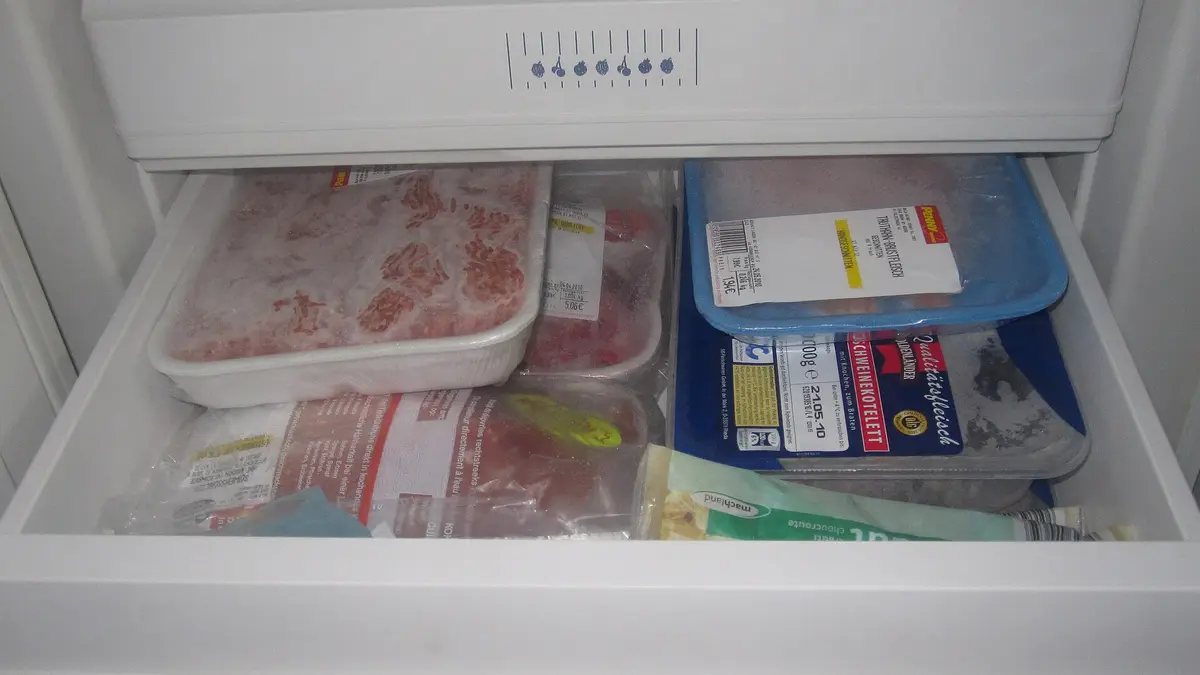
- Keep it full, even with frozen water bottles: frozen food holds the cold and the compressor starts less often.
- Set the thermostat to -18 °C, the usual storage temperature; colder does not preserve better and uses more power.
- Place it somewhere cool, away from the sun, the oven and a hot utility room in summer, with space for the condenser's heat to escape.
- Check the door or lid seal: if a sheet of paper slides out without resistance when it is closed, the gasket is letting air in.
- Defrost manual units in time, before frost builds up.
- Do not put hot food in: let it cool before freezing it.
In a home that already has a refrigerator with a freezer compartment, adding a separate freezer adds between 12 and 25 kWh a month. For a typical household, which uses about 180 kWh a month according to the CNE reference, that is between 7% and 14% more electricity. The rest of a home's consumption is detailed in how much electricity a house in Chile uses per month.
When a freezer is worth buying
A freezer makes sense when buying in bulk, cooking for several days, storing seasonal produce, or in country houses and areas far from shops. If the refrigerator's freezer compartment is enough, an extra freezer is a fixed cost of between CLP 36,000 and 75,000 a year in electricity alone. To compare with the main refrigerator, see how much a refrigerator costs in pesos per month.
If the freezer is old, it is worth checking its rating plate: an appliance more than ten years old can use considerably more than a new one of the same size, and replacing it can pay for itself through savings within a few years. When replacing it, ask the store or the municipality about collecting the old unit, which contains refrigerant gas and should not go out with regular trash.
Does your company sell major appliances or energy efficiency solutions? Reach Energía Futura's readers.
See advertising optionsFrequently asked questions
How much electricity does a freezer use per month?
According to the label, between 12 and 25 kWh a month for household models of 85 to 290 liters, between CLP 3,000 and 6,300 with electricity at CLP 255.27 per kWh.
Which uses less, an upright or a chest freezer?
In real use, generally the chest freezer, because it loses less cold when opened and is usually manual defrost. On the label, the difference between Chilean models of similar size is small.
How many watts does a freezer use?
A household freezer's compressor runs at a few hundred watts, but only part of the time. To calculate the bill, use the label consumption in kWh per month, not the power rating.
Why do an A+ freezer and a C freezer use the same?
Because they probably carry different labels. The new E2.0 label, mandatory at every point of sale from 31 October 2026, uses a stricter A to G scale.
What temperature should a freezer be set to?
To -18 °C, the usual storage temperature for frozen food. Going colder raises consumption with no practical benefit for household use.