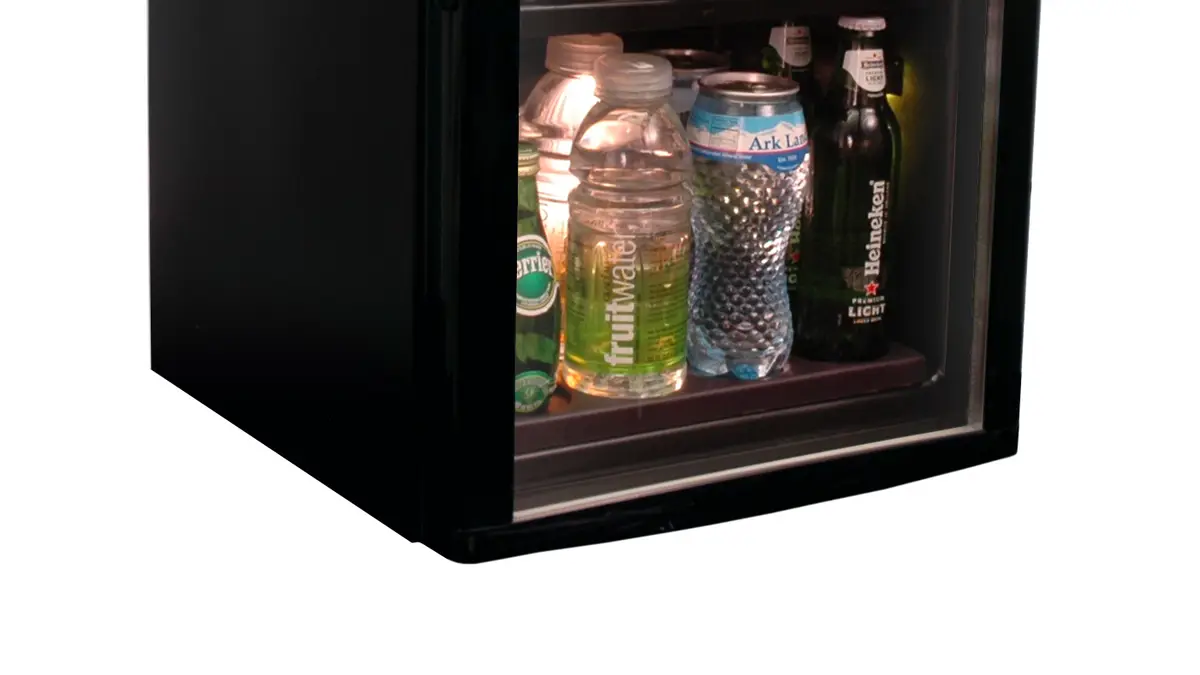
A 90-liter mini fridge with a compressor lists between 9 and 10 kWh a month on its label: between CLP 2,300 and 2,500 on the electricity bill with power at CLP 255.27 per kWh (CGE's BT1 residential rate in Chile since October 2026), or close to CLP 30,000 a year. The Mademsa MMB91, for example, lists 9 kWh a month according to the brand's online store.
A mini fridge is small, but it is not free: it runs all day and, for every liter of space, uses more than a large refrigerator. This guide calculates how much it costs to keep one on, explains what changes between compressor and thermoelectric models, and offers criteria for choosing one for a bedroom, an office, a barbecue area or a rented room.
How much electricity a mini fridge uses according to its label
As with refrigerators, Chile's efficiency label states a mini fridge's consumption in kWh per month. That is the figure for calculating the bill. These are the consumption figures for some 90-liter models sold in Chile:
| Model | Capacity | Label consumption | Class | List price | Monthly cost | Yearly cost |
|---|---|---|---|---|---|---|
| Mademsa MMB91 | 90 L | 9 kWh/month | E | CLP 119,990 | CLP 2,300 | CLP 27,600 |
| Libero LFB-101S | 92 L | 9.30 kWh/month | E | CLP 139,990 | CLP 2,370 | CLP 28,500 |
| Libero LFB-90N | 90 L | 9.90 kWh/month | F | CLP 119,990 | CLP 2,530 | CLP 30,300 |
Consumption, classes and prices from the spec sheets at the Mademsa store and Libero, checked on 27 October 2026 (discounted prices on that date). Cost calculated by Energía Futura with electricity at CLP 255.27 per kWh, rounded.
A word of caution: consumption data do not always match between stores. The Libero LFB-90N, which its manufacturer lists at 9.90 kWh a month, appears with 20 kWh a month on a department store's listing. When in doubt, the valid figure is the one on the label stuck on the appliance or on the manufacturer's certificate. At 20 kWh, the cost would rise to about CLP 5,100 a month.
The price per kWh changes by municipality and utility; in CGE's service areas it ranges from CLP 240.83 to 285.56. To adjust the calculation, see Chile's electricity price per kWh by city and utility.
Why a mini fridge uses more per liter than a refrigerator
It is striking that mini fridges using just 9 kWh a month carry class E or F, low grades. The explanation lies in how efficiency is measured: it is not total consumption that is compared, but consumption relative to the volume being cooled. A small appliance has proportionally more wall surface per liter, through which heat gets in, and a compressor that works less efficiently.
| Appliance | Capacity | Label consumption | Consumption per 100 liters | Monthly cost |
|---|---|---|---|---|
| Mademsa MMB91 mini fridge | 90 L | 9 kWh/month | 10.0 kWh | CLP 2,300 |
| Samsung RT43K6631SL refrigerator | 438 L | 36.2 kWh/month | 8.3 kWh | CLP 9,240 |
Refrigerator consumption according to its Chilean energy efficiency label, published by Samsung. Energía Futura calculations with electricity at CLP 255.27 per kWh.
In practice, this means a mini fridge is no better replacement for a refrigerator: if a family needs space, a large, efficient refrigerator cools more liters per peso. A mini fridge makes sense as a second appliance or where a full-size refrigerator does not fit. To compare with the kitchen refrigerator, its cost by size is detailed in how much electricity a refrigerator uses in watts and pesos.

Compressor or thermoelectric mini fridge: which to choose
Mini fridges sold by Chilean retailers fall into two main families according to how they cool:
- Compressor with direct cooling: they work like a small refrigerator, with a compressor and refrigerant gas (the Mademsa MMB91 uses R600a, isobutane). They cool well, reach refrigerator temperatures and are the ones listing 9 to 10 kWh a month. Their downside is the compressor hum when it starts.
- Thermoelectric (Peltier): they use a cell that cools when current flows through it, plus a fan. They are quiet and light, which is why they are used in hotels, cars and as desktop mini coolers, but their efficiency is low: they use more electricity to cool the same amount and do not always reach a safe temperature for perishable food.
- Absorption: common in some hotel minibars, they have no compressor and are completely silent, but they are also less efficient than compressor models.
To store drinks, milk, fruit or prepared food in a room or an office, the best option in terms of consumption is a compressor mini fridge. Thermoelectric units make sense when silence is the priority, for example in a light sleeper's student bedroom, or to chill a few cans.
With or without a freezer compartment
Some mini fridges include a small freezer compartment inside the cooling space. It is useful for making ice or keeping something for a few days, but it does not replace a freezer: it usually does not reach the -18 °C of a real freezer and builds up frost quickly, so it needs frequent defrosting. If you need to freeze food seriously, a small freezer is a better choice.

How much it adds to the electricity bill and how to save
A typical Chilean household uses about 180 kWh a month, the reference figure used by the National Energy Commission (CNE). An efficient 90-liter mini fridge, at 9 to 10 kWh, equals about 5% of that bill. It is little on its own, but it is a fixed cost that runs 12 months a year, and in many cases the appliance sits on while nearly empty.
| Mini fridge use | Monthly consumption | Monthly cost | Yearly cost |
|---|---|---|---|
| Efficient compressor mini fridge, on all year | 9 kWh | CLP 2,300 | CLP 27,600 |
| Same unit, unplugged 4 months a year (for example in winter or on vacation) | 6 kWh (average) | CLP 1,530 | CLP 18,400 |
| Mini fridge with the department store listing's consumption | 20 kWh | CLP 5,100 | CLP 61,300 |
| Old or thermoelectric mini fridge (estimate) | 20 to 30 kWh | CLP 5,100 to 7,700 | CLP 61,300 to 91,900 |
Energía Futura calculations with electricity at CLP 255.27 per kWh. The last row is a range estimate for less efficient appliances, not the figure for a specific model: for your own unit, the right approach is to read its label or measure it with a plug-in energy meter.
To put it in perspective against the rest of the home, a mid-size TV or a fan used daily in summer costs about the same as a mini fridge. The full calculation of a household's consumption is in how much electricity a house in Chile uses per month.
Five tips to make a mini fridge use less
- Unplug it when it will not be used for weeks, such as during vacations, leaving it empty, dry and with the door ajar to prevent mold.
- Do not put it inside a closed cabinet or against the wall: the condenser's heat needs to escape. Manufacturers state the required clearance in the manual.
- Keep it away from the sun, the oven and other hot appliances, such as a TV or a computer that is on.
- Set the thermostat to a medium level: the maximum is rarely needed for drinks.
- Check the door gasket and defrost the ice compartment when frost builds up.
For anyone renting rooms or running a business with several mini fridges, such as a hotel or a hostel, the savings multiply: ten mini fridges at 9 kWh add up to 90 kWh a month, about CLP 23,000. In those cases it is worth choosing the lowest label consumption and unplugging units in unoccupied rooms.
Does your company sell appliances, hotel equipment or energy efficiency solutions? Reach Energía Futura's readers.
See advertising optionsFrequently asked questions
How much electricity does a mini fridge use per month?
A 90-liter compressor mini fridge lists between 9 and 10 kWh a month, between CLP 2,300 and 2,500 with electricity at CLP 255.27 per kWh.
How many watts does a mini fridge use?
The compressor runs at low power and only part of the time. To calculate the bill, use the label consumption in kWh per month, not the power on the rating plate.
Does a mini fridge or a refrigerator use more?
In total, the mini fridge uses less, because it is smaller. But per liter it uses more: about 10 kWh per 100 liters a month, versus 8.3 kWh for an efficient 438-liter refrigerator.
Is a thermoelectric or a compressor mini fridge better?
For storing food, the compressor model: it cools more and uses less. The thermoelectric one is quieter, but less efficient.
Can a mini fridge be switched off at night?
Not if it holds food: when switched off, the inside warms up and on restart it has to cool everything again. Unplugging it makes sense when it will be empty for several days or weeks.