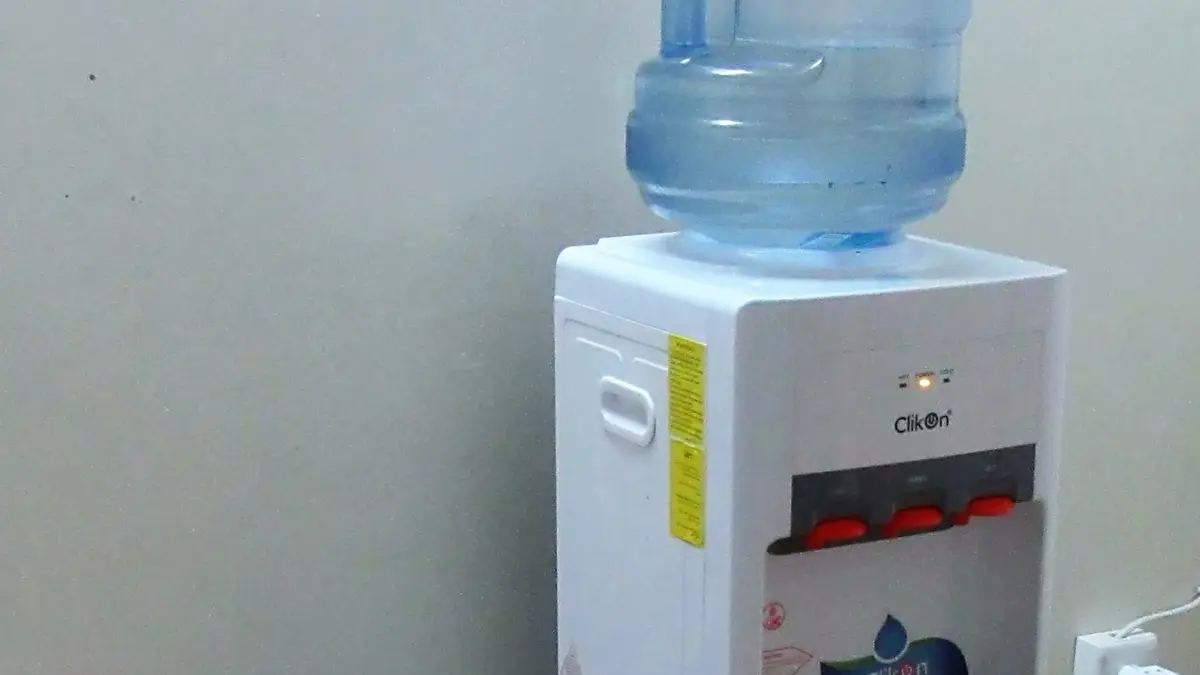
A hot and cold water dispenser with a compressor, left plugged in all day, uses roughly 1 kWh a day: about 30 kWh a month, between CLP 6,900 and 9,200 on the electricity bill with power at CLP 255.27 per kWh (CGE's BT1 residential rate in Chile since October 2026). If the hot water is switched off and only the cold side is left on, the cost can drop to close to CLP 1,200 a month. Cheap models that cool with a thermoelectric cell are another story: their cooling system alone can cost up to CLP 18,400 a month.
With warmer weather arriving in Chile, the water dispenser is once again one of the most searched appliances for homes and offices. This guide explains where its consumption comes from, calculates its cost in Chilean pesos by type and use, and offers criteria for choosing one that will not inflate the electricity bill.
How much electricity a water dispenser uses and why it spends even when nobody uses it
A hot and cold water dispenser has two independent systems. The hot water side is an electric heating element that warms a small tank of 1 to 1.5 liters and keeps it between 85 and 95 °C. The cold water side can be a compressor, like the one in a refrigerator, or a thermoelectric (Peltier) cell with a fan, which is cheaper and less efficient.
The power ratings on the spec sheets are high, but they are not drawn all the time. The Aqua1 floor-standing dispenser by aQualitat, sold in Chile for CLP 74,990, lists 550 W for heating and 100 W for cooling, with fan cooling and no compressor, according to its listing on the manufacturer's store. The Voda V-300S purifier and dispenser, connected to the water mains, uses a 1/10 HP compressor and lists 66 W for cold water, according to Voda Chile's spec sheet.
The key to consumption is that a dispenser uses power even when nobody draws water. The tanks lose heat (the hot one) or gain it (the cold one) to the surrounding air, and the thermostats switch the heater and compressor on again and again to hold the temperature. That standby loss weighs more on the bill than the water actually served.
The US ENERGY STAR program measures exactly that: the daily consumption of a dispenser that is switched on without drawing water. To be certified, a hot and cold unit with storage tanks cannot exceed 0.68 kWh a day (low capacity) or 0.80 kWh a day (high capacity), and a cold-only unit, 0.16 kWh a day, according to ENERGY STAR's criteria for water coolers. The agency estimates certified units are about 22% more efficient than standard models.
| Type of dispenser | Standby consumption (no water drawn) | Source |
|---|---|---|
| Cold only, efficient | Up to 0.16 kWh a day | ENERGY STAR limit |
| Hot and cold with tanks, efficient (low capacity) | Up to 0.68 kWh a day | ENERGY STAR limit |
| Hot and cold with tanks, efficient (high capacity) | Up to 0.80 kWh a day | ENERGY STAR limit |
| Standard hot and cold, not certified | About 1 kWh a day | Estimate: certified units are 22% more efficient |
| 100 W thermoelectric cooling running all day | Up to 2.4 kWh a day for cooling alone | Calculated from the spec-sheet power |
The ENERGY STAR limits apply to units certified in the United States. In Chile, water dispensers currently have no mandatory energy efficiency label like refrigerators do, so the best reference is the power on the spec sheet and the type of cooling system.
How much a water dispenser costs in Chilean pesos per month
On top of standby consumption comes the water that is served. Physics says heating one liter of water from 15 to 90 °C takes about 0.087 kWh; cooling a liter from 20 to 10 °C takes far less, because the temperature difference is small. A household that draws 2 liters of hot water a day for tea, coffee or baby bottles adds about 0.17 kWh a day, a little over CLP 1,300 a month.
| Scenario | Daily use | Monthly use | Monthly cost | Yearly cost |
|---|---|---|---|---|
| Cold water only, efficient unit | 0.16 kWh | 4.8 kWh | CLP 1,225 | CLP 14,700 |
| Hot and cold with compressor, efficient, 2 L hot a day | 0.9 kWh | 27 kWh | CLP 6,890 | CLP 82,700 |
| Hot and cold with compressor, standard, 2 L hot a day | 1.2 kWh | 36 kWh | CLP 9,190 | CLP 110,300 |
| 100 W thermoelectric cooling all day (cooling only) | 2.4 kWh | 72 kWh | CLP 18,380 | CLP 220,600 |
Energía Futura calculations with electricity at CLP 255.27 per kWh, rounded. The compressor scenarios use the ENERGY STAR limits (efficient) and 22% more (standard), plus 2 liters of hot water a day. The thermoelectric scenario assumes the 100 W cell runs 24 hours a day, the worst case; with a thermostat that switches it off at times, consumption is lower. The price per kWh varies by municipality, as shown in Chile's electricity price per kWh by city and utility.
For scale: a typical Chilean household uses about 180 kWh a month, the reference figure used by the National Energy Commission (CNE). A standard hot and cold dispenser, at 36 kWh, equals about 20% of that bill, as much as or more than a modern refrigerator. It is a small appliance, but because it is on 24 hours a day, 365 days a year, its cost adds up.
Compressor or thermoelectric: which water dispenser to choose
The most important difference between dispensers is not the brand but the cooling system. Thermoelectric units are cheaper, lighter and quieter, but their efficiency is low: they use much more electricity than a compressor to pull heat out of the cold tank. They also tend to cool less. On the Aqua1 spec sheet, the manufacturer states that cold water comes out at 10 to 15 °C, at a rate of 2 liters per hour, and notes that it does not chill the water to freezing point.
Compressor dispensers cost more but cool faster, reach lower temperatures and generally use less electricity per liter cooled. For an office or a large family that draws a lot of cold water in summer, the compressor pays for itself through bill savings and cooler water. For occasional use, a thermoelectric unit can work, as long as it is switched off when not needed.
| Feature | Compressor dispenser | Thermoelectric dispenser |
|---|---|---|
| Purchase price | Higher | Lower (from about CLP 75,000) |
| Typical cooling power | 65 to 100 W, cycling on and off | About 100 W, often on for long periods |
| Cold water temperature | Colder, similar to a refrigerator | 10 to 15 °C in basic models |
| Electricity used for cooling | Lower | Higher, up to 2.4 kWh a day |
| Noise | Compressor hum when starting | Constant fan |
| Best for | Offices, large families, heavy daily use | Occasional use, small spaces |
Power ratings from the aQualitat and Voda Chile spec sheets, checked in October 2026. Thermoelectric cooling consumption is the worst case, with the cell running all day.
Bottled, mains-fed or countertop
Beyond the cooling system, dispensers differ in how they get their water. Bottled units use 10, 12 or 20 liter jugs bought separately, and bottom-load models hide the jug in a cabinet so it does not have to be lifted. Mains-fed units or purifiers connect to the plumbing and filter the water, like the Voda V-300S, but cost far more: that model is listed at CLP 925,380 on the brand's store. Countertop units are compact and fit in a kitchen, with the same electricity use as a floor-standing model of the same type.
Seven ways to use less electricity on hot and cold water
Since most of the consumption goes into keeping the tanks at temperature, the biggest savings come from cutting the hours the unit works with nobody using it:
- Switch off the hot water if it is not used daily. Most dispensers have a switch at the back for each system. With only the cold side on, an efficient unit drops to about CLP 1,200 a month.
- Use a plug-in timer in offices: switching it off at night and on weekends cuts standby hours by more than half.
- Keep it away from the sun and heat sources, such as the oven or a west-facing window: the cold tank gains less heat and the compressor works less.
- Leave space behind it so the condenser or fan can shed heat; pushed against the wall, the unit performs worse.
- Clean the dust off the rear grille every few months.
- For a lot of hot water, use the kettle. The dispenser is for single cups; for a pot or a large thermos the kettle is faster.
- Choose compressor models if the unit will be on all day in summer.
Heating water takes the same energy wherever it is done: what changes is how much is lost while the water waits. A kettle heats only what will be used and then switches off, keeping nothing hot. That is why, in a home where tea is made a couple of times a day, the kettle uses less than the dispenser's hot tank, as we calculated in how much it costs to boil water with an electric kettle.
Dispenser or refrigerator: which uses less for cold drinking water
For someone who only wants cold water at home, the cheapest option in electricity is a jug in the refrigerator, which is on anyway: adding a few liters of water barely raises its consumption. A dispenser makes sense when a lot of water is served at once, as in offices, clinics or homes with many children, or when instant hot water is wanted without waiting for the kettle.
Compared with the rest of the household, a standard hot and cold dispenser uses about as much in a year as a modern refrigerator. The refrigerator's consumption is detailed in how much electricity a refrigerator uses in watts and pesos, a useful reference for deciding whether it is worth keeping both appliances on all day.
Does your company sell water dispensers, water purifiers or energy efficiency solutions? Reach Energía Futura's readers.
See advertising optionsFrequently asked questions
How much electricity does a water dispenser use per month?
A hot and cold unit with a compressor uses roughly 27 to 36 kWh a month, between CLP 6,900 and 9,200 with electricity at CLP 255.27 per kWh. An efficient cold-only unit can drop to about 5 kWh, close to CLP 1,200.
How many watts does a water dispenser have?
The hot water heater usually has about 500 to 550 W and the cooling system between 65 and 100 W. Neither runs at that power all the time: thermostats switch them on and off.
Should a water dispenser be unplugged at night?
In offices, yes: switching it off at night and on weekends can cut consumption by more than half. At home, the simplest step is to turn off the hot water switch when it is not used.
Which is better, a compressor or a thermoelectric dispenser?
For heavy daily use, the compressor model: it cools more and uses less electricity. The thermoelectric one is cheaper to buy, but can use up to 2.4 kWh a day for cooling alone, and the water comes out less cold.
Which uses more for hot water, the dispenser or the kettle?
For a few cups a day, the kettle uses less, because it heats only what is used. The dispenser keeps its tank hot 24 hours a day and loses energy while it waits.