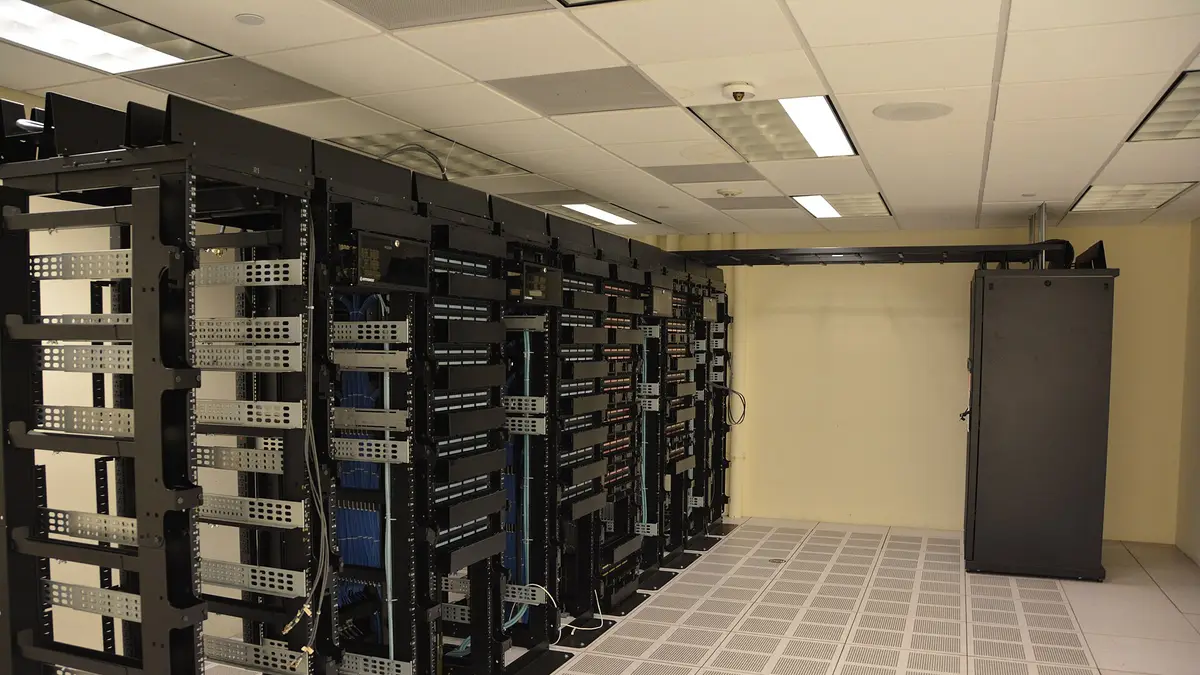
A 20 MW data center in Huechuraba, in northern Santiago, will be able to connect to the power grid with a single authorisation, even though it will be fed from two different points of the Recoleta substation. That was the decision of the electricity sector’s Panel of Experts in its ruling on dispute 28-2026, published on 21 October on the Panel’s website, which rejected the dispute filed by transmission company STM against Chile’s National Electricity Coordinator.
The decision is technical, but it comes at a time when data centers have become one of the big issues for Chile’s power system: their consumption is one of the main uncertainties in planning, and every new project needs to connect to a grid that is already stretched in Santiago.
What was at stake for the Huechuraba data center
The project, developed by Eléctrica Huechuraba, is a single 20 MW consumption centre that will connect at 12 kV to the Recoleta substation, owned by Sociedad Transmisora Metropolitana (STM), part of Grupo Saesa, according to the summary of the ruling published by Electrominería. For backup, it will use two circuits connected to two different bays (E24 and E30), linked to independent busbars and transformers, and will draw 10 MW from each.
| Project data | Detail |
|---|---|
| Capacity | 20 MW (a single consumption centre) |
| Connection point | Recoleta substation, 12 kV (zonal transmission) |
| Substation owner | Sociedad Transmisora Metropolitana (STM), Grupo Saesa |
| Bays | E24 and E30, with 10 MW drawn from each |
| Transformers | T3 and T4, with existing overloads of 24% and 19.9% at high demand, according to STM |
| Authorisation challenged | The Coordinator’s Final Connection Authorisation Report, 25 June 2026 |
| Outcome | Dispute rejected: a single request is enough |
Source: Panel of Experts, ruling on dispute 28-2026, and Electrominería summary of 23 October 2026.
STM argued that one connection authorisation request (SAC) per bay should be processed, in order to manage restrictions, studies, costs, testing and commissioning separately. Its technical argument was that transformers T3 and T4 already showed overloads of 24% and 19.9% at high demand, which, in its view, required individual conditions for each connection.
The Coordinator argued that this is a single customer and a single consumption centre, and that the transformers will continue to operate independently, because the customer cannot run them in parallel.
Why the Panel of Experts sided with the Coordinator
The Panel concluded that current regulations do not expressly require one request per connection point, and that STM did not identify any omitted studies, unassessed restrictions or technical analyses that would justify splitting the procedure. It added that a single request does not prevent each point from being assessed separately or from setting specific technical conditions for each one.
In the words of the ruling, “the number of connection authorisation requests has no bearing on the material outcome of the connection”. Requiring two requests would have duplicated procedures already carried out, something the Panel considered contrary to the principle of procedural economy in the open-access transmission regime.
The Panel of Experts is the body that settles technical and economic disputes between power companies, the Coordinator and Chile’s National Energy Commission (CNE). It was created by Law 19,940 of 2004 and its rulings are binding. In 2026 alone it is already handling at least 34 disputes: the most recent one published is Metrogas against the CNE over the annual gas profitability report, while dispute 27-2026 pitted a small generator against Minera Los Pelambres over a dedicated transmission toll.
A precedent for other projects
The ruling serves as a reference for any large consumer wishing to connect with redundancy, that is, from two feeders so as not to lose supply if one fails. Data centers need this by design, but so do hospitals, industrial plants and high-power charging stations. Under the Panel’s criterion, such projects can be processed as a single connection, with technical conditions for each point.
The connection procedure is one of the system’s bottlenecks. At the beginning of October there were 12,188 MW of projects waiting to connect, as we reported in our article on projects awaiting grid connection, and Chile’s National Economic Prosecutor’s Office (FNE) called for changes to connection rules, as we reviewed in our article on competition in the power sector.
Data centers and electricity demand
Worldwide, data centers consumed about 415 TWh of electricity in 2024, close to 1.5% of the global total, and their consumption could more than double to about 945 TWh by 2030, according to the International Energy Agency’s Energy and AI report (April 2025). Growth is driven by servers for artificial intelligence.
| Data center electricity consumption | Figure | Source |
|---|---|---|
| World, 2024 | about 415 TWh (close to 1.5% of global electricity) | IEA, Energy and AI (2025) |
| World, 2030 projection (base case) | about 945 TWh | IEA, Energy and AI (2025) |
| Huechuraba data center | 20 MW of capacity | Panel of Experts, ruling 28-2026 |
| Annual consumption of 20 MW at full load (indicative) | about 175 GWh | Energía Futura calculation (20 MW × 8,760 hours) |
The calculation in the last row assumes continuous operation at full capacity, something a real data center does not always reach; it serves as an order of magnitude. As a reference, 175 GWh equals the annual consumption of about 73,000 households using 200 kWh a month.
In Chile, the Coordinator includes data centers among the drivers of a rise in electricity demand that could almost double it by 2046, as we explained in our article on electricity demand to 2046. The CNE’s executive secretary, Carlos Barría, cited on 22 October the uncertainty over consumption, particularly from data centers, as one of the challenges of the reliability agenda, according to Electrominería.
Data centers seek to locate close to the fibre-optic network and to substations with available capacity, and in Santiago that capacity is scarce. Congestion in zonal grid transformers, which the Recoleta case itself brought to light, is one of the reasons why transmission planning in the capital has become a priority.
Does your company work in electrical infrastructure, data centers or energy efficiency? Reach Energía Futura’s readers.
See advertising optionsFrequently asked questions
What did the Panel of Experts decide about the Huechuraba data center?
That the connection of the 20 MW data center to the Recoleta substation can be processed with a single connection authorisation request, even though it uses two bays. It rejected STM’s dispute.
What is the Panel of Experts?
It is the body that settles disputes between power companies, Chile’s National Electricity Coordinator and the CNE. It was created by Law 19,940 and its rulings are mandatory.
How much electricity does a data center use?
It depends on its size. The Huechuraba one has 20 MW of capacity, which at full load would be equivalent to about 175 GWh a year. Worldwide, data centers used about 415 TWh in 2024, according to the IEA.
Who owns the Recoleta substation?
Sociedad Transmisora Metropolitana (STM), part of Grupo Saesa, according to the summary of the ruling.