Near-zero marginal costs are no longer a midday phenomenon in Chile. In October 2026, 74.7% of the early-morning hours north of the Charrúa node, in the Biobío Region, had a marginal cost below US$5 per megawatt-hour (MWh). A year earlier, in October 2025, that share was just 2.8%. South of Charrúa, the indicator jumped from 26.9% to 88.8%, according to the latest operating report by Aclai Consultores, published on November 5 by Electrominería.
The consultancy describes it as one of the most significant changes in the hourly price profile of Chile's National Electric System (SEN). At the same time, an analysis by the Chilean Renewable Energy and Storage Association (Acera) and SPEC Energy Consulting found that battery energy storage systems already supply more than 80% of the energy in the evening peak block, a slot once covered by gas turbines and diesel engines, with average discharges of almost 1,700 MW at 9 p.m.
View the data as a table
| Early-morning hours below US$5/MWh north of Charrúa | 74.7% |
| Same indicator south of Charrúa | 88.8% |
| Average battery discharge at 9 p.m. | 1,700 MW |
| Energy charged by batteries in 2026 | 4.3 TWh |
Marginal costs in the early morning: what changed in a year
The marginal cost is the price at which power is traded between generators in each hour and at each node of the system: it is the cost of producing the last MWh needed to meet demand. When there is surplus solar or wind power, which burns no fuel, that value approaches zero. That is why low prices were, until recently, a daylight phenomenon.
What Aclai's report shows is that low marginal costs have also moved into the early morning. Between October 2025 and October 2026, the share of early-morning hours with a marginal cost below US$5/MWh grew 26.7-fold north of Charrúa and 3.3-fold to the south. “The phenomenon spread both north and south of Charrúa,” the report says, calling for its impact on generators and storage systems to be monitored.
| System zone | October 2025 | October 2026 | Change |
|---|---|---|---|
| North of Charrúa | 2.8% of hours | 74.7% of hours | +71.9 points |
| South of Charrúa | 26.9% of hours | 88.8% of hours | +61.9 points |
Source: Aclai Consultores, October 2026 operating report, via Electrominería. The indicator measures the share of hours in the early-morning block with a marginal cost below US$5/MWh. The Charrúa node, near Cabrero, is one of the points that split the system: to the north lie the large solar plants and most batteries; to the south, run-of-river hydropower and much of the wind power.
Claudio Espinoza, founding partner of Aclai, warns that it remains to be seen whether the change is persistent in the hourly price profile or mainly reflects this spring's supply conditions. The doubt is reasonable: October 2026 combined abundant snowmelt, strong sunshine and wind in a month of moderate demand. In the week of October 12 to 18, the marginal cost fell to US$3.4 per MWh at Polpaico, its lowest level since 2002, according to DNV.
Batteries replace diesel in the evening peak
The other piece of the shift is the evening peak, between sunset and midnight, when demand is still high and solar output has disappeared. According to the Acera and SPEC study, carried out with the Galilei analytics platform and released on November 4, batteries' share of the energy in that block rose from 42% in 2024 to 55% in 2025 and over 80% in 2026.
View the data as a table
| Batteries in the evening peak | |
|---|---|
| 2024 | 42% |
| 2025 | 55% |
| 2026 | 80% |
Batteries charge when power is cheap and discharge when it is expensive. In 2026 they have charged 4.3 TWh, and almost three quarters of that energy was bought at zero marginal cost. Between January and August, 70% of the 2,900 GWh of new wind and solar generation was absorbed by storage units, according to the same analysis. In other words, much of the power that used to be lost to curtailment is now stored and used at night.
| Storage indicator | Value | Period |
|---|---|---|
| Share of the evening peak | 42% | 2024 |
| Share of the evening peak | 55% | 2025 |
| Share of the evening peak | Over 80% | 2026 |
| Average discharge at 9 p.m. | Almost 1,700 MW | 2026 |
| Energy charged | 4.3 TWh | 2026 |
| New renewable generation absorbed by batteries | 70% of 2,900 GWh | January-August 2026 |
| Systems providing frequency control | 18 | September 2026 |
Source: Acera and SPEC Energy Consulting, via Electrominería (November 4, 2026). Batteries also underpin system security: 18 systems take part in frequency control, and in September they provided more than 50% of secondary control reserve and between a third and half of primary control.
Why low marginal costs reached the night
There is an apparent explanation in these figures. If batteries take cheap midday power and deliver it at night, the night price should fall, because they displace thermal plants, which are the ones that set high prices. The more batteries discharge at night, the fewer hours the system needs a diesel turbine to close the gap. Add wind generation, which often blows harder at night in several areas, and hydropower from a spring with plenty of snow.
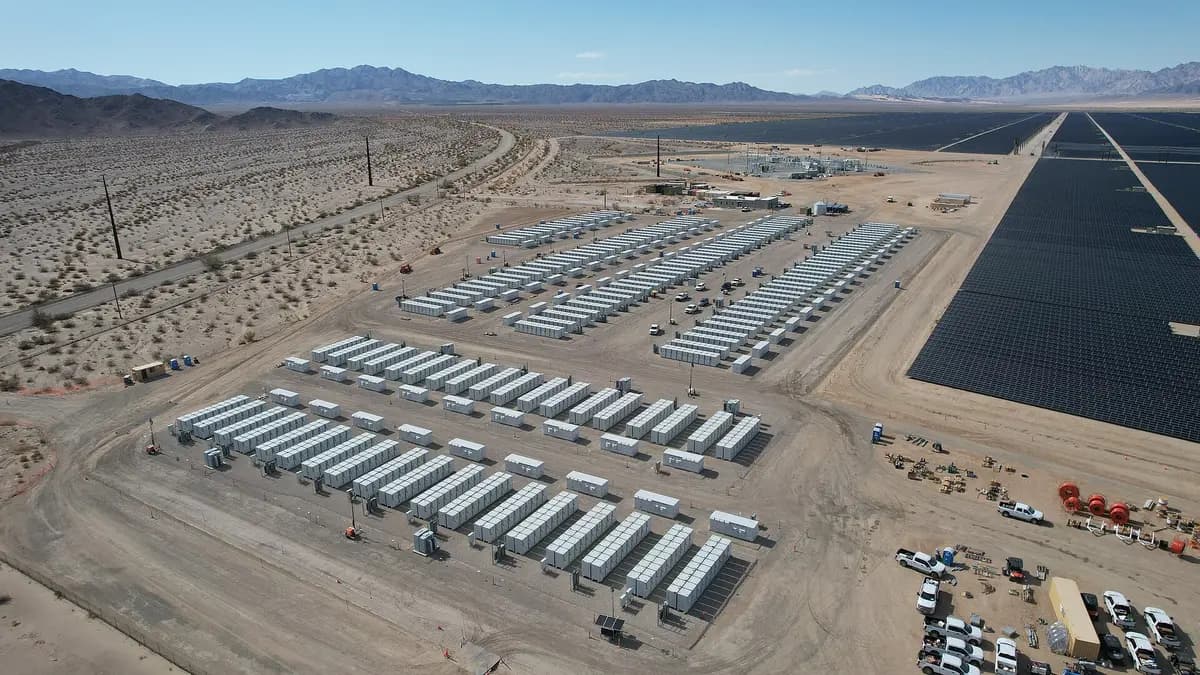
The size of the battery fleet explains the speed of the change. Chile has 11.3 GW of storage across projects in service, in testing and under construction, compared with only 84 MW three years ago: 3.2 GW are operating, 3.7 GW are in testing and 4.3 GW are under construction. 84% of that capacity is located between Arica y Parinacota and Atacama, and the municipality of María Elena alone hosts 2.3 GW in 14 projects. The details are in our story on storage in Chile, which now reaches 11.3 GW.
Who wins and who loses with low marginal costs
For generators selling on the spot market, a marginal cost of US$5/MWh in the early morning means minimal revenue for every MWh they inject in those hours. Solar plants without storage already knew that scenario at midday; now wind farms producing at night and run-of-river hydro plants that cannot store water face it too.
For batteries, the business depends on the price spread between the hour they charge and the hour they discharge. If nights also get cheaper, that margin narrows, especially in the hours after the peak. That is why Aclai calls for the phenomenon to be tracked: the value of a storage project is calculated on that spread, and a permanent change would force a review of cash flows. The signal comes as the industry closes billions of dollars in financing for new batteries.
For regulated customers, by contrast, the immediate effect is limited. Household tariffs are set by the prices of supply contracts auctioned years ago, not by the hourly marginal cost. Large free customers with contracts indexed to the spot market, such as some mines and industries, can capture part of the drop. September generation, 83.6% renewable, already showed the retreat of thermal power behind these prices.
What comes next: summer, demand and new batteries
The real test will come in summer, when hydropower output falls and demand for cooling rises. If early-morning marginal costs stay low with less water, the change will be structural rather than seasonal. The arrival of the 3.7 GW of batteries in testing and the 4.3 GW under construction will push in that direction, because more daytime solar power will be available at night.
Transmission is the other variable. Much of the low pricing is explained by congestion: when lines cannot move power out of the north or the south, prices decouple between zones. Projects such as the Kimal-Lo Aguirre line, scheduled for the end of this decade, will better connect markets and could change the price map by node.
Does your company develop batteries, renewables or services for the power market? Reach Energía Futura's readers.
See advertising optionsFrequently asked questions
What is the marginal cost of electricity?
It is the cost of producing the last MWh needed to meet demand in a given hour and node of the system. It is the price at which generators trade on the spot market.
How many early-morning hours had marginal costs below US$5?
In October 2026, 74.7% of early-morning hours north of Charrúa and 88.8% to the south, according to Aclai. A year earlier the figures were 2.8% and 26.9%.
How much do batteries supply at night?
Over 80% of the energy in the evening peak block in 2026, with average discharges of almost 1,700 MW at 9 p.m., according to Acera and SPEC.
Will household power bills fall?
Not immediately. Regulated tariffs depend on auctioned supply contracts, not on the hourly marginal cost.
Is the change permanent?
It is not yet known. Aclai warns it may reflect this spring's supply conditions; summer, with less water and more demand, will be the test.