A canal built to irrigate farmland in Chile's Metropolitan Region could add another hydroelectric plant. Nueva Carena SpA submitted to the Environmental Assessment Service (SEA) the Vicente Mini Hydroelectric Plant, with 3 MW of maximum capacity, which will use water from the Las Mercedes canal in the municipality of Curacaví, with an estimated investment of US$9 million, Reporte Minero and Redimin reported on November 6.
The project, filed as an Environmental Impact Declaration (DIA) on October 30, 2026, would generate 20.7 GWh a year. At 180 kWh a month per typical home, according to our estimate of how much electricity a home in Chile uses, that is the electricity of about 9,600 houses. All the water that goes through the turbine returns to the same canal, so downstream irrigators lose no flow and the project requires no new water rights.
View the data as a table
| Maximum capacity | 3 MW |
| Estimated annual generation | 20.7 GWh |
| Investment | US$9 million |
| Gross head | 34 m |
How the Vicente mini hydro plant will work
It is a run-of-river plant: it has no reservoir and uses the slope of the land. Water will be taken at a concrete intake, flow into a forebay and run down a 1,112-meter penstock to the powerhouse, where it will drive a 3,000 kVA Francis turbine. It then returns to the canal.
| Feature | Value |
|---|---|
| Maximum capacity | 3 MW |
| Estimated annual generation | 20.7 GWh |
| Maximum design flow | 10.2 m³/s |
| Gross head | 34 m |
| Penstock | 1,112 m |
| Turbine | Francis, 3,000 kVA |
| Grid connection | Existing 6.3 kV line |
| Investment | US$9 million |
| Service life | At least 30 years |
Source: Reporte Minero, based on the DIA filed with the SEA of the Metropolitan Region (November 6, 2026).
The figures match the basic physics of a turbine: hydraulic power is the weight of the water times the flow times the head. With 10.2 m³/s and 34 meters, the water delivers about 3.4 MW; with a typical turbine-generator efficiency of 85% to 90%, that leaves around the 3 MW declared. The calculation is by Energía Futura.
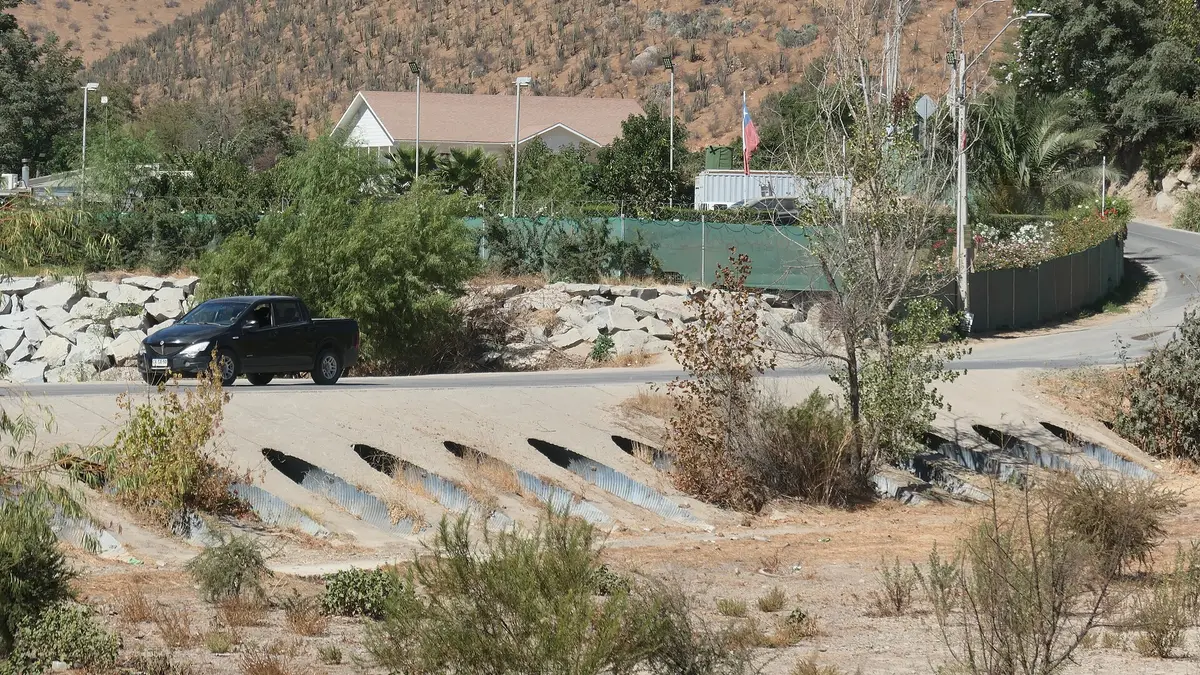
The Las Mercedes canal and the Carena plant
The Las Mercedes canal already powers a plant. Upstream is the Carena hydroelectric plant, which started operating in 1937 with 10 MW, according to Colbún's fact sheet. According to the project documents cited by Reporte Minero, the owner of Nueva Carena acquired that plant in 2025, and Vicente will operate as an independent facility downstream.
In January 2024 the company signed an agreement with the Las Mercedes Canal Association (ACLM), the irrigators' organization that manages the canal. The plant will be operated remotely, without permanent staff, with a maintenance crew of two people.
- 1937Carena plant starts operating10 MW using water from the Las Mercedes canal.
- January 2024Agreement with irrigatorsAgreement with the Las Mercedes Canal Association.
- 2025Carena acquiredThe owner of Nueva Carena acquires the plant, according to project documents.
- 30 October 2026Vicente mini hydro filed (DIA)3 MW and US$9 million.
- Sep 2027 - Sep 2028Planned construction12 months and 15 workers on average, if approved.
Construction and environmental effects
Construction is planned between September 2027 and September 2028, about 12 months, with an average of 15 workers. According to the DIA, the project requires clearing 0.83 hectares of native forest, under a management plan approved by Conaf, the national forestry agency, and generates no polluting discharges or hazardous waste. The closure phase would take three months with ten workers.
The project does not yet have an Environmental Qualification Resolution (RCA), so both construction and the projected generation depend on the review. Redimin stresses that the 20.7 GWh is a company projection, not actual output.
Mini hydro plants on canals: renewable power without reservoirs
Small plants on irrigation canals use infrastructure that already exists and do not dam rivers. That is why their impacts tend to be limited compared with large hydro projects, such as the 154 MW San Carlos plant that Innergex refiled with the SEIA in Biobío. Their output depends on the irrigation calendar and on water availability in the basin.
Water remains a key part of Chile's power mix: in September hydropower took the lead again in a month with 83.6% renewable electricity. A plant like Vicente adds little to the national total, but its power is injected close to consumption centers in central Chile and at hours when solar does not produce.
- No reservoir: it uses the canal's drop and returns all the water.
- No new water rights: according to the DIA, none are required.
- High capacity factor: 20.7 GWh a year from 3 MW implies running at full power about 79% of the time (Energía Futura calculation).
- Nearby connection: it injects into the grid through an existing 6.3 kV line.
What the plant's 20.7 GWh mean
The generation figure says a lot about the type of plant. If a 3 MW plant ran at full power all year it would produce 26.3 GWh. The projected 20.7 GWh equal about 6,900 hours at full load, a capacity factor close to 79%, far above a solar plant, which only produces during the day. The reason is that the canal carries water fairly continuously during the irrigation season. The calculations are by Energía Futura using the DIA data.
| Equivalence | Value | How it is calculated |
|---|---|---|
| Typical homes supplied | ~9,600 | 20.7 GWh ÷ 2,160 kWh a year per home |
| Full-power hours per year | ~6,900 | 20.7 GWh ÷ 3 MW |
| Capacity factor | ~79% | 6,900 ÷ 8,760 hours in a year |
| Investment per MW | US$3 million | US$9 million ÷ 3 MW |
Source: Energía Futura calculations with the DIA data cited by Reporte Minero and Redimin. These are references, not operating results: actual generation will depend on the flow available each year, which in central Chile has varied with the megadrought.
Because of its size, under 9 MW, and its connection to a 6.3 kV line, a plant like Vicente is usually processed as a small distributed generation facility (PMGD), the category that allows injecting power directly into distribution grids. The cited sources do not say under which commercial regime it will sell its energy.
Does your company develop small hydro plants or generation equipment? Reach Energía Futura's readers.
See advertising formatsFrequently asked questions
What is the Vicente mini hydro plant?
A 3 MW run-of-river plant that Nueva Carena wants to build in Curacaví using water from the Las Mercedes canal.
How much energy will it generate?
20.7 GWh a year, according to the company's projection: the consumption of about 9,600 typical homes.
Does it affect farmers' irrigation?
According to the DIA, no: all the water used by the turbine returns to the same canal.
When would it be built?
Between September 2027 and September 2028, if it obtains environmental approval.
How much does it cost?
An estimated US$9 million.