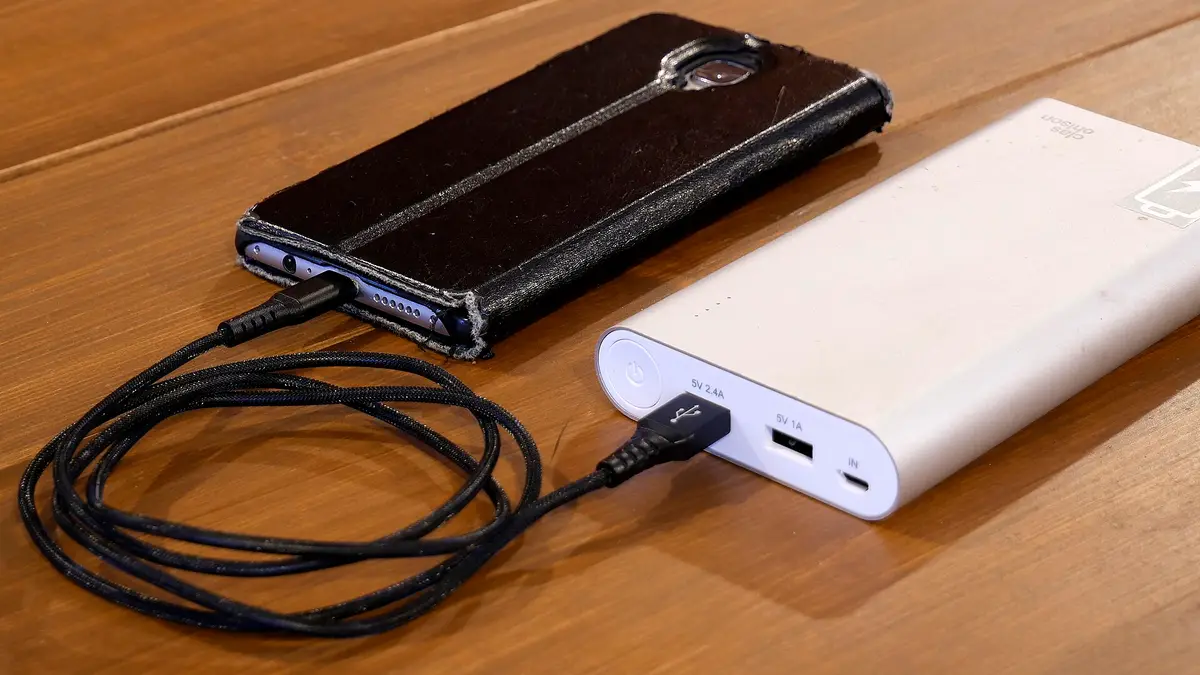
A 20,000 mAh power bank does not charge a 5,000 mAh phone four times, as simple division suggests: it charges it about 2.5 times. The reason is that the label figure is measured at the battery's internal voltage (3.7 V), not at the 5 V it delivers over USB, and that energy is lost in the conversion. Manufacturer Anker estimates usable capacity is often 60% to 70% of the rated figure, according to its capacity guide.
In Chile, power banks range from CLP 8,990 (5,000 mAh) to CLP 159,990, according to Falabella prices on 8 November 2026, and a 20,000 mAh model costs from CLP 15,990. This guide explains how many charges each capacity gives, which one suits each use, what a recharge costs and what changed in 2026 for flying with one.
View the data as a table
| Stored energy | 74 Wh |
| Usable capacity at 5 V | 13,000 mAh |
| Charges of a 5,000 mAh phone | 2.5 |
| Cost of a full recharge | $22 |
How many charges a power bank gives by mAh
The measure that matters is energy, in watt-hours (Wh). It is calculated by multiplying mAh by voltage and dividing by 1,000. A 20,000 mAh power bank at 3.7 V stores 74 Wh. A modern phone with a 5,000 mAh battery at about 3.87 V holds roughly 19.4 Wh. Applying 65% efficiency, the midpoint of Anker's range, the power bank delivers about 48 usable Wh: enough for about 2.5 full charges.
| Power bank capacity | Energy (Wh) | Approx. usable energy (65%) | Charges of a 5,000 mAh phone |
|---|---|---|---|
| 5,000 mAh | 18.5 Wh | 12 Wh | 0.6 |
| 10,000 mAh | 37 Wh | 24 Wh | 1.2 |
| 20,000 mAh | 74 Wh | 48 Wh | 2.5 |
| 30,000 mAh | 111 Wh | 72 Wh | 3.7 |
Energía Futura calculations with 3.7 V per cell and the 0.65 factor suggested by Anker. Anker details the losses: the circuit that boosts voltage to 5 V is 80% to 85% efficient, and charging the phone loses another share. A 10,000 mAh power bank, according to the brand, delivers around 6,000 to 7,000 mAh at 5 V.
Other factors make it worse: cold, accumulated charge cycles and charging at high voltages, as when charging a laptop at 20 V. Using the phone while it charges also eats part of the energy. So the number of charges is an approximation, not a promise.
Which one to choose for each use
Choose capacity according to the device and the days without a socket. Output power, in watts, sets the speed: a phone with fast charging takes advantage of 20 to 25 W outputs, and a laptop needs 65 W or more, with a USB-C port and the Power Delivery (PD) standard.
| Use | Suggested capacity | Output | From (Falabella, 8 Nov 2026) |
|---|---|---|---|
| Emergencies in your bag | 5,000 mAh | 15 to 22.5 W | CLP 8,990 |
| A day away from home | 10,000 mAh | 20 to 25 W | CLP 11,990 |
| Trips and weekends | 20,000 mAh | 20 to 33 W | CLP 15,990 |
| Laptop and phone | 20,000 mAh | 65 to 110 W | CLP 64,990 |
| Several devices, very fast charging | 27,650 mAh | 250 W | CLP 159,990 |
Magnetic (MagSafe or Qi2) models stick to the phone and charge without a cable, but wireless charging wastes more energy than wired charging. For anyone spending days off-grid, such as camping, pairing a power bank with a portable solar panel lets you recharge it during the day.
Power bank prices in Chile by capacity
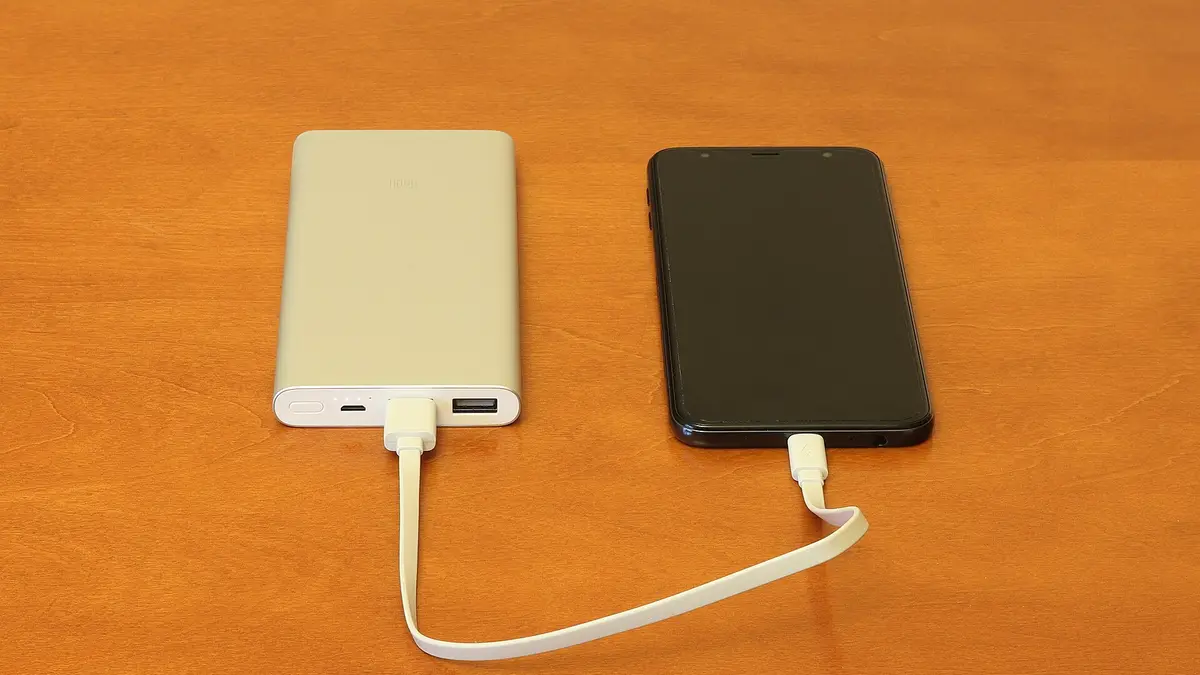
Falabella's power bank search on 8 November 2026 included models from Xiaomi, Master G, Linkon, Samsung and Anker. Price per Wh shows that 20,000 and 30,000 mAh units from entry-level brands give the most energy for the money: some fall below CLP 250 per Wh. Models with high-power outputs, magnetic charging or displays cost much more for the same energy.
| Master G UCP10LPD | 10,000 | 37.0 | 22.5 | 11,990 | 324 |
| Linkon 10.000 mAh | 10,000 | 37.0 | No data | 11,990 | 324 |
| Xiaomi 10.000 mAh 22,5 W | 10,000 | 37.0 | 22.5 | 13,990 | 378 |
| Master G MagSafe 10.000 mAh | 10,000 | 37.0 | No data | 17,990 | 486 |
| Samsung 10.000 mAh 25 W | 10,000 | 37.0 | 25.0 | 34,990 | 946 |
| Linkon 20.000 mAh | 20,000 | 74.0 | No data | 15,990 | 216 |
| Master G UCP20LPD | 20,000 | 74.0 | 22.5 | 17,990 | 243 |
| Xiaomi Redmi 20.000 mAh | 20,000 | 74.0 | 18.0 | 17,990 | 243 |
| Xiaomi 20.000 mAh 33 W | 20,000 | 74.0 | 33.0 | 25,990 | 351 |
| Samsung 20.000 mAh | 20,000 | 74.0 | No data | 41,990 | 567 |
| Master G 20.000 mAh 65 W | 20,000 | 74.0 | 65.0 | 64,990 | 878 |
| Master G 20.000 mAh 110 W | 20,000 | 74.0 | 110.0 | 92,490 | 1,250 |
| Master G UCP30LPD | 30,000 | 111.0 | 22.5 | 26,990 | 243 |
| Linkon 30.000 mAh | 30,000 | 111.0 | No data | 25,990 | 234 |
| Anker Prime 27.650 mAh 250 W | 27,650 | 99.5 | 250.0 | 159,990 | 1,608 |
| Master G 5.000 mAh | 5,000 | 18.5 | No data | 8,990 | 486 |
| Anker Nano 5.000 mAh | 5,000 | 18.5 | 22.5 | 25,990 | 1,405 |
| Anker Nano MagSafe 5.000 mAh | 5,000 | 18.5 | 15.0 | 51,490 | 2,783 |
View the data as a table
| Capacity (mAh) | Price (CLP) | |
|---|---|---|
| Master G UCP10LPD | 10,000 | 11,990 |
| Linkon 10.000 mAh | 10,000 | 11,990 |
| Xiaomi 10.000 mAh 22,5 W | 10,000 | 13,990 |
| Master G MagSafe 10.000 mAh | 10,000 | 17,990 |
| Samsung 10.000 mAh 25 W | 10,000 | 34,990 |
| Linkon 20.000 mAh | 20,000 | 15,990 |
| Master G UCP20LPD | 20,000 | 17,990 |
| Xiaomi Redmi 20.000 mAh | 20,000 | 17,990 |
| Xiaomi 20.000 mAh 33 W | 20,000 | 25,990 |
| Samsung 20.000 mAh | 20,000 | 41,990 |
| Master G 20.000 mAh 65 W | 20,000 | 64,990 |
| Master G 20.000 mAh 110 W | 20,000 | 92,490 |
| Master G UCP30LPD | 30,000 | 26,990 |
| Linkon 30.000 mAh | 30,000 | 25,990 |
| Anker Prime 27.650 mAh 250 W | 27,650 | 159,990 |
| Master G 5.000 mAh | 5,000 | 8,990 |
| Anker Nano 5.000 mAh | 5,000 | 25,990 |
| Anker Nano MagSafe 5.000 mAh | 5,000 | 51,490 |
Source: sale prices listed on Falabella on 8 November 2026; Wh calculated at 3.7 V, except for the Anker Prime, which states 99.5 Wh. Prices change often, especially around Cyber Monday.
What a recharge costs
Recharging a power bank costs very little. With an 85% efficient charger, filling a 20,000 mAh unit from empty draws about 87 Wh from the wall, which at CGE's residential rate of CLP 255.27 per kWh, in force since October 2026, costs about CLP 22. Recharging it every day for a month would add up to about CLP 667.
| Capacity | Energy from the wall | Cost of one recharge | Cost of 30 recharges |
|---|---|---|---|
| 5,000 mAh | 21.8 Wh | CLP 6 | CLP 167 |
| 10,000 mAh | 43.5 Wh | CLP 11 | CLP 333 |
| 20,000 mAh | 87.1 Wh | CLP 22 | CLP 667 |
| 30,000 mAh | 130.6 Wh | CLP 33 | CLP 1,000 |
Energía Futura calculations with CGE's tariff schedule (BT1, October 2026) and 85% charging efficiency. The price per kWh varies by municipality, as shown in the price of electricity per kWh in Chile.
Do you sell batteries, chargers or tech accessories? Reach Energía Futura's readers.
See advertising optionsHow to take a power bank on a plane in 2026
The rules changed this year. On 27 March 2026, the International Civil Aviation Organization (ICAO) approved an addendum to its Technical Instructions that separates power banks from spare batteries, according to IATA's guidance for airlines. Since then, each passenger may carry two power banks at most, always in carry-on baggage, and recharging them during the flight is prohibited. It is also recommended not to use them to charge other devices on board.
| Capacity | Equivalent to | Rule in 2026 |
|---|---|---|
| Up to 100 Wh | Up to about 27,000 mAh at 3.7 V | Allowed in the cabin, two at most |
| 100 to 160 Wh | About 27,000 to 43,000 mAh | With airline approval; IATA will drop this option from 2027 |
| Over 160 Wh | Over about 43,000 mAh | Forbidden for passengers |
| Any capacity | — | Never in checked baggage |
Source: IATA, guidance document for operators on power banks, 31 March 2026. IATA says the option of carrying 100-160 Wh power banks with approval will not carry into the 68th edition of its Dangerous Goods Regulations, effective 1 January 2027. Each airline may apply stricter rules, so check yours before flying. A 30,000 mAh power bank (111 Wh) already exceeds the general limit.
- Before 2026Power bank = spare batteryCabin only; up to 100 Wh freely and 100-160 Wh with approval.
- 27 Mar 2026ICAO addendumTwo power banks per person at most and no recharging them in flight.
- 31 Mar 2026IATA guidance for airlinesRecommends not using them to charge other devices on board.
- 1 Jan 2027New edition of IATA rulesThe 100-160 Wh with-approval option will not carry into the 68th edition.
How to read the label
The label on the back of a power bank carries more information than the big number on the box. Anker explains that manufacturers usually state two capacities: the nominal one, measured at 3.7 V, and the rated capacity, measured at 5 V, which is what actually reaches the phone. If the label shows both, the second is the one to use for counting charges.
- Capacity (mAh): the charge of the cells at 3.7 V; for example, 20,000 mAh.
- Energy (Wh): the measure airlines use; 74 Wh for a 20,000 mAh model.
- Rated capacity: what it delivers at 5 V; about 12,000 to 13,000 mAh for that same model.
- Input: the power it recharges at, such as 5 V / 3 A or 18 W.
- Output: the maximum power per port, such as 20 W, 22.5 W or 65 W.
- PD or QC: the Power Delivery and Quick Charge fast-charging standards.
If the label does not show Wh, multiply mAh by 3.7 and divide by 1,000. Input matters as much as output: a 20,000 mAh power bank recharged at only 10 W takes about 9 hours to fill; with an 18 to 20 W input, half that. Before a trip or an announced power cut, charge it in advance. For long outages, an emergency solar kit gives more autonomy than several power banks.
Safety and lifespan
IATA explains that power banks worry aviation because of the risk of thermal runaway, when a cell overheats and catches fire, and warns that some manufacturers do not meet the UN 38.3 test for transporting lithium batteries. At home, the risk is low if a few simple rules are followed.
- Buy identifiable brands: unbranded models at very low prices are the ones IATA worries about most.
- Do not leave it in the sun or inside a car in summer: heat degrades the cells.
- Unplug it when full and do not charge it on a bed or sofa.
- Discard it if it swells, overheats or smells odd, and take it to a battery recycling point.
- Store it at 40% to 60% charge if you will not use it for months.
Frequently asked questions
How many times does a 20,000 mAh power bank charge a phone?
About 2.5 times for a 5,000 mAh phone, because roughly a third of the energy is lost in conversion.
How many Wh does a 20,000 mAh power bank have?
74 Wh at 3.7 V. That is below the 100 Wh limit for flying in the cabin.
Can I put a power bank in checked baggage?
No. It always goes in carry-on baggage, with a maximum of two per person since March 2026.
Can I use a power bank during the flight?
Recharging it on board is prohibited, and IATA recommends not using it to charge other devices. Some airlines ban it entirely.
How much does a 20,000 mAh power bank cost in Chile?
From CLP 15,990 on Falabella on 8 November 2026; models with 65 W outputs or more cost over CLP 60,000.