The copper price remains at high levels. On Friday, October 16, grade A copper on the London Metal Exchange (LME) closed at US$14,595 per tonne, equivalent to 662.018 US cents per pound (US$6.62), up 0.39% on the day, according to the price report of the Chilean Copper Commission (Cochilco) published by Reporte Minero.
The year-on-year comparison shows the size of the cycle: in October 2025 a tonne traded at US$13,501.88, and the current price is 40.37% higher, according to the same report. The October average so far is US$14,566.50 per tonne, above September's US$14,483.39.
The copper price today: the October 16 figures
The spot price is not the only figure going up. Futures contracts in London also moved higher, a sign that the market does not expect a quick drop in the short term. These were the day's figures:
| Indicator (October 16, 2026) | Value | Daily change |
|---|---|---|
| LME cash (spot) | US$14,595/t (662.018 ¢/lb) | +0.39% |
| LME three months | US$14,485/t (657.029 ¢/lb) | +0.86% |
| LME December 2027 | US$14,490/t (657.256 ¢/lb) | +0.76% |
| LME December 2028 | US$14,540/t (659.523 ¢/lb) | +0.87% |
| Comex, October 2026 delivery | 651.15 ¢/lb | — |
| Comex, September 2027 delivery | 686.10 ¢/lb | — |
| October average (to the 16th) | US$14,566.50/t | — |
| September average | US$14,483.39/t | — |
One detail stands out: Comex contracts in New York for September 2027 delivery trade at 686.10 cents per pound, above today's price. That structure, in which metal for future delivery is worth more than metal available now, is usually read as a sign that the market expects demand to stay firm.

Why the copper price is rising
Cochilco's report attributes the rally to three factors: structural supply pressures, sustained demand from electromobility, renewable energy and infrastructure in developed economies, and geopolitical tensions in supply chains. Copper is the metal of electrification: an electric car, a wind farm or a transmission line uses much more copper than its combustion or fossil equivalent.
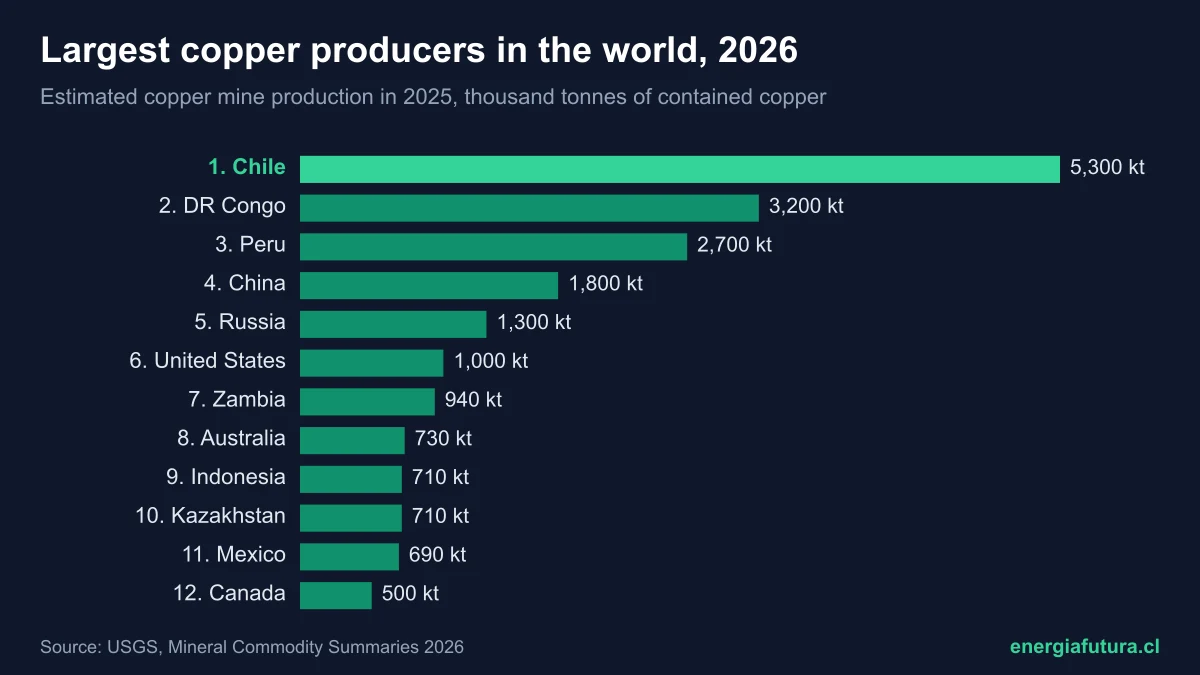
On the supply side, mine output is not keeping pace with demand. According to the US Geological Survey (USGS) mineral commodity summary, world mine production held at around 23 million tonnes in 2024 and 2025, and Chile's, the largest producer, fell from 5.51 to 5.3 million tonnes over that period. We explain it with all the figures in the ranking of the world's largest copper producers.
Inventories matter too. The LME held 226,600 tonnes on October 16, 1,175 tonnes less than the previous day. Meanwhile, 716,765 tonnes are piling up on Comex, and inventories on the Shanghai Futures Exchange (SHFE) jumped 25.91% in a day to 73,962 tonnes. In August, Cochilco had already warned that the concentration of inventories in the United States restricts physical availability of the metal in Asia.
| Exchange | Copper inventory (October 16) | Change |
|---|---|---|
| LME (London) | 226,600 t | -1,175 t (-0.52%) |
| Comex (New York) | 716,765 t | +0.23% |
| SHFE (Shanghai) | 73,962 t | +15,218 t (+25.91%) |
What the copper price means for Chile
For Chile, every cent counts. Copper is the country's main export and a direct source of fiscal revenue through state-owned Codelco and taxes on private mining. That is why the Finance Ministry plans public spending with a long-term reference price set by a committee of independent experts.
For the 2027 budget, that committee set the reference price at US$5.37 per pound (2027-2036 average, in 2027 dollars), 22.6% more than the US$4.38 used for the 2026 budget, as the Finance Ministry and the Budget Office announced on September 4 and Minería Chilena reported. The current price of US$6.62 per pound is well above that reference.
That same budget cuts resources for the energy sector. We covered it in the 2027 budget of Chile's Energy Ministry, which falls 11.2% and eliminates a just energy transition program.
| Reference | Value | Source and date |
|---|---|---|
| LME spot price (October 16, 2026) | US$6.62/lb | Cochilco |
| Average price forecast for 2026 | US$5.95/lb | Cochilco, August 2026 report |
| Average price forecast for 2027 | US$5.10/lb | Cochilco, August 2026 report |
| 2027 budget reference price | US$5.37/lb | Advisory committee, September 4, 2026 |
| 2026 budget reference price | US$4.38/lb | Budget Office (Dipres) |
Cochilco's August forecasts, published in its second-quarter market trends report and reported by Reporte Minero, estimated an average price of US$5.95 per pound in 2026 and US$5.10 in 2027. They also projected Chilean output would close 2026 at 5.27 million tonnes (-2.6%) and rise to 5.55 million in 2027.
The other energy transition metals
Cochilco's report also recorded gains in other metals on October 16: nickel rose 1.91% to US$15,170 per tonne, tin 1.20% to US$50,700 and aluminium 0.50% to US$3,014. Lithium carbonate (99.5% min, FOB South America) was stable at US$18.95 per kilo.
Lithium is going through its own cycle. Chile's exports of the mineral nearly tripled this year, as we explained in Chile's lithium exports from January to September 2026, driven by better prices and higher volumes.
| Metal | LME or reference price (October 16) | Daily change |
|---|---|---|
| Copper | US$14,595/t | +0.39% |
| Nickel | US$15,170/t | +1.91% |
| Tin | US$50,700/t | +1.20% |
| Aluminium | US$3,014/t | +0.50% |
| Zinc | — | +0.40% |
| Lithium carbonate (FOB South America) | US$18.95/kg | Stable |
What to watch in the coming weeks
- Inventories in London and Shanghai: if LME stocks keep falling, the spot price tends to hold.
- Chinese demand: according to Cochilco, China accounts for 57.6% of world refined copper consumption projected for 2026.
- Chilean output: monthly figures from Cochilco and the national statistics institute (INE) will show whether the projected 2.6% drop for 2026 is confirmed.
- Energy and fuels: higher diesel prices raise mining costs, since mines run large haul trucks.
- US trade policy: tariffs on copper imports moved the Comex price in 2025, according to the USGS.
Does your company work in mining, metals or energy? Reach Energía Futura readers who follow the copper market and the energy transition.
See advertising optionsFrequently asked questions
What is the copper price today?
The latest reported close is from Friday, October 16, 2026: US$14,595 per tonne on the London Metal Exchange, equivalent to US$6.62 per pound. The LME does not trade on weekends, so the next price will be known on Monday, October 19.
How much has copper risen in a year?
According to Cochilco, the October 16 price is 40.37% higher than in October 2025, when a tonne traded at US$13,501.88.
Who publishes the official copper price in Chile?
The Chilean Copper Commission (Cochilco) publishes the LME and Comex prices every business day on its website, together with inventories and prices of other metals.
Why does the copper price matter for Chile's budget?
Because Codelco's revenue and taxes on private mining depend on it. The Finance Ministry uses a long-term reference price, US$5.37 per pound for 2027, to calculate how much the state can spend while meeting its fiscal rule.