The electricity interconnection between Chile and Peru has taken a concrete step. EnorChile Transmisión SpA filed with Chile's Environmental Impact Assessment System (SEIA) the Environmental Impact Statement (DIA) for the “2x220 kV Los Héroes-Parinacota Power Line”, with an estimated investment of US$30 million, Portal Minero reported on October 16.
The line would run about 22 kilometres in the commune of Arica, with a 220 kV double circuit and a maximum transport capacity of 250 MVA. Its purpose is to allow electricity imports and exports between Chile's National Electric System and Peru's interconnected grid. The project is at the admission stage before the environmental authority and plans to start works in January 2028.
What the Chile-Peru electricity interconnection would look like
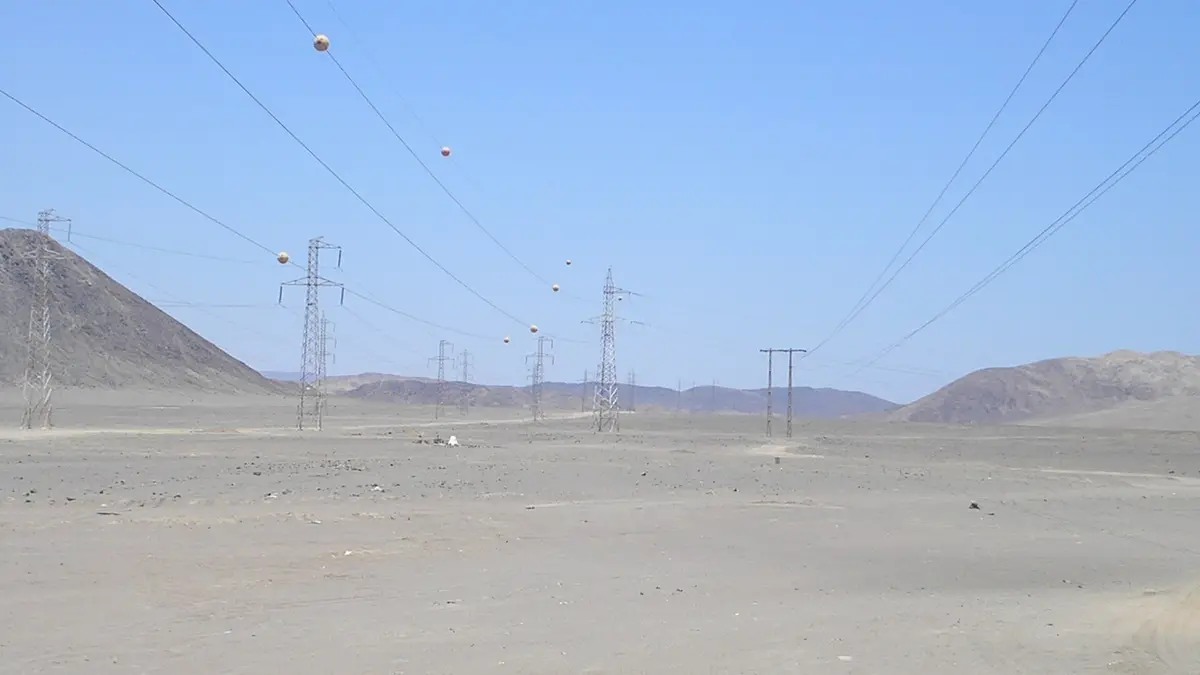
The route starts at the Parinacota Substation in Arica, reaches the border and continues to the Los Héroes Substation in Tacna. According to the project description, both existing substations are mentioned only as context for the interconnection and are not part of the works being assessed in Chile. The line would be mostly overhead, with an underground section between structures 40 and 49 and transition facilities.
| Feature | Project data |
|---|---|
| Developer | EnorChile Transmisión SpA |
| Name | 2x220 kV Los Héroes-Parinacota Power Line |
| Environmental filing | Environmental Impact Statement (DIA) |
| Estimated investment | US$30 million |
| Length | ~22 km in the commune of Arica |
| Voltage and circuits | 220 kV, double circuit |
| Maximum transport capacity | 250 MVA |
| End points | Parinacota Substation (Arica) and Los Héroes Substation (Tacna, Peru) |
| Planned start of works | January 2028 |
| Status | Admission stage at SEIA (October 2026) |
An idea with more than a decade of studies
The interconnection with Peru is not new. In 2016, T13 reported that EnorChile, part of the Cardoen Group, had been working for about five years on a 100 MW project between Tacna and Arica, with a frequency converter plant in Peru and an estimated cost of US$80 to US$100 million, together with Peru's Coelvisag. The converter is a technical requirement: Chile and Peru run their grids at different frequencies, 50 and 60 Hz.
That same year, the Andean Electrical Interconnection System (Sinea) had proposed two options, according to the same report: a short line of about 55 km between Tacna and Arica, of up to 200 MW, costing US$130 to US$150 million, and a long 607 km line between Crucero (Antofagasta) and Montalvo (Moquegua), of 1,000 MW and about US$989 million. Three feasibility studies concluded in late 2015 that the interconnection was viable and beneficial for both countries.
| Option | Route | Capacity | Estimated cost |
|---|---|---|---|
| EnorChile 2026 (under review) | Parinacota-Los Héroes, ~22 km in Chile | 250 MVA | US$30 million (section under review) |
| EnorChile 2016 | Tacna-Arica, with converter | 100 MW | US$80 to 100 million |
| Sinea, short line | ~55 km, Tacna-Arica | Up to 200 MW | US$130 to 150 million |
| Sinea, long line | 607 km, Crucero-Montalvo | 1,000 MW | ~US$989 million |
The US$30 million investment covers the line under review in Chile; at this stage the project description does not detail the cost of works on Peruvian territory or of any frequency conversion.
Regional power integration gains momentum
The project comes in a week of announcements on energy integration. On October 16, the presidents of Chile and Bolivia signed a declaration to study a future power interconnection between both countries, as we reported in the energy integration agreement with Bolivia. Chile already has an operating interconnection with Argentina.
For Chile, a link with Peru would open an outlet for solar power from the north, part of which is currently lost for lack of transmission. During sunny hours, the system generates more than it can consume or transport and renewables must cut output (curtailment). Grid congestion is also behind the long queue of projects waiting to connect, which we reviewed in the 12,188 MW of projects awaiting connection.
New grid connections are at the centre of the regulatory debate. Chile's antitrust prosecutor (FNE) has asked for changes to how connections are allocated and to the grid operator's tender rules, as detailed in the FNE proposal on competition in the power sector. An international 250 MVA line would have to operate under those same access and coordination rules.
The project's scale is limited. At 250 MVA, the line could carry around 250 MW under normal operating conditions, a fraction of the solar capacity installed in northern Chile, but enough for a first exchange between Arica and Tacna, two cities that already share intense cross-border trade. Earlier Sinea studies saw this kind of short link as the first step towards a larger interconnection.
What is still needed for the electricity interconnection with Peru
Environmental review is only one of the steps. For energy to flow, both countries must agree on a regulatory framework: how transfers are paid for, who coordinates operation and which commercial rules apply. That discussion between governments and grid operators has moved slowly for years. Permits are also needed in Peru for the section north of the border.
- Admission at SEIA: the Environmental Assessment Service must declare the DIA admissible before reviewing it.
- Environmental review: agencies with environmental responsibilities review the DIA and may request clarifications.
- Permits in Peru: the section between the border and Los Héroes requires approval from Peruvian authorities.
- Binational regulatory framework: rules to operate and trade energy between the two systems.
- Construction: the developer plans to start in January 2028.
Does your company work in transmission, electrical engineering or energy trading? Reach Energía Futura readers.
See advertising optionsFrequently asked questions
Are Chile and Peru connected electrically today?
No. The power systems of Chile and Peru are not interconnected. Chile does have an interconnection with Argentina.
Who is EnorChile?
A Chilean company linked to the Cardoen Group which, according to T13 in 2016, remotely operated about 800 MW of third-party renewable energy and built diesel backup plants. Its subsidiary EnorChile Transmisión SpA is the project developer.
How much does the Los Héroes-Parinacota line cost?
The estimated investment reported to SEIA is US$30 million.
When would it be built?
The developer plans to start construction in January 2028, if it obtains environmental approval and the other permits.