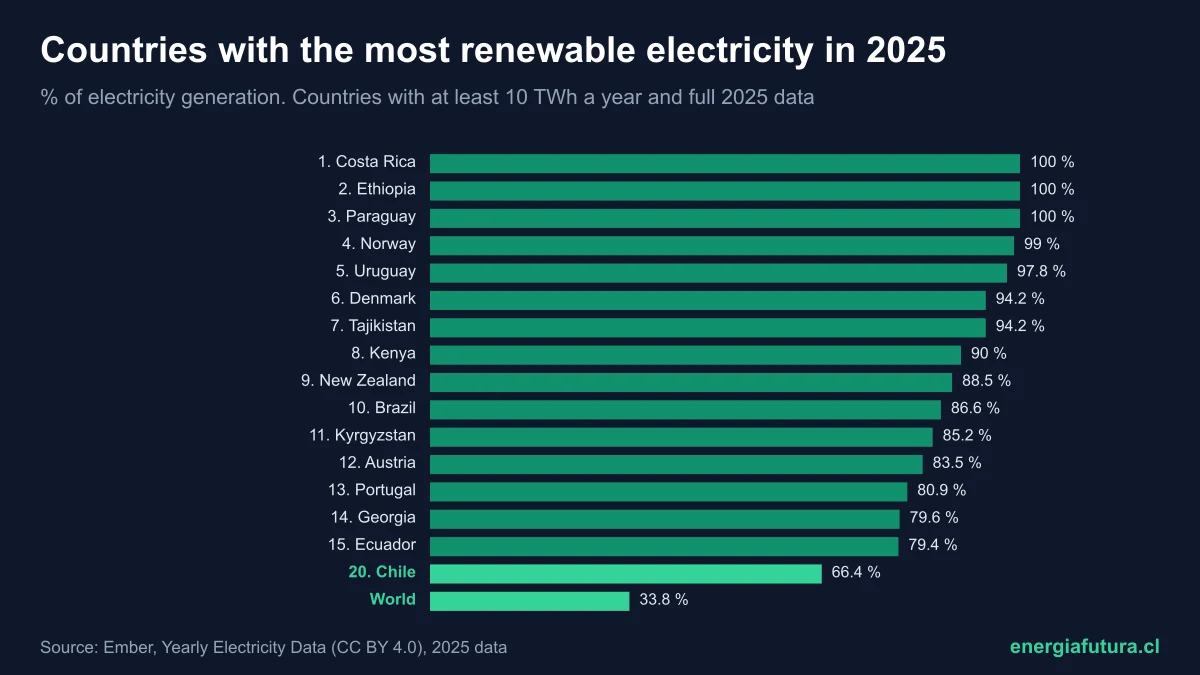
Updated on 22 October 2026. The countries with the most renewable energy in their electricity are Costa Rica, Ethiopia and Paraguay, which in 2025 generated virtually 100% of their electricity from renewable sources, according to annual data from the think tank Ember. Chile ranked 20th among the 78 countries with at least 10 TWh of generation and complete data, with 66.4%: twice the world average of 33.8%.
Chile stands out more for solar power: at 25.1% of its electricity, it is the second country in the world with the highest solar share, behind only Hungary (27.3%). And with 38.1% wind and solar combined, it is ninth, ahead of the United Kingdom and Australia.
Ranking of countries with the most renewable energy in their electricity (2025)
The table ranks countries by the percentage of their electricity generation that comes from renewable sources (hydro, wind, solar, bioenergy and geothermal). It includes the 78 countries with at least 10 TWh of annual generation and complete 2025 data in Ember:
| # | Country | Renewable electricity | Hydro | Wind + solar | Total generation |
|---|---|---|---|---|---|
| 1 | Costa Rica | 100.0% | 74.8% | 12.8% | 12.8 TWh |
| 2 | Ethiopia | 100.0% | 96.5% | 3.4% | 33.4 TWh |
| 3 | Paraguay | 100.0% | 99.5% | 0.0% | 45.4 TWh |
| 4 | Norway | 99.0% | 90.0% | 8.8% | 160.8 TWh |
| 5 | Uruguay | 97.8% | 27.2% | 45.7% | 11.9 TWh |
| 6 | Denmark | 94.2% | 0.1% | 72.1% | 34.5 TWh |
| 7 | Tajikistan | 94.2% | 94.2% | 0.0% | 23.9 TWh |
| 8 | Kenya | 90.0% | 20.9% | 21.0% | 14.0 TWh |
| 9 | New Zealand | 88.5% | 54.9% | 10.6% | 43.3 TWh |
| 10 | Brazil | 86.6% | 51.8% | 27.5% | 750.5 TWh |
| 11 | Kyrgyzstan | 85.2% | 85.2% | 0.0% | 15.7 TWh |
| 12 | Austria | 83.5% | 51.8% | 25.4% | 73.3 TWh |
| 13 | Portugal | 80.9% | 29.7% | 44.1% | 51.1 TWh |
| 14 | Georgia | 79.6% | 78.8% | 0.8% | 13.5 TWh |
| 15 | Ecuador | 79.4% | 77.9% | 0.6% | 36.6 TWh |
| 16 | Colombia | 77.0% | 69.2% | 5.3% | 90.4 TWh |
| 17 | Croatia | 76.3% | 39.3% | 30.1% | 14.7 TWh |
| 18 | Sweden | 71.4% | 40.1% | 25.4% | 170.3 TWh |
| 19 | Switzerland | 67.8% | 52.3% | 12.3% | 65.0 TWh |
| 20 | Chile | 66.4% | 22.2% | 38.1% | 88.5 TWh |
| — | World | 33.8% | 14.0% | 17.3% | 31,734 TWh |
Source: Ember, Yearly Electricity Data (CC BY 4.0 licence), 2025 data, downloaded on 22 October 2026. The percentages for Costa Rica, Ethiopia and Paraguay are rounded. The difference between total renewables and the sum of hydro, wind and solar is bioenergy, geothermal and other renewables.
The ranking shows two paths. Most of the top places go to countries with plenty of hydropower, such as Paraguay, which shares the Itaipu dam, one of the largest in the world, with Brazil. Others reached the top with wind and sun: Denmark generates 72.1% of its electricity from wind and solar, and Uruguay 45.7%. Kenya combines geothermal, hydro and wind.
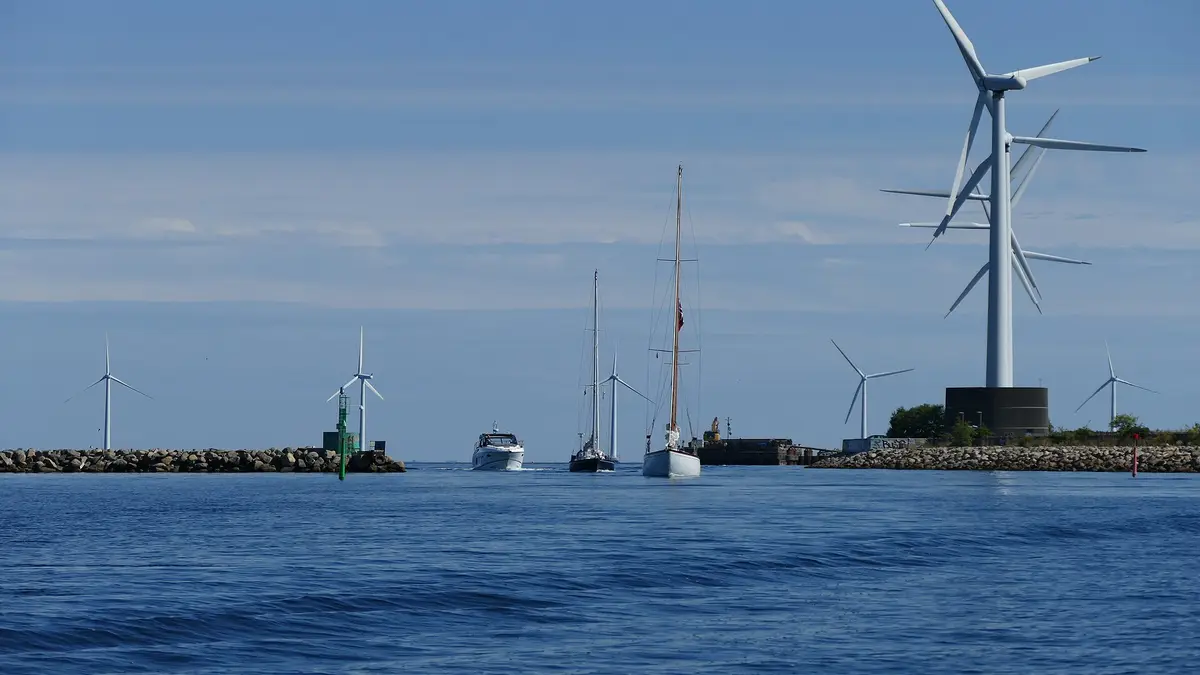
Chile, second in the world for solar power
Chile is not in the top ten for total renewables, because it still generates a third of its electricity from coal and gas. But in solar it is among the world's elite. Among countries with at least 10 TWh of generation, these are the most dependent on the sun:
| # | Country | Solar power (% of electricity, 2025) |
|---|---|---|
| 1 | Hungary | 27.3% |
| 2 | Chile | 25.1% |
| 3 | Spain | 21.9% |
| 4 | Netherlands | 21.1% |
| 5 | Pakistan | 20.7% |
| 6 | Greece | 19.8% |
| 7 | Australia | 19.7% |
| 8 | Bulgaria | 18.2% |
| 9 | Germany | 17.9% |
| 10 | Sri Lanka | 17.6% |
Source: Ember, 2025 data. The ranking by installed capacity, which puts China far ahead in absolute terms, is in our world ranking of countries by solar power.
The Atacama Desert, with the highest solar radiation on the planet, explains Chile's leadership. Solar went from 1.7% of the country's electricity in 2015 to 25.1% in 2025, according to Ember. Capacity figures and the country's largest parks are in solar energy in Chile in figures.
Renewable energy in Chile: from 43% to 66% in ten years
The transformation of Chile's power mix is one of the fastest in the world. In 2015 renewables generated 43.2% of the country's electricity, almost all from hydro, and coal 37.4%. In 2025 renewables reached 66.4% and coal fell to 17.8%:
| Year | Renewables | Solar | Wind | Coal |
|---|---|---|---|---|
| 2015 | 43.2% | 1.7% | 2.8% | 37.4% |
| 2020 | 48.5% | 9.0% | 6.6% | 31.2% |
| 2024 | 70.0% | 22.8% | 11.8% | 15.3% |
| 2025 | 66.4% | 25.1% | 13.1% | 17.8% |
Source: Ember, Yearly Electricity Data. In 2025 the renewable share fell from 2024 because hydro generation dropped from 26.0 TWh to 19.7 TWh in a drier year, and that energy was partly replaced with coal and gas.
The 2025 drop shows the fragility of relying on water: in dry years hydro falls and the system turns to fossil fuels. That is why batteries and transmission are key for solar power from the north, which today is sometimes lost for lack of lines, to reach consumption centres at all hours.
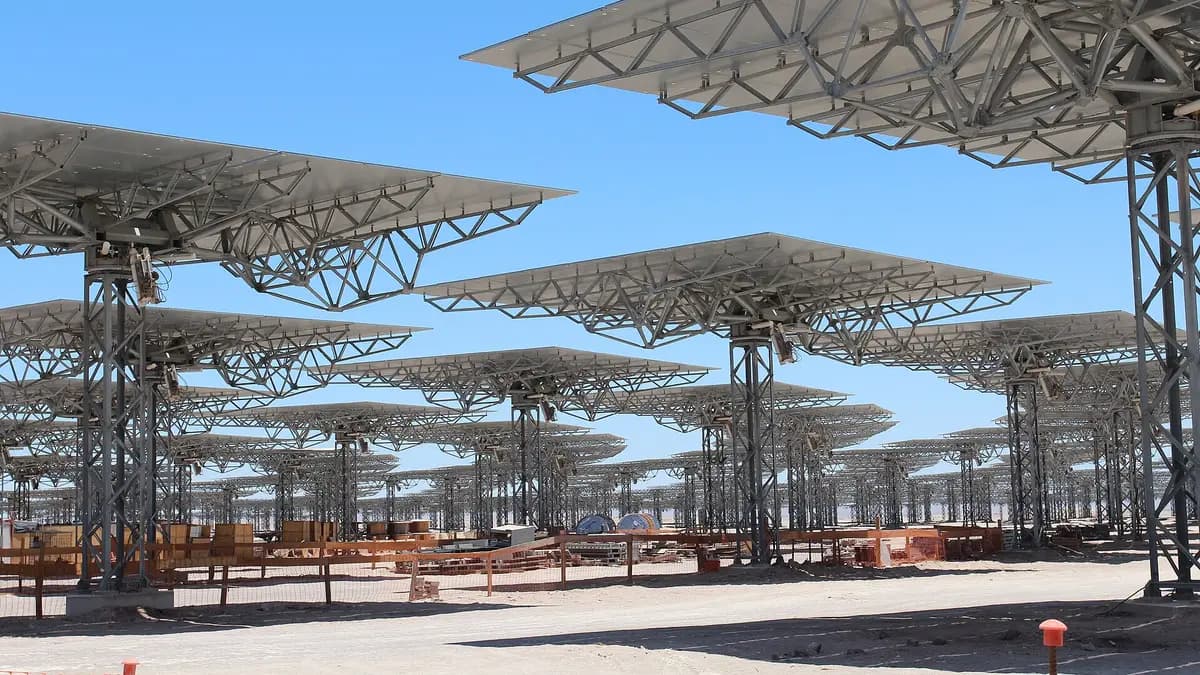
Renewable energy in the largest economies
The top places go to small countries or those with plenty of water. Among economies generating more than 200 TWh a year, the picture is different:
| Country | Renewable electricity (2025) | Total generation |
|---|---|---|
| Brazil | 86.6% | 750.5 TWh |
| Canada | 63.9% | 652.4 TWh |
| Germany | 59.1% | 500.5 TWh |
| Spain | 55.9% | 288.0 TWh |
| United Kingdom | 52.0% | 292.3 TWh |
| Italy | 48.7% | 264.9 TWh |
| Australia | 38.7% | 286.7 TWh |
| China | 37.0% | 10,577.7 TWh |
| France | 26.1% | 570.1 TWh |
| United States | 25.6% | 4,519.8 TWh |
| India | 24.1% | 2,081.6 TWh |
| Japan | 23.6% | 1,030.0 TWh |
| Mexico | 23.1% | 357.0 TWh |
Source: Ember, 2025 data. France ranks low on renewables but generates most of its electricity from nuclear power, which is not renewable but does not emit CO₂ either. That is why Ember also publishes a “clean” electricity indicator (renewables plus nuclear), which reached 42.6% worldwide in 2025.
China is the most striking case: with only 37% renewables, it generates more renewable electricity in absolute terms than any other country, because its power system is the world's largest, at more than 10,500 TWh a year. It is also home to the largest solar plant in the world.
Latin America, the most renewable region
Seven of the top twenty places are Latin American: Costa Rica, Paraguay, Uruguay, Brazil, Ecuador, Colombia and Chile. The region combines large rivers, such as the Paraná, the Amazon and those flowing down from the Andes, with some of the world's best solar and wind resources. Mexico and Argentina are the exception, at 23.1% and 34.6%, because they rely much more on natural gas.
Countries missing from the ranking for lack of data
Ember publishes complete 2025 data only for countries whose monthly or annual figures are already available. Several countries with almost entirely renewable power mixes are missing because their latest figure is from 2024:
| Country | Renewable electricity (latest figure, 2024) | Total generation |
|---|---|---|
| Iceland | 100% | 19.1 TWh |
| Democratic Republic of the Congo | 100% | 15.9 TWh |
| Nepal | 100% | 11.1 TWh |
| Bhutan | 100% | 11.0 TWh |
| Venezuela | 91.1% | 80.1 TWh |
| Zambia | 87.5% | 19.7 TWh |
| Mozambique | 83.4% | 19.8 TWh |
| Laos | 76.7% | 52.3 TWh |
| Guatemala | 68.3% | 15.8 TWh |
| Panama | 68.0% | 13.4 TWh |
Source: Ember, 2024 data. When Ember publishes their complete data, this ranking will be updated on this same page.
Methodology
The data come from Ember's Yearly Electricity Data set (CC BY 4.0 licence), downloaded on 22 October 2026. Renewable electricity includes hydro, wind, solar, bioenergy and other renewables, such as geothermal. The ranking includes only countries with at least 10 TWh of annual generation, so that islands or very small countries do not distort the table, and only those with complete 2025 data.
Does your company develop or finance renewable energy? Reach Energía Futura's readers.
See advertising optionsFrequently asked questions
Which country has the most renewable energy?
Costa Rica, Ethiopia and Paraguay generated virtually 100% of their electricity from renewables in 2025, according to Ember. Norway reached 99%.
Where does Chile rank in renewable energy?
20th, with 66.4% renewable electricity in 2025, among the 78 countries with at least 10 TWh of generation and complete data.
What share of the world's electricity is renewable?
33.8% in 2025. Including nuclear, clean electricity reached 42.6%.
Which country generates the most electricity from solar?
As a share, Hungary (27.3%) and Chile (25.1%). In absolute terms, China.
How to cite this data
Energía Futura (2026). Countries with the most renewable energy 2026: renewable electricity ranking and where Chile stands. Based on Ember, Yearly Electricity Data (2025). Available at https://energiafutura.cl/en/news/countries-with-the-most-renewable-energy-2026-renewable-electricity-ranking-and-where-chile-stands. The cover chart may be reproduced crediting Energía Futura and linking to this page.