Chile's copper production is set to end 2026 at its lowest level in 23 years. Between January and August the country produced 3,248,000 tonnes, 7.7% less than in the same period of 2025 (3,518,300 tonnes), according to data from the Chilean Copper Commission (Cochilco) reported by Electrominería. That is about 270,000 tonnes less in eight months.
At that pace, the think tank Núcleo Minero projects 5.15 million tonnes for the whole of 2026, “the lowest level since 2003”, its director Álvaro Merino told Diario Financiero on Thursday 22 October. Consultancy Plusmining estimates even less than 5.1 million.
Chile's copper production, mine by mine
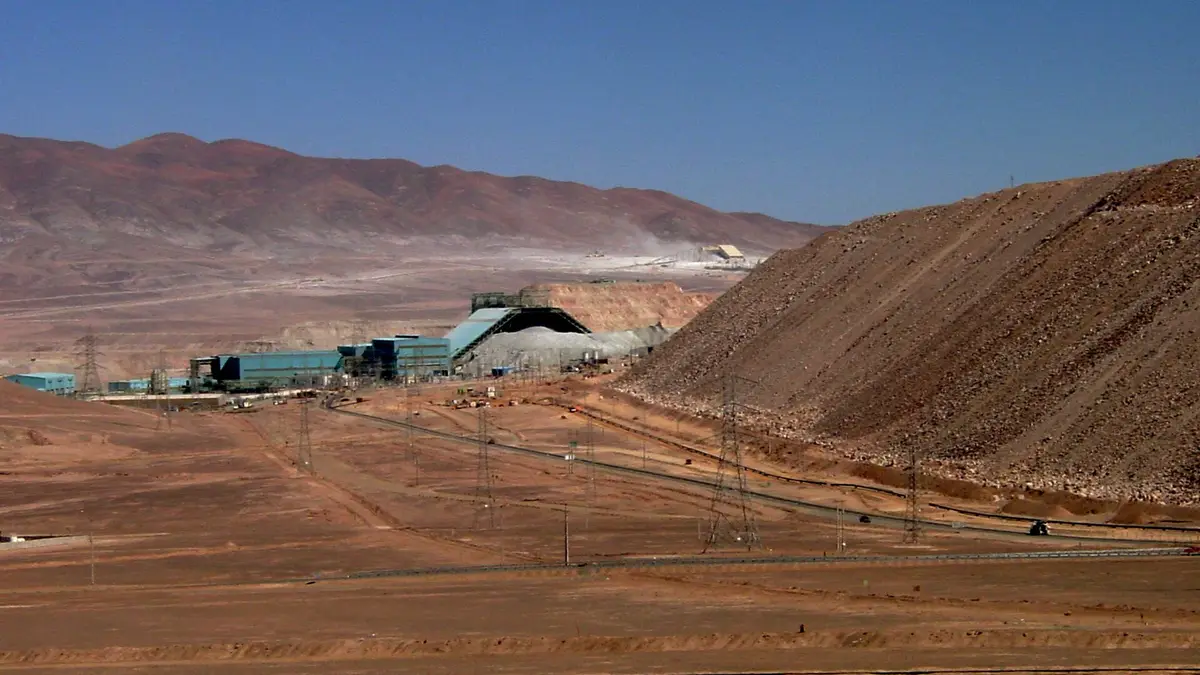
The decline is concentrated in a few operations. BHP's Escondida, the world's largest copper mine, produced 102,500 tonnes less than a year earlier, about 38% of the national drop. Spence, also owned by BHP, fell 25.5%, and Codelco's El Teniente division dropped 20.3%. According to Andrés González of Plusmining, about 80% of the decline is explained by BHP and Codelco.
| Operation or company | January-August 2026 (tonnes) | January-August 2025 (tonnes) | Change |
|---|---|---|---|
| Chile total | 3,248,000 | 3,518,300 | -7.7% |
| Codelco (total) | 833,400 | 900,700 | -7.5% |
| Escondida (BHP) | 797,500 | 900,000 | -11.4% |
| Collahuasi | 249,900 | 259,100 | -3.6% |
| Los Pelambres | 195,100 | 200,500 | -2.7% |
| El Teniente (Codelco) | 170,600 | — | -20.3% |
| Spence (BHP) | 131,200 | 176,100 | -25.5% |
Source: Cochilco, January to August 2026 production, reported by Electrominería on 19 October.
August was the worst month of the year: 366,300 tonnes, 12.7% less than in August 2025 and the lowest monthly level in the series Cochilco has published since January 2023, according to CNN Chile. Winter weather took its toll: companies reported stoppages due to storms and snowfall, as we covered in our story on Anglo American's 6% drop.

Why copper production is falling: ore grades, maintenance and weather
Analysts cite three immediate causes: falling ore grades (each tonne of rock contains less copper), scheduled maintenance at large plants and winter weather events. Merino adds a structural problem: ageing deposits, which require moving more material to extract the same amount of copper.
Last year was already low. In 2025 Chile produced 5,388,000 tonnes, below the 5,413,000 of 2004, according to Núcleo Minero. And the all-time high, in 2018, is far off: Plusmining estimates the country will be about 800,000 tonnes below that record this year.
| Source | Forecast for 2026 | Forecast for 2027 |
|---|---|---|
| Núcleo Minero (Álvaro Merino) | 5.15 million t (lowest since 2003) | Close to 5.5 million t |
| Plusmining (Andrés González) | Less than 5.1 million t | 5.2 to 5.3 million t |
| Cochilco (cited by Economy and Mining Minister Daniel Mas) | 6.6% below 2025, “just slightly above 5 million” | An increase of about 300,000 t |
| Cochilco, August 2026 report | 5.27 million t (-2.6%) | 5.55 million t |
Sources: Diario Financiero (22 October 2026) and Cochilco's copper market outlook of 11 August 2026. Cochilco's August forecast predates the weak July and August figures; the more recent figure cited by the minister is more pessimistic.
Less copper, but at record prices
Lower output comes with copper at record highs. In August Cochilco raised its forecast for the 2026 average price to US$5.95 per pound, and the metal topped US$14,500 per tonne on the London Metal Exchange this month, as we detailed in our story on the copper price. That price partly offsets the drop in tonnes in the country's revenues.
The treasury feels it. Between January and August, mining contributed US$7,306 million: US$5,973 million in taxes from private miners, up 45.9% in real terms, and US$1,333 million in transfers from Codelco, down 0.2% in real terms, according to figures cited by Merino. For the whole of 2026, Núcleo Minero projects about US$10,800 million.

When Chile's copper production could recover
Analysts agree on a rebound from 2027, thanks to a low comparison base and maturing projects, but not on its size. Merino sees Chile at 6 million tonnes by 2033 if the investment pipeline under review goes ahead, and calls for legal certainty and faster environmental permits without lowering standards. Between 2006 and 2025, copper mining invested US$234 billion in the country, according to his figures.
González is more cautious: “Chile will remain below its all-time high at least for the rest of this decade”. Meanwhile, Chile remains the world's largest producer, with about a quarter of global mine output, as shown in our ranking of copper producers, followed by Congo, the fastest-growing producer.
What it means for the energy transition
Copper is the metal of electrification: it is in grid cables, in the motors and batteries of electric cars, in wind farms and in solar plants. That is why Chilean supply matters beyond the treasury. In its August report, Cochilco projected world mine output of 23.5 million tonnes in 2026, just 0.2% more than in 2025, against consumption of 27.8 million tonnes, up 1.9%, with China as the driver (16 million tonnes, +2.7%).
Cochilco therefore estimated a surplus of only 225,000 tonnes, 0.8% of world demand: a margin so thin that any production drop in Chile, the largest producer, puts pressure on prices. The roughly 270,000 tonnes Chile failed to produce between January and August already exceed that margin.
For the energy transition, the consequence is copper staying expensive for longer: it raises the cost of the transmission and distribution grids the country needs to strengthen and of electrical equipment in general. For Chile, by contrast, the high price partly offsets the lower volume exported and supports tax revenue, at least while the price cycle lasts.
Does your company work with copper mining on its energy transition? Reach Energía Futura's readers.
See advertising optionsFrequently asked questions
How much copper did Chile produce between January and August 2026?
3,248,000 tonnes, 7.7% less than in the same period of 2025, according to Cochilco.
Why is it called the lowest level in 23 years?
Because Núcleo Minero projects 5.15 million tonnes in 2026, the lowest figure since 2003. Plusmining estimates less than 5.1 million.
Which mines explain the drop?
Mainly Escondida (-11.4%), Spence (-25.5%) and El Teniente (-20.3%). BHP and Codelco account for about 80% of the decline.
When could production recover?
From 2027, with estimates of between 5.2 and 5.5 million tonnes, according to the consultancies cited.