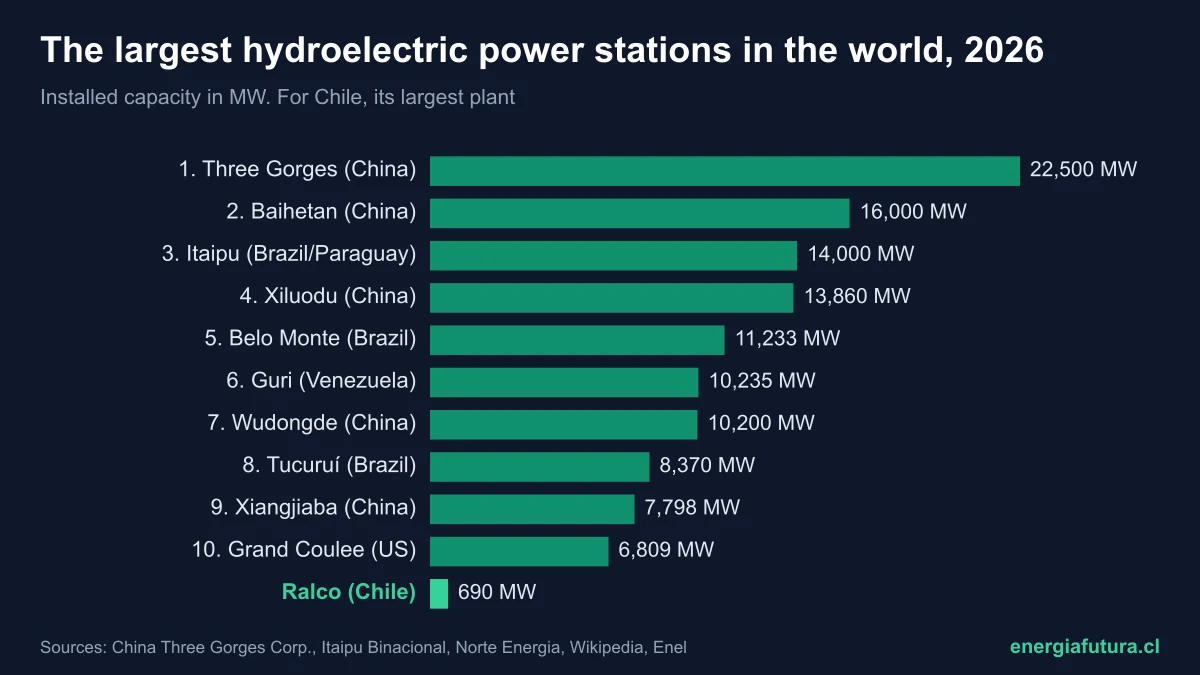
Updated on 22 October 2026. The largest hydroelectric power station in the world is Three Gorges, on the Yangtze River in China, with 22,500 MW of installed capacity: 32 turbines of 700 MW and two of 50 MW. It is followed by Baihetan (16,000 MW), also in China, and Itaipu (14,000 MW), on the border between Brazil and Paraguay, according to Wikipedia's list of hydroelectric power stations and data from their operators.
Three Gorges has 32 times the capacity of Ralco, Chile's largest hydroelectric plant, at 690 MW. And the record will not last: China is building the Medog plant in Tibet, which at a planned 60,000 MW would almost triple Three Gorges.
Ranking: the largest hydroelectric power stations in the world in 2026
The table ranks plants in operation by installed capacity, the maximum power they can deliver. Five of the ten largest are in China and three in Brazil:
| # | Plant | Country | River | Installed capacity | Completed |
|---|---|---|---|---|---|
| 1 | Three Gorges | China | Yangtze | 22,500 MW | 2012 |
| 2 | Baihetan | China | Jinsha | 16,000 MW | 2022 |
| 3 | Itaipu | Brazil and Paraguay | Paraná | 14,000 MW | 1991 (expanded in 2007) |
| 4 | Xiluodu | China | Jinsha | 13,860 MW | 2014 |
| 5 | Belo Monte | Brazil | Xingu | 11,233 MW | 2019 |
| 6 | Guri | Venezuela | Caroní | 10,235 MW | 1986 |
| 7 | Wudongde | China | Jinsha | 10,200 MW | 2021 |
| 8 | Tucuruí | Brazil | Tocantins | 8,370 MW | 2007 |
| 9 | Xiangjiaba | China | Jinsha | 7,798 MW | 2014 |
| 10 | Grand Coulee | United States | Columbia | 6,809 MW | 1980 (later upgrades) |
| — | Ralco | Chile | Biobío | 690 MW | 2004 |
Sources: Wikipedia's list of conventional hydroelectric power stations (accessed on 22 October 2026), China Three Gorges Corporation, Itaipu Binacional, Norte Energia (Belo Monte) and Enel (Ralco). Years refer to the commissioning of the last unit of the original project or its main expansion.
Baihetan also has the largest turbines in the world: 16 units of 1,000 MW each. Four of the ten largest, Baihetan, Xiluodu, Wudongde and Xiangjiaba, are on the same river, the Jinsha, the upper course of the Yangtze. China built them as a cascade: the water passing through one plant reaches the next. Together with Three Gorges, they form the largest hydroelectric generation system on the planet.
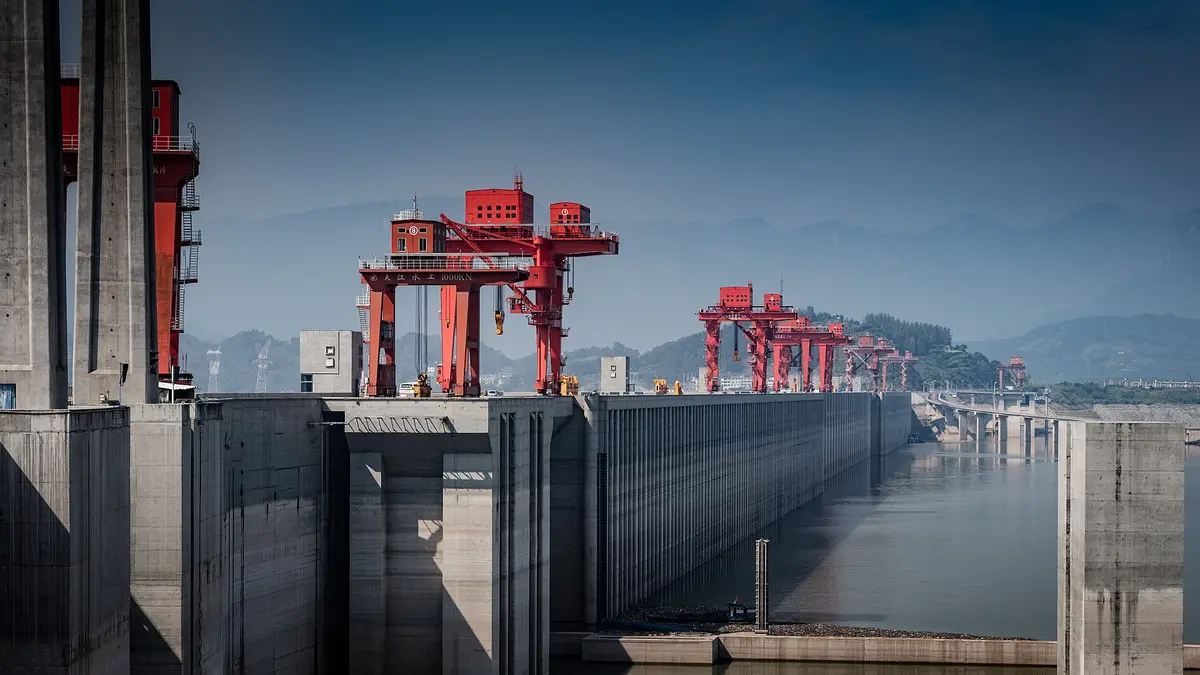
Three Gorges, the largest hydroelectric power station in the world
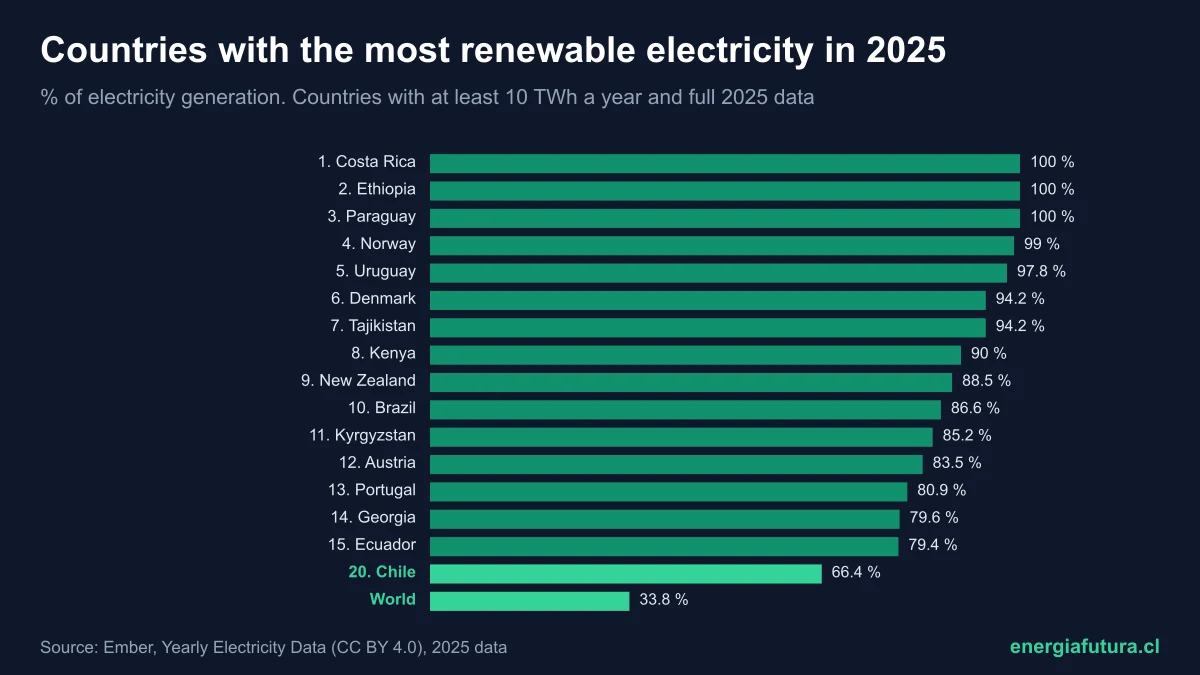
Construction of Three Gorges began in 1994 and ended in 2012. The dam is 181 metres high and 2,335 metres long. In December 2007 it overtook Itaipu as the world's most powerful plant, and in 2020 it set its production record: 111.8 TWh in one year, more than all the electricity Chile generates in a year (88.5 TWh in 2025, according to Ember).
Its size came at a cost: the reservoir forced the relocation of more than a million people and changed the Yangtze's ecosystem. The plant also serves for flood control and navigation, with a system of locks and a ship lift.
More capacity is not always more energy
Itaipu has a third less capacity than Three Gorges, but in some years produces almost as much, because the Paraná River brings water evenly all year, while the Yangtze has months of low flow. Itaipu reached 103 TWh in 2016, according to Wikipedia. So, when comparing plants, capacity in MW says how much they can deliver at one moment, but not how much energy they produce in a year.
| Plant | Capacity | Annual generation record | Year of record |
|---|---|---|---|
| Three Gorges | 22,500 MW | 111.8 TWh | 2020 |
| Itaipu | 14,000 MW | 103 TWh | 2016 |
| Chile (entire power system) | — | 88.5 TWh (total generation) | 2025 |
Medog: the project under construction that will surpass them all
In July 2025 construction began on the Medog plant, on the lower Yarlung Tsangpo River in Tibet. The project plans 60,000 MW and about 300 TWh a year, three times Three Gorges, with an investment of 1.2 trillion yuan, about US$167 billion, according to Foreign Policy. Commercial operation is expected in the next decade.
The project worries India and Bangladesh, because downstream the river becomes the Brahmaputra, and environmental groups, because of the area's seismic activity and ecosystem. Many details of the design and of resettlement are not public.
| Project | Country | Planned capacity | Status |
|---|---|---|---|
| Medog (Yarlung Tsangpo) | China | 60,000 MW | Under construction since July 2025 |
| Grand Inga | Democratic Republic of the Congo | About 39,000 MW or more | Planned |
| Grand Ethiopian Renaissance Dam (GERD) | Ethiopia | 5,150 MW | Inaugurated in September 2025 |
Sources: Foreign Policy, Wikipedia and Tractebel (GERD). The Grand Ethiopian Renaissance Dam, on the Blue Nile, was inaugurated on 9 September 2025 and is Africa's largest hydroelectric plant, with 13 turbines and an investment of about US$5 billion.
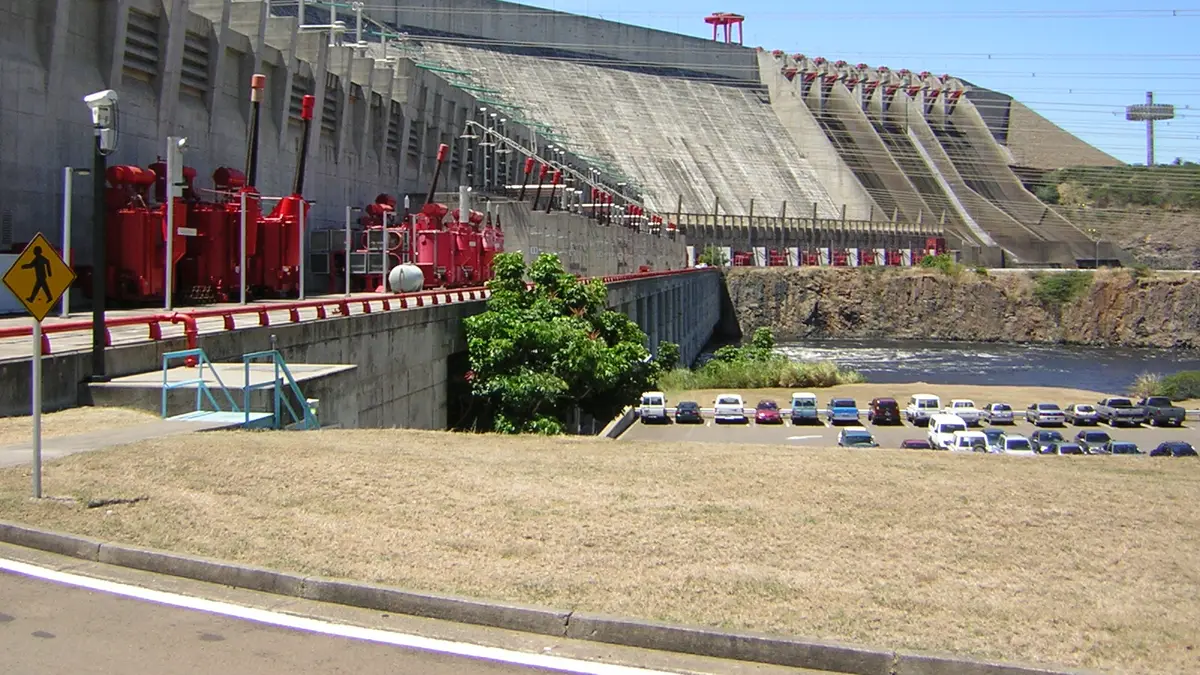
The countries that generate the most hydroelectricity
Hydropower is still the world's largest renewable source. In 2025 it generated 4,432 TWh, 14% of global electricity, with 1,296 GW installed, according to Ember. China produces almost a third:
| # | Country | Hydro generation 2025 |
|---|---|---|
| 1 | China | 1,394.8 TWh |
| 2 | Brazil | 388.6 TWh |
| 3 | Canada | 344.7 TWh |
| 4 | United States | 241.7 TWh |
| 5 | Russia | 199.7 TWh |
| 6 | India | 178.0 TWh |
| 7 | Norway | 144.8 TWh |
| 8 | Vietnam | 102.4 TWh |
| 9 | Japan | 73.9 TWh |
| 10 | Sweden | 68.2 TWh |
| — | Chile | 19.7 TWh |
Source: Ember, Yearly Electricity Data, 2025. Venezuela, which generated 73 TWh in 2024, has no complete 2025 data. Countries that generate almost all their electricity from water, such as Paraguay and Norway, are in our ranking of countries with the most renewable energy.
The largest hydroelectric power station in Chile: Ralco
Ralco, owned by Enel, on the upper Biobío River in the municipality of Alto Biobío, is Chile's largest hydroelectric plant, with 690 MW in two Francis turbines. It entered service in 2004, after a long conflict with Pehuenche families over the flooding of their land. Downstream is Pangue, at 467 MW. The Alto Maipo complex, in the Cajón del Maipo, has 531 MW across its Alfalfal II and Las Lajas plants.
Chile has 7.6 GW of hydro capacity, according to Ember, but its output depends on rain and snow. In 2025 it generated 19.7 TWh, 22.2% of the country's electricity, compared with 26.0 TWh in 2024, because of a drier year. Drought is one of the reasons the country bet on solar and wind power over the past decade.
Hydro, solar, wind and batteries: energy's records
Large dams are still the world's biggest power plants by capacity, but variable renewables are catching up. The largest wind complex, in Hami (China), exceeds 10,000 MW, as we detailed in our ranking of the largest wind farms, and the largest battery systems already measure their capacity in gigawatt-hours, as shown in our ranking of the largest batteries in the world.
The difference is that a hydro plant with a reservoir stores energy as water and delivers it when needed, something solar and wind achieve only with batteries. That is why dams and pumped-storage plants will remain a key part of renewable power systems.
Methodology
The ranking includes conventional hydroelectric power stations in operation, ordered by nominal installed capacity, according to Wikipedia's list and operator data, accessed on 22 October 2026. It does not include pure pumped-storage plants or projects under construction. Country generation data are from Ember (2025).
Does your company work in hydroelectric or renewable generation? Reach Energía Futura's readers.
See advertising optionsFrequently asked questions
What is the largest hydroelectric power station in the world?
Three Gorges, in China, with 22,500 MW of installed capacity.
What is the largest hydroelectric plant in Latin America?
Itaipu, on the Brazil-Paraguay border, with 14,000 MW. It is followed by Belo Monte (11,233 MW) and Guri (10,235 MW).
What is the largest hydroelectric power station in Chile?
Ralco, in Alto Biobío, with 690 MW, operated by Enel since 2004.
Which plant will surpass Three Gorges?
Medog, in Tibet, under construction since July 2025, with a planned 60,000 MW.
How to cite this data
Energía Futura (2026). The largest hydroelectric power station in the world 2026: ranking of the biggest dams. Based on Wikipedia, China Three Gorges Corporation, Itaipu Binacional, Norte Energia, Enel and Ember. Available at https://energiafutura.cl/en/news/the-largest-hydroelectric-power-station-in-the-world-2026-ranking-of-the-biggest-dams. The cover chart may be reproduced crediting Energía Futura and linking to this page.