A household washing machine generally uses between 0.3 and 1.5 kWh per load, and most of that energy goes not to the motor but to the element that heats the water. A real example: the Samsung WW90CGC04DTE, a 9 kg front-loader, declares in its European product sheet 0.444 kWh per cycle on the eco 40-60 programme, with 50 litres of water, according to the EU's EPREL database.
With 14 loads a month and electricity at 255.27 pesos per kWh (CGE's price in cities such as Rancagua or Concepción since October 2026), a washing machine costs between 1,200 and 5,400 pesos a month in electricity, depending on temperature and type of machine. Here is the calculation, how many watts a washing machine uses and what changes between front-loaders and top-loaders.
How many watts does a washing machine use
A washing machine's power is not constant during the cycle. It has three very different loads, which is why the wattage on the rating plate does not tell you what you will pay:
| Wash stage | What uses power | Typical power | Weight in total consumption |
|---|---|---|---|
| Water heating | Electric element | 1,800 to 2,400 W | The largest, if washing with hot water |
| Washing (slow spin) | Motor | 150 to 500 W | Low |
| Spin | Motor at high speed | 300 to 800 W | Low to medium |
| Standby or end of programme | Electronics | Less than 1 W | Minimal |
In practice, the rating plate of a washing machine with a heater shows a maximum power close to 2,000 W. But that power is used only for the minutes the water is being heated. If you wash cold, the machine barely goes above a few hundred watts.
How much electricity a washing machine uses per load
Real labels show the range. In Europe, the official sheet gives kWh per cycle; in Colombia, the Retiq label gives kWh per month based on 14 cycles. These are three Samsung examples with data published by the brand:
| Model | Type | Declared consumption | kWh per load | Water per load |
|---|---|---|---|---|
| Samsung WW90CGC04DTE (9 kg) | Front-loader with heater | 0.444 kWh/cycle (eco 40-60, EU) | 0.44 | 50 L |
| Samsung WF22K6500AV (22 kg) | Front-loader with heater | 4.6 kWh/month (14 cycles, Colombia) | ~0.33 | 50 L |
| Samsung WA22B3554GV1 (22 kg) | Top-loader, impeller | 8 kWh/month (14 cycles, Colombia) | ~0.57 | 220 L |
The Colombian labels are on Samsung's website: the one for the WF22K6500AV and the one for the WA22B3554GV1. In Chile, washing machines are sold with the energy efficiency label overseen by the SEC, which shows energy and water use per wash.
Hot water: what uses the most energy in a washing machine
The physics is simple: heating one litre of water by one degree takes 1.163 Wh. With that you can calculate how much a machine uses to heat 15 litres of water from 15 °C, a typical amount for the wash phase of a front-loader. These are Energía Futura calculations, excluding the motor:
| Programme temperature | Energy to heat 15 L from 15 °C | Cost per load | Cost per month (14 loads) |
|---|---|---|---|
| Cold water (no heating) | 0 kWh | 0 pesos (motor only) | Motor only |
| 30 °C | 0.26 kWh | ~67 pesos | ~940 pesos |
| 40 °C | 0.44 kWh | ~111 pesos | ~1,560 pesos |
| 60 °C | 0.78 kWh | ~200 pesos | ~2,800 pesos |
| 90 °C | 1.31 kWh | ~335 pesos | ~4,680 pesos |
The difference is huge: a 90 °C wash uses three times more electricity than one at 40 °C, and washing cold removes almost all the heater's cost. Today's detergents are designed to work well at 30 or 40 °C, and most everyday clothes do not need more.
How much a washing machine costs per month
Adding heating, motor and spin, these are the monthly cost ranges with 14 loads and electricity at 255.27 pesos per kWh:
| Type of use | kWh per load (approx.) | kWh per month | Cost per month |
|---|---|---|---|
| Front-loader, cold programmes | 0.1 to 0.2 | 1.4 to 2.8 | 360 to 710 pesos |
| Efficient front-loader, eco 40-60 | 0.33 to 0.44 | 4.6 to 6.2 | 1,180 to 1,590 pesos |
| Top-loader with mains water (Samsung WA22B3554GV1) | ~0.57 | 8 | ~2,040 pesos |
| Frequent 60 °C programmes | 0.9 to 1.0 | 12.6 to 14 | 3,200 to 3,600 pesos |
| Frequent 90 °C programmes | 1.4 to 1.5 | 19.6 to 21 | 5,000 to 5,400 pesos |
Compared with other appliances, a washing machine uses little. An average home in Chile uses about 180 kWh a month, according to the National Energy Commission, and a washing machine on warm programmes accounts for 3% to 4% of that. What really drives the bill up is the dryer: one drying cycle can use more than several washes, as we explain in how much a clothes dryer costs to run.
How much a washing machine costs per year
Over a year, with 168 loads (14 a month), the difference between washing cold and washing hot becomes clearer. These are Energía Futura calculations at 255.27 pesos per kWh:
| Type of use | kWh per year | Cost per year |
|---|---|---|
| Front-loader, cold programmes | 17 to 34 kWh | 4,300 to 8,600 pesos |
| Efficient front-loader, eco 40-60 | 55 to 74 kWh | 14,100 to 19,000 pesos |
| Top-loader (Samsung 22 kg example) | 96 kWh | ~24,500 pesos |
| Frequent 90 °C programmes | 235 to 252 kWh | 60,000 to 64,300 pesos |
Washing almost always at 90 °C can cost between 41,000 and 50,000 pesos more per year than using the eco programme, in electricity alone.
Front-loader or top-loader: which uses less
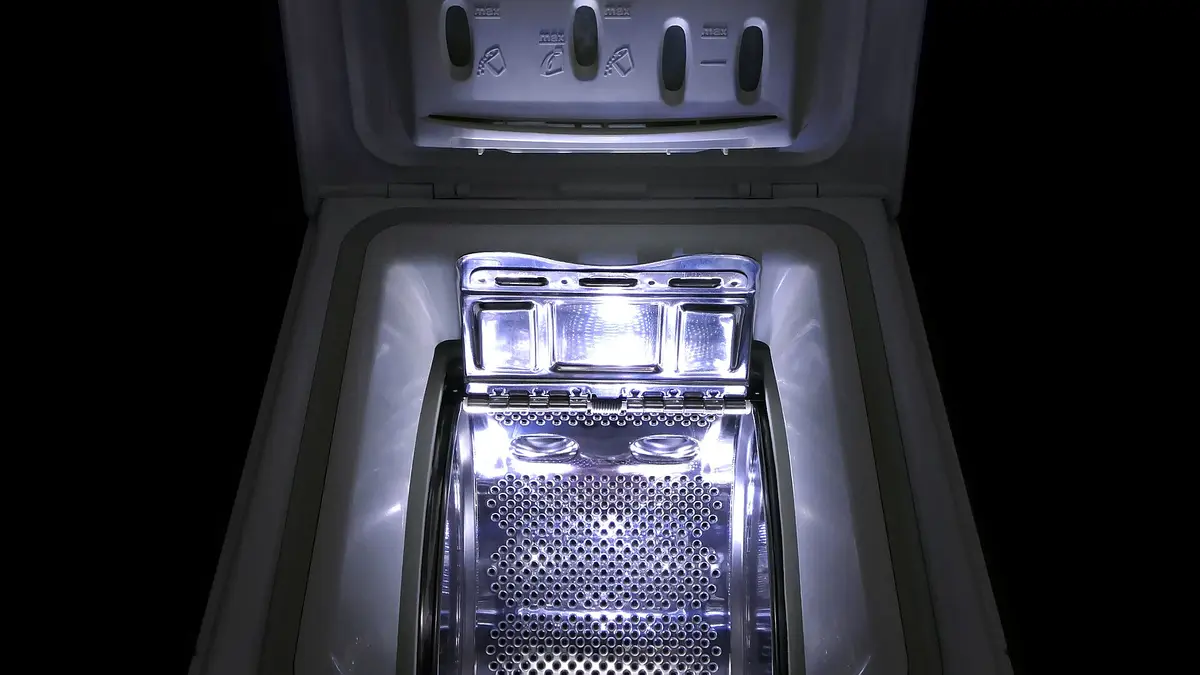
Top-loaders are very popular in Chile and usually have no heater: they fill with mains water or hot water from the gas water heater. Their electricity use is low, but they use much more water. Front-loaders use less water and have their own heater, so their consumption depends on the chosen temperature.
| Feature | Front-loader | Impeller top-loader |
|---|---|---|
| Water per wash | ~50 L (Samsung examples) | ~220 L (22 kg Samsung example) |
| Heating | Own heater | Mains water or gas water heater |
| Typical electricity use | 0.3 to 1.5 kWh depending on temperature | ~0.5 kWh (motor and pump) |
| Spin | Faster (up to 1,400 rpm) | Slower |
| Fabric care | Gentler | More friction |
A key point: if a top-loader uses hot water from a gas or electric water heater, that cost does not show on the electricity bill, but it does on the gas bill or in the water heater's consumption. If you heat water electrically, see how much an electric water heater uses, because that may be the real cost of washing.
How to cut your washing machine's consumption
- Wash cold or at 30 °C: the change that saves the most; it removes most of the heater's consumption.
- Use the eco programme: it takes longer but heats the water less and makes up for it with soaking time.
- Fill the drum: two half loads use almost twice as much as one full load.
- Spin at high speed if you will tumble dry: clothes come out with less water and drying uses less.
- Clean the filter and use the right amount of detergent: excess foam forces extra rinsing.
- Wash during sunny hours if you have solar panels: your own energy is the cheapest.
- When buying, compare labels: at equal capacity, check energy and water use per wash; the difference is paid over the machine's whole life.
The price per kWh varies by city: in CGE areas it ranges from 240.83 to 285.56 pesos. To adjust these calculations, see the price per kWh by city and utility and multiply it by your washing machine's kWh. For the bigger picture, see how much electricity a house in Chile uses per month.
Do you sell washing machines or efficient appliances? Reach Energía Futura readers who compare consumption before buying.
See advertising optionsFrequently asked questions
How many watts does a washing machine use?
With a heater, maximum power is around 2,000 W while heating water. When washing and spinning, the motor uses 150 to 800 W.
How much electricity does a washing machine use per load?
Between 0.3 and 1.5 kWh, depending on temperature. An efficient front-loader on the eco 40-60 programme uses about 0.44 kWh, around 111 pesos per load.
How much does a washing machine cost per month?
With 14 loads a month, between 1,200 and 5,400 pesos in electricity, depending on temperature. Washing cold, it can fall below 1,000 pesos.
Which uses more, a washing machine or a dryer?
The dryer. One cycle of a vented dryer can use several times what a warm wash uses.
Do top-loaders use less electricity?
They usually use less electricity because they do not heat water, but in the 22 kg Samsung example they use over four times more water per wash (220 L vs. 50 L).