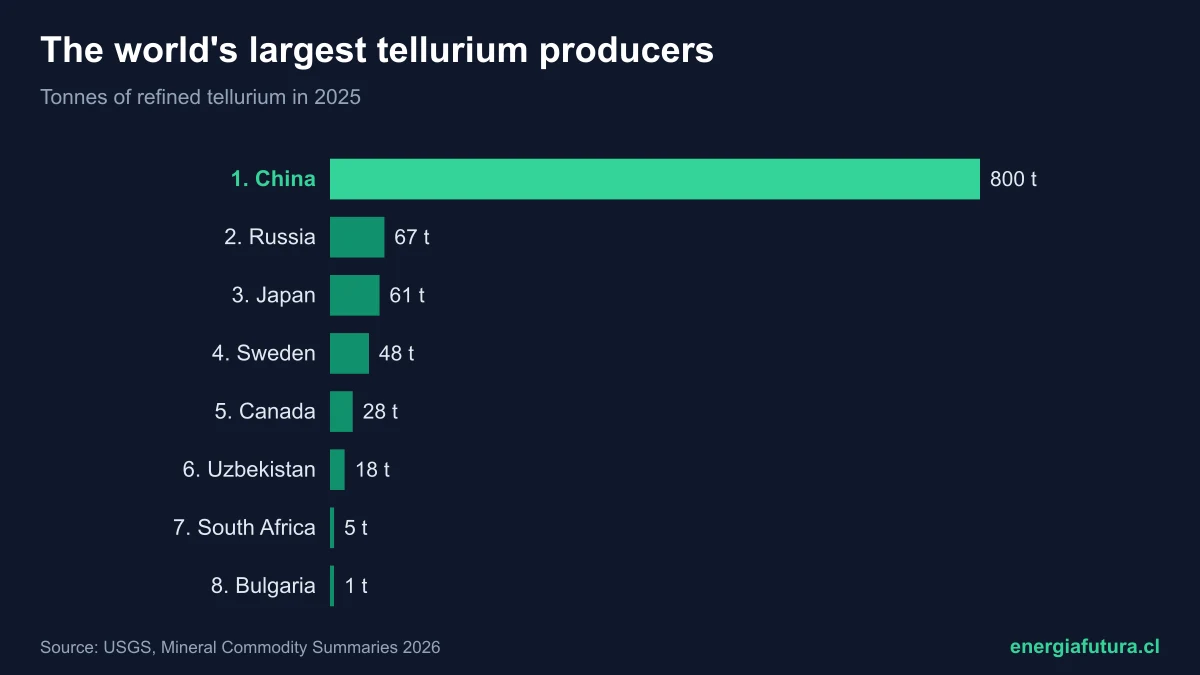
Updated on 28 November 2026. China is the world's largest tellurium producer: it refined about 800 tonnes in 2025, 80% of estimated world output of 1,000 tonnes, according to the USGS Mineral Commodity Summaries 2026, published in February 2026 by the US Geological Survey. Far behind come Russia (67 t), Japan (61 t) and Sweden (48 t).
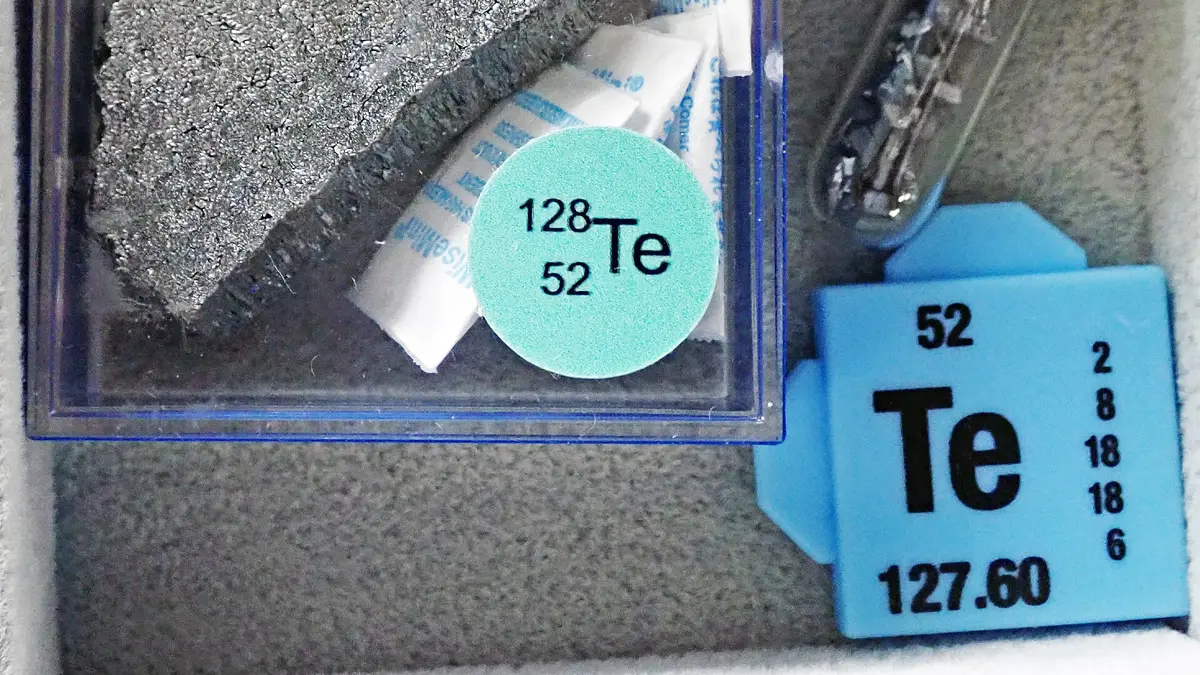
Tellurium is one of the scarcest elements in the Earth's crust and is hardly ever mined on its own: more than 90% is obtained as a by-product of copper refining. Its main use is solar power: 70% of world consumption in 2025 went into cadmium telluride (CdTe) cells, the thin-film technology made by US manufacturer First Solar. In 2025, China's export controls pushed its price in Europe up 84%, to US$150 per kilogram.
View the data as a table
| World refined output | 1,000 t |
| China's share | 80% |
| Used in solar cells | 70% |
| Price in Europe | US$150/kg |
Ranking of the largest tellurium producers in the world
| # | Country | 2024 (t) | 2025 (t) | % of world 2025 | Refinery capacity (t) |
|---|---|---|---|---|---|
| 1 | China | 750 | 800 | 80.0% | 1,000 |
| 2 | Russia | 64 | 67 | 6.7% | 80 |
| 3 | Japan | 70 | 61 | 6.1% | 75 |
| 4 | Sweden (concentrate) | 46 | 48 | 4.8% | 50 |
| 5 | Canada | 27 | 28 | 2.8% | 30 |
| 6 | Uzbekistan | 18 | 18 | 1.8% | 50 |
| 7 | South Africa | 5 | 5 | 0.5% | 10 |
| 8 | Bulgaria | 1 | 1 | 0.1% | 5 |
| — | World (excl. US) | 980 | 1,000 | 100% | 1,300 |
Source: USGS, Mineral Commodity Summaries 2026: Tellurium. Estimated figures for refined tellurium. The United States produces copper telluride at two refineries, in Texas and Utah, but the USGS withholds the figure to avoid disclosing company data. The USGS adds that Australia, Belgium, Chile, Germany, India, Indonesia, South Korea and the Philippines may have produced refined tellurium, but it lacks enough information to estimate how much.
View the data as a table
| China | 800 t |
| Russia | 67 t |
| Japan | 61 t |
| Sweden | 48 t |
| Canada | 28 t |
| Uzbekistan | 18 t |
| South Africa | 5 t |
| Bulgaria | 1 t |
China, the largest tellurium producer in the world
China's tellurium output has grown strongly over the last decade, in step with its copper refining capacity: according to the USGS, the country's electrolytic copper refining capacity rose almost 75% in ten years and its copper anode capacity, the feedstock, more than doubled. Since tellurium comes from those refineries' residues, more refined copper in China means more tellurium. The same happens with other copper by-products, as we explain in the ranking of the largest copper producers.
China's figures have gone through major revisions. The USGS 2024 edition estimated 430 tonnes for China in 2023, a 67% share; the 2025 edition raised that same year's figure to 725 tonnes. The series therefore shows a jump in 2023 that is largely explained by a better estimate, not only by a real increase in output.
View the data as a table
| World | China | |
|---|---|---|
| 2018 | 460 t | 280 t |
| 2019 | 520 t | 325 t |
| 2020 | 562 t | 330 t |
| 2021 | 610 t | 330 t |
| 2022 | 584 t | 380 t |
| 2023 | 944 t | 725 t |
| 2024 | 980 t | 750 t |
| 2025 | 1,000 t | 800 t |
There is room to produce more. According to the USGS, world tellurium refining capacity is about 1,300 tonnes a year, and around 77% of it was used in 2025. China runs at 80% of its 1,000-tonne capacity; Uzbekistan, by contrast, produced 18 tonnes with a capacity of 50, and Russia 67 with a capacity of 80. Because tellurium depends on copper, output cannot rise much unless the copper refining that generates the residues it comes from rises too.
Tellurium's role in solar panels
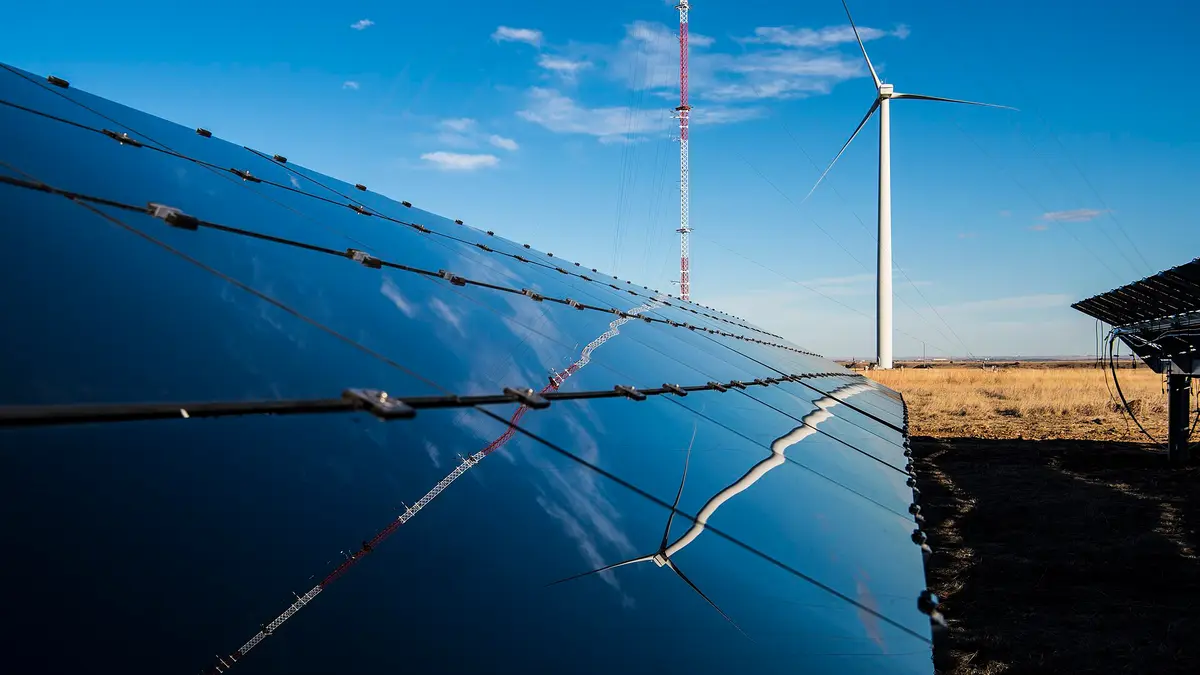
Cadmium telluride (CdTe) panels are the main alternative to silicon ones. Instead of silicon wafers, they use a very thin CdTe layer deposited on glass. It is the technology of First Solar, the largest panel maker in the United States, which in 2025 produced 16.1 GW of modules (10 GW in the United States and 6.1 GW in other countries) and sold 17.5 GW, according to its 2025 annual report.
The USGS notes that in August 2025 First Solar opened its fifth factory in the United States, due to start production at the end of 2026, and that the company expects to make up to 14 GW a year in that country alone at full capacity. That growth explains why solar's share of tellurium use rose from 40% of world consumption in 2023 to 70% in 2025, according to the USGS 2024 and 2026 editions. The other uses are bismuth telluride thermoelectric devices, which cool or generate electricity (15%), and metallurgy (10%).
View the data as a table
| Solar cells | Thermoelectrics | Metallurgy | Rubber | Other | |
|---|---|---|---|---|---|
| 2023 | 40 | 30 | 15 | 5 | 10 |
| 2025 | 70 | 15 | 10 | 0 | 5 |
Compared with silicon panels, which make up the vast majority of the market, CdTe is a niche, but a large one: First Solar ranks 12th in our list of the largest solar panel manufacturers, with 17.5 GW sold in 2025. Silicon has its own supply chain, which we review in the ranking of the largest silicon producers.
Tellurium prices: the 2025 jump
Since February 2025, Chinese tellurium exporters must submit documents to the government verifying who will use the metal and for what. According to the USGS, a licence takes 45 days on average and a new one is needed if the buyer or use changes. In Europe, these controls sharply limited supply: the annual average price in Rotterdam rose 84%, from US$81.54 per kilogram in 2024 to about US$150 in 2025. In US warehouses it rose 60%, from US$74.77 to US$120.
| Year | Europe (US$/kg) | US (US$/kg) |
|---|---|---|
| 2020 | 56.05 | 59.37 |
| 2021 | 67.26 | 69.72 |
| 2022 | 68.10 | 70.34 |
| 2023 | 76.74 | 79.09 |
| 2024 | 81.54 | 74.77 |
| 2025 | 150 | 120 |
Source: USGS, Mineral Commodity Summaries 2025 and 2026, with Argus Media data. Europe: minimum 99.99% purity, in warehouse in Rotterdam. US: minimum 99.95% purity. 2025 figures are estimates.
View the data as a table
| Europe (Rotterdam, 99.99%) | US (99.95%) | |
|---|---|---|
| 2018 | US$74 | US$80 |
| 2019 | US$60 | US$68 |
| 2020 | US$56 | US$59 |
| 2021 | US$67 | US$70 |
| 2022 | US$68 | US$70 |
| 2023 | US$77 | US$79 |
| 2024 | US$82 | US$75 |
| 2025 | US$150 | US$120 |
It is not the only solar panel metal hit by Chinese controls: something similar happened with antimony, used in solar glass, as we explain in the ranking of the largest antimony producers.
Tellurium reserves: why they are no longer published
Until the 2025 edition, the USGS published tellurium reserves by country, calculated mainly from the tellurium contained in copper reserves. The last estimate totalled 35,000 tonnes worldwide: 5,800 in Russia, 3,800 in the United States, 3,100 in China, 900 in Canada, 800 in South Africa, 740 in Sweden and 20,000 in "other countries". In the 2026 edition, the USGS stopped publishing them: it says tellurium reserves are not reported at the mine or country level and cannot be reliably quantified.
Chile, as the world's largest copper producer, has tellurium in its ores, but the USGS does not estimate how much it refines. It lists Chile among the countries that may produce refined tellurium, without enough data. Tellurium can also be recovered from CdTe panels at the end of their life: in the United States it is already recycled, though in small amounts, because most of those panels are still new, according to the USGS.
| China | 750 | 800 | 1,000 | 80.0 |
| Russia | 64 | 67 | 80 | 6.7 |
| Japan | 70 | 61 | 75 | 6.1 |
| Sweden | 46 | 48 | 50 | 4.8 |
| Canada | 27 | 28 | 30 | 2.8 |
| Uzbekistan | 18 | 18 | 50 | 1.8 |
| South Africa | 5 | 5 | 10 | 0.5 |
| Bulgaria | 1 | 1 | 5 | 0.1 |
How to cite this data
Energía Futura (2026). "Largest tellurium producers in the world 2026: country ranking, reserves and its role in solar panels". Updated on 28 November 2026. energiafutura.cl/en/news/largest-tellurium-producers-in-the-world-2026-country-ranking-reserves-and-its-role-in-solar-panels. Data: USGS, Mineral Commodity Summaries 2020 to 2026, and First Solar.
Does your company sell panels or develop solar projects? Reach Energía Futura's readers.
See advertising optionsFrequently asked questions
Which country produces the most tellurium?
China, with about 800 tonnes of refined tellurium in 2025, 80% of the world total, according to the USGS.
How much tellurium is produced worldwide?
About 1,000 tonnes of refined tellurium in 2025, excluding the United States, whose figure is withheld. World refining capacity is about 1,300 tonnes a year, according to the USGS.
What is tellurium used for?
Mainly cadmium telluride solar panels (70% of world consumption in 2025), thermoelectric devices (15%) and metallurgy (10%), according to the USGS.
Where does tellurium come from?
More than 90% comes from anode slimes in electrolytic copper refining. The rest comes from lead refinery skimmings and from flue dusts and gases from smelting bismuth, copper and lead-zinc ores.
How much does tellurium cost?
About US$150 per kilogram in Europe and US$120 in the United States as the estimated 2025 average, according to the USGS with Argus Media data.
Does Chile produce tellurium?
The USGS includes Chile among the countries that may have produced refined tellurium, but it lacks enough information to estimate how much.
Which solar panels use tellurium?
Cadmium telluride (CdTe) thin-film panels, whose main manufacturer is First Solar. Silicon panels, which make up most of the market, do not use tellurium.