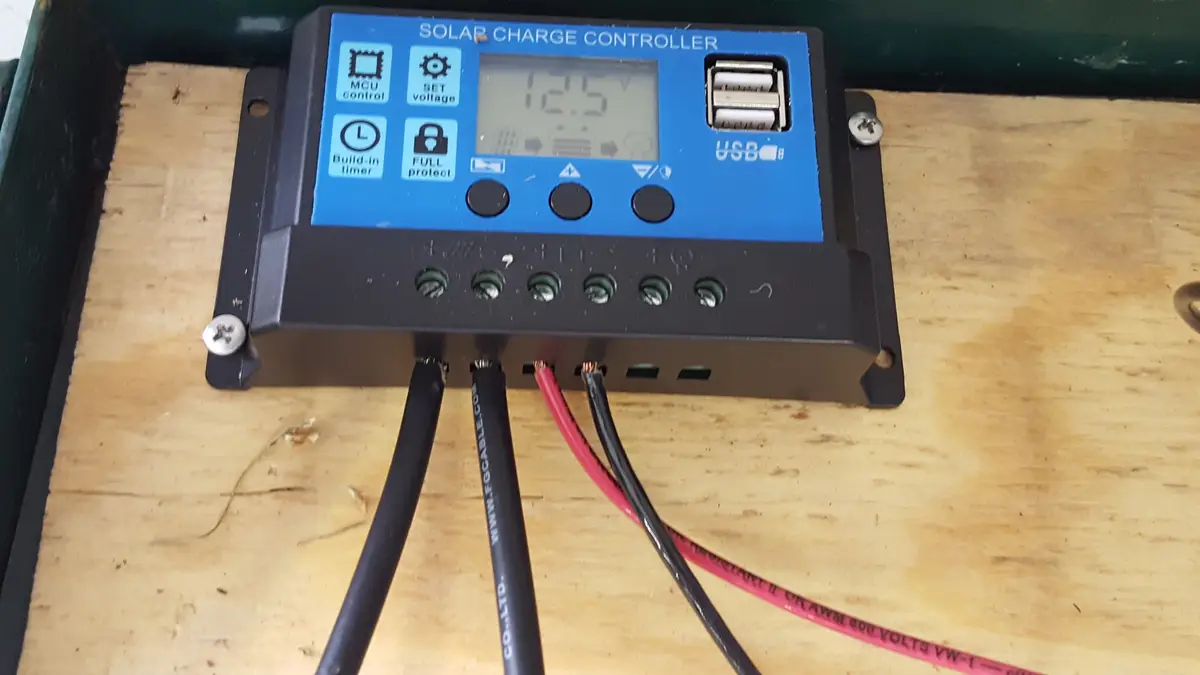
The solar charge controller, also called a charge regulator, sits between the panels and the battery in an off-grid system. It stops the battery from overcharging and, in more advanced models, gets more energy out of the panels. There are two types, PWM and MPPT, and the gap can be large: with a 100 W panel and a 12 V battery at 25 °C, an MPPT harvests 100 W and a PWM 81 W, that is, 19% less, according to the technical paper "Which solar charge controller: PWM or MPPT?" by Dutch manufacturer Victron Energy.
But the advantage is not constant: with very hot panels, the same paper shows the gap almost disappears. This guide explains how each controller works, which suits each system, how to size the amps and what they cost in Chile, with prices checked on 27 November 2026.
View the data as a table
| MPPT | 100 W |
| PWM | 81 W |
| MPPT efficiency | 98% |
What a solar charge controller does
A solar panel does not deliver a fixed voltage: a 36-cell panel, the typical 12 V type, produces its maximum power at around 18 V and reaches 21.6 V at open circuit, according to the specification Victron uses. A 12 V battery, by contrast, charges at roughly 13 to 15 V. Connecting the panel straight to the battery would overcharge it on sunny days and drain it at night. The controller cuts the current when the battery is full, prevents backflow into the panels and, on many models, powers 12 V lights or devices through its own output.
If you are just putting the system together, the controller goes hand in hand with the battery and the inverter. Our guide to 12, 24 or 48 V lithium batteries explains how many Ah each use needs.
PWM controller: cheap, but it wastes voltage
A PWM (pulse width modulation) controller is essentially a switch: it connects the panel to the battery and disconnects it in pulses as the battery fills up. While connected, the panel is forced to work at the battery's voltage. In Victron's example, with the battery at 13 V and half a volt lost in the cables, the panel runs at 13.5 V and delivers 6 A: 81 W out of the 100 W it could give.
MPPT controller: it tracks the maximum power point
An MPPT (maximum power point tracking) controller has a microprocessor that searches, second by second, for the voltage at which the panel performs best, and a converter that transforms that energy to the battery's voltage. In the example, it holds the panel at 18 V and 5.56 A (100 W) and charges the battery with 7.7 A at 13 V. The energy does not change, it is only converted, with an efficiency that in models such as the Victron SmartSolar 100/30 exceeds 98%.
The other big advantage is that MPPT allows panels to be wired in series, at a much higher voltage than the battery. Victron calculates that doubling the panel voltage halves the current, so the cable can have a quarter of the cross-section for the same losses. In large systems, that makes the installation cheaper.
PWM or MPPT: temperature changes the answer
When a panel heats up, its voltage drops: power and voltage fall by about 4.5% for every 10 °C, according to Victron. At a cell temperature of 75 °C, the maximum power voltage falls so close to the battery's that the PWM stops losing out: in that case the MPPT harvests 77.5 W and the PWM 77 W. Victron concludes that PWM performs almost as well as MPPT (within 10%) when cells are between 45 and 75 °C.
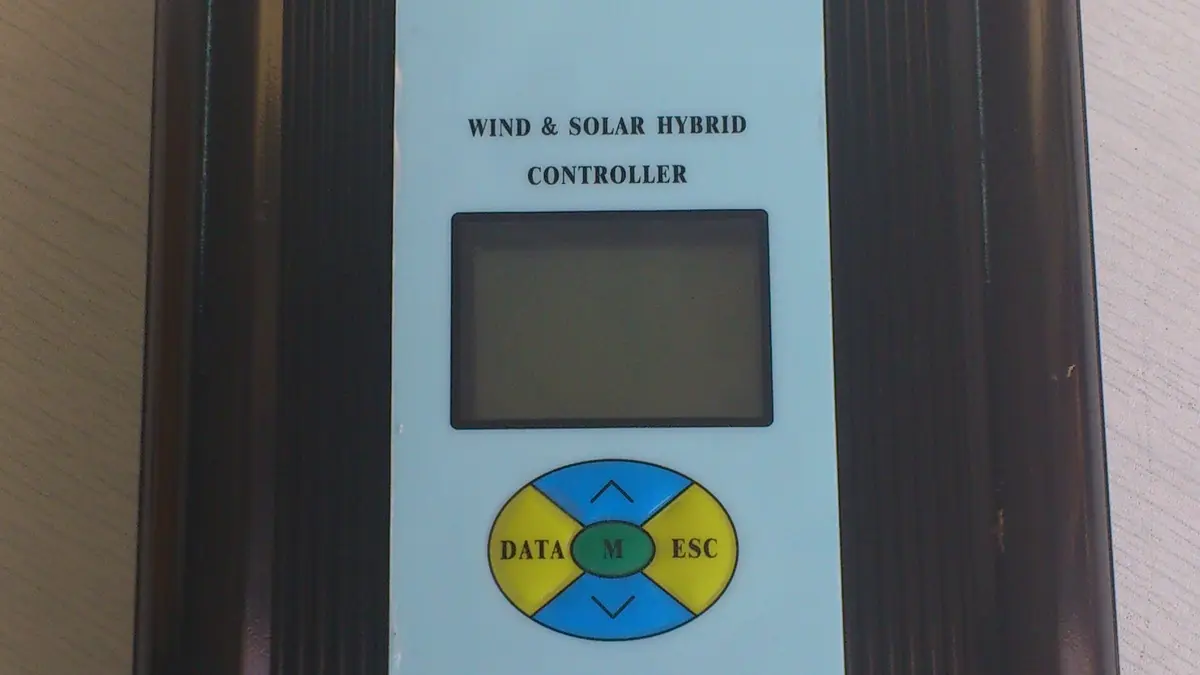
In practice, that means in northern Chile, with small panels and lots of heat, a PWM may be enough. MPPT wins in the cold, on cloudy days (in low light the panel voltage falls quickly), with partial shading and in systems of several hundred watts. Victron recommends switching to MPPT once the panels exceed a few hundred watts on 12 V batteries.
| Camping, boat or shed light | 1 panel of 100-200 W | PWM |
| Camper or small cabin | 200-400 W | MPPT (or PWM in hot weather) |
| Off-grid cabin or plot | Over 400 W | MPPT |
| Southern Chile, winter or shade | Any | MPPT |
| 60- or 72-cell rooftop panels | Any | MPPT (a PWM wastes voltage) |
How to size the amps of a solar charge controller
The basic rule is to divide the panel power by the battery voltage: amps = panel watts ÷ battery volts. With 1,000 W of panels, a 12 V battery needs an 83 A controller; a 24 V one, 42 A; and a 48 V one, 21 A. That is why large systems are built at 24 or 48 V: the same controller can handle twice or four times as many panels.
| Panels | 12 V battery | 24 V battery | 48 V battery |
|---|---|---|---|
| 200 W | 17 A → 20 A controller | 8 A → 10 A | 4 A → 10 A |
| 400 W | 33 A → 40 A | 17 A → 20 A | 8 A → 10 A |
| 800 W | 67 A → 80 A | 33 A → 40 A | 17 A → 20 A |
| 1,000 W | 83 A → 100 A | 42 A → 50 A | 21 A → 30 A |
| 2,000 W | 167 A (not advisable) | 83 A → 100 A | 42 A → 50 A |
Source: Energía Futura calculation (W ÷ V), rounded up to the next commercial size. Manufacturers also publish the panel power each unit accepts: the SmartSolar 100/30 takes 440 W at 12 V and 880 W at 24 V, according to its datasheet.
There is a second number that must not be exceeded: the maximum input voltage. Panel voltage rises in the cold; with the -0.35% per degree coefficient in Victron's specification, a panel rated at 21.6 V open circuit reaches about 24.2 V at -10 °C. If several are wired in series, the total on the coldest morning must stay below the controller's limit (for example, 100 V on the SmartSolar 100/30).
Solar charge controller prices in Chile
At Sodimac, PWM regulators of 10 to 60 A cost between CLP 16,000 and CLP 37,990. Branded MPPT units, such as the 40 A Epever, cost CLP 139,990 in the 12/24 V version and CLP 179,990 in the up-to-48 V version at full price. Beware of generic units advertised as "100 A MPPT" for under CLP 60,000: a genuine MPPT of that current is a large and much more expensive device, so check the specifications, the weight and the reviews before buying.
| PWM regulator 12/24 V 10 A with USB (Eoland) | PWM | 10 A | 16,000 | 16,000 |
| PWM regulator 12/24 V 30 A with USB | PWM | 30 A | 18,990 | 18,990 |
| Digital regulator 12/24 V 60 A with USB | PWM | 60 A | 37,990 | 35,990 |
| "MPPT" controller 100 A 12/24/36/48 V (generic) | MPPT* | 100 A | 56,990 | 30,990 |
| Epever MPPT controller 40 A 12/24 V | MPPT | 40 A | 139,990 | 125,991 |
| Epever MPPT controller 40 A 12/24/36/48 V | MPPT | 40 A | 179,990 | 161,991 |
| Controller | Type | Regular price | Discounted (27 Nov) |
|---|---|---|---|
| PWM regulator 12/24 V 10 A with USB | PWM | CLP 16,000 | CLP 16,000 |
| PWM regulator 12/24 V 30 A with USB | PWM | CLP 18,990 | CLP 18,990 |
| Digital regulator 12/24 V 60 A | PWM | CLP 37,990 | CLP 35,990 |
| Epever MPPT 40 A 12/24 V | MPPT | CLP 139,990 | CLP 125,991 |
| Epever MPPT 40 A 12/24/36/48 V | MPPT | CLP 179,990 | CLP 161,991 |
Source: Sodimac, prices checked on 27 November 2026.
Common installation mistakes
- Connecting the panels first: most manufacturers ask you to connect the battery first, so the controller detects whether it is 12, 24 or 48 V.
- Using 60- or 72-cell panels with a PWM: their voltage is far higher than the battery's and the PWM wastes it. Use an MPPT with them.
- Choosing a controller with no headroom: if the panels grow, the unit becomes too small. Leave a margin or pick one that supports 24 and 48 V.
- Forgetting the battery profile: LiFePO4 lithium and lead-acid batteries charge at different voltages; the controller must have the right profile.
- Thin, long cables: they lose energy. The shorter the run between controller and battery, the better.
If you want a more integrated solution, some units combine the MPPT, inverter and charger in one box; we explain them in our home solar kit guide.
To run 220 V appliances from the battery, see our guide to the 12 V to 220 V inverter.
Do you sell solar equipment or install off-grid systems? Reach Energía Futura's readers.
See advertising optionsFrequently asked questions
Which is better, PWM or MPPT?
MPPT harvests more energy: 19% more than a PWM with a 100 W panel at 25 °C, according to Victron Energy. With very hot panels the gap almost disappears, so PWM remains a cheap option for small systems in warm climates.
How many amps should the charge controller be?
Divide the panel power by the battery voltage. For 400 W and a 12 V battery that is 33 A, so a 40 A controller is advisable. With a 24 V battery, 20 A is enough.
Can a 12 V controller be used with a 24 V battery?
Only if the unit supports it. Many controllers automatically detect 12 or 24 V batteries, and some go up to 48 V. Check the specifications before buying.
How much does a solar charge controller cost in Chile?
At Sodimac, a 10 to 60 A PWM regulator costs CLP 16,000 to CLP 37,990, and a 40 A Epever MPPT CLP 139,990 to CLP 179,990 at full price, according to prices on 27 November 2026.
Can a solar panel be connected straight to the battery?
It is not advisable. Without a controller, the battery overcharges on sunny days and drains back into the panel at night. Only very small maintenance panels are sometimes connected without a regulator.