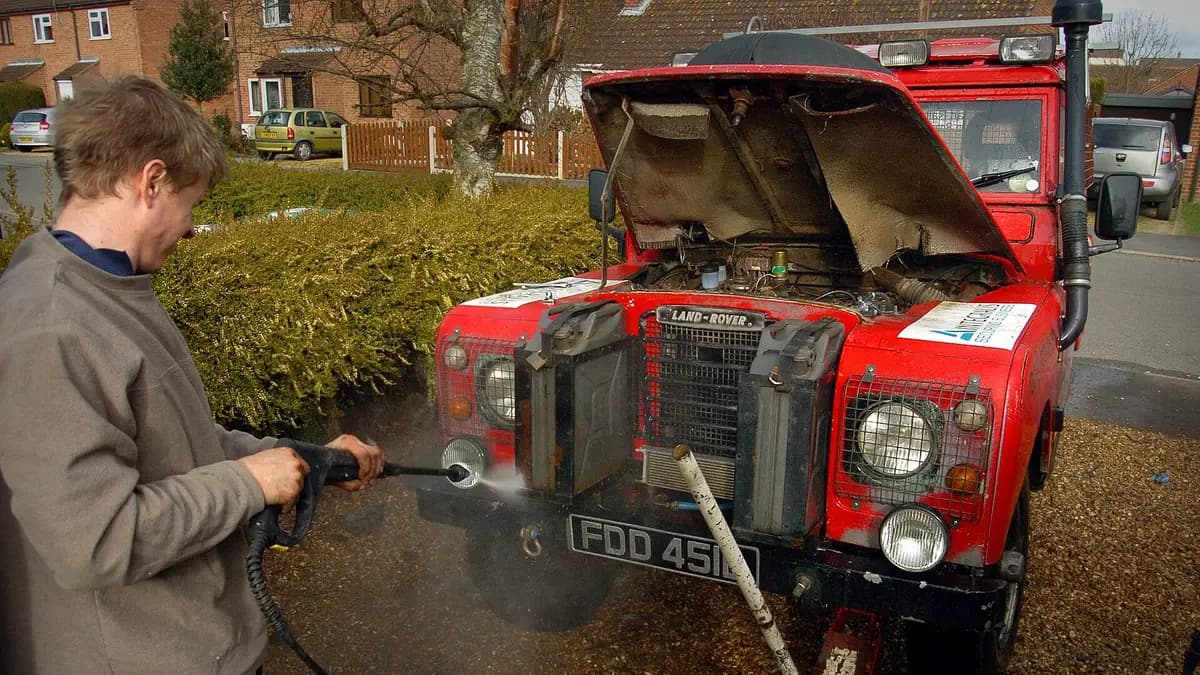
A household pressure washer such as the Kärcher K2, rated at 1,400 W, 110 bar and 360 litres per hour, costs about CLP 357 in electricity and CLP 498 in water for every hour of use, with power at CLP 255.27 per kWh (CGE's BT1 residential rate in Chile since October 1, 2026) and Aguas Andinas water at CLP 1,384 per m³ including drinking water and sewerage. Washing a car in 20 minutes costs around CLP 285 in total. In other words, with a pressure washer water weighs more on the bill than electricity.
This guide calculates how much a pressure washer uses according to its power and flow rate, what it costs to wash the car or the patio, whether it really saves water compared with a garden hose and what to buy: a corded electric unit, a cordless battery model, or one with more bar.
How much a pressure washer uses by model
A pressure washer has two costs: the electricity for the motor, which drives the high-pressure pump, and the water, which leaves the nozzle at a fixed flow rate. Both figures are on the spec sheet. According to Kärcher, the K 2 Power Control draws 1.4 kW, delivers up to 110 bar and 360 l/h, and cleans about 20 m² per hour. The K 5 Power Control, one step up, draws 2.1 kW, reaches 145 bar and 500 l/h, and covers 40 m² per hour.
Chilean retailers also sell their own brands. At Sodimac, for example, the Bauker line includes units rated at 1,700 W and 130 bar and 2,200 W and 160 bar, according to the store's listings checked on November 1, 2026. Among cordless models, Kärcher's K 2 Battery Set runs on a 36 V, 5.0 Ah battery, delivers 110 bar and 340 l/h, and lasts about 14 minutes per charge.
| Model | Power | Maximum pressure | Maximum flow | Performance |
|---|---|---|---|---|
| Kärcher K 2 Power Control | 1,400 W | 110 bar | 360 l/h | 20 m²/h |
| Kärcher K 5 Power Control | 2,100 W | 145 bar | 500 l/h | 40 m²/h |
| Kärcher K 2 Battery Set (cordless) | 36 V, 5.0 Ah battery (180 Wh) | 110 bar | 340 l/h | 14 minutes per charge |
| Bauker 1,700 W (Sodimac) | 1,700 W | 130 bar | Not stated in the listing | — |
| Bauker 2,200 W (Sodimac) | 2,200 W | 160 bar | Not stated in the listing | — |
Sources: Kärcher spec sheets (Spain and Ireland) and Sodimac Chile listings, checked on November 1, 2026. Battery energy (180 Wh) is Energía Futura's calculation: 36 V times 5 Ah.
What a pressure washer costs in Chilean pesos for electricity and water
The electricity cost is power times hours of use times the price per kWh. The water cost is flow rate times time times the tariff. For water we use Aguas Andinas Group 1 (Greater Santiago), whose tariff sheet, in force for meter readings since May 11, 2026, charges CLP 611.48 per m³ of drinking water in the off-peak period and CLP 772.93 per m³ for sewerage, VAT included. In total, CLP 1,384.41 per m³, or CLP 1.38 per litre.
| Model | Electricity per hour | Water per hour | Total per hour of use |
|---|---|---|---|
| K 2 Power Control (1.4 kW; 360 l/h) | CLP 357 | CLP 498 | CLP 856 |
| K 5 Power Control (2.1 kW; 500 l/h) | CLP 536 | CLP 692 | CLP 1,228 |
| K 2 Battery Set (one 14-minute charge) | CLP 51 per recharge | CLP 110 | CLP 161 per charge |
| Garden hose (about 1,500 l/h) | CLP 0 | CLP 2,077 | CLP 2,077 |
Energía Futura calculations with power at CLP 255.27 per kWh and water at CLP 1,384.41 per m³ (Aguas Andinas Group 1, off-peak period), rounded. The battery recharge assumes about 0.2 kWh, including charger losses. The hose flow rate is the one Kärcher Australia uses in its comparisons: 25 litres per minute. In the peak period (December to March), drinking water drops to CLP 605.25 per m³, but consumption above the overuse threshold is charged at CLP 1,737.17 per m³.
The price per kWh varies by municipality and distribution company, as shown in the guide to the price per kWh in Chile by city and utility. With a more expensive kWh, the electricity cost rises in the same proportion; the water cost depends on each city's water utility.
What it costs to wash the car or the patio
In practice, what matters is the cost of each job. The table uses typical household times and, for surfaces, the area performance in m² per hour that Kärcher lists on its spec sheets.
| Job | Equipment and time | Electricity | Water | Total |
|---|---|---|---|---|
| Washing a car | K 2, 20 minutes | CLP 119 | CLP 166 | CLP 285 |
| Washing a car | Hose, 20 minutes | CLP 0 | CLP 692 | CLP 692 |
| 20 m² patio | K 2, 1 hour | CLP 357 | CLP 498 | CLP 856 |
| 20 m² patio | K 5, 30 minutes | CLP 268 | CLP 346 | CLP 614 |
| Garden furniture | Pressure washer, 2.5 minutes and 20 litres | About CLP 15 | CLP 28 | About CLP 43 |
Energía Futura calculations, rounded. The garden furniture case uses Kärcher's example: 2.5 minutes and about 20 litres with a pressure washer, versus 5 minutes and up to 100 litres with a hose.
The surprising figure is the patio: the K 5, with more power and flow, ends up cheaper per m² than the K 2, because it cleans twice the area per hour and is switched on for less time. On the other hand, for a job that takes the same time with any unit, such as rinsing a car, the more powerful model costs more.
Does a pressure washer save water compared with a hose?
Yes, quite a lot. Kärcher says its pressure washers use up to 80% less water than a hose, assuming the unit's flow is 40% of the hose's and the job takes half the time. With the figures in this guide, washing a car with the K 2 uses 120 litres, versus 500 litres with a hose left running for the same 20 minutes. Even adding electricity, the pressure-washer wash costs less than half.
Does your company sell cleaning equipment, power tools or water and energy saving solutions? Reach Energía Futura's readers.
See advertising formatsCorded or cordless pressure washer: which to choose
The corded electric pressure washer is the most common option and the cheapest per hour of work. It suits patios, facades, cars and any long job near a socket. Its limit is mobility: it needs a socket and a tap nearby, and an extension cord suited to its power.
The cordless model is more expensive per litre of work, because the battery runs out quickly: the K 2 Battery's 14 minutes are enough to rinse a car or a few bicycles, not a whole patio. Its advantage is that it works where there is no socket, such as a parking space or a rural plot. Low-pressure units such as the Kärcher OC 3 deliver about 2 litres per minute, run for about 15 minutes and are good for cleaning bikes, pets or camping gear, but they do not replace a pressure washer.
On a rural plot, an alternative is to draw water from a tank: Kärcher says its K 4 and K 5 classes can suck water from a container, for example a rainwater tank. If the water comes from a well, the guide to how much electricity a water pump uses helps add up that cost.
What power and how many bar to choose
- Occasional use (car, bicycles, garden furniture): a K 2 class unit, of about 1,400 W, 110 bar and 360 l/h, is enough and costs the least per hour.
- Patios, yards and walls: a K 4 or K 5 class unit, of 1,800 to 2,100 W and 130 to 145 bar, cleans faster and ends up costing less per m².
- Places without a socket: a 36 V cordless model, knowing its runtime is around 14 minutes per charge.
- Look at the flow rate and the m²/h performance, not just the bar: flow defines how much water you pay for, and performance how long it will be switched on.
- Check the socket and the extension cord: a 2,100 W unit needs a heavy-gauge extension cord and a circuit without other large appliances connected.
How to use less water and electricity when washing
- Sweep or remove dust first: the pressure washer works for less time if it does not have to push loose dirt.
- Stop the water between passes: most units stop when you release the trigger; leaving it running unused only wastes water and electricity.
- Use the right nozzle: a rotating nozzle cleans hard surfaces faster.
- Wash in the late afternoon or early morning: with less sun, the water does not evaporate before rinsing.
- Avoid summer for big cleaning jobs: between December and March, consumption above the overuse threshold is charged at CLP 1,737.17 per m³ in Aguas Andinas Group 1.
- Measure the effect on the bill: washing the car four times a month with a K 2 adds up to about CLP 1,140; the guide to how much electricity a house in Chile uses per month helps compare that cost with the household total.
Frequently asked questions
How much electricity does a pressure washer use?
A household pressure washer draws between 1,400 and 2,200 W. With power at CLP 255.27 per kWh, it costs between CLP 357 and CLP 562 in electricity per hour of continuous use. Washing a car in 20 minutes with a 1,400 W unit costs about CLP 119 in electricity.
How much water does a pressure washer use?
Between 340 and 500 litres per hour for Kärcher's household units, according to its spec sheets. In Santiago, at Aguas Andinas rates, that costs between CLP 470 and CLP 692 per hour. A running hose can use about 1,500 litres per hour.
What costs more with a pressure washer, electricity or water?
Water. With a K 2, one hour of use adds up to about CLP 357 in electricity and CLP 498 in water in Greater Santiago, VAT included.
Is a cordless pressure washer worth it?
Only for short jobs or places without a socket. The K 2 Battery Set delivers the same pressure as a corded K 2, 110 bar, but its 36 V battery lasts about 14 minutes per charge.
How many bar do I need to wash a car?
A pressure washer of about 110 bar, such as the K 2 class, is enough for a car. More pressure does not wash the bodywork faster and, at close range, can damage the paint or decals.