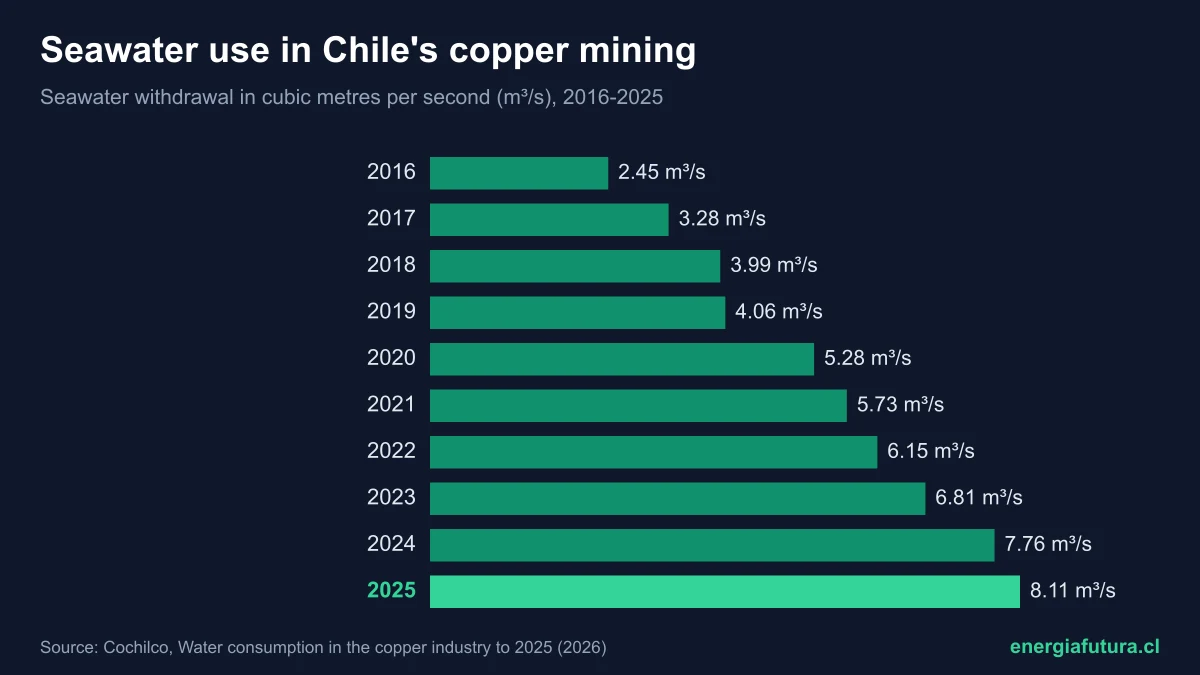
Updated on 26 October 2026. Copper mining in Chile drew 8.11 m³/s of seawater in 2025, 4.6% more than in 2024 and 231% more than in 2016, according to the report Water consumption in Chile's copper industry to 2025, published by Cochilco in 2026. Seawater now accounts for 36.8% of all the water withdrawn by mines, and 70.4% of it is desalinated before use.
The report is based on the Mining Survey on Production, Water and Energy (EMPAE), which in 2025 covered 52 operations of 27 companies, 100% of the country's fine copper output. Its methodology is aligned with the water reporting guide of the International Council on Mining and Metals (ICMM).
Seawater in Chilean mining, year by year
| Year | Seawater (m³/s) | Freshwater (m³/s) |
|---|---|---|
| 2016 | 2.45 | 13.36 |
| 2017 | 3.28 | 13.07 |
| 2018 | 3.99 | 13.35 |
| 2019 | 4.06 | 11.68 |
| 2020 | 5.28 | 12.04 |
| 2021 | 5.73 | 12.01 |
| 2022 | 6.15 | 11.90 |
| 2023 | 6.81 | 12.02 |
| 2024 | 7.76 | 14.98 |
| 2025 | 8.11 | 13.94 |
Source: Cochilco, chart 4 of the water report to 2025 (operational withdrawal). The freshwater jump in 2024 reflects higher inflows from rain and runoff; in 2025 it fell 7.0%.
In 2025, desalinated seawater reached 5.71 m³/s and untreated seawater 2.40 m³/s. 74% of seawater is the miners' own supply and 26% is bought from third parties. Almost all of last year's growth came from desalinated water, up 0.28 m³/s, even though no new mining desalination plant came on stream in 2025: the increase came from using more of the existing capacity.
Copper mining's water balance in 2025
To size up seawater, it has to be seen within the full balance. The industry withdrew 22.05 m³/s, consumed 18.21 m³/s (water lost to evaporation, in tailings or embedded in the product) and reused 58.17 m³/s within its processes. Recirculation, at a rate of 72.5%, remains by far the main source of water for mines.
| Source or flow (2025) | m³/s | Share |
|---|---|---|
| Surface water | 5.33 | 24.2% of withdrawal |
| Groundwater | 5.52 | 25.1% of withdrawal |
| Water bought from third parties | 3.08 | 14.0% of withdrawal |
| Seawater | 8.11 | 36.8% of withdrawal |
| Total withdrawal | 22.05 | 100% |
| Operational consumption | 18.21 | 82.1% of outflows |
| Discharges | 3.96 | 17.9% of outflows |
| Reused and recirculated water | 58.17 | 72.5% of total use |
| Total water use | 80.22 | Withdrawal plus reuse |
Source: Cochilco (2026). Entrainment losses (44.8%) and evaporation (38.6%) account for most consumption. By process, concentration and tailings deposition make up 79.8% of operational consumption.
Where seawater is used in Chilean mining
99.6% of the seawater withdrawn by mining is used in four regions: Antofagasta, Tarapacá, Atacama and Coquimbo. Antofagasta accounts for 50.1% of all water withdrawn by the sector (11.05 m³/s) and is the only region where seawater already exceeds freshwater: 57.2% of its withdrawal comes from the ocean. At the other end, Valparaíso, the Metropolitan Region and O'Higgins still rely solely on freshwater; O'Higgins, home to El Teniente, ranks second in withdrawal, with 17.6%.
Mining's desalination plants
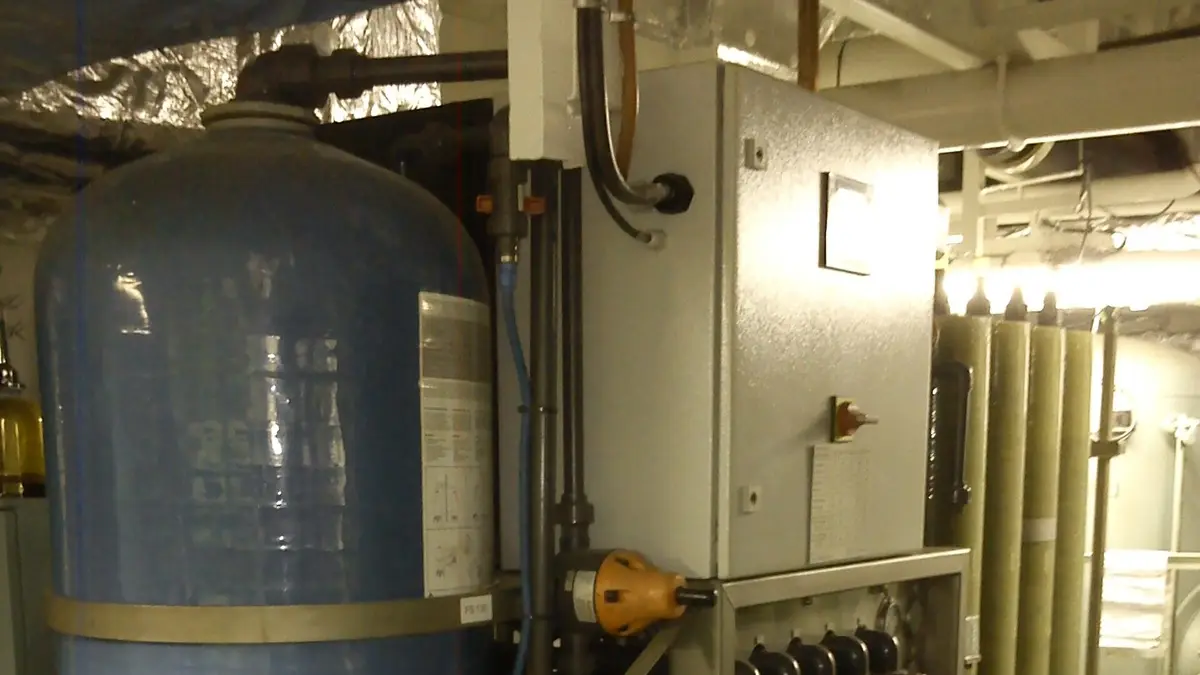
Cochilco's inventory shows how the infrastructure grew. The first large plant was Escondida's at Coloso (2006), but the leap came with the Escondida Water Supply (EWS), at 2,500 l/s, in 2018, the largest in the sector. It is followed by Spence (SGO), at 1,000 l/s (2021), and Quebrada Blanca, at 865 l/s with potential for 1,200 l/s (2023).
| Start-up | Owner | Plant or site | Region | Desalination (l/s) | Untreated seawater (l/s) |
|---|---|---|---|---|---|
| 2006 | BHP | Escondida (Coloso plant) | Antofagasta | 525 | - |
| 2010 | Antofagasta Minerals | Centinela District | Antofagasta | 50 | 920 |
| 2013 | Lundin Mining | Candelaria | Atacama | 500 | - |
| 2014 | Mantos Copper | Mantoverde | Atacama | 120 | - |
| 2014 | KGHM | Sierra Gorda | Antofagasta | - | 1,315 |
| 2015 | CAP Minería | CAP Minería and other clients | Atacama | 600 | - |
| 2017 | Antofagasta Minerals | Antucoya | Antofagasta | 30 | 280 |
| 2018 | BHP | Escondida Water Supply (EWS) | Antofagasta | 2,500 | - |
| 2021 | BHP | Spence Growth Option | Antofagasta | 1,000 | - |
| 2023 | Teck | Quebrada Blanca | Tarapacá | 865 (potential 1,200) | - |
| 2024 | Antofagasta Minerals | INCO / Los Pelambres | Coquimbo | 400 | - |
| 2024 | Capstone | Mantoverde Development | Atacama | Adds 260 | - |
Source: Cochilco, table 1 of the water report to 2025 (four small plants of 30 l/s or less are omitted). Sites such as Sierra Gorda and Centinela use large volumes of untreated seawater, an option that avoids the energy cost of reverse osmosis; it is also the one chosen by the Tovaku project, approved on 23 October.
What is coming: 2026 and 2027
The water demand projection report for 2025-2034 identifies 2026-2027 as a milestone because several projects arrive at once: the plant of Collahuasi's C20+ project, with 1,050 l/s and a 195 km pipeline; the Codelco Northern District desalination plant, with 840 l/s (expandable to 1,956 l/s) for Chuquicamata, Radomiro Tomic and Ministro Hales; Aguas Pacífico's Aconcagua project, which would deliver 500 l/s to Los Bronces; the 400 l/s expansion at Los Pelambres; and the SIAM II system at Nueva Centinela, with 652 l/s of untreated seawater. According to public information available as of October 2026, Collahuasi and Codelco were commissioning their plants.
Outlook: seawater will be the main source by 2034
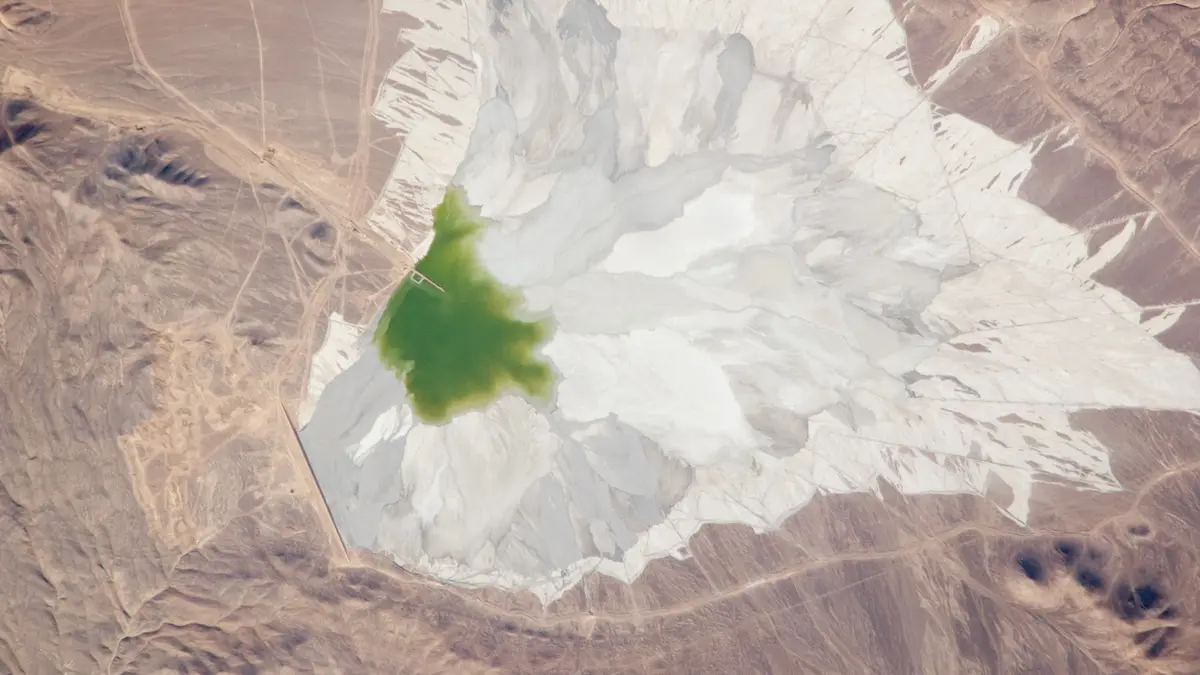
Cochilco projects copper mining's water demand to rise from 18.5 m³/s in 2024 to 20.6 m³/s in 2034, an increase of about 1.2% a year. The key change is in the mix: seawater would rise from 7.5 to 13.9 m³/s (+85.3%) and from 40.7% to 67.6% of consumption, while freshwater would fall from 10.9 to 6.7 m³/s. Desalinated water would make up about three quarters of marine supply by the end of the period.
| Indicator | 2024 (actual) | 2034 (projection) | Change |
|---|---|---|---|
| Total water demand | 18.5 m³/s | 20.6 m³/s | +11% |
| Seawater | 7.5 m³/s | 13.9 m³/s | +85.3% |
| Seawater share | 40.7% | 67.6% | +26.9 points |
| Freshwater | 10.9 m³/s | 6.7 m³/s | -39% |
| Antofagasta's share | - | 48.7% | - |
Source: Cochilco, Water demand projection for copper mining 2025-2034 (2026). The projection report's demand figures use a different basis from the annual report's operational consumption (18.13 m³/s in 2024), so they should not be added to or subtracted from each other.
The cost of seawater: energy and brine
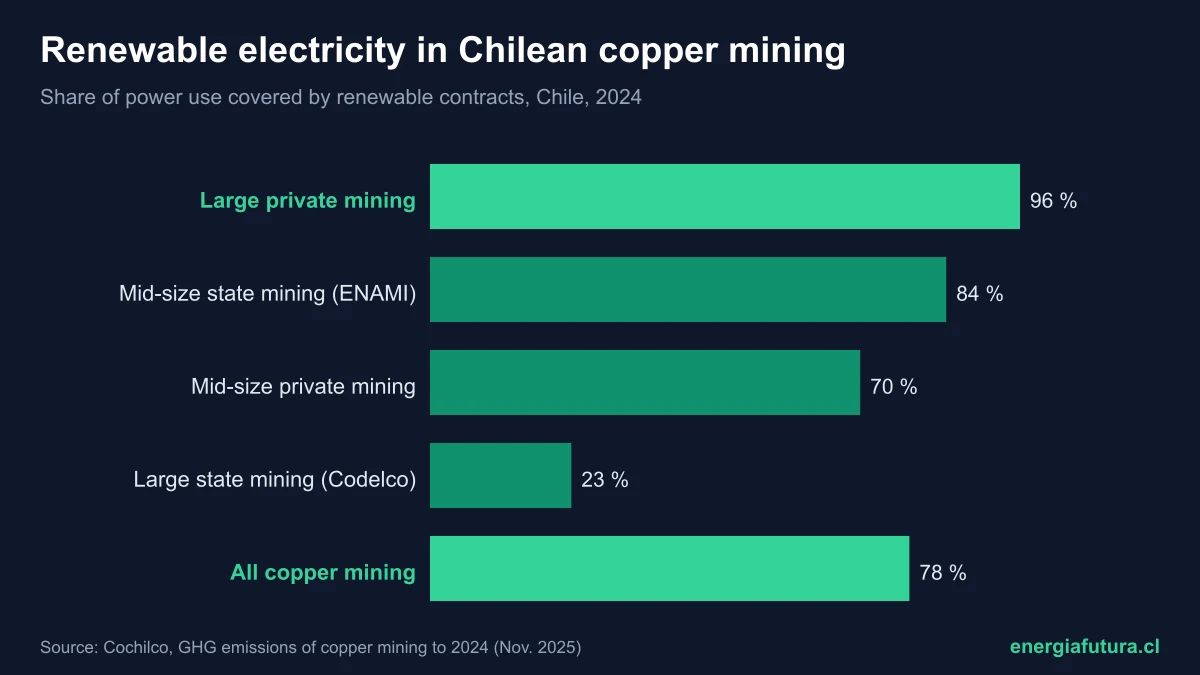
Seawater is not free in energy terms. According to Cochilco's energy report to 2025, the energy used to desalinate and pump seawater rose 5.6-fold between 2015 and 2025 and now accounts for 5.9% of copper mining's energy consumption. Operations using seawater rose from 7 in 2015 to 15 in 2025, and 11 of them desalinate. The emissions report ranks seawater as the sector's third-largest source of power consumption in 2024, at 11%. That is why the origin of that electricity matters, as shown in how much renewable energy each major miner uses.
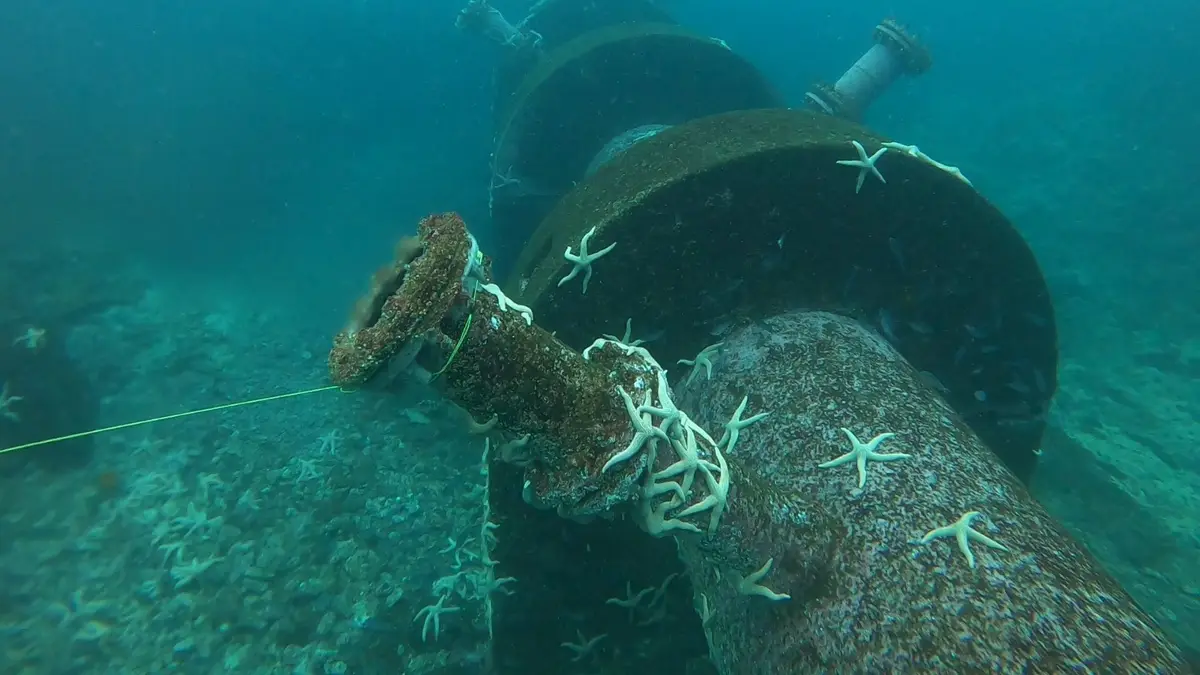
The other cost is on the coast: the brine that desalination plants return. In October 2026 it emerged that the state is funding a CLP 190.5 million study to measure its effect, while the new Desalination Law (Law 21,813) opens the door to an emission standard, as detailed in the study on desalination brine.
Most of this water ends up at giant mines in the Antofagasta Region; the ranking of those sites is in the largest copper mine in the world.
Does your company work in desalination, pumping or water management? Reach Energía Futura's readers.
See advertising optionsFrequently asked questions
How much seawater does mining use in Chile?
8.11 m³/s in 2025, equivalent to 8,110 litres per second, according to Cochilco. That is 36.8% of the water withdrawn by copper mining.
What is the largest mining desalination plant in Chile?
BHP's Escondida Water Supply (EWS), with 2,500 l/s of capacity, in operation since 2018.
How much water does copper mining consume in total?
Operational consumption was 18.21 m³/s in 2025, with output of 5,415 kt of fine copper. Total withdrawal was 22.05 m³/s.
Is all seawater desalinated?
No. 70.4% is desalinated and the rest (2.40 m³/s) is used untreated, mainly in leaching processes and some concentrators.
How much seawater will mining use in 2034?
Cochilco projects 13.9 m³/s, 67.6% of the sector's water demand.
How to cite this data
Energía Futura (2026). Seawater in Chilean mining 2026: consumption, desalination plants and projections in figures. With data from Cochilco (Water consumption in the copper industry to 2025; Water demand projection 2025-2034; Energy consumption to 2025), accessed on 26 October 2026. Available at https://energiafutura.cl/en/news/seawater-in-chilean-mining-2026-consumption-desalination-plants-and-projections-in-figures. The cover chart may be reproduced by citing Energía Futura and linking to this page.