The Tovaku mining project now has environmental approval. The Environmental Evaluation Commission of the Antofagasta Region approved it unanimously at its session on Friday 23 October 2026, as reported by Reporte Minero and REDIMIN magazine on 26 October. It is a US$870 million open-pit copper mine to be built in the communes of María Elena and Tocopilla, with two features that are unusual for a project of its size: it will have its own 193 MW solar photovoltaic park with battery storage, and it will use untreated seawater instead of freshwater.
The project holder before Chile's Environmental Impact Assessment System (SEIA) is Sociedad Punta del Cobre (Pucobre), which filed the Environmental Impact Study on 23 July 2025, according to the extract published in the Diario Oficial on 6 August 2025. The project will be carried out by Minera Puntilla S.A., a company in which Pucobre holds 60% and Codelco 40%: the state miner contributes the mining concessions and Pucobre finances development and construction.
What the Tovaku mining project is
Tovaku will mine the Puntilla deposit, about 70 kilometres east of Tocopilla, with estimated reserves of 633 million tonnes of ore, according to REDIMIN. The goal is to produce 46,000 tonnes a year of high-purity copper cathodes for 21 years. The process will be hydrometallurgical: crushing, heap leaching, solvent extraction and electrowinning, the stage that deposits pure copper on cathode plates using electric current.
| Feature | Tovaku mining project |
|---|---|
| Holder in the SEIA | Sociedad Punta del Cobre (Pucobre) |
| Developer | Minera Puntilla S.A.: Pucobre 60%, Codelco 40% |
| Location | Communes of María Elena and Tocopilla, Antofagasta Region |
| Output | 46,000 t/year of copper cathodes |
| Operation | 21 years (total life of 25 years and 4 months, including construction and closure) |
| Process | Heap leaching, solvent extraction and electrowinning (SX-EW) |
| Energy | 193 MW photovoltaic park with batteries |
| Water | Untreated seawater, through a 72.5 km pipeline from Tocopilla |
| Grid connection | 220 kV, 27 km line from the Ana María substation |
| Investment | US$870 million (US$650 million mine and plant; US$220 million solar park) |
| Estimated jobs | Up to 984 people during construction and about 700 in operation |
Sources: extract of the Environmental Impact Study in the Diario Oficial (6 August 2025), Reporte Minero and REDIMIN (26 October 2026). Investment, output and employment are figures declared by the project holder.
Tovaku's solar park: 193 MW for a cathode mine
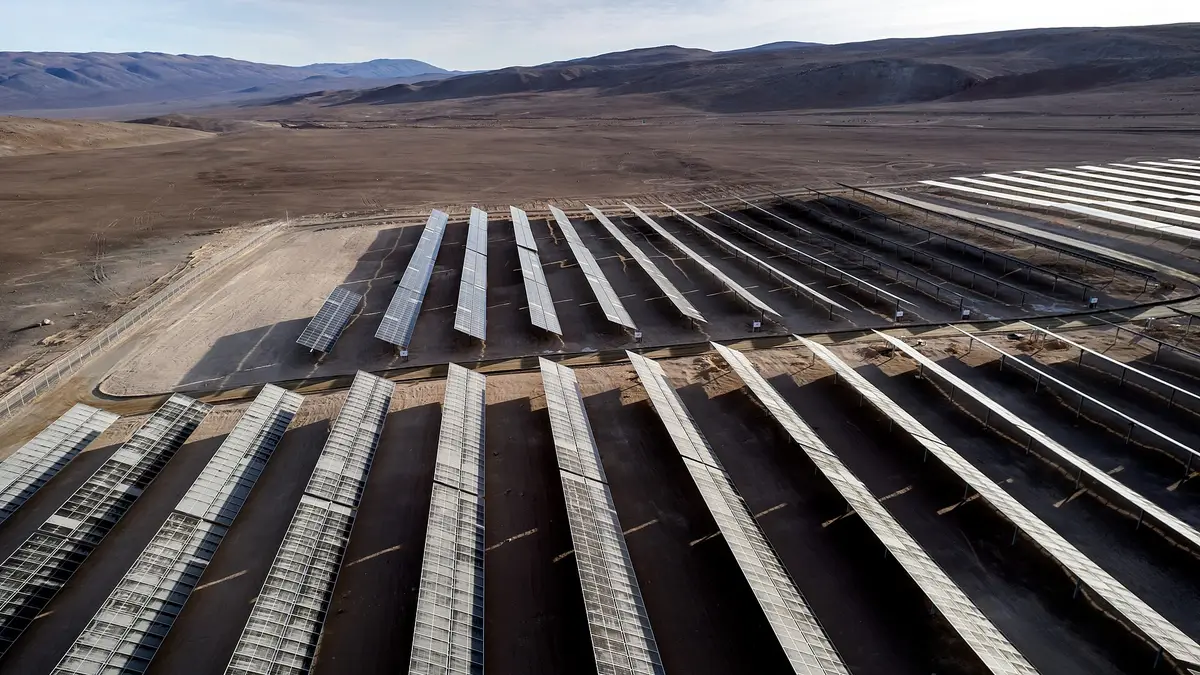
The most striking energy component is the 193 MW solar photovoltaic park of installed capacity, with battery energy storage, which is part of the same Environmental Impact Study. REDIMIN reports that about US$220 million of the US$870 million investment corresponds to that solar plant. The project will also connect to Chile's National Electric System through a 220 kV line to the Ana María substation, so it can buy power from the grid when the sun is not enough.
The choice makes technical sense. A cathode mine depends on electricity in the electrowinning stage, while a concentrate mine spends most of its electricity grinding and floating ore. According to the Cochilco report on copper mining emissions up to 2024, direct emissions linked to electrowon cathodes are 0.23 tonnes of CO2 equivalent per tonne of copper, compared with 1.29 tonnes for the industry average across the whole operation. Having electricity come from its own solar plant also cuts the indirect part of that footprint.
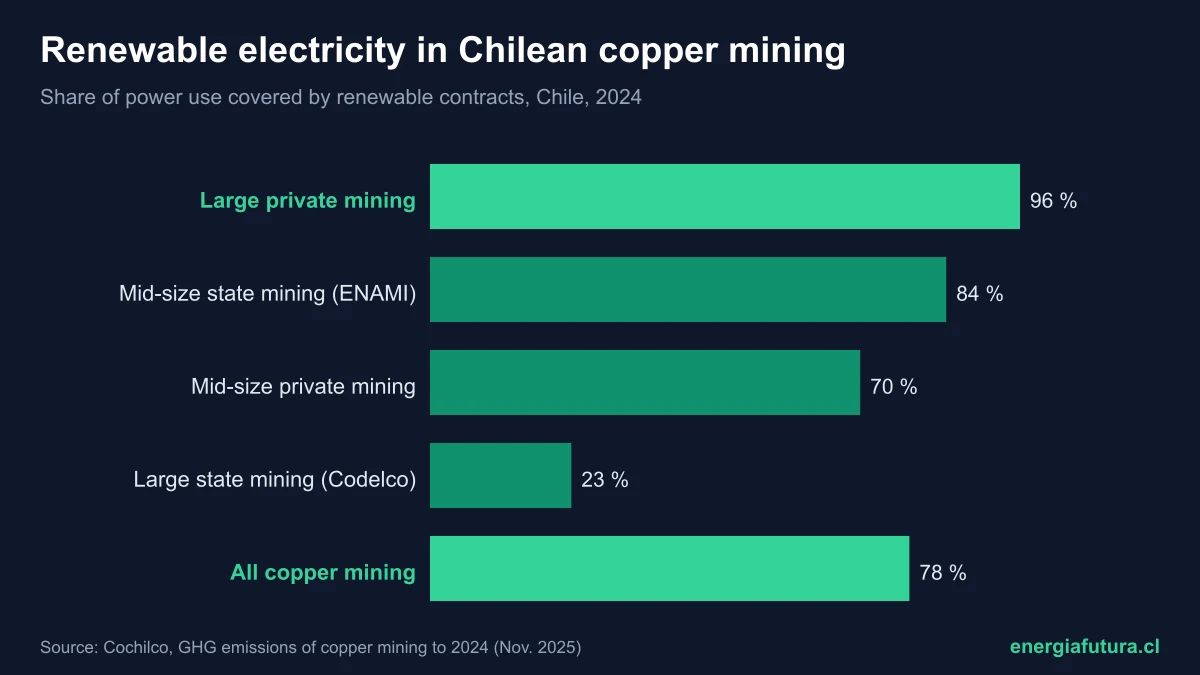
Tovaku thus joins the trend that already dominates large private mining, where 96% of power consumption was covered by renewable contracts in 2024, as detailed in how much renewable energy each major Chilean miner uses. The difference is that here the generation will be part of the project itself, not just a supply contract with a power company.
Untreated seawater
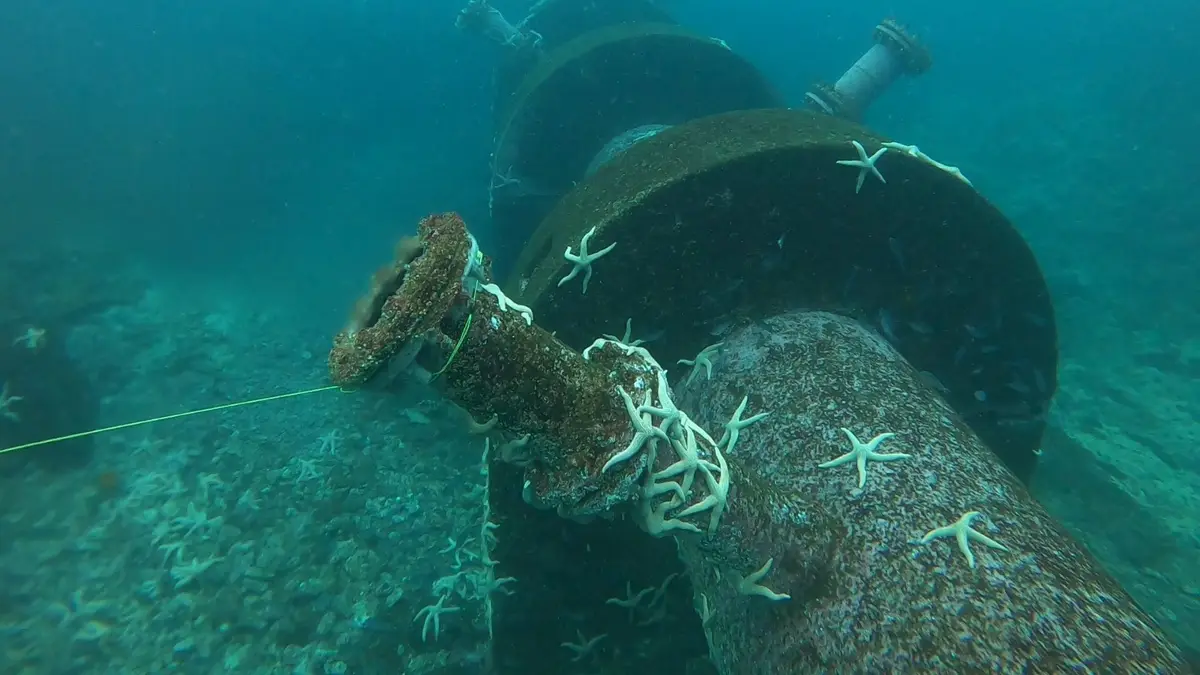
The second pillar is water. Tovaku will not use water from wells or rivers: a 72.5 km Seawater Pumping System will carry untreated seawater from the header tanks of the Estación de Bombeo Cero in Tocopilla to the site. The project does not draw the water directly from the ocean; according to the official extract, that intake is handled by a supplier that already holds its own permits. Using untreated seawater is possible in some leaching processes and avoids the energy cost of reverse osmosis, although it requires corrosion-resistant materials.
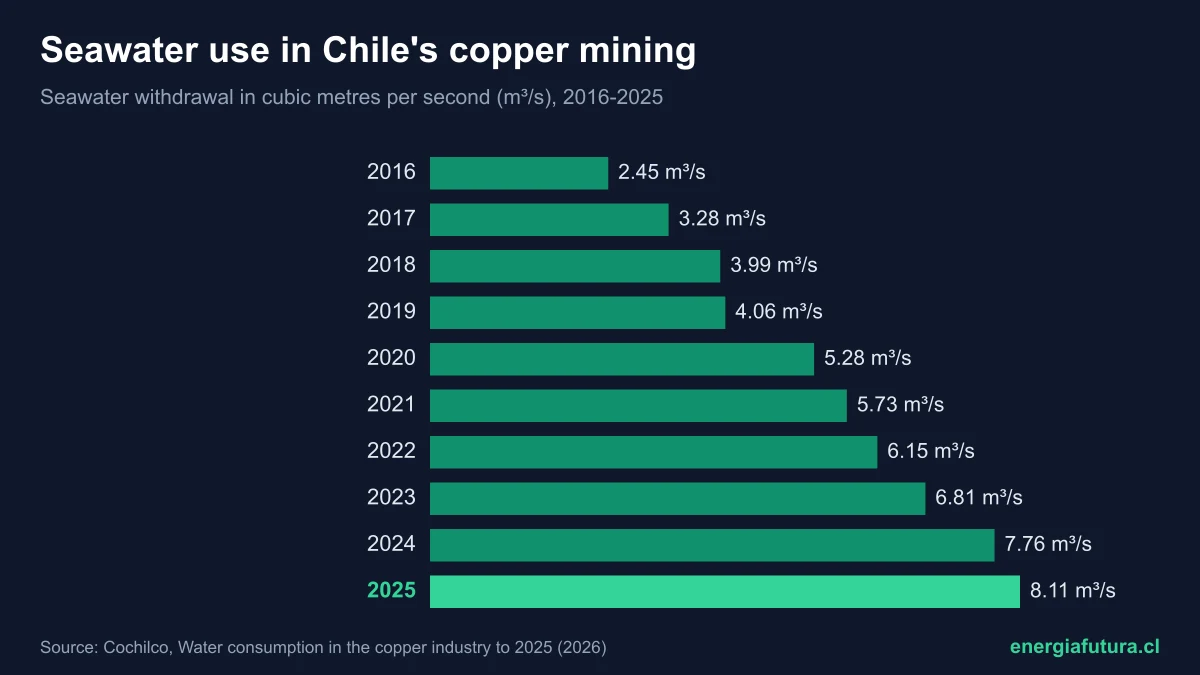
Copper mining drew 8.11 m³/s of seawater in 2025, of which 2.40 m³/s was used without desalination, according to Cochilco. The breakdown by site, region and plant is in seawater in Chilean mining in figures.
Tovaku's environmental review step by step
The review took 450 days, about 40% less than the average for Environmental Impact Studies in 2025, according to Reporte Minero. There were three rounds of clarifications before the Antofagasta office of the Environmental Evaluation Service (SEA) published a 142-page Consolidated Evaluation Report (ICE) recommending approval.
| Date | Milestone |
|---|---|
| 2009 | Pucobre begins exploration; it has invested about US$35 million in drilling and studies |
| 23 July 2025 | Environmental Impact Study filed with the SEIA |
| 6 August 2025 | Extract published in the Diario Oficial |
| 25 August 2026 | Codelco and Pucobre formalise Minera Puntilla S.A. |
| 15 October 2026 | The SEA publishes the ICE recommending approval |
| 23 October 2026 | Antofagasta's Evaluation Commission approves unanimously |
| Second half of 2027 | Planned start of construction (about three years) |
| 2030 | Projected first copper output |
Sources: Diario Oficial, Reporte Minero and REDIMIN. The 2027 and 2030 dates are company projections and depend on sector permits, detailed engineering and bank financing, which are still pending.
Objections during the review
The process was not free of objections. The significant impact declared by the holder itself concerns archaeological heritage: REDIMIN counts 118 finds, of which 63 lie within the area of influence and could be affected during construction, for which the project committed to permanent archaeological monitoring, rescue and recording. The General Water Directorate and the Hydraulic Works Directorate questioned why no sector permit was required for three ravine diversion works, and the Aymara community of Quillagua requested an indigenous consultation that was ultimately not held; Conadi approved the report without observations.
Why it matters for Codelco and for sustainable mining
For Codelco, the deal is a way to add output without spending capital: it keeps 40% with no new contributions, and Pucobre recovers its investment from future distributions that would go to the state miner. The 46,000 tonnes a year amount to less than 1% of Chile's output, but they arrive as the country is producing less copper: Cochilco projects that 2026 will close at its lowest level in more than two decades, as explained in the fall in Chile's copper output.
| Chilean copper mining indicator | Value | Source |
|---|---|---|
| Electricity under renewable contracts (2025) | 80.1% | Cochilco, energy 2025 |
| Total energy consumption (2025) | 210.6 PJ | Cochilco, energy 2025 |
| Total emissions (2024) | 12,861 kt CO2e | Cochilco, GHG 2024 |
| Seawater withdrawal (2025) | 8.11 m³/s | Cochilco, water 2025 |
| Fine copper output (2025) | 5,415 kt | Cochilco, water 2025 |
Sources: Cochilco reports Energy consumption in copper mining to 2025 and Water consumption in the copper industry to 2025, both published in 2026.
Tovaku's design sums up the two conditions the sector has set itself to grow in the desert: renewable energy and water that does not compete with communities. What the mine still needs to exist is financial close; environmental approval is only the first permit on a long list, and construction has not been decided.
Does your company supply energy, water or technology to mining? Reach Energía Futura's readers.
See advertising optionsFrequently asked questions
Who owns the Tovaku project?
Minera Puntilla S.A., 60% owned by Pucobre (Sociedad Punta del Cobre) and 40% by Codelco. Pucobre controls and operates the company.
Where is Tovaku?
In the communes of María Elena and Tocopilla, in the Antofagasta Region, about 70 km east of Tocopilla.
How much copper will it produce?
About 46,000 tonnes a year of high-purity copper cathodes over 21 years of operation.
What energy will the mine use?
Its own 193 MW photovoltaic park with batteries, plus a connection to the National Electric System through a 220 kV line.
When would it start producing?
The companies plan to start construction in the second half of 2027 and produce copper in 2030, subject to sector permits and financing.