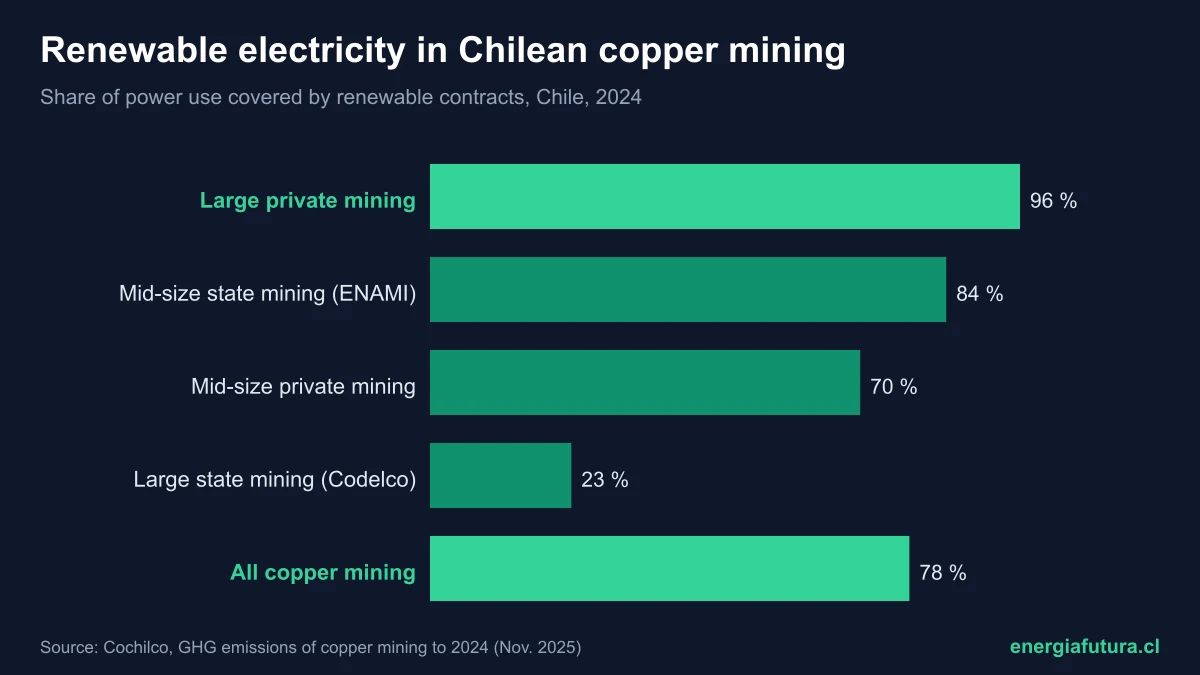
Updated on 26 October 2026. In 2025, 80.1% of the electricity consumed by copper mining in Chile came from renewable supply contracts, up from 45.1% in 2022, according to the report Energy consumption in copper mining: update to 2025, published by Cochilco in 2026. The gap between companies is wide: in 2024 large private mining covered 96% of its power use with renewable energy, while large state mining (Codelco) reached 23%.
The comparison by type of operation comes from the Cochilco report on greenhouse gas emissions from copper mining up to 2024 (November 2025), based on the EMPAE survey of 49 operations representing 98% of output. The company-by-company detail comes from each firm's announcements and reports.
Renewable energy in Chilean mining by type of operation
| Type of mining (2024) | Operations | Power consumption (TJ) | Operations with renewable PPA | Renewable electricity (TJ) | % renewable |
|---|---|---|---|---|---|
| Large private mining | 19 | 74,526 | 19 | 71,274 | 96% |
| Mid-size state mining (ENAMI) | 6 | 464 | 5 | 392 | 84% |
| Mid-size private mining | 16 | 3,259 | 9 | 2,286 | 70% |
| Large state mining (Codelco) | 8 | 24,058 | 1 | 5,531 | 23% |
| Total | 49 | 102,307 | 34 | 79,483 | 78% |
Source: Cochilco, GHG emissions from copper mining up to 2024, table 2. One terajoule (TJ) equals 277,778 kWh. All 19 large private mining operations have renewable contracts; at Codelco, only one of its eight operations had them in 2024.
In the energy report series, the renewable share rises every year: 45.1% in 2022, 74.4% in 2023, 77.3% in 2024 and 80.1% in 2025. In 2025, electricity backed by renewable contracts reached 84.1 PJ: 80.9 PJ in large mining and 3.2 PJ in mid-size mining. The emissions report, using a different method, gives 78% for 2024; the two figures are not identical, but the trend is the same.
| Year | Electricity from renewable contracts | Source |
|---|---|---|
| 2022 | 45.1% | Cochilco, energy 2025 |
| 2023 | 74.4% | Cochilco, energy 2025 |
| 2024 | 77.3% | Cochilco, energy 2025 |
| 2025 | 80.1% | Cochilco, energy 2025 |
Ranking: how much renewable energy each major miner uses
Most large private miners already report 100% renewable power supply in Chile. The table summarises the latest public figure for each one, with its date and source. This refers to electricity backed by power purchase agreements (PPAs) or certificates, not to the site's total energy, which also includes truck diesel.
| Miner and operations | Renewable electricity | Since | Main contract | Source |
|---|---|---|---|---|
| Collahuasi (Anglo American, Glencore and Japanese partners) | 100% | 2020 | Enel, about 1 TWh/year since April 2020; Colbún, up to 650 GWh/year in 2026-2035 | Collahuasi via Reporte Minero (2023) |
| Antofagasta Minerals (Zaldívar, Centinela, Antucoya, Los Pelambres) | 100% | 2020-2022 | Zaldívar since July 2020; Centinela and Antucoya since January 2022; Los Pelambres in 2022 | Antofagasta plc; International Copper Association |
| Anglo American (Los Bronces, El Soldado, Chagres smelter) | 100% | 2021 | Enel, up to 3 TWh/year for 10 years from January 2021 | Anglo American and Enel (2019) |
| BHP (Escondida and Spence) | 100% | Reported in 2024 | Renewable contracts; the two sites account for about 9% of Chile's power demand | BHP, Chile site tour (2024) |
| Teck (Quebrada Blanca) | 100% | 2025 | AES Andes, 1,069 GWh/year for 17 years | Teck (2022) |
| Lundin Mining (Candelaria) | 100% NCRE | 2023 | AES Andes, contract to 2035 | Lundin Mining via MCH (2025) |
| Codelco (8 operations) | 23% in 2024; target over 85% from 2026 | 2026 | Atlas, Colbún and Innergex, 1.8 TWh/year for 15 years from January 2026 | Cochilco (2025); Codelco (2024) |
Sources linked in the text. The 100% shares are those reported by each company for its power consumption in Chile; they are not audits by Energía Futura. Collahuasi is owned 44% by Anglo American, 44% by Glencore and 12% by a Japanese consortium led by Mitsui.
The pioneers: Collahuasi and Zaldívar
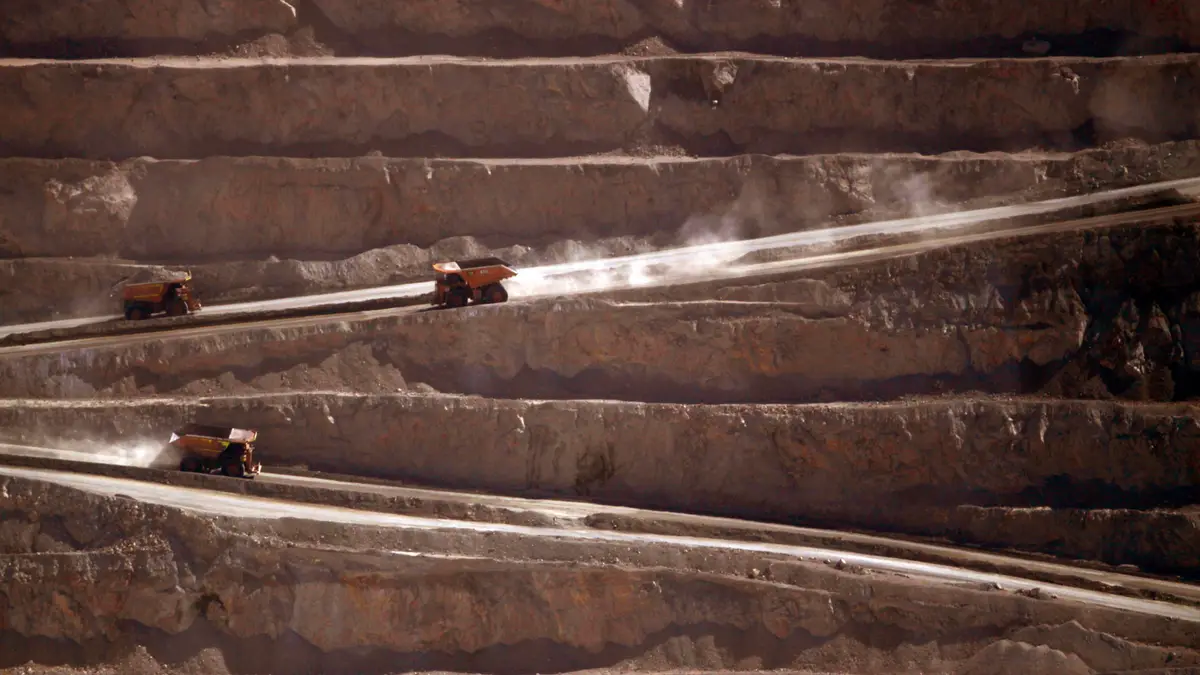
Collahuasi describes itself as the first miner in Chile with 100% renewable power supply, since 2020, thanks to a ten-year contract with Enel for about 1 TWh a year, the largest of its kind in the country when it was signed. In September 2023 it added a deal with Colbún for up to 650 GWh a year between 2026 and 2035, to support its desalination plant and life extension, according to Reporte Minero.
Zaldívar, owned by Antofagasta Minerals, has run on renewable energy since July 2020. Centinela and Antucoya followed in January 2022 and Los Pelambres the same year, leaving the group's entire mining division on renewable electricity, as noted by the International Copper Association. In 2021, the switch at the first two sites avoided about 375,000 tonnes of CO2 equivalent.
The big contracts: Anglo American, BHP and Teck
Anglo American signed a contract with Enel in July 2019 for up to 3 TWh a year over ten years, from January 2021, for Los Bronces, El Soldado and the Chagres smelter. The company estimated at the time that the switch would cut its CO2 emissions in Chile by more than 70%, according to Mining Weekly.
BHP stated in its Chilean site tour presentation of November 2024 that Escondida and Spence operate on 100% renewable electricity and that the two sites account for about 9% of Chile's power demand. Mining is also one of the drivers behind the projection that Chile's electricity demand could almost double by 2046. Teck secured a 1,069 GWh a year contract for 17 years with AES Andes in 2022 so that Quebrada Blanca would be 100% renewable from 2025, according to its official release.
The Codelco case: from 23% to more than 85%
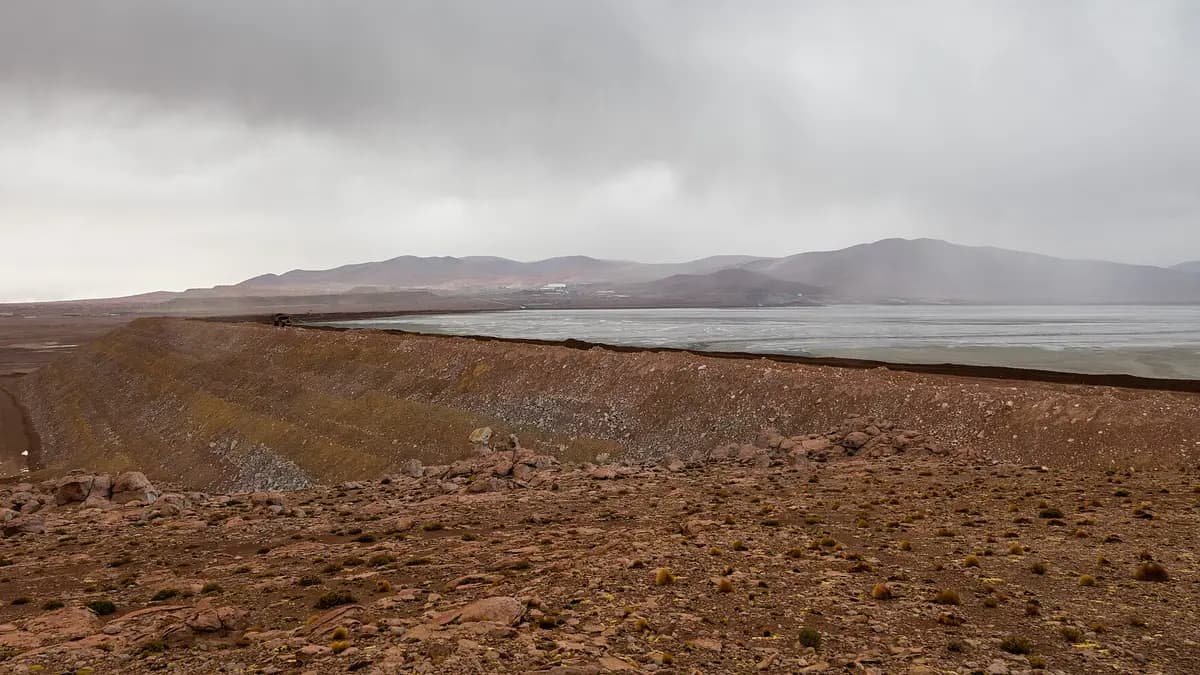
Large state mining weighs most on the average. In 2024, its eight operations consumed 24,058 TJ of electricity, about a quarter of the sector total, and only 5,531 TJ were backed by renewable contracts. Codelco was tied to long-term contracts signed before the solar and wind boom, and has been renegotiating them since 2021.
In March 2024, Codelco announced that it had awarded three contracts for 1.8 TWh a year over 15 years, starting 1 January 2026: Atlas (375 GWh), Colbún (1,100 GWh) and Innergex (350 GWh). With these and earlier agreements with Colbún (2022) and AES Andes (2023), the state miner estimates that more than 85% of its electricity will be renewable from 2026, and that a 100% renewable supply would avoid about 2,780,000 tonnes of CO2 equivalent a year. Its goal is to reach 100% by the end of the decade. The actual 2026 figure will be known when Cochilco publishes that year's survey.
| Codelco contract | Annual energy | Term |
|---|---|---|
| Atlas Renewable Energy | 375 GWh | 15 years from 2026 |
| Colbún | 1,100 GWh | 15 years from 2026 |
| Innergex | 350 GWh | 15 years from 2026 |
| AES Andes (January 2023 agreement) | Up to 1.6 TWh | 2026 to 2040 |
Source: Codelco (1 March 2024). The three 2024 awards add up to 1,825 GWh a year.
What renewable energy in Chilean mining does not yet cover
Almost fully renewable electricity does not make mining renewable. In 2025, the sector consumed 210.6 PJ: 105.0 PJ of electricity and 105.6 PJ of fuels, and for the first time fuels exceeded electricity. Diesel makes up 93% of those fuels and is used mainly by haul trucks in open pits, which alone account for 44% of the industry's energy.
That is the next front, and it explains the trials of battery, trolley and hydrogen trucks in Chilean mining fleets. As long as diesel is not replaced, direct emissions will keep rising, as shown by the carbon footprint of Chilean copper.
Contracts, certificates and physical power
The electricity reaching a site through the National Electric System is the same for everyone; what changes is the contract. Miners certify its renewable origin with PPAs tied to solar, wind or hydro plants, and with certificates such as I-RECs. That is why mining accounts for 83% of the country's certified renewable energy, as explained in the 2025 renewable certification record. Self-generation, on the other hand, is marginal: less than 1% of the sector's power use, according to Cochilco.
Corporate PPAs are what big companies sign to lock in clean power at a stable price for many years. New projects, such as Pucobre and Codelco's Tovaku mine, go a step further and include their own solar park in the site design.
Methodology
The percentages by type of mining come from Cochilco's EMPAE survey and refer to 2024. The 2022-2025 series comes from the energy report to 2025, which covered 52 operations of 27 companies. Company data are those reported by each firm in releases and presentations; the date of each figure is included. If a miner publishes a newer figure, this page will be updated at the same address.
Does your company generate or sell renewable energy to industry? Reach Energía Futura's readers.
See advertising optionsFrequently asked questions
How much renewable energy does Chilean mining use?
80.1% of copper mining's electricity came from renewable contracts in 2025, according to Cochilco. Taking all energy into account, including diesel, electricity backed by renewable contracts is about 40% of the sector's total consumption (84.1 of 210.6 PJ).
Which miners use 100% renewable energy in Chile?
Collahuasi, Antofagasta Minerals, Anglo American, BHP (Escondida and Spence), Teck (Quebrada Blanca) and Lundin Mining (Candelaria) report 100% renewable electricity.
Why does Codelco use less renewable energy?
Because of long-term supply contracts signed earlier, which it has been renegotiating. In 2024 it reached 23%; with the contracts that started in January 2026 it projects more than 85%.
What is a renewable PPA?
A long-term power purchase agreement between a company and a generator, tied to renewable plants, that backs the clean origin of the electricity consumed.
Is mining carbon neutral if its electricity is renewable?
No. Diesel from trucks and equipment still emits: in 2024 it produced 6,651 kt of CO2 equivalent, more than half of the sector's emissions.
How to cite this data
Energía Futura (2026). Renewable energy in Chilean mining 2026: how much each major miner uses. With data from Cochilco, Codelco, BHP, Teck, Antofagasta Minerals, Anglo American, Collahuasi and Lundin Mining, accessed on 26 October 2026. Available at https://energiafutura.cl/en/news/renewable-energy-in-chilean-mining-2026-how-much-each-major-miner-uses. The cover chart may be reproduced by citing Energía Futura and linking to this page.