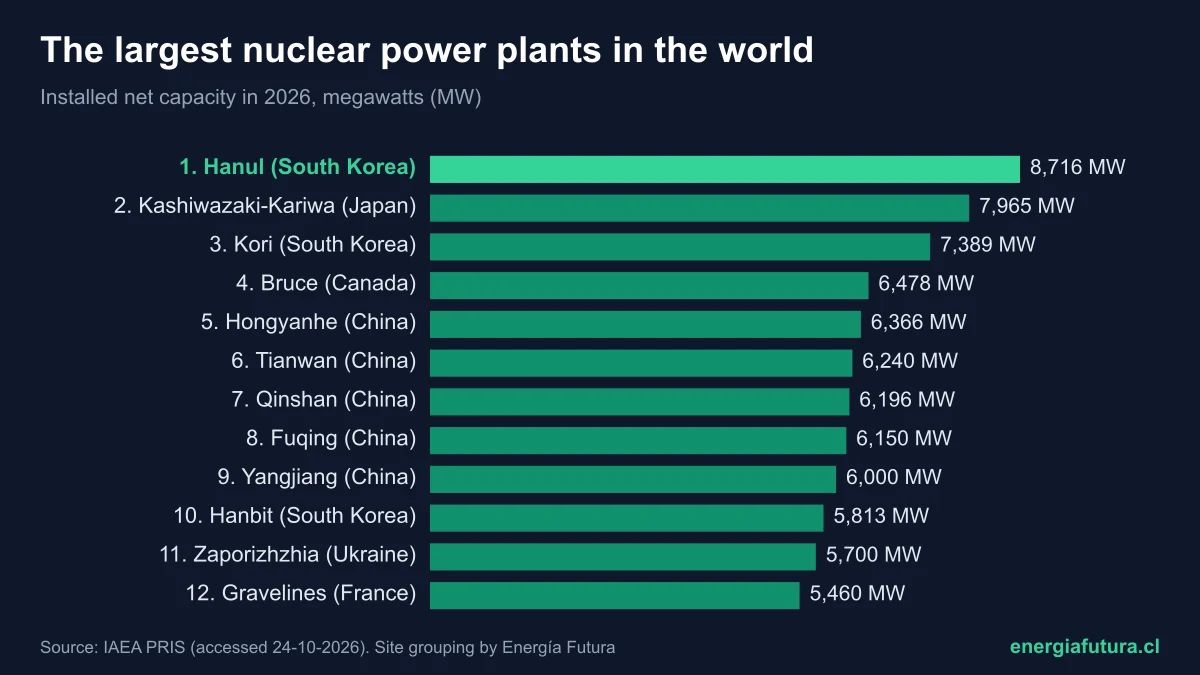
Updated on 24 October 2026. The largest nuclear power plant in the world is Hanul, on the east coast of South Korea, with 8,716 MW of net capacity in eight reactors in operation, according to the Power Reactor Information System (PRIS) of the International Atomic Energy Agency (IAEA), accessed on 24 October 2026. It overtakes Kashiwazaki-Kariwa, in Japan, which held the record for years with 7,965 MW but today has only one of its seven reactors back in commercial operation.
There are 417 nuclear reactors in operation worldwide, with 379,611 MW net, and another 78 under construction, adding up to 81,349 MW, according to the same IAEA database. Chile has no nuclear power plants. This is the ranking of the largest plants and what is happening at each one.
Ranking: the largest nuclear power plant in the world and the runners-up
The table ranks the plants by installed net capacity, the power they deliver to the grid after their own consumption. It includes reactors in operation and those in suspended operation, such as Japan's, because they are still part of the plant:
| # | Plant | Country | Reactors | Net capacity (MW) | Status in October 2026 |
|---|---|---|---|---|---|
| 1 | Hanul (includes Shin-Hanul) | South Korea | 8 | 8,716 | All eight in operation |
| 2 | Kashiwazaki-Kariwa | Japan | 7 | 7,965 | Only unit 6 running since April 2026 |
| 3 | Kori (includes Shin-Kori and Saeul) | South Korea | 7 | 7,389 | Kori 3 and 4 offline pending licence extension |
| 4 | Bruce | Canada | 8 | 6,478 | In operation |
| 5 | Hongyanhe | China | 6 | 6,366 | In operation |
| 6 | Tianwan | China | 6 | 6,240 | In operation; 2 more reactors under construction |
| 7 | Qinshan | China | 9 | 6,196 | In operation |
| 8 | Fuqing | China | 6 | 6,150 | In operation |
| 9 | Yangjiang | China | 6 | 6,000 | In operation |
| 10 | Hanbit | South Korea | 6 | 5,813 | In operation |
| 11 | Zaporizhzhia | Ukraine | 6 | 5,700 | Occupied; all six reactors in cold shutdown |
| 12 | Gravelines | France | 6 | 5,460 | In operation |
| 13 | Barakah | United Arab Emirates | 4 | 5,348 | In operation |
| 14 | Paluel | France | 4 | 5,320 | In operation |
| 15 | Cattenom | France | 4 | 5,200 | In operation |
Source: IAEA, Power Reactor Information System (PRIS), reactor-by-reactor data accessed on 24 October 2026. Energía Futura combined into a single plant the reactors that PRIS records as separate sites but which share location and operator: Hanul and Shin-Hanul; Kori, Shin-Kori and Saeul; and Bruce A and Bruce B. The current status of each plant comes from the sources cited in the text.
South Korea has three of the ten largest plants and China, five. None in the United States makes the list: the largest is Vogtle, in Georgia, with 4,536 MW.
Hanul, the largest nuclear power plant in the world in 2026
Hanul is in Uljin County, North Gyeongsang Province, and is run by state-owned Korea Hydro & Nuclear Power (KHNP). It has six reactors of between 953 and 994 MW net, connected to the grid between 1988 and 2005, and two newer APR-1400 reactors, Shin-Hanul 1 (1,429 MW, connected in June 2022) and Shin-Hanul 2 (1,416 MW, connected in December 2023), according to PRIS.
With Shin-Hanul 2 online, the plant surpassed Kashiwazaki-Kariwa's capacity. And it will keep growing: PRIS lists Shin-Hanul 3 and 4, of 1,340 MW each, as under construction. Once they enter service, Hanul will reach about 11,400 MW, a figure no other nuclear plant in the world has in the pipeline.
For scale: Hanul has more than ten times the capacity of Horizonte, Chile's largest wind farm (816 MW), but less than half that of Three Gorges, the largest power plant on the planet, with 22,500 MW, as shown in the ranking of the largest hydroelectric plant in the world.
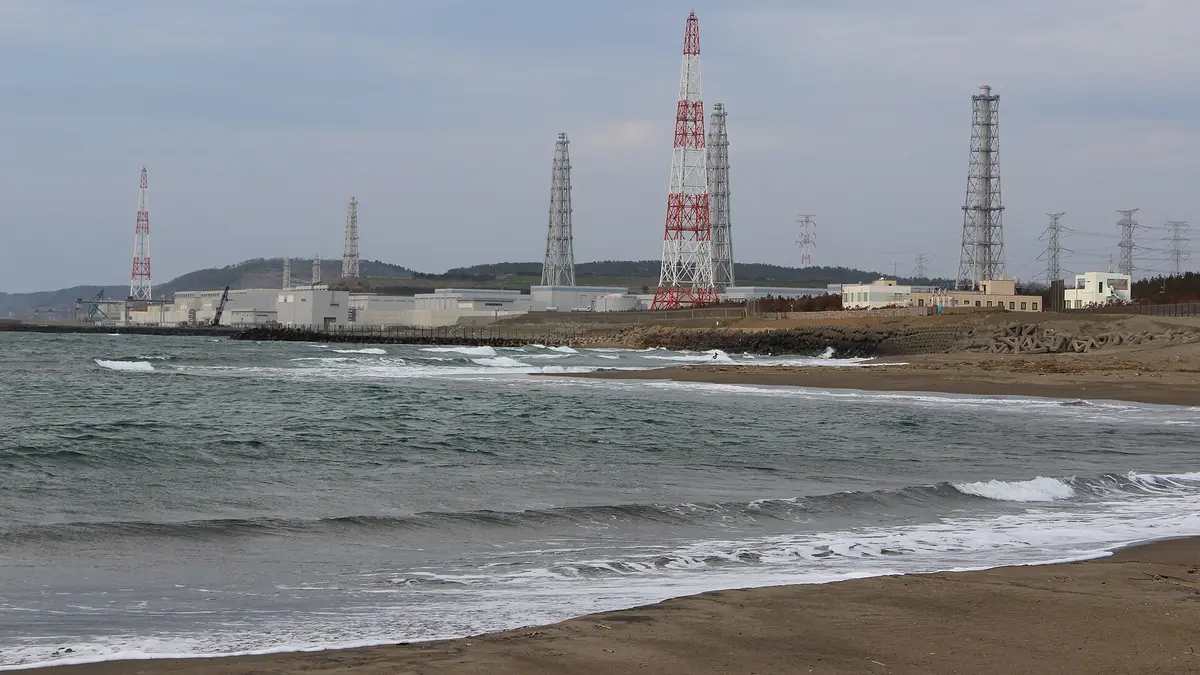
Kashiwazaki-Kariwa: the former record holder, half back
The Tokyo Electric Power (TEPCO) plant in Niigata Prefecture was for years the largest nuclear power plant in the world, with five 1,067 MW reactors and two 1,315 MW ABWRs net. All of them were shut down between 2007 and 2012, after a 2007 earthquake and the 2011 Fukushima Daiichi accident.
Unit 6 resumed commercial operation on 16 April 2026, after more than 14 years offline and with a delay of about 50 days caused by control rod and generator alarms, according to World Nuclear News. TEPCO plans to run it until its next inspection, in April 2027. Unit 7 remains offline and units 1 to 5 have no return date. PRIS still lists all seven reactors as in suspended operation.
Kori: Korea's largest plant by number of reactors
The Kori complex, between Busan and Ulsan, brings together Kori 2 to 4, Shin-Kori 1 and 2 and Saeul 1 and 2, with 7,389 MW net. Kori 1, Korea's first reactor, closed in 2017. Kori 2 returned to operation in April 2026, after the regulator approved extending its life until 2033, according to World Nuclear News.
Kori 3 and 4, with almost 2,000 MW between them, have been offline since September 2024 and August 2025, when their 40-year licences expired, according to World Nuclear News. The Nuclear Safety and Security Commission reviewed their extension on 11 September 2026 without reaching a decision, Asia Economy reported. In addition, Saeul 3 and 4, of 1,340 MW each, are under construction at the same site.
The largest nuclear power plants outside Asia
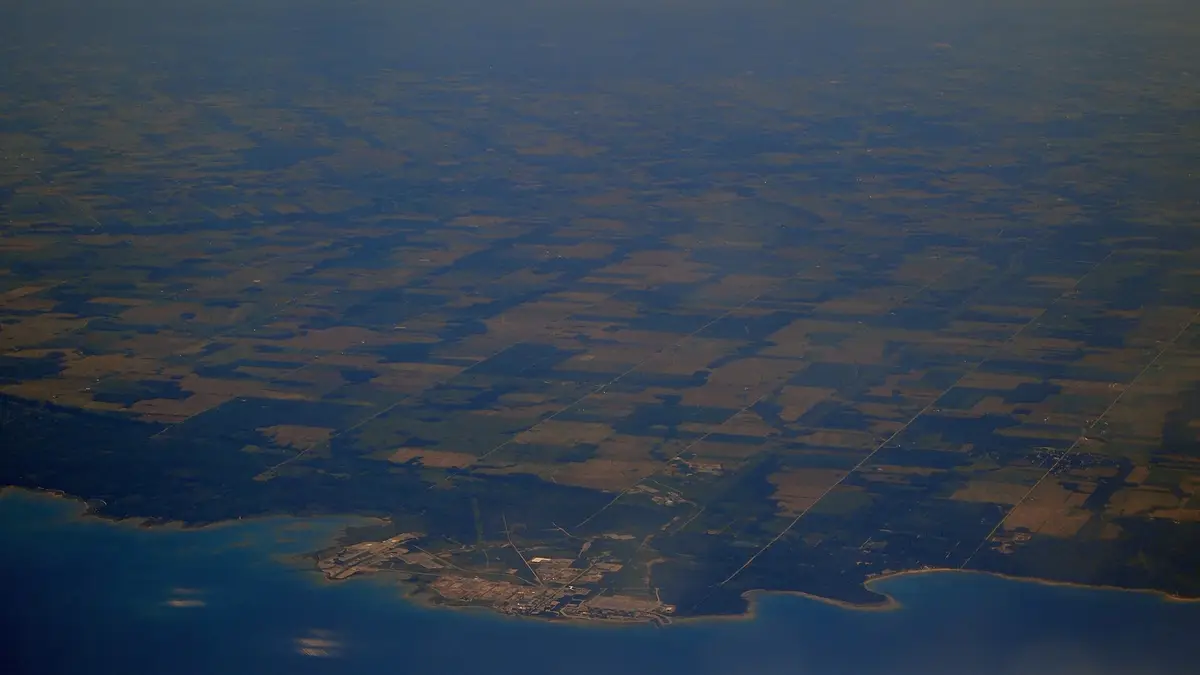
The largest nuclear plant in the Americas and the West is Bruce, on the shores of Lake Huron, in Ontario (Canada). Its eight CANDU reactors add up to 6,478 MW net, according to PRIS. Four of them, those of Bruce A, were offline from the late 1990s into the 2000s and returned to service between 2003 and 2012 after refurbishment.
In Europe, the largest is Zaporizhzhia, in Ukraine, with six 950 MW reactors. It has been occupied by Russian forces since March 2022 and its six reactors remain in cold shutdown, generating no electricity. On 7 September 2026 its 330 kV off-site connection was restored after almost three weeks of outage, according to the German nuclear safety authority BASE, which compiles IAEA reports. PRIS still lists it as an operating plant.
France, the country most dependent on nuclear power, has four plants among the 20 largest: Gravelines (5,460 MW), Paluel (5,320 MW), Cattenom (5,200 MW) and Flamanville (4,290 MW), the latter with the 1,630 MW EPR reactor connected in 2024. In the Middle East, Barakah, in the United Arab Emirates, stands out as the first nuclear plant in the Arab world, with four 1,337 MW reactors.
The countries with the most nuclear power in the world
The United States leads by country by a wide margin, although its reactors are spread across many smaller plants:
| # | Country | Nuclear capacity in operation (MW net) |
|---|---|---|
| 1 | United States | 96,952 |
| 2 | France | 63,000 |
| 3 | China | 58,721 |
| 4 | Russia | 27,969 |
| 5 | South Korea | 25,609 |
| 6 | Ukraine | 13,107 |
| 7 | Canada | 12,714 |
| 8 | Japan | 12,631 |
Source: IAEA, PRIS, reactors in operational status as of 24 October 2026. Ukraine's figure includes Zaporizhzhia's 5,700 MW, which are not generating; Japan's does not include Kashiwazaki-Kariwa unit 6, which PRIS still records as suspended.
China is the fastest-growing country: it accounts for a large share of the 78 reactors under construction worldwide. For example, the Tianwan plant has two 1,171 MW reactors under construction, which would take it to about 8,580 MW and could let it challenge Hanul for first place before Hanul completes its own expansions.
The largest reactors in the world
If individual reactors are compared instead of plants, the record is Chinese: the two EPR reactors at Taishan, in Guangdong Province, have 1,660 MW net each, according to PRIS. They are followed by Flamanville 3 (France), with 1,630 MW; Olkiluoto 3 (Finland), with 1,575 MW, and the two Chooz B reactors (France), with 1,500 MW each.
| Reactor | Country | Technology | Net capacity (MW) |
|---|---|---|---|
| Taishan 1 | China | EPR | 1,660 |
| Taishan 2 | China | EPR | 1,660 |
| Flamanville 3 | France | EPR | 1,630 |
| Olkiluoto 3 | Finland | EPR | 1,575 |
| Chooz B1 and B2 | France | N4 | 1,500 each |
Source: IAEA, PRIS, accessed on 24 October 2026.
Chile and nuclear power
Chile has no nuclear power plants. The Chilean Nuclear Energy Commission (CChEN) has operated the RECH-1 research reactor, of 5 MW thermal, at the La Reina Nuclear Centre in Santiago since 1974. It is used mainly to produce medical radioisotopes, according to World Nuclear News, which reported on an IAEA mission to the reactor in 2022. It does not generate electricity for the grid.
In South America, only Argentina and Brazil have nuclear power plants. Argentina runs Atucha I and II and Embalse, with 1,631 MW net in total, and Brazil runs Angra 1 and 2, with 1,884 MW, while it builds Angra 3, of 1,340 MW, according to PRIS. The region's largest plant, Angra, has less than a quarter of Hanul's capacity.
Chile's power mix is betting on renewables and storage: the country is already among those generating the most renewable electricity in the world, as shown in the ranking of countries with the most renewable energy. With electricity demand that could almost double by 2046 due to mining, hydrogen and data centres, according to the grid operator's projections, the debate over firm energy sources will remain open.
Methodology
Capacity data come from the IAEA Power Reactor Information System (PRIS), checked reactor by reactor on 24 October 2026. Net electrical capacity is used for reactors in operational status or in suspended operation; permanently shut down reactors and those under construction are not added. PRIS records some complexes as separate sites; Energía Futura grouped them when they share location and operator (Hanul with Shin-Hanul; Kori with Shin-Kori and Saeul; Bruce A with Bruce B). Daya Bay and Ling Ao, in China, are neighbouring but distinct plants and are counted separately. The current status of Kashiwazaki-Kariwa, Kori and Zaporizhzhia comes from the linked sources, because PRIS does not always immediately reflect restarts or prolonged shutdowns.
Does your company work in power generation, transmission or large energy projects? Reach Energía Futura's readers.
See advertising optionsFrequently asked questions
What is the largest nuclear power plant in the world?
Hanul, in South Korea, with 8,716 MW net across eight reactors, according to the IAEA PRIS as of 24 October 2026.
Is Kashiwazaki-Kariwa no longer the largest?
It has 7,965 MW installed, less than Hanul, and only unit 6 (1,315 MW) has been in commercial operation since 16 April 2026.
What is the largest nuclear power plant in Europe?
Zaporizhzhia, in Ukraine, with 5,700 MW, but it is occupied and its six reactors are in cold shutdown. The largest one generating is Gravelines, in France, with 5,460 MW.
Does Chile have nuclear power plants?
No. It only has the RECH-1 research reactor, of 5 MW thermal, operated by CChEN in La Reina, which does not generate electricity for the grid.
How to cite this data
Energía Futura (2026). The largest nuclear power plant in the world 2026: ranking of the biggest nuclear plants. With data from the IAEA Power Reactor Information System (PRIS), accessed on 24 October 2026. Available at https://energiafutura.cl/en/news/the-largest-nuclear-power-plant-in-the-world-2026-ranking-of-the-biggest-nuclear-plants. The cover chart may be reproduced by crediting Energía Futura and linking to this page.