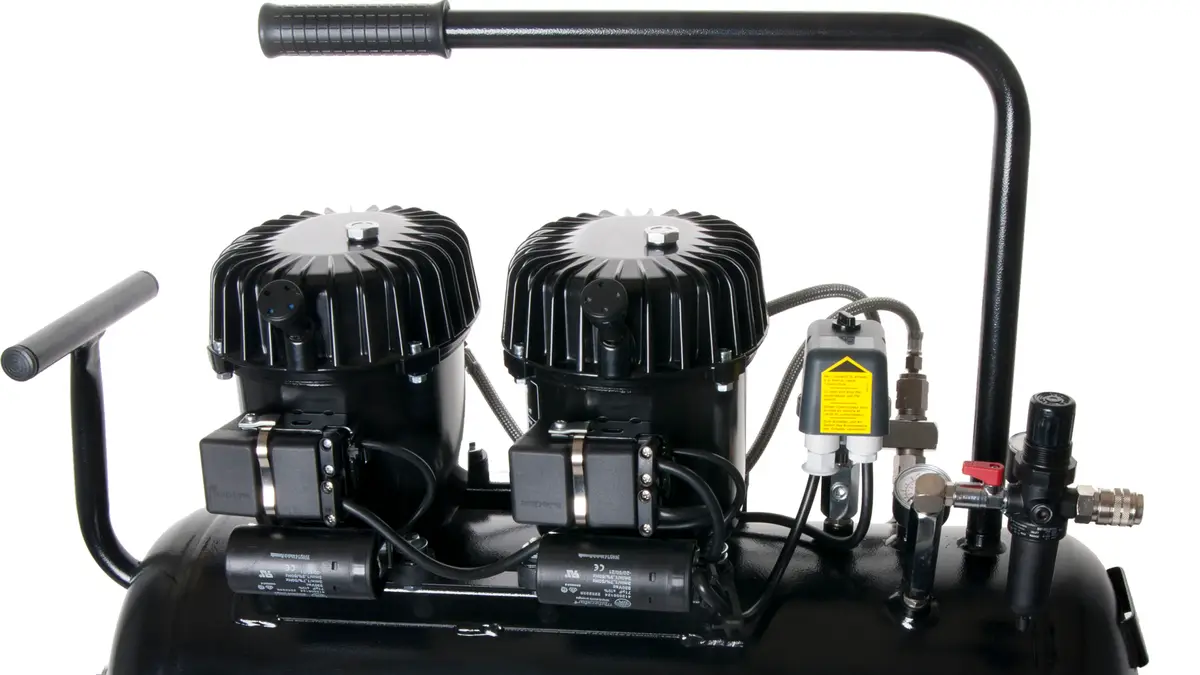
A 2 HP air compressor, the most common size for homes and small workshops, draws about 1,492 watts while its motor is running. At the BT1 residential tariff of CGE for October 2026, CLP 255.27 per kWh, one hour of motor time costs about CLP 381, and filling a 50-litre tank from empty about CLP 29. A 12 V car inflator, by contrast, uses just 120 W and costs next to nothing to run.
The key to working out what an air compressor costs is that its motor does not run all the time: it starts when tank pressure drops and stops when it reaches the maximum. What matters is how many hours of motor time it adds up over a month, not how long it stays plugged in. This guide covers consumption by power rating, the monthly cost by type of use, prices in Chile as of 16 November 2026 and which compressor suits each job.
View the data as a table
| 2 HP compressor | 1,492 W |
| One hour of motor time | $381 |
| Filling a 50 L tank | $29 |
| 12 V car inflator | 120 W |
How much electricity an air compressor uses by power rating
Home compressors are sold by their power in horsepower (HP). Each HP equals 746 watts, so a 1.5 HP unit draws about 1,119 W, a 2 HP one about 1,492 W and a 3 HP one about 2,238 W. It is an approximation: actual consumption can be somewhat higher because of motor losses, and on cheap units the HP figure is often nominal. The simplest way to know your own unit's consumption is to put a plug-in energy meter between the socket and the compressor.
The cost uses the usual formula: watts × motor hours ÷ 1,000 = kWh, then kWh × price per kWh. One hour of motor time on a 2 HP compressor is 1.49 kWh, about CLP 381.
| Compressor | Approximate power | kWh per motor hour | Cost per motor hour |
|---|---|---|---|
| 12 V car inflator | 120 W | 0.12 kWh | CLP 31 |
| Quiet 360 W, 11 litres | 360 W | 0.36 kWh | CLP 92 |
| 1.5 HP | 1,119 W | 1.12 kWh | CLP 286 |
| 1.6 HP | 1,193 W | 1.19 kWh | CLP 305 |
| 2 HP | 1,492 W | 1.49 kWh | CLP 381 |
| 3 HP | 2,238 W | 2.24 kWh | CLP 571 |
Source: Energía Futura calculation with CGE's October 2026 BT1 tariff (CLP 255.27 per kWh). Wattage for HP-rated units was estimated with 1 HP = 746 W. The 12 V inflator figure is 10 amps at 12 volts, as stated for the Ingco AAC1408.
What an air compressor costs per month
For someone who uses it now and then, to pump up bicycle tyres, blow off dust or paint a fence, an air compressor costs little to run. With 2 hours of motor time a month, a 2 HP unit uses about 3 kWh, around CLP 762. Used one hour a week, it rises to 6.4 kWh, about CLP 1,638 a month.
The picture changes in a workshop. A 2 HP compressor adding up 20 motor hours a month uses about 29.8 kWh, around CLP 7,617, and one working two hours a day over 22 working days reaches 65.6 kWh, about CLP 16,758 a month.
| Use | Motor hours per month | kWh per month | Cost per month |
|---|---|---|---|
| Hobby | 2 | 3.0 | CLP 762 |
| One hour a week | 4.3 | 6.4 | CLP 1,638 |
| Small workshop | 20 | 29.8 | CLP 7,617 |
| Workshop: 2 h a day, 22 days | 44 | 65.6 | CLP 16,758 |
Source: Energía Futura calculation for a 2 HP (1,492 W) compressor at CGE's October 2026 BT1 tariff. Hours are motor-on time, not tool time: with a large tank, the motor rests much of the time.

What it costs to fill the tank
A 50-litre tank at 8 bar holds the equivalent of about 400 litres of air at normal pressure. 2 HP compressors state an air flow of 124 to 135 litres per minute, but that is the air they draw in; what they actually deliver is usually quite a bit lower. In practice, filling the tank from empty takes 4 to 5 minutes of motor time, about 0.11 kWh and around CLP 29. A 24-litre tank fills in half the time.
This explains why a large tank does not cost more to run: electricity goes into compressing the air you actually use. What changes with tank size is how often the motor starts and how long it rests between starts, which matters for its service life.
Air compressor for cars: how much the 12-volt type uses
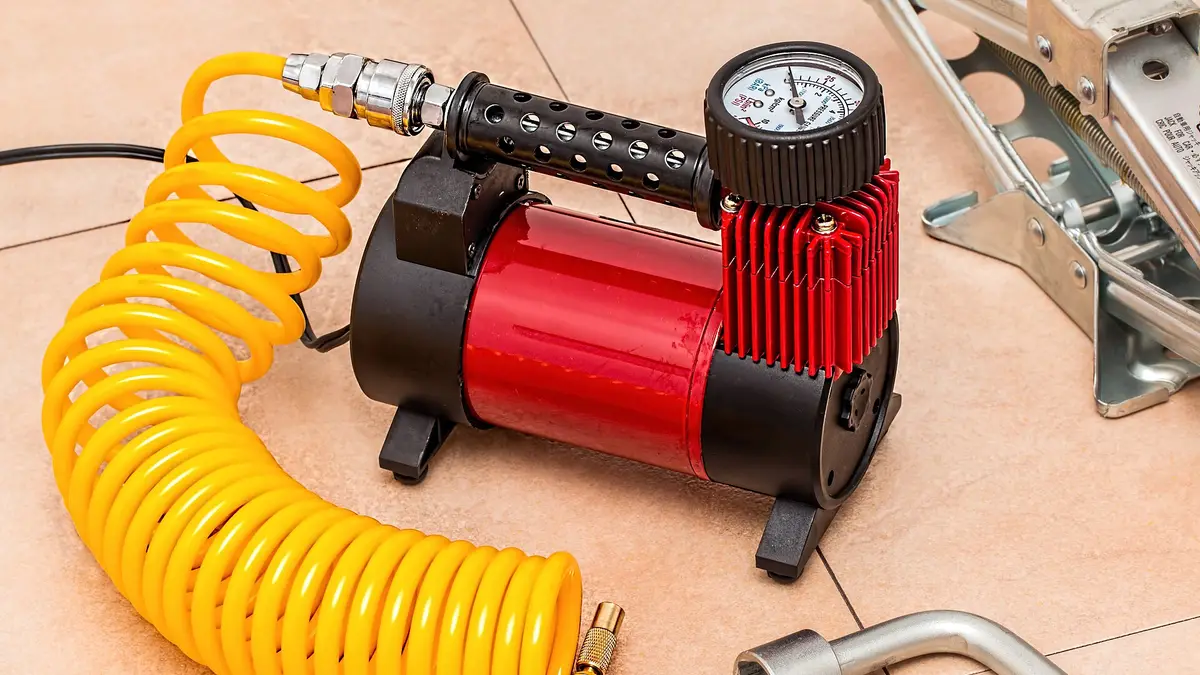
Air compressors for cars (also called tyre inflators) plug into the vehicle's 12 V socket or run on a rechargeable battery. A model such as the Ingco AAC1408 works at 10 amps, about 120 watts. Inflating all four tyres, at roughly four minutes each, uses about 32 watt-hours: the energy comes from the car battery and, with the engine running, from the alternator, so its fuel cost is minimal.
What is worth checking is that the maximum pressure (100 to 160 psi) is enough for your vehicle, that it has a digital gauge with automatic cut-off and that the cable reaches the rear wheels. Keeping the right pressure also saves energy: an under-inflated tyre raises rolling resistance and fuel use, or battery use in an electric car.
Does your company sell tools, compressors or efficient equipment? Reach Energía Futura's readers.
See advertising optionsPrices in Chile
On Falabella.com, as of 16 November 2026, 12 V inflators start at about CLP 15,000 and well-known brands cost between CLP 39,990 and CLP 59,990. Electric tank compressors range from CLP 96,022 (11 litres, oil-free) to CLP 1,499,990 (300 litres, 3 HP). A 2 HP, 50-litre unit, the most versatile for home use, costs between CLP 139,990 and CLP 252,690 depending on the brand.
| Model | Type | Power | Tank | Price |
|---|---|---|---|---|
| Ingco AAC1408 | 12 V car inflator | 120 W | — | CLP 39,990 |
| Ubermann 0211153A | Quiet oil-free | 360 W | 11 L | CLP 96,022 |
| Daewoo DAAC24DN | Piston | 2 HP | 24 L | CLP 125,900 |
| Daewoo DAAC50DN | Piston | 2 HP | 50 L | CLP 139,990 |
| Bauker 3305059 | Quiet oil-free | 1.6 HP | 50 L | CLP 179,990 |
| Indura Huracán 1520 | Piston | 2 HP | 50 L | CLP 252,690 |
| Indura Huracán 3100 | Piston | 3 HP | 100 L | CLP 669,990 |
Source: prices listed on Falabella.com on 16 November 2026 (lowest available price, which may be a sale or card price). Power is as stated on each listing.
| Ingco AAC1408 (12 V) | Car inflator | 120 | No data | 39,990 |
| Black+Decker 12 V 160 psi | Car inflator | No data | No data | 49,990 |
| Xiaomi Mijia Air Compressor 2 Pro | Battery inflator | No data | No data | 59,990 |
| Ubermann 0211153A | Quiet oil-free | 360 | 11 | 96,022 |
| Daewoo DAAC24DN (2 HP) | Piston | 1,492 | 24 | 125,900 |
| Daewoo DAAC50DN (2 HP) | Piston | 1,492 | 50 | 139,990 |
| Bauker 3305059 (1,6 HP) | Quiet oil-free | 1,193 | 50 | 179,990 |
| Indura Huracán 1520 (2 HP) | Piston | 1,492 | 50 | 252,690 |
| Indura Huracán 3100 (3 HP) | Piston | 2,238 | 100 | 669,990 |
| Hyundai 78HYAC300C (3 HP) | Piston | 2,238 | 300 | 1,499,990 |
Which one to buy for each job
- To inflate tyres and balls: a 12 V or battery inflator is enough. You don't need a tank.
- For blowing, nail guns or staplers: a quiet 24-litre, 1.5 HP compressor. Oil-free models need less maintenance.
- For spray painting or impact wrenches: at least 50 litres and 2 HP, because those tools use air continuously.
- For a workshop: 100 litres or more and 3 HP, ideally belt-driven, which run cooler and last longer.
- If neighbours are close: quiet oil-free units are much less noisy than traditional piston compressors.
Before buying, check the air flow your tool needs (in litres per minute) and choose a compressor that delivers at least 30% more. An undersized unit will run all the time, overheat and use more electricity per litre of air. Another appliance that often shares the same corner of the house is the pressure washer, which draws similar power.
How to use less electricity
The biggest hidden cost is leaks. According to a tip sheet from the US Department of Energy, leaks in poorly maintained compressed air systems can waste 20% to 30% of a compressor's output, and a reasonable target is to keep them at 5% to 10%. At home, you notice it when the motor starts on its own while nobody is using air.
View the data as a table
| Output that can be lost to leaks | 30% |
| Reasonable leak target | 10% |
- Check couplings and hoses with soapy water: where bubbles appear, there is a leak.
- Don't set the pressure higher than needed: higher pressure means more energy per litre and more leakage.
- Unplug the compressor when you finish and empty the tank, so it doesn't start overnight because of a leak.
- Drain the water from the tank as often as the manual says: it prevents rust and loss of capacity.
- Plug it straight into the wall: thin extension cords make the motor struggle to start.
To see how much the compressor weighs on your bill, multiply the kWh by the price on your own bill. What a kWh costs in each Chilean municipality is in our guide to the price of electricity per kWh in Chile.
Frequently asked questions
How much electricity does a 2 HP air compressor use?
About 1,492 watts with the motor running. One hour of motor time is 1.49 kWh, about CLP 381 at CGE's October 2026 BT1 tariff.
How much does an air compressor cost per month?
It depends on motor hours. With occasional home use, under CLP 1,000 a month; one hour a week, about CLP 1,638; and in a workshop, between CLP 7,600 and CLP 16,800.
How much does a car air compressor use?
About 120 watts (10 amps at 12 volts). Inflating all four tyres takes about 32 watt-hours, practically free.
Does a bigger tank use more electricity?
Not in normal use: the compressor spends energy according to the air you use. A large tank means the motor starts less often, though the first fill takes longer.
How much does an air compressor cost in Chile?
As of 16 November 2026, from about CLP 15,000 for a 12 V inflator and from CLP 96,022 for an electric tank unit. A 2 HP, 50-litre model costs between CLP 139,990 and CLP 252,690.