The power supply tender that will set part of what Chilean households pay for electricity from 2029 is entering its final stretch. Generators have until 4 December 2026 to bid in Supply Tender 2026/01, which seeks to contract 2,625 GWh a year for 15 years for the regulated customers of 14 distribution companies and cooperatives, according to the tender page run by Empresas Eléctricas AG.
The process comes with a new rule. The economic evaluation will include a 40% uncovered-energy threshold in the first award stage, consultancy SPEC, which built the award tool with the National Energy Commission (CNE), told Energía Estratégica on 25 November. The change follows two tenders in a row in which Enel Generación Chile took 100% of the energy.
View the data as a table
| Energy tendered per year | 2,625 GWh |
| Length of each contract | 15 years |
| Uncovered-energy threshold | 40% |
| Bid deadline | 4 December |
What is on offer in the 2026/01 supply tender
There are two blocks. Supply Block No. 1 totals 1,470 GWh a year from 1 January 2029 to 31 December 2043. Block No. 2 totals 1,155 GWh a year from 1 January 2030 to 31 December 2044. Each block is split into four zones and three time blocks: A, from 23:00 to 07:59; B, from 08:00 to 17:59; and C, from 18:00 to 22:59.
Zone 2, which groups the demand of Enel Distribución, Chilquinta and other central utilities, accounts for 1,993 GWh a year, or 76% of the total. Time block B, the daylight hours, is the largest in every zone. The buyers are CGE, Enel, Chilquinta, LuzOsorno, Litoral, Emelca, Frontel, EEPA, Edecsa, LuzParral, SAESA, Codiner and the cooperatives Socoepa and Crell.
| Zone | Block 1 (2029-2043) | Block 2 (2030-2044) | Total |
|---|---|---|---|
| Zone 1 (north, CGE demand) | 70 GWh | 55 GWh | 125 GWh |
| Zone 2 (centre) | 1,116 GWh | 877 GWh | 1,993 GWh |
| Zone 3 (south-centre) | 212 GWh | 167 GWh | 379 GWh |
| Zone 4 (south) | 72 GWh | 56 GWh | 128 GWh |
| Total | 1,470 GWh | 1,155 GWh | 2,625 GWh |
Source: Empresas Eléctricas AG, description of Supply Tender 2026/01 (accessed 27 November 2026). Annual energy in GWh.
View the data as a table
| Block A (23:00-07:59) | Block B (08:00-17:59) | Block C (18:00-22:59) | |
|---|---|---|---|
| Zone 1 (north) | 39 | 55 | 31 |
| Zone 2 (centre) | 616 | 884 | 493 |
| Zone 3 (south-centre) | 118 | 168 | 93 |
| Zone 4 (south) | 38 | 57 | 33 |
The volume is smaller than announced in July. In its RENMAD presentation, the CNE spoke of 1,575 GWh for block 1 and 1,260 GWh for block 2, 2,835 GWh in total. On 2 October the Commission approved amendments to the tender rules through Exempt Resolution No. 546, to address questions and reflect the best available information. The current tender page shows 2,625 GWh, 210 GWh less; the CNE did not explain the reason in its statement.
The new 40% threshold in the supply tender
Until now, any energy left unawarded in the first stage was valued at the reserve price, the maximum the CNE will accept. Under the new rule, if uncovered energy is below 40%, it is valued at the base-case price: the cheapest combination of bids that keeps the number of awarded sub-blocks equal across each zone's three time slots. If the uncontracted volume is 40% or more, the reserve price still applies.
Any remaining energy goes to an auction, where the priority is to contract as much as possible and, among combinations with the same coverage, pick the lowest price. The combined result of both stages must beat the base case; if not, the base case is awarded. In one of SPEC's seven simulated scenarios, the second stage reached US$65.2 per MWh, against US$65.9 in the initial case.
The organisers acknowledged that the rule does not guarantee more diversity among winners. Asked about it, they said that if applied to the 2023 and 2025 tenders it would probably produce the same result, because the cheapest bid also covered all the demand. What it does is widen the room for the auction to work when the first stage does not cover everything.
| Outcome of the first stage | How uncovered energy is valued | What happens next |
|---|---|---|
| Uncovered energy below 40% | At the base-case price | Remaining energy goes to auction |
| Uncovered energy 40% or more | At the reserve price, as in 2025 | Remaining energy goes to auction |
| Two-stage result worse than the base case | - | The base case is awarded |
Source: SPEC and CNE, via Energía Estratégica, 25 November 2026.
Why it matters: Enel won the last two tenders
In Tender 2025/01, awarded in December 2025, six companies submitted 708 bids for 3.9 times the energy required, and Enel Generación Chile took 100% of the 3,360 GWh a year at US$64.499 per MWh, the CNE reported. Enel filed 384 bids; Colbún, 120; Guacolda, 93; BTG Pactual, 72; GR Power, 27; and Evol, 12. In 2023/01, the same company won all 3,600 GWh at US$56.679 per MWh.
Prices remain far above the 2021 record, when tender 2021/01 closed at an average of US$23.78 per MWh with 29 companies bidding, according to the Energy Ministry. Even so, the CNE noted that the 2025 price came in below the average of contracts in force in 2026, of US$92.3 per MWh. Tender contracts underpin the price regulated customers pay, as seen in the 4.4% cut in electricity bills from January.
What comes next: bids on 4 December and award in January
Companies can buy the tender documents until 4 December itself, for 100 UF plus VAT in Chile or US$5,000 from abroad. The CNE expects to award in January 2027. Bids can be backed by power plants or storage systems, existing or new, and the rules require progress milestones such as financial close for committed projects. SPEC said its scenario-simulation tool will be available to bidders.
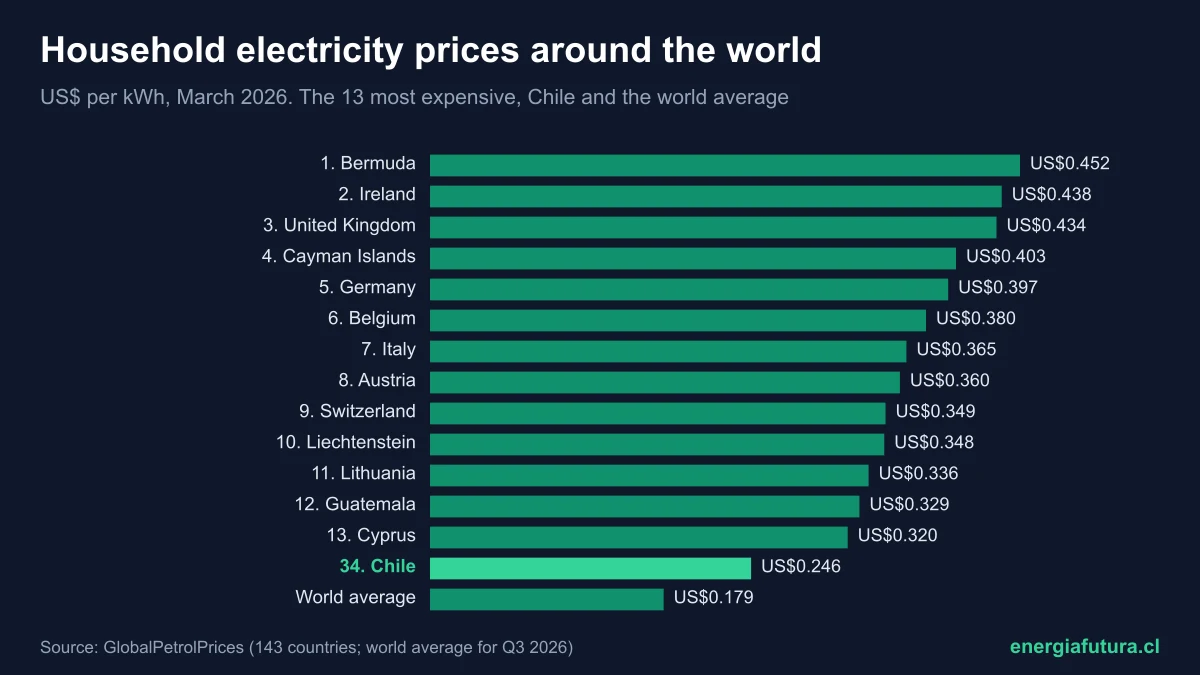
The outcome will weigh on bills in a country where power is already expensive for the region: in March Chile had the fourth most expensive residential electricity in Latin America, at US$0.262 per kWh, as shown in our ranking of electricity prices in the region. Since these contracts start in 2029 and 2030, their price will not show up on bills before then.
Another open front for energy costs is system guarantees: Enel Generación took to the Panel of Experts a calculation that would raise costs for 2027, as we explained in our story on the 2027 guarantees.
- 20 July 2026Tender rules publishedTwo blocks totalling 2,835 GWh a year are announced.
- 28 AugustDeadline for questions
- 2 OctoberCNE amends the rules (Exempt Res. 546)
- 4 DecemberLast day to submit bids
- January 2027Contracts awarded
- 1 January 2029Block 1 starts (1,470 GWh/yr)
- 1 January 2030Block 2 starts (1,155 GWh/yr)
Does your company generate, trade or advise on power contracts? Reach Energía Futura's readers.
See advertising optionsFrequently asked questions
What is supply tender 2026/01?
It is the process run by the CNE so that utilities can sign long-term energy contracts for their regulated customers. This time it seeks 2,625 GWh a year for 15 years, starting in 2029 and 2030.
What is the bid deadline?
4 December 2026. The award is expected in January 2027.
What does the 40% threshold change?
If less than 40% of the energy is left uncovered after the first stage, that energy is valued at the base-case price rather than the reserve price. That widens the room for the auction to award the rest.
At what price was the previous tender awarded?
Tender 2025/01 went entirely to Enel Generación Chile at US$64.499 per MWh.