Chile's power system now has almost nine times more fast-response reserves than on the day of the 2025 total blackout. Verified reserves to stabilise grid frequency rose from 368 MW in February 2025 to 3,223 MW in November 2026, the executive director of the national grid operator, the Coordinador Eléctrico Nacional, Ramón Castañeda, said at the “Resilience of Energy Infrastructure” seminar held by the Senate Mining and Energy Committee on Monday 23 November.
The other half of the message was a warning: according to the October 2026 compliance report, 222 of the 879 companies assessed (25.3%) have gaps in the technical standards the Coordinador monitors. “Our goal is for the gaps we have identified to translate into concrete and timely corrective action,” Castañeda said, according to the operator's statement.
View the data as a table
| Reserves to stabilise frequency | 3,223 MW |
| Voltage control from solar and wind | 540 MVAr |
| Batteries supporting frequency | 16 |
| Time with frequency out of range | 1.23% |
What happened in the blackout of 25 February 2025
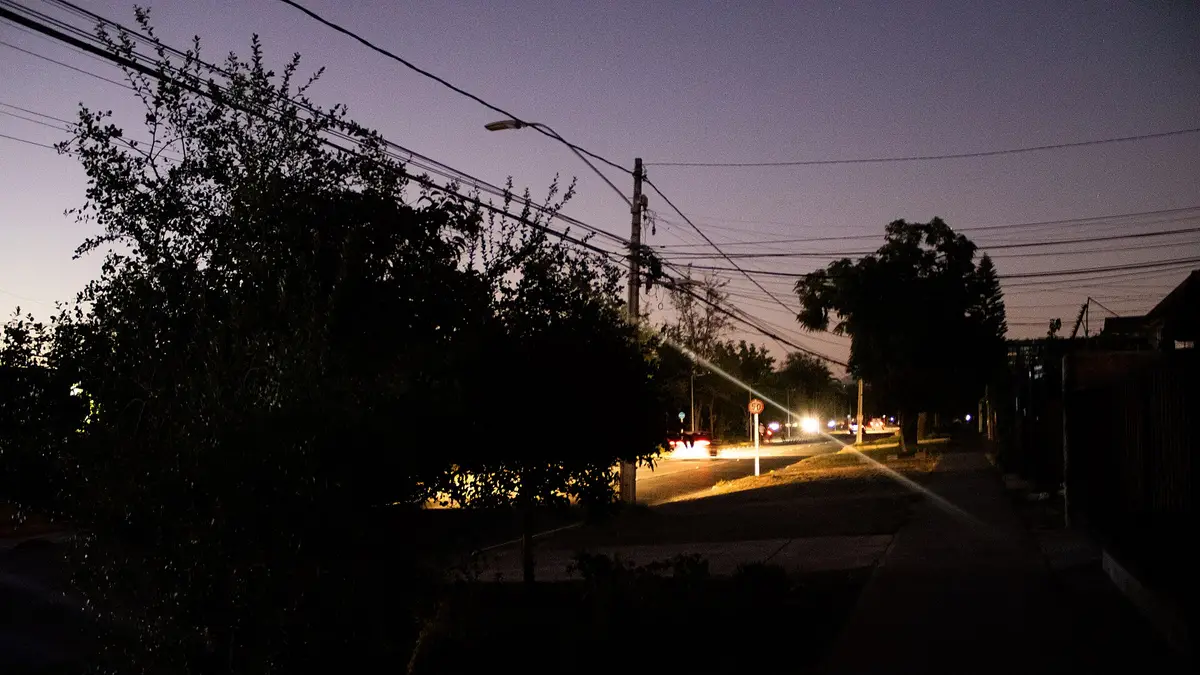
The presentation the Coordinador took to the Senate sums up the sequence. At 15:15 that Tuesday, an unauthorised intervention on a 500 kV line tripped both of its circuits. Seconds later the system split into two islands, North and Centre-South. Before the collapse, the companies' contingency-control resources performed poorly and 1,350 MW of power plants disconnected too early. The result was a total loss of supply from Arica to Chiloé.
Speakers at the seminar recalled that the outage hit 98.5% of the country's customers, according to Revista Electricidad. The line involved was the Nueva Maitencillo-Nueva Pan de Azúcar section, run by ISA InterChile. The case is still in the courts: an appeals court overturned the SEC's fines on the Coordinador's board members over the event.
That diagnosis produced four lines of action: prevent (anticipate risks so a fault does not happen), contain (stop a fault from spreading to the whole system), recover (restore supply safely and quickly) and learn (analyse every fault and enforce compliance). On that basis the operator drew up a 20-measure plan, presented in August 2025, plus immediate instructions to companies.
What has changed in the grid since the blackout
The Coordinador expects 90% of the 20 measures to be fully in place by 31 December 2026. The results it showed the Senate are already visible in day-to-day operation and go beyond frequency reserves:
- Voltage control from solar and wind plants: from 0 MVAr in February 2025 to 540 MVAr in November 2026, with 721 MVAr expected by December.
- Batteries helping to stabilise frequency: from none to 16 systems.
- Time with frequency outside its normal range: halved, from 2.47% to 1.23%.
- Visible distributed generation: since August 2026 a platform shows 481 small-generator (PMGD) companies online, with 3,983 MW.
- Training: 377 professionals from more than 100 companies trained in the work-permit and risk system.
| Indicator | February 2025 | November 2026 |
|---|---|---|
| Verified frequency-stabilisation reserves | 368 MW | 3,223 MW |
| Voltage control from solar and wind plants | 0 MVAr | 540 MVAr (721 expected by December) |
| Battery systems supporting frequency | 0 | 16 |
| Time with frequency out of range | 2.47% | 1.23% |
Source: Coordinador Eléctrico Nacional, presentation to the Senate, 23 November 2026. At the seminar, Castañeda rounded the reserves to 3,200 MW.
The PMGD platform is behind one of the hottest disputes of the month. After a fault on 8 November, the Coordinador capped the output of a group of small generators at 15%, and the industry took the matter to the regulator: independent generators filed a complaint against the Coordinador with the SEC over that restriction.
The national drill of 26 August
One milestone the Coordinador highlighted was the national service-restoration drill of 26 August 2026. The exercise assumed a total blackout, but everything was simulated without touching real supply. It took six months of preparation, involved 44 control centres and more than 200 people, ran for 5 hours 35 minutes of actual exercise and produced 4,762 records of instructions, communications and confirmations.
Four stages were tested: activating the plan and coordinating companies, starting power plants without external power (black start), progressively joining the restored areas, and reconnecting networks to bring back essential loads first. Among the lessons, the operator noted the need for more staff to run parallel manoeuvres, clearer communication protocols and more automation. Its conclusion is that the drill should be repeated every year.
The general manager of transmission company Transelec, Arturo Le Blanc, told the seminar that a full recovery currently takes 13 to 18 hours, helped by interconnection, black-start capability and thermal plants able to island themselves and pick up load again. For a household, that window is what justifies having its own backup, such as an emergency solar kit.
- 25 Feb 2025, 15:15Blackout from Arica to ChiloéAn unauthorised intervention on a 500 kV line splits the system into two islands.
- Aug 202520-measure plan
- Aug 2026Platform to monitor PMGD481 companies and 3,983 MW visible online.
- 26 Aug 2026National blackout drill44 control centres and 5 h 35 min of exercise.
- 23 Nov 2026Senate seminar
- 18 Dec 2026Meeting with Argentina, Bolivia and PeruGrid integration, Minister Rincón announced.
- 31 Dec 202690% of the plan in place
The compliance gaps that worry the grid operator
The figure of 222 companies with gaps comes from the monthly monitoring the Coordinador has run since June 2026. Most of those gaps concern information: fuel stocks, costs and availability, wind and solar forecasts, real-time operating data and energy-balance data. The operator stresses that they are not necessarily administrative offences, but they can hamper scheduling and supervision of the system.
The more sensitive gaps are technical: automatic schemes and defence plans, checks on ancillary services, supervision tests and pending corrective measures. For those cases the Coordinador turns to the SEC, the power and fuels regulator. In 2026 it sent 6 letters on possible breaches involving 43 different companies. The broadest, dated 7 October, named 30 companies with pending upgrade plans and reports on how they respond to voltage dips.
| Letter to the SEC | Matter | Companies |
|---|---|---|
| CD00035-26, 11 Mar | Cardones-Polpaico audit: incomplete records | 1 |
| CD00059-26, 15 Apr | Project injecting power without commissioning approval | 1 |
| CD00102-26, 19 Jun | Available-power signal: missing or poor data | 12 |
| CD00112-26, 22 Jul | Ancillary-services checks: delays | 5 |
| CD00152-26, 4 Sep | Secondary frequency control: integration pending | 6 |
| CD00184-26, 7 Oct | Response to voltage dips: pending upgrades | 30 |
Source: Coordinador Eléctrico Nacional, annex to the Senate presentation. The six letters add up to 55 mentions but 43 distinct companies, because some appear in more than one.
How to avoid another blackout: what was said in the Senate

The committee chair, Senator Yasna Provoste, said the discussion should lead to proposals to “design next year's legislative agenda”. Energy Minister Ximena Rincón said that “Chile is still an island” and announced that on 18 December she will meet the energy ministers of Argentina, Bolivia and Peru to move forward on grid integration. Her legislative priorities are, first, a grid reform and then a comprehensive law against cable theft, since the current rule, she said, is 44 years old.
From academia, Rodrigo Moreno (UAI and the Enlace Energy Centre) said Chilean customers lose supply for about 15 hours a year, compared with about two hours in Italy, and that an extreme-contingency plan for the north is still pending. Juan Meriches, of the distributors' association Empresas Eléctricas, argued that the theoretical “efficient company” model used to set distribution tariffs gives too little incentive to invest in resilient networks. Javier Jorquera, an analyst at the International Energy Agency, summed up: “The key is to expand and modernise the grids.”
That expansion is one of the bottlenecks. The Coordinador's latest report showed that a third of transmission works go unawarded because of price caps, while batteries are growing fast and already provide frequency services that did not exist in 2025.
Does your company offer power backup, batteries or grid-security services? Reach Energía Futura's readers.
See advertising formatsFrequently asked questions
What caused Chile's blackout of 25 February 2025?
According to the Coordinador, an unauthorised intervention on a 500 kV line tripped both circuits; the system split into two islands and 1,350 MW of plants dropped out too early, leading to the total outage from Arica to Chiloé.
Could a total blackout happen again?
The operator does not rule out contingencies, but says the system now has more resources to contain them: 3,223 MW of fast reserves, 16 batteries supporting frequency and voltage control from renewable plants.
What are compliance gaps?
Technical or information obligations a company in the system has not met on time. In October 2026 they affected 222 of 879 companies; the most serious are reported to the SEC, which inspects and sanctions.
When will the 20-measure plan be complete?
The Coordinador expects 90% to be in place by 31 December 2026. Still under way are, among others, the expansion of phasor measurement and the EDAG defence scheme in the North and Centre-South zones.