A string of 100 LED lights draws around 7 W. Lit five hours a night for 30 days, it uses 1.08 kWh, or about CLP 276 for the whole season, with power at CLP 255.27 per kWh (CGE's BT1 residential rate in Chile since October 2026). A string of 100 incandescent mini lights draws about 48 W and, with the same use, costs CLP 1,838: almost seven times more. And the old large C7 bulbs, at 6 W each, can push the bill to several thousand pesos.
This guide calculates how much electricity Christmas lights use by type, what it costs to decorate the tree and the front of the house, when it makes sense to switch to LED or solar lights and what to check before buying, because Chile's Superintendency of Electricity and Fuels (SEC) cracks down every December on the sale of uncertified light strings.
How much electricity Christmas lights use by type
The difference between one string and another lies in the technology of each bulb. According to a fact sheet by the US Western Area Power Administration published by Cornell Cooperative Extension (2013), an incandescent mini light draws 0.48 W, a large flame-shaped incandescent C7 bulb 6 W, and a multicolour LED C7 just 0.08 W. The Energy Star specification for light strings requires each LED lamp to draw no more than 0.2 W.
In Chilean stores, the wattage appears on the product sheet. For example, the 100-light multicolour LED string sold by Easy, 4.95 metres long, is rated at 7.2 W at 220 V and cost CLP 17,990 as of 30 October 2026. That is 0.072 W per light, within the typical range for LEDs.
| Type of light | Power per lamp | Power of a 100-light string | Source |
|---|---|---|---|
| LED (Easy string) | 0.072 W | 7.2 W | Easy product sheet, October 2026 |
| Multicolour LED C7 | 0.08 W | 8 W | Western/Cornell (2013) |
| Energy Star limit for LED | 0.2 W maximum | 20 W maximum | Energy Star |
| Incandescent mini light | 0.48 W | 48 W | Western/Cornell (2013) |
| Incandescent C7 bulb | 6 W | 600 W | Western/Cornell (2013) |
Power of a 100-light string calculated by Energía Futura from the power per lamp. Incandescent C7 strings usually come with 25 bulbs, not 100: one of that size draws 150 W. The Energy Star programme estimates that a certified LED string uses 75% less energy than an incandescent one; with the product sheets in this table, the gap is even wider.
How much Christmas lights cost in Chilean pesos
The calculation is power times hours of use times the price per kWh. For the table we use typical December use: five hours a night (for example, from 8 pm to 1 am) for 30 days, or 150 hours over the season.
| String | Power | Cost per night (5 hours) | Cost for the season (30 nights) |
|---|---|---|---|
| 100 LED lights | 7.2 W | CLP 9 | CLP 276 |
| 25 LED C7 bulbs | 2 W | CLP 3 | CLP 77 |
| 100 incandescent mini lights | 48 W | CLP 61 | CLP 1,838 |
| 25 incandescent C7 bulbs | 150 W | CLP 191 | CLP 5,744 |
Energía Futura calculations with power at CLP 255.27 per kWh, rounded. The price per kWh varies by municipality and distribution company, as shown in the price of a kWh in Chile by municipality and utility. With a more expensive kWh, the cost rises in the same proportion.
The bottom line: with LEDs, the electricity cost of a string is almost irrelevant, about CLP 9 a night. With incandescent bulbs it is not, especially the large ones: 25 C7 bulbs use as much in one night as 20 LED strings of 100 lights.
What it costs to light the tree and the house
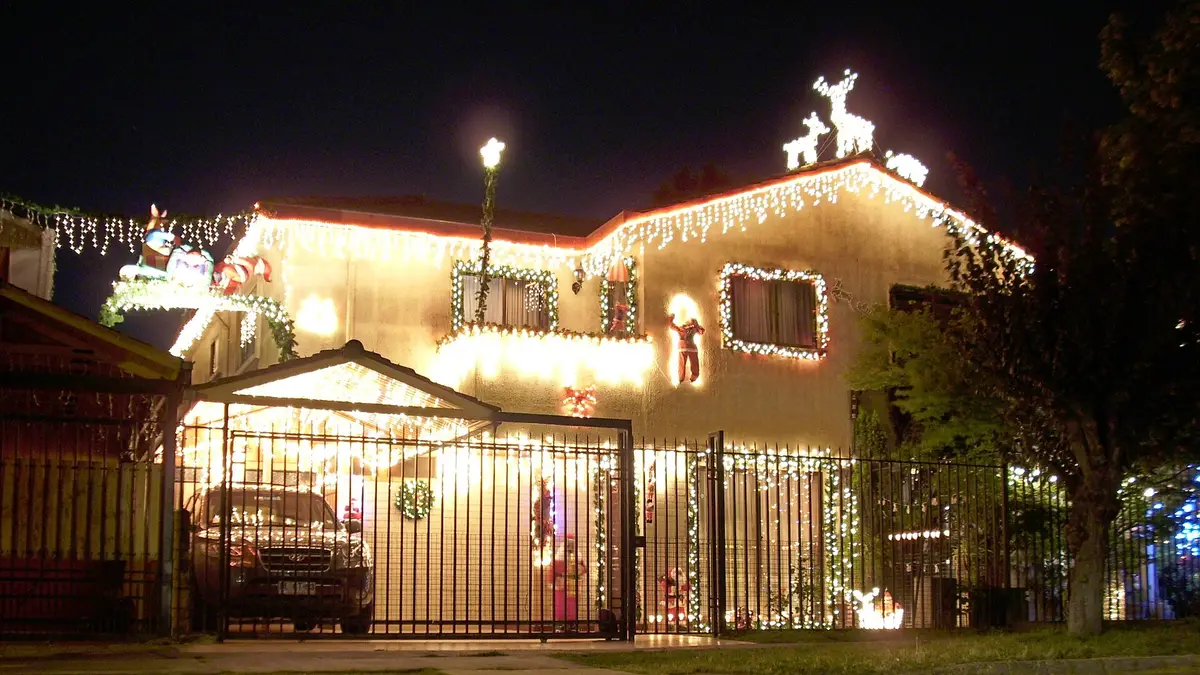
A Christmas tree about two metres tall usually carries around 300 lights, or three strings of 100. A house with a decorated front can reach 1,000 lights or more. The table compares both scenarios with LED and incandescent mini lights, and adds the case of a string left on 24 hours a day.
| Scenario | Total power | Energy over the season | Cost for the season |
|---|---|---|---|
| Tree with 300 LED lights (5 h a night) | 21.6 W | 3.24 kWh | CLP 827 |
| Tree with 300 incandescent lights (5 h a night) | 144 W | 21.6 kWh | CLP 5,514 |
| House front with 1,000 LED lights (5 h a night) | 72 W | 10.8 kWh | CLP 2,757 |
| House front with 1,000 incandescent lights (5 h a night) | 480 W | 72 kWh | CLP 18,379 |
| 100 LED lights on 24 hours a day (30 days) | 7.2 W | 5.18 kWh | CLP 1,323 |
Energía Futura calculations with 30 days of use and power at CLP 255.27 per kWh. The 300-light incandescent tree matches the 144 W that the Western/Cornell fact sheet reports for a standard string of 300 mini lights.
To put it in perspective: a house front with 1,000 incandescent lights adds 72 kWh in December, almost 40% of the 180 kWh a month that Chile's National Energy Commission uses as the reference consumption of a household. With LEDs, the same display adds 10.8 kWh, around 6%. The guide to how much electricity a home in Chile uses each month explains that average and which appliances drive it.
Is it worth replacing incandescent strings with LED?
On the electricity bill alone, it does not pay off in one season: replacing a 100-light incandescent string with an LED one saves about CLP 1,560 a year with the use in the table, and a 100-light LED string costs around CLP 18,000. The reasons to switch are others: LEDs barely heat up, are sturdier and last more seasons, which lowers the fire risk on a natural tree or a paper ornament. Where there is a clear saving is with the large C7 bulbs: 25 of them cost CLP 5,744 a season, against CLP 77 for their LED equivalents.
Does your company sell LED lighting, certified decorations or solar products? Reach Energía Futura's readers.
See advertising formatsSolar and battery-powered strings: when they make sense
Solar strings come with a small panel and a battery that charges during the day and switches the lights on at dusk. They use no grid electricity and, according to the SEC, do not need the SEC seal, because they are not connected to the grid. They work well on patios, fences and gardens in direct sun. Their limit is the battery: on a cloudy day or with the panel in the shade, they last fewer hours.
Battery-powered lights do not need the SEC seal either, but they do have a cost: a set of batteries can cost more than all the electricity an LED string uses over the season. They suit one-off decorations, such as wreaths, centrepieces or places without a socket, not a whole tree. For anyone who wants to take solar power beyond decorations, the guide to what a home solar kit includes and what it costs shows the options.
What Chile's SEC requires: the SEC seal
In Chile, light strings that plug into the grid must have a safety certification and the SEC seal, with a QR code to verify it. Between January and November 2025, 545,067 light strings were certified, 5% more than in the same period of 2024, the Ministry of Energy and the SEC reported on 3 December 2025.
Enforcement is also large-scale. In the same statement, the SEC reported charges against 25 importers for bringing in more than 122,000 kilos of uncertified strings, over 600,000 units. In the Valparaíso region it found uncertified lights and boxes tampered with to look certified, and ordered them pulled from sale.
- Look for the SEC seal on the box and scan the QR code to confirm the certification is genuine.
- Buy from established retailers and ask for a receipt: products carry a six-month legal warranty, according to consumer agency Sernac.
- For outdoor use, check that the box says «Para uso exterior» (for outdoor use).
- Inspect strings from previous years and throw away any with cut wires or cracked bulbs.
- Unplug lights and extension cords when leaving home or going to bed, as the SEC and the Ministry of Energy recommend.
How to spend less on Christmas lights
- Choose LED: going by the Easy product sheet, a 100-light LED string costs CLP 9 a night; an incandescent one, CLP 61.
- Use a timer or a smart plug: switching off at 1 am instead of leaving the lights on until dawn cuts consumption by more than half.
- Do not leave them on 24 hours a day: they cannot be seen in daylight, and an LED string left on all month costs CLP 1,323, almost five times more than five hours a night.
- Solar lights outdoors: on sunny patios and fences, they use no grid electricity.
- Check the wattage on the product sheet: between two similar LED strings, the one with fewer watts costs less.
- Do not overload the extension cord: add up the wattages and respect the maximum shown on the cord or power strip.
Frequently asked questions
How much electricity does a string of Christmas lights use?
A string of 100 LED lights draws around 7 to 8 W; one of 100 incandescent mini lights, about 48 W; and one of 25 incandescent C7 bulbs, about 150 W.
How much does it cost to keep Christmas lights on all December?
At five hours a night for 30 days, a 100-light LED string costs about CLP 276, and a tree with 300 LED lights about CLP 827, with power at CLP 255.27 per kWh. With incandescent lights, the same tree costs CLP 5,514.
Do LED Christmas lights use a lot of electricity?
No. A 100-light LED string costs about CLP 9 per five-hour night. According to Energy Star, a certified LED string uses 75% less energy than an incandescent one.
Do solar lights need the SEC seal?
No. According to the SEC, certification is mandatory only for strings that plug into the grid. Battery-powered and solar lights do not require the SEC seal.
Is it dangerous to leave Christmas lights on all night?
The SEC and the Ministry of Energy recommend unplugging lights and extension cords when going out or to bed, to cut consumption and the risk of overheating, especially with uncertified or damaged strings.