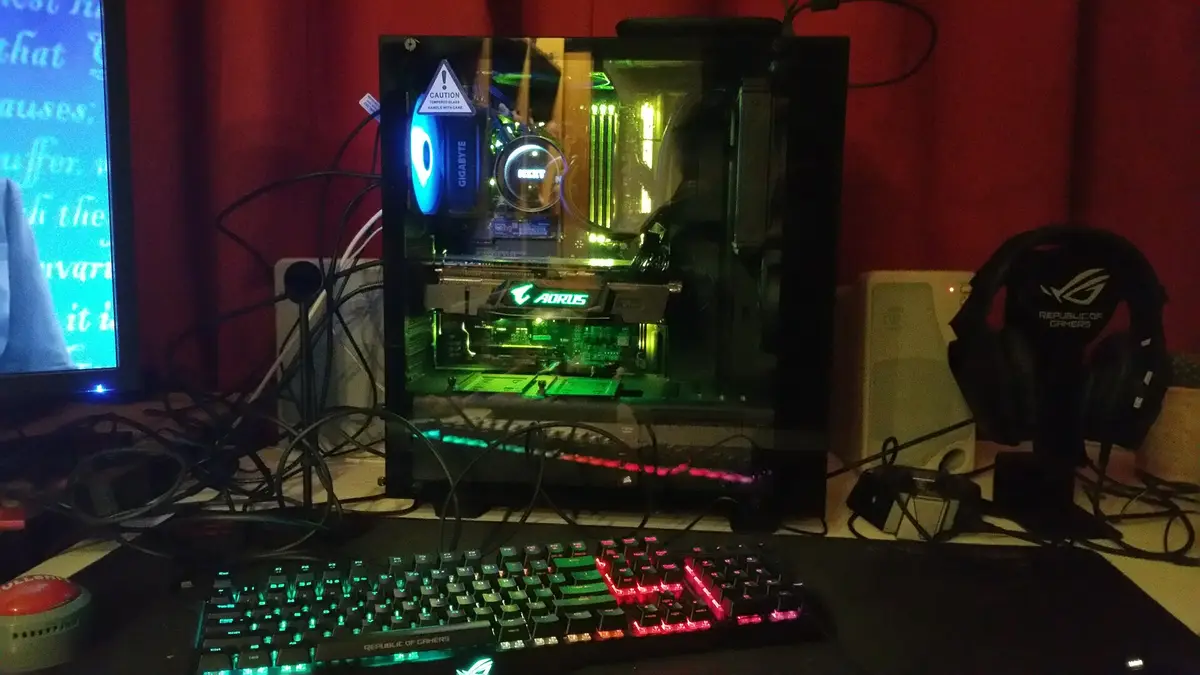
A mid-range gaming PC, with a graphics card such as the GeForce RTX 5060 (145 W), draws around 300 W while gaming, monitor included. Three hours a day add up to 27 kWh a month, or about CLP 6,900, with power at CLP 255.27 per kWh (CGE's BT1 residential rate in Chile since October 2026). A PlayStation 5 costs about CLP 5,000 with the same use, and an office laptop less than CLP 700 a month working eight hours a day.
This guide calculates how much electricity a gaming PC, a laptop and a console use, with data measured by the manufacturer or by testing labs, what each costs per month and which decisions really change the electricity bill.
How much electricity a gaming PC uses
In a gaming PC, most of the energy goes to the graphics card. Nvidia states each model's TGP (total graphics power): 145 W for the RTX 5060 and 250 W for the RTX 5070, according to Notebookcheck, and 575 W for the RTX 5090, the most powerful in the series, according to the same outlet. On top of that come the processor, motherboard, memory, fans and monitor.
Beware of the power supply rating: a 750 W or 850 W label does not mean the computer draws that much. It is the maximum capacity. A Lawrence Berkeley National Laboratory study, Taming the energy use of gaming computers (Mills and Mills, 2016), found that the actual peak consumption of complete systems was about 50% lower than the sum of their components' nameplate ratings.
| Device | Reference figure | Typical consumption gaming or under load |
|---|---|---|
| Mid-range gaming PC (RTX 5060) | 145 W card | ~300 W with monitor (estimate) |
| High-end gaming PC (RTX 5070) | 250 W card | ~450 W with monitor (estimate) |
| Enthusiast gaming PC (RTX 5090) | 575 W card | ~850 W with monitor (estimate) |
| PlayStation 5 Slim (CFI-2016) | Measured by Sony | 216.8 W |
| Gaming laptop (ASUS TUF A15 2024, RTX 4060) | 240 W charger | ~170 W (estimate) |
| MacBook Air 13 M4 | Measured by Notebookcheck | 29.9 W under load; 8.7 W idle |
Sources: Sony, PlayStation ecodesign information (three-game average in HD); Notebookcheck reviews of the MacBook Air 13 M4 and the ASUS TUF Gaming A15 2024. Consumption for the desktop PCs and the gaming laptop are Energía Futura estimates based on the graphics card's power and the rest of the components; every machine varies by configuration and game.
How much a gaming PC costs per month in Chilean pesos
The calculation is power times hours of use times the price per kWh. For gaming devices we use three hours a day for 30 days; for office devices, eight hours a day over 22 working days.
| Device and use | Energy per month | Cost per month | Cost per year |
|---|---|---|---|
| Enthusiast gaming PC, 850 W, 3 h a day | 76.5 kWh | CLP 19,528 | CLP 234,338 |
| High-end gaming PC, 450 W, 3 h a day | 40.5 kWh | CLP 10,338 | CLP 124,061 |
| Mid-range gaming PC, 300 W, 3 h a day | 27 kWh | CLP 6,892 | CLP 82,707 |
| PlayStation 5, 216.8 W, 3 h a day | 19.5 kWh | CLP 4,981 | CLP 59,770 |
| Gaming laptop, 170 W, 3 h a day | 15.3 kWh | CLP 3,906 | CLP 46,868 |
| Office PC with monitor, 80 W, 8 h on 22 days | 14.1 kWh | CLP 3,594 | CLP 43,130 |
| Office laptop, 15 W, 8 h on 22 days | 2.6 kWh | CLP 674 | CLP 8,087 |
Energía Futura calculations with power at CLP 255.27 per kWh, rounded. The price per kWh varies by municipality and distribution company, as shown in the price of a kWh in Chile by municipality and utility. Consumption for the office PC and office laptop is an estimate for tasks such as browsing, email and spreadsheets.
To put it in perspective: a high-end gaming PC used three hours a day adds 40.5 kWh a month, about 22% of the 180 kWh a month that Chile's National Energy Commission uses as the reference consumption of a household. The Berkeley study estimated that a typical gaming PC, with display, uses about 1,400 kWh a year in the United States, where people play more hours: the equivalent of ten game consoles, six standard computers or three refrigerators. At the Chilean rate, that would be about CLP 357,000 a year.
Laptop and console: how much they use by comparison
Laptops are designed to run on battery and are therefore much more efficient. The MacBook Air 13 with the M4 chip drew 8.7 W on average at idle and 29.9 W under load in Notebookcheck's tests, and its charger is rated at 30 W. A Windows office laptop usually comes with a 45 to 65 W charger, although it draws much less than that for light tasks.
Gaming laptops sit in between. The ASUS TUF Gaming A15 2024, with an RTX 4060, comes with a 240 W charger, according to Notebookcheck. While gaming it draws less than a desktop PC with an equivalent card, because its components are power-limited to avoid overheating in a thin chassis.
The PlayStation 5 is the most precise reference, because Sony publishes measurements for each model. The PS5 Slim (CFI-2016) draws 216.8 W gaming in HD and 217.7 W in 4K, averaged over three games. Streaming video, it drops to 56.3 W. The PS5 Pro (CFI-7021) measures 215.2 W in HD, practically the same.
| PS5 mode | Measured consumption (CFI-2016) | Cost per month if left that way 24 hours a day |
|---|---|---|
| Gaming (HD) | 216.8 W | Not applicable |
| Video streaming | 56.3 W | Not applicable |
| Rest mode, maximum saving | 0.31 W | CLP 57 |
| Rest mode connected to the internet | 1.2 W | CLP 220 |
| Rest mode with all features (internet and USB charging) | 3.8 W | CLP 698 |
Source of the measurements: Sony, PlayStation ecodesign information, checked on 30 October 2026. Monthly cost calculated by Energía Futura with 30 days and power at CLP 255.27 per kWh. Rest mode with downloads and USB charging enabled uses twelve times more than the saving mode, although in pesos it is still little. The same analysis applies to the TV that goes with the console: the guide to how much electricity a TV uses by screen size and standby mode calculates it by size.
Does your company sell computers, efficient components or backup power solutions? Reach Energía Futura's readers.
See advertising formatsWhat makes sense for gaming and for work
- For work and study: a laptop costs five times less than an office PC with a monitor, in the scenarios of this calculation. It is the most efficient option.
- For gaming at the lowest cost: a console uses less than a mid-range gaming PC, about CLP 5,000 a month at three hours a day, and its consumption is predictable.
- For gaming on a PC: the graphics card sets the cost. Moving from an RTX 5060 to an RTX 5070 adds around CLP 3,400 a month at three hours a day.
- Gaming laptop: uses less than a comparable desktop PC, but runs hotter and performs worse with the same card.
For a gamer, the difference on the electricity bill rarely justifies switching devices: between a console and a mid-range PC there is about CLP 1,900 a month. It matters more for people who play many hours or leave the computer on downloading or mining: a gaming PC left on 24 hours a day drawing 150 W under light load would add about 108 kWh a month, more than half a household's reference consumption.

How to cut a gaming PC's consumption
- Cap the frame rate at the monitor's maximum (for example, 60 or 144): the card stops doing unnecessary work.
- Enable power-saving mode or lower the power limit of the graphics card in its software: the Berkeley study found that efficient components can save more than 75% of the energy.
- Put the computer to sleep instead of leaving it on unused, and switch off the monitor.
- Choose an efficient power supply, with 80 Plus Gold certification or higher: it loses less energy as heat.
- On the PS5, use the maximum-saving rest mode when automatic downloads are not needed.
- Use a power strip with a switch to cut the standby draw of the monitor, speakers and peripherals.
In an area with frequent power cuts, a desktop computer loses unsaved work instantly, while a laptop keeps running on its battery. To keep the modem on and charge devices during an outage, the guide to what an emergency solar kit is and which one to choose compares portable power stations.
Frequently asked questions
How many watts does a gaming PC use?
It depends mainly on the graphics card. A mid-range machine with an RTX 5060 (145 W) draws around 300 W while gaming, monitor included; one with an RTX 5090 (575 W) can exceed 800 W.
How much does a gaming PC cost per month in Chile?
At three hours a day, a mid-range machine costs about CLP 6,900 a month and a high-end one about CLP 10,300, with power at CLP 255.27 per kWh.
Which uses more electricity, a gaming PC or a PS5?
Generally, the gaming PC. The PS5 Slim draws 216.8 W while gaming, according to Sony, and costs about CLP 5,000 a month at three hours a day, against about CLP 6,900 for a mid-range PC.
How much electricity does a laptop use?
Very little. A MacBook Air 13 M4 draws 8.7 W at idle and 29.9 W under load, according to Notebookcheck. An office laptop used eight hours on working days costs less than CLP 700 a month.
Does an 850 W power supply draw 850 W?
No. That is the maximum it can deliver. The computer only draws what its components demand, and in Lawrence Berkeley National Laboratory measurements the actual peak consumption of complete systems was about 50% lower than their nameplate rating.