An electric hand dryer is powerful, between 700 and 2,300 W, but it only runs for a few seconds. So each dry uses very little: a 2,300 W warm-air model that takes 12.5 seconds uses 0.008 kWh, about CLP 2.04 at CGE's November 2026 BT1 tariff (CLP 255.91 per kWh). Drying with two sheets of paper towel costs between CLP 12 and CLP 25, depending on the brand.
This guide calculates how much each type of hand dryer sold in Chile uses, what an office, restaurant or school washroom spends a month, and how many months it takes to pay for itself compared with paper towels. Prices are from Falabella as of 20 November 2026 and the calculations are Energía Futura's.
View the data as a table
| 2,300 W dryer (12.5 s) | $2.04 |
| 1,500 W dryer (8.5 s) | $0.91 |
| Two paper towel sheets | $11.98 |
How much power an electric hand dryer uses
Each dry's consumption is calculated as: power in watts × seconds of use ÷ 3,600,000 = kWh. A 2,300 W dryer running for 12.5 seconds uses 2,300 × 12.5 ÷ 3,600,000 = 0.008 kWh. Multiply by the price per kWh and you get the cost in pesos.
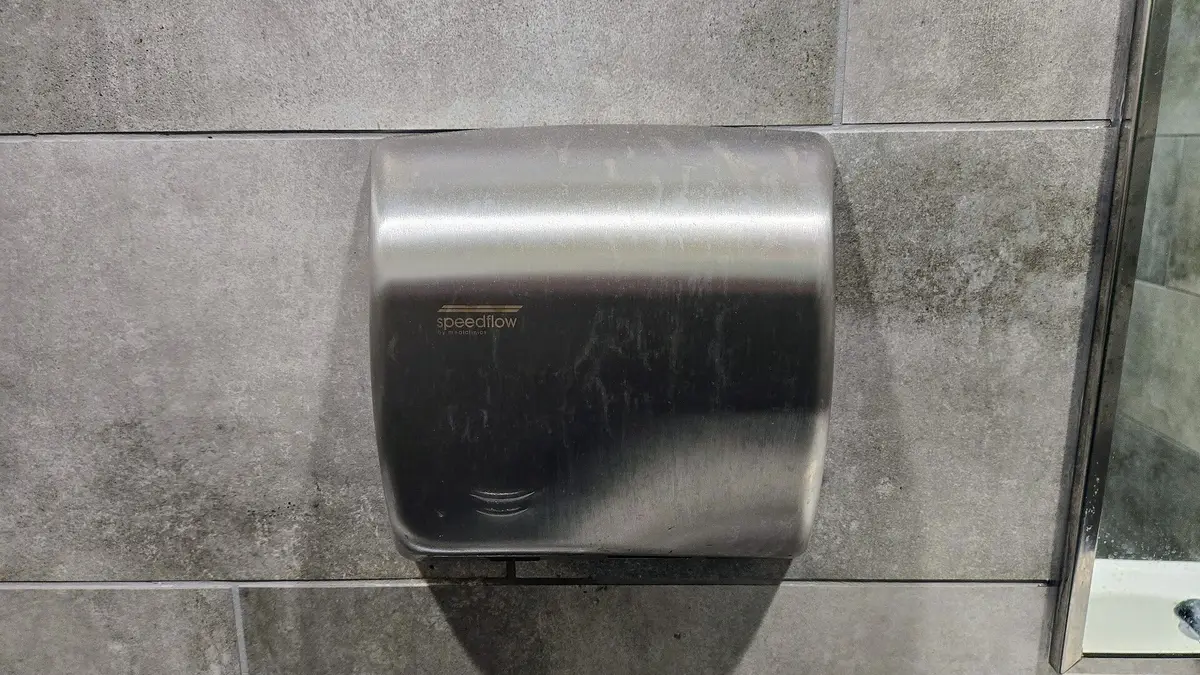
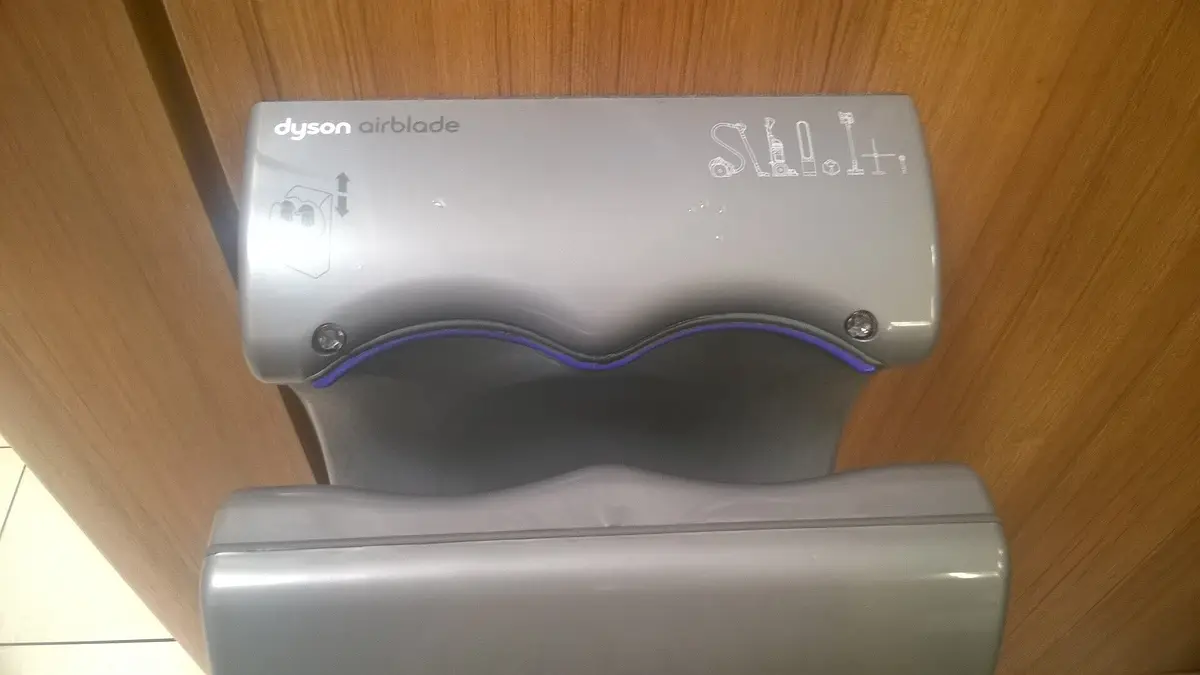
There are two main families. Warm-air dryers heat the air with an element: they draw more power and take longer. High-speed dryers ("jet" or air-blade) push air with a fast motor, at 216 to 360 km/h according to the listings, and dry in less time with less power. That is why a 1,500 W jet dryer uses less than half as much as a 2,300 W warm-air one.
| Hand dryer | Power | Drying time (listing) | kWh per dry | CLP per dry |
|---|---|---|---|---|
| UBLOX UB2504BL (warm air) | 2,300 W | 10 to 15 s | 0.0080 | 2.04 |
| Quimical Power Dryer (fast air) | 1,200 W | 10 to 20 s | 0.0050 | 1.28 |
| Quimical Turbo Jet (high speed) | 1,500 W | 7 to 10 s | 0.0035 | 0.91 |
| Airolite HD-2001W (PTC warm air) | 1,000 W | 10 to 15 s | 0.0035 | 0.89 |
| Dual Jet 2.0 (dual air blade) | 700 W | 10 s | 0.0019 | 0.50 |
Source: Falabella listings as of 20 November 2026 and CGE's November 2026 BT1 tariff (CLP 255.91 per kWh, Buin, base tier). Where the listing gives a time range, we use the midpoint. For a business on another tariff, the cost changes in proportion to the price per kWh; you can check the rate in your area in our guide to the price per kWh in Chile by municipality.
How much it costs per month
Monthly spending depends on how often it is used. In a washroom with 50 uses a day (about 1,500 a month), the 2,300 W dryer spends CLP 3,066 a month on electricity and the 1,500 W high-speed one CLP 1,360. In a busy washroom with 200 uses per working day (4,400 a month), the 2,300 W unit reaches CLP 8,992 and the 1,500 W one CLP 3,988.
| UBLOX UB2504BL | Warm air | 2,300 | 12.5 | 2.04 | 3,066 | 63,980 |
| Quimical Power Dryer | High-speed air | 1,200 | 15.0 | 1.28 | 1,919 | 120,000 |
| Quimical Turbo Jet | High-speed jet | 1,500 | 8.5 | 0.91 | 1,360 | 322,000 |
| Airolite HD-2001W | Warm air (PTC) | 1,000 | 12.5 | 0.89 | 1,333 | 106,495 |
| Dual Jet 2.0 | Dual air blade | 700 | 10.0 | 0.50 | 746 | 718,760 |
Over a year, the 2,300 W dryer with 50 daily uses consumes about 144 kWh, less than an average Chilean home uses in a month (about 180 kWh, according to our guide on how much a home in Chile consumes). The dryer also has a small standby draw from its sensor, which the listings reviewed do not state.
Hand dryer or paper towels: which is better
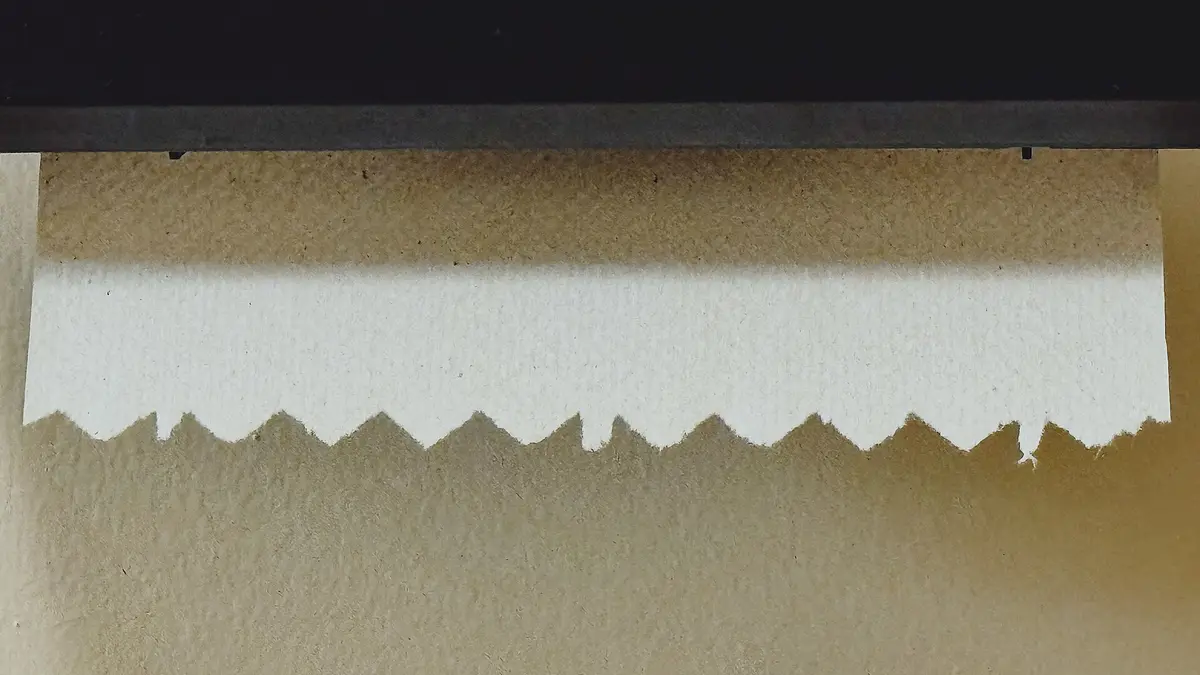
Paper towels are far more expensive per use. A pack of 1,000 interfolded sheets cost CLP 5,990 at Falabella on 20 November (CLP 5.99 per sheet), and a premium pack of 200 double sheets, CLP 2,490 (CLP 12.45 per sheet). If each person uses two sheets, a dry costs CLP 11.98 or CLP 24.90: between 6 and 12 times more than the 2,300 W dryer, and up to 50 times more than the 700 W one.
View the data as a table
| Paper towel (2 sheets) | UBLOX 2.300 W | Quimical Power Dryer 1.200 W | |
|---|---|---|---|
| Month 0 | $0 | $63,980 | $120,000 |
| Month 1 | $17,970 | $67,046 | $121,919 |
| Month 2 | $35,940 | $70,111 | $123,839 |
| Month 3 | $53,910 | $73,177 | $125,758 |
| Month 4 | $71,880 | $76,242 | $127,677 |
| Month 5 | $89,850 | $79,308 | $129,597 |
| Month 6 | $107,820 | $82,374 | $131,516 |
| Month 7 | $125,790 | $85,439 | $133,435 |
| Month 8 | $143,760 | $88,505 | $135,355 |
| Month 9 | $161,730 | $91,570 | $137,274 |
| Month 10 | $179,700 | $94,636 | $139,193 |
| Month 11 | $197,670 | $97,701 | $141,113 |
| Month 12 | $215,640 | $100,767 | $143,032 |
The difference pays for the dryer quickly. With 50 uses a day, paper towels cost CLP 17,970 a month and the CLP 63,980 UBLOX dryer pays for itself in 4.3 months. With 200 uses a day, in 1.5 months. Expensive dryers take longer: the CLP 718,760 Dual Jet needs 42 months at 50 daily uses, even though it uses very little electricity.
| Scenario | Paper towel (2 sheets at CLP 5.99) | 2,300 W dryer | 1,500 W jet dryer | Months to pay off the CLP 63,980 dryer |
|---|---|---|---|---|
| Home or small office (10 uses a day) | CLP 3,594 a month | CLP 613 a month | CLP 272 a month | 21.5 months |
| Office or restaurant (50 uses a day) | CLP 17,970 a month | CLP 3,066 a month | CLP 1,360 a month | 4.3 months |
| High-traffic washroom (200 uses per working day) | CLP 52,712 a month | CLP 8,992 a month | CLP 3,988 a month | 1.5 months |
Source: Energía Futura calculation with Falabella prices (20 Nov 2026) and CGE's November 2026 BT1 tariff. It excludes the paper dispenser (from CLP 6,790), the dryer's electrical installation and waste removal.
On the environment, the comparison also favours efficient dryers. A life-cycle assessment by the Massachusetts Institute of Technology (MIT) published in 2013, funded by a dryer manufacturer, concluded that high-speed dryers have a lower global warming impact than paper towels, whose impact is concentrated in making the paper. Conventional warm-air dryers were among the higher-impact options because of their electricity use.
Which one to buy for each use
- For a home bathroom or small office: a basic warm-air model, around CLP 54,990 to CLP 63,980. With few uses, the electricity cost is a few hundred pesos a month.
- For restaurants and busy offices: a 1,200 to 1,500 W high-speed model, which dries in under 10 to 15 seconds and spends less than half per dry.
- For high-traffic washrooms (malls, schools, terminals): an air-blade or dual air-curtain model, more expensive but with the lowest consumption per use.
- Check the SEC seal: electrical equipment sold in Chile must be certified by the Superintendency of Electricity and Fuels; several listings highlight it.
- Mind the noise: listings state between 60 and 78 dB; high-speed models are louder.
- Ask for a suitable circuit: a 2,300 W dryer needs a socket or connection rated for about 10 amps.
Lifespan and maintenance
The listings of dryers sold in Chile state a 5-year lifespan under normal use, and the Airolite pack 10 years. Warranties range from 1 year (Dual Jet 2.0) to 3 years (the SEC-certified Quimical models). In a washroom with 50 uses a day, 5 years means about 90,000 dries: the CLP 63,980 purchase of the UBLOX works out at less than CLP 1 per dry, and with electricity added each use costs about CLP 2.75 in total. Paper towels never drop below CLP 12.
Maintenance is simple: clean the air-intake grille so the motor doesn't overheat, check the sensor if it stops triggering and, on models with a filter, replace it as the manual says. A dryer with a blocked intake takes longer to dry and therefore uses more electricity per dry. At home a hand dryer is rarely worth it: with 10 uses a day it takes almost two years to pay off, and a washable cloth towel remains the cheapest option.
For a company with several washrooms, the numbers multiply. An office building with five washrooms of 50 daily uses each would spend about CLP 89,850 a month on paper towels (two sheets at CLP 5.99) versus CLP 15,330 with 2,300 W dryers or CLP 6,800 with 1,500 W high-speed dryers, at the same prices and CGE's November tariff.
Does your company sell efficient equipment for washrooms, offices or shops? Reach Energía Futura's readers.
See advertising optionsHand dryer versus hair dryer: not the same thing
A hair dryer has similar power, 1,700 to 2,300 W, but runs for several minutes at a time, so each use costs far more than a 10-second hand dry. We calculated it in the guide to the hair dryer: how much power it uses and what it costs.
Frequently asked questions
How much power does an electric hand dryer use?
Between 0.002 and 0.008 kWh per dry, depending on the power (700 to 2,300 W) and the time (7 to 15 seconds).
How much does each dry cost in pesos?
Between CLP 0.50 and CLP 2.04 at CGE's November 2026 tariff of CLP 255.91 per kWh.
Is a dryer cheaper than paper towels?
Yes. Two sheets of paper towel cost CLP 12 to CLP 25; an electric dry, under CLP 2.10. With 50 uses a day, a CLP 63,980 dryer pays for itself in about four months.
How much does a hand dryer cost in Chile?
At Falabella, as of 20 November 2026, from CLP 54,990 (1,400 W) to CLP 718,760 (700 W dual air curtain).
Which hand dryer uses the least electricity?
Air-blade or dual air-curtain models, which dry in about 10 seconds at 700 W. Warm-air models above 2,000 W spend the most per use.