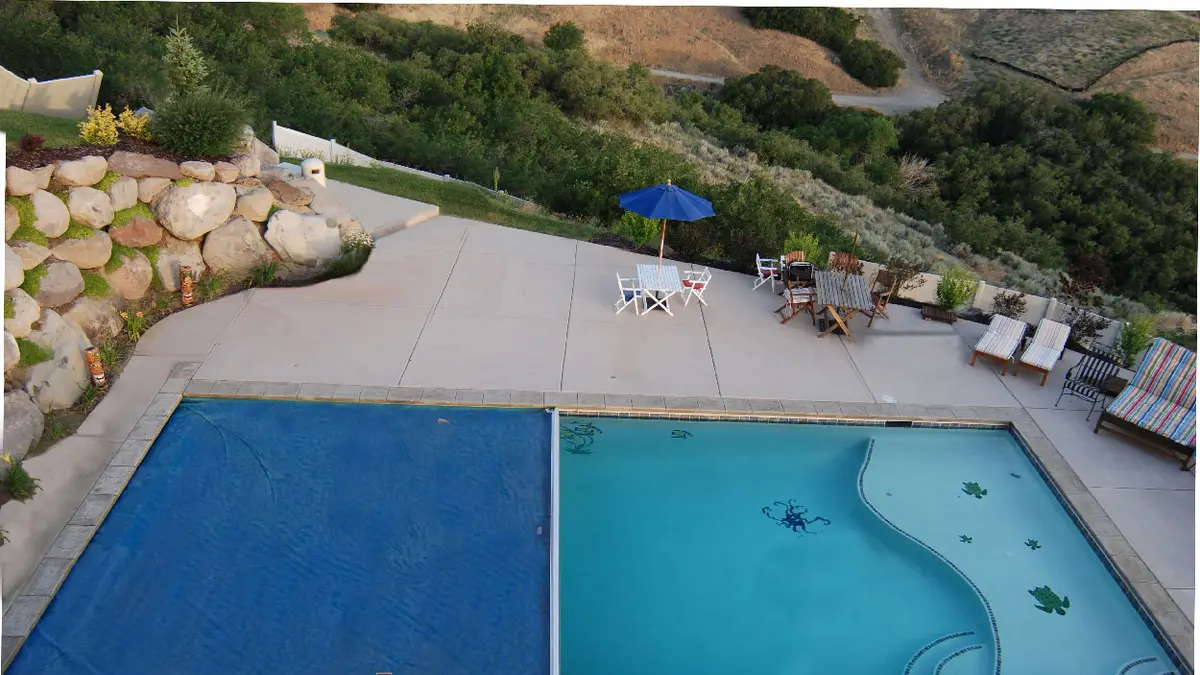
A pool cover is the cheapest way to save water and energy in a swimming pool. According to the WaterSense pools technical sheet from the US Environmental Protection Agency (EPA), an uncovered pool of about 46 m² loses between 45,000 and 117,000 litres of water a year to evaporation alone, depending on the climate. A solid cover cuts that evaporation by more than 90% and, in heated pools, saves between 50% and 70% of heating costs.
With summer arriving in Chile, this guide explains how much a pool cover or thermal blanket saves in a typical Chilean pool, how many degrees of temperature it helps keep, which type suits each use and what they cost in Chile, with prices checked on 27 November 2026.
View the data as a table
| Evaporation avoided | over 90% |
| Heating savings | 50 to 70% |
| Water evaporated per year | 31 to 81 m³ |
What a pool cover is and why it saves energy
A pool cover is a tarp or sheet spread over the water when nobody is swimming. Its main job is not to block the sun but to stop evaporation. Every litre of water that evaporates takes a lot of heat with it: about 0.68 kWh per litre, the energy water needs to turn into vapour. That is why evaporation is by far the largest heat loss of an outdoor pool.
The cover also keeps out leaves, dust and insects, which reduces the work of the filter and the pump hours. To see how much that equipment costs to run, read our guide to pool pumps and filters, which can use more electricity than a whole house in summer.
How much water a pool cover saves
The EPA estimates that a 500 square foot (46.5 m²) pool loses between 12,000 and 31,000 gallons a year to evaporation, that is, between 45,400 and 117,300 litres. Scaled to a typical Chilean 8 x 4 metre (32 m²) pool, that is between 31,300 and 80,800 litres a year, or between 86 and 221 litres a day on average. It is like lowering the water level by 2.7 to 6.9 millimetres a day.
| Pool size | Area | Water evaporated per year (uncovered) | With a solid cover (90% less) |
|---|---|---|---|
| 3 x 2 m (inflatable or frame) | 6 m² | 5,900 to 15,200 litres | 590 to 1,520 litres |
| 4 x 2 m | 8 m² | 7,800 to 20,200 litres | 780 to 2,020 litres |
| 6 x 3 m | 18 m² | 17,600 to 45,500 litres | 1,760 to 4,550 litres |
| 8 x 4 m | 32 m² | 31,300 to 80,800 litres | 3,130 to 8,080 litres |
| 10 x 5 m | 50 m² | 48,900 to 126,300 litres | 4,890 to 12,630 litres |
Source: Energía Futura calculation using the evaporation rates in the WaterSense (EPA) technical sheet. The range depends on the climate: more sun, wind and dry air mean more evaporation. In central Chile, with dry summers, the upper end is the safer assumption.
| Solid, mesh or hybrid | Up to 95% | Yes |
| Solar (bubble, rings or thermal) | 50% to 95%, depending on shape and coverage | Yes |
| Liquid evaporation suppressant | 15% | No |
How many degrees a thermal blanket keeps
The most common question is how many degrees a pool thermal blanket adds or keeps. The answer depends on sun, wind and night temperatures, but the heat lost without one can be estimated. An 8 x 4 metre pool with an average depth of 1.4 metres holds 44.8 m³ of water: raising or lowering all of it by one degree takes 52 kWh of heat.
If 86 to 221 litres evaporate each day, 58 to 150 kWh of heat go with them. That is equivalent to cooling the water by 1.1 to 2.9 °C a day, a loss the sun must replace before it can warm the pool further. With the cover on, most of that loss disappears: that is why a covered pool is warmer in the morning and reaches a comfortable temperature sooner.
Solar bubble blankets add a second effect: they let part of the light through and trap heat under the air bubbles, like a small greenhouse. According to the EPA, they cut evaporation by 50% to 95%, depending on how well they cover the surface. Solid covers reach 95%, while liquid suppressants, which form a film on the water, achieve only 15%.
How much you save in a heated pool
Covers pay off fastest in heated pools. A heat pump delivering about 6 kW of heat draws around 1.2 kW of electricity. Running 8 hours a day, with power at CLP 255.91 per kWh (the BT1 rate of CGE in Buin, November 2026), it costs CLP 73,702 a month. The EPA estimates that covering the pool saves 50% to 70% of heating costs: between CLP 36,851 and CLP 51,591 a month.
At those figures, a 4 x 7 metre thermal blanket, which Sodimac sells for CLP 199,990 at full price and CLP 99,990 on sale as of 27 November, would pay for itself in two to six months of the season with the pump running. If you have not chosen the equipment yet, this guide explains how much a pool heat pump uses and what size to choose.
| Situation (8 x 4 m pool) | Monthly electricity cost | Monthly savings |
|---|---|---|
| Heat pump, no cover, 8 h a day | CLP 73,702 | - |
| With cover, 50% savings | CLP 36,851 | CLP 36,851 |
| With cover, 70% savings | CLP 22,111 | CLP 51,591 |
Source: Energía Futura calculation with CGE's November 2026 BT1 rate and the EPA savings range. Actual cost varies with the target temperature, wind and hours of use.
Types of cover: which to choose
- Tarp or PVC cover (protective): the cheapest, designed for inflatable and frame pools. It keeps out leaves and dirt and reduces evaporation, but does not insulate. In Chile they start at CLP 6,990.
- Solar or bubble cover: a sheet with air bubbles that floats on the water. It warms with the sun and slows evaporation. From CLP 16,743 for 4 x 2 metre pools.
- Thermal blanket: a thicker bubble cover, measured in microns (400 or 500). Double-bubble blankets insulate more and last more seasons. From CLP 99,990 on sale in 4 x 7 metre sizes.
- Winter cover: a thick, opaque tarp with eyelets or tensioners to close the pool in autumn and winter. It blocks light and slows algae.
- Reel: a cart or crank-operated roller that makes the blanket easy to put on and take off. If covering the pool is a chore, it does not get done: that is why this purchase makes the others pay.
| Round cover 3.00 m | Bestway | 9,990 | 6,990 |
| Rectangular cover 3.00 x 2.01 m | Bestway | 39,990 | 9,990 |
| Rectangular cover 4.00 x 2.11 m | Bestway | 49,990 | 13,990 |
| Rectangular cover 4.50 x 2.20 m | Intex | 24,990 | 19,958 |
| Rectangular solar cover 4.00 x 2.00 m | Intex | 24,990 | 16,743 |
| Round solar cover 5.49 m | Intex | 59,990 | 44,990 |
| Thermal blanket 4 x 7 m, 400 microns | Kaltemp | 199,990 | 99,990 |
| Thermal blanket 5 x 9 m, 400 microns | Kaltemp | 259,990 | 149,990 |
| Double-bubble blanket 4 x 7 m, 500 microns | Kaltemp | 229,990 | 134,990 |
| Double-bubble blanket 5 x 9 m, 500 microns | Kaltemp | 319,990 | 179,990 |
| Winter tarp with eyelets 4 x 8 m | Genérica | 306,990 | 164,990 |
| Telescopic reel cart 4.3 to 6 m | Kaltemp | 369,990 | 199,990 |
Pool cover and thermal blanket prices in Chile
The price gap is wide. Bestway and Intex tarp covers for above-ground pools cost between CLP 6,990 and CLP 59,990, while thermal blankets for in-ground pools are sold by area and thickness: a Kaltemp 400-micron, 4 x 7 metre blanket costs CLP 199,990 at full price, about CLP 7,143 per m², and the 5 x 9 metre double-bubble version, CLP 319,990.
| Product | Size | Regular price | Discounted (27 Nov) |
|---|---|---|---|
| Bestway round cover | 3.00 m | CLP 9,990 | CLP 6,990 |
| Bestway rectangular cover | 4.00 x 2.11 m | CLP 49,990 | CLP 13,990 |
| Intex solar cover | 4.00 x 2.00 m | CLP 24,990 | CLP 16,743 |
| Intex round solar cover | 5.49 m | CLP 59,990 | CLP 44,990 |
| Kaltemp thermal blanket, 400 microns | 4 x 7 m | CLP 199,990 | CLP 99,990 |
| Kaltemp double-bubble blanket, 500 microns | 5 x 9 m | CLP 319,990 | CLP 179,990 |
| Winter tarp with eyelets | 4 x 8 m | CLP 306,990 | CLP 164,990 |
| Kaltemp telescopic reel cart | 4.3 to 6 m | CLP 369,990 | CLP 199,990 |
Source: Sodimac, prices checked on 27 November 2026. Several products carried seasonal discounts; compare against the regular price, since sales change from week to week.
View the data as a table
| Area (m²) | Regular price | |
|---|---|---|
| Round cover 3.00 m (Bestway) | 7 m² | 9,990 |
| Rectangular cover 3.00 x 2.01 m (Bestway) | 6 m² | 39,990 |
| Rectangular cover 4.00 x 2.11 m (Bestway) | 8 m² | 49,990 |
| Rectangular cover 4.50 x 2.20 m (Intex) | 10 m² | 24,990 |
| Rectangular solar cover 4.00 x 2.00 m (Intex) | 8 m² | 24,990 |
| Round solar cover 5.49 m (Intex) | 24 m² | 59,990 |
| Thermal blanket 4 x 7 m, 400 microns (Kaltemp) | 28 m² | 199,990 |
| Thermal blanket 5 x 9 m, 400 microns (Kaltemp) | 45 m² | 259,990 |
| Double-bubble blanket 4 x 7 m, 500 microns (Kaltemp) | 28 m² | 229,990 |
| Double-bubble blanket 5 x 9 m, 500 microns (Kaltemp) | 45 m² | 319,990 |
| Winter tarp with eyelets 4 x 8 m (Genérica) | 32 m² | 306,990 |
How to use it to save more
- Cover it every night: that is when most heat is lost, because the air cools and the water stays warmer than its surroundings.
- Put the bubble side facing the water on solar blankets; upside down they work worse and degrade faster.
- Cut it to size: a blanket that leaves edges uncovered loses part of the effect. The EPA gives a 50% to 95% range precisely because of coverage.
- Take it off after a shock chlorination, so the chemicals do not damage the material.
- Store it rolled up and in the shade when not in use: direct sun on a dry blanket makes it brittle.
- Pair it with solar energy: to heat without electricity, one option is a solar water heater or a solar pool collector, which perform better if the water does not lose its heat at night.
Do you sell pool equipment or energy efficiency solutions? Reach Energía Futura's readers.
See advertising optionsFrequently asked questions
How much does a pool cover save?
A solid cover cuts evaporation by more than 90%, according to the EPA. In an 8 x 4 metre pool that is 28,000 to 73,000 litres of water a year. In heated pools it saves 50% to 70% of heating costs.
How many degrees does a thermal blanket add?
It depends on the sun and the climate. What can be calculated is the loss it prevents: in an 8 x 4 metre pool, evaporation removes heat equivalent to 1.1 to 2.9 °C of the water every day. The blanket keeps most of that heat.
What is the difference between a pool cover and a thermal blanket?
A tarp cover protects against dirt and reduces evaporation. A thermal blanket is a thicker bubble cover, 400 or 500 microns, that also insulates and uses the sun to warm the water.
How much does a pool thermal blanket cost in Chile?
At Sodimac, a Kaltemp 400-micron, 4 x 7 metre blanket costs CLP 199,990 at full price and a 5 x 9 metre double-bubble one, CLP 319,990, according to prices on 27 November 2026. Tarp covers for above-ground pools start at CLP 6,990.
Should the blanket stay on all day?
Not necessarily. What matters most is covering the pool at night and whenever nobody is using it. On hot, humid days evaporation drops, and a solar blanket can stay on during the day to warm the water.