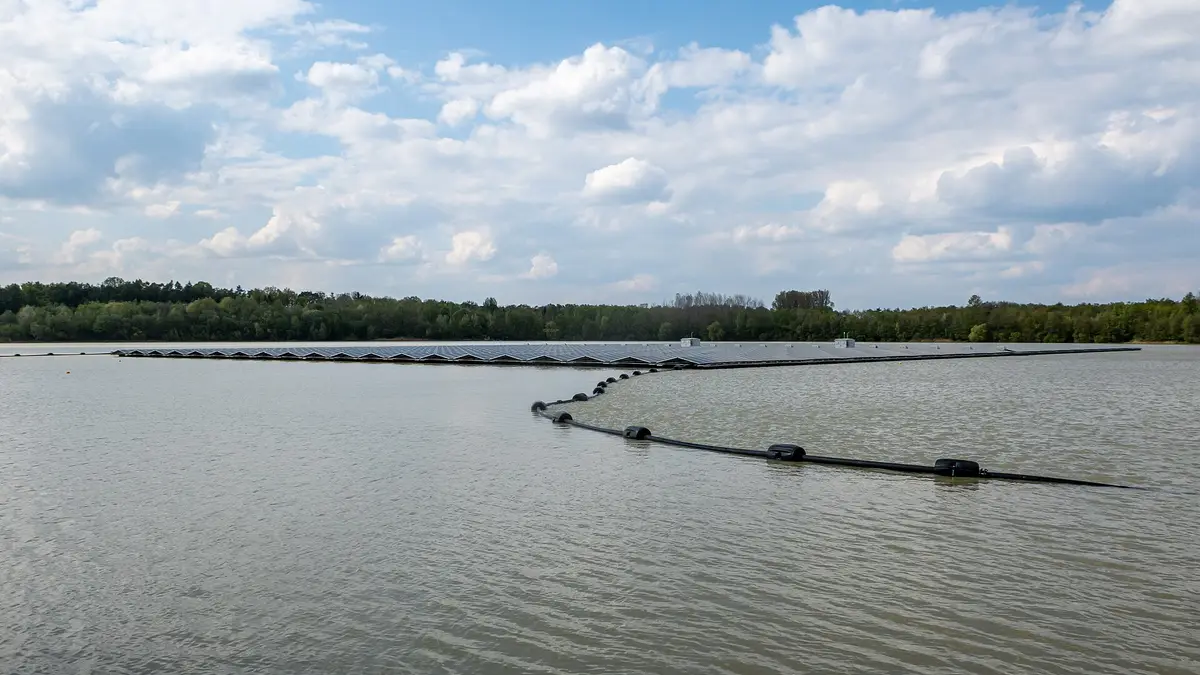
Updated on 22 November 2026. The largest floating solar plant in the world is in Fuyang, in China's Anhui province: 650 MW of panels on 867 hectares of water that flooded old coal mines. It was developed by China Three Gorges and reached full capacity in December 2023, according to CGTN. It is followed by Wenzhou Taihan (550 MW, China) and the Changhua plant in Taiwan (373 MWac).
This ranking brings together 15 operating floating photovoltaic plants whose capacity and date can be verified in an identifiable source: the operator, a government or the trade press. It is not exhaustive: China has many floating plants of tens of megawatts on lakes and ponds that do not report their capacity publicly. Announced or under-construction projects are excluded.
View the data as a table
| The largest: Fuyang, China | 650 MW |
| The largest outside China: Changhua, Taiwan | 373 MWac |
| Europe's largest: Les Îlots Blandin | 74.3 MWp |
Ranking of the largest floating solar plants in the world
| # | Plant | Country | Capacity | Operating since | Operator |
|---|---|---|---|---|---|
| 1 | Fuyang (Anhui) | China | 650 MW | 2023 | China Three Gorges |
| 2 | Wenzhou Taihan (Zhejiang) | China | 550 MW | 2021 | Not publicly stated |
| 3 | Changhua (Changbin) | Taiwan | 373 MWac | 2024 | HEXA Renewables |
| 4 | Dezhou Dingzhuang (Shandong) | China | 320 MW | 2021 | Huaneng |
| 5 | Omkareshwar (Madhya Pradesh) | India | 278 MW of 600 planned | 2024 | NHDC, SJVN, Tata Power and AMP |
| 6 | Cirata (West Java) | Indonesia | 192 MWp (145 MWac) | 2023 | Masdar / PLN |
| 7 | Huainan (Anhui) | China | 150 MW | 2018 | China Three Gorges |
| 8 | Ramagundam (Telangana) | India | 100 MW | 2022 | NTPC |
| 9 | Kayamkulam (Kerala) | India | 92 MW | 2022 | NTPC |
| 10 | Les Îlots Blandin (Haute-Marne) | France | 74.3 MWp | 2025 | Q ENERGY France |
| 11 | Suzhou (Anhui) | China | 70 MW | 2019 | CECEP / Ciel & Terre |
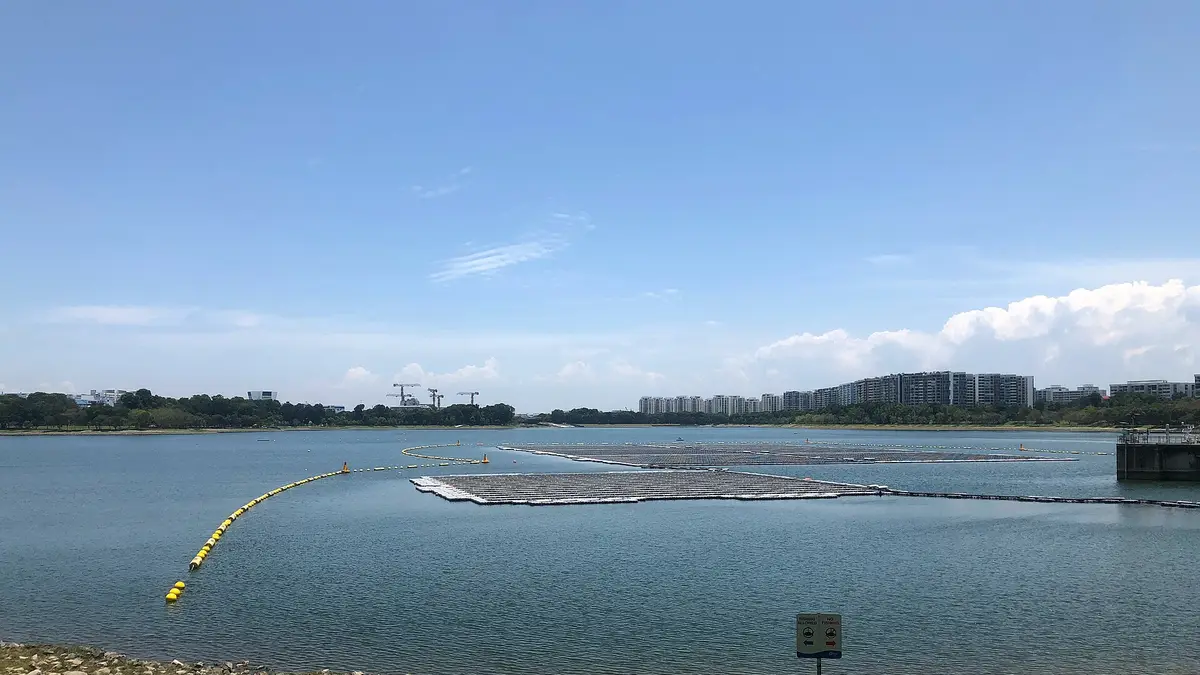
| 12 | Tengeh (reservoir) | Singapore | 60 MW | 2021 | PUB / Sembcorp |
| 13 | Sirindhorn (Ubon Ratchathani) | Thailand | 45 MW | 2021 | EGAT |
| 14 | Obourg (Wallonia) | Belgium | 31 MW | 2026 | TotalEnergies / Holcim |
| 15 | Oued Rmel (Tangier) | Morocco | 13 MW | 2026 | H2air |
Sources by plant: CGTN (Fuyang), Offshore Energy (Wenzhou Taihan), Offshore Energy (Changhua), pv magazine India (Dezhou), PIB, Government of India (Omkareshwar), PV Tech (Cirata), pv magazine (Huainan), PSU Watch (Ramagundam and Kayamkulam), PV Tech (Les Îlots Blandin), PV Tech (Suzhou), RenewEconomy (Tengeh), RenewEconomy (Sirindhorn), PV Tech (Obourg) and pv magazine (Oued Rmel). MW or MWp as reported by each source.
| 1 | Fuyang (Anhui) | China | 650 MW | 2023 | China Three Gorges |
| 2 | Wenzhou Taihan (Zhejiang) | China | 550 MW | 2021 | Not stated |
| 3 | Changhua (Changbin) | Taiwan | 373 MWac | 2024 | HEXA Renewables |
| 4 | Dezhou Dingzhuang (Shandong) | China | 320 MW | 2021 | Huaneng |
| 5 | Omkareshwar (Madhya Pradesh) | India | 278 MW | 2024 | Several (NHDC, SJVN, Tata Power, AMP) |
| 6 | Cirata (Java Occidental) | Indonesia | 192 MWp | 2023 | Masdar / PLN |
| 7 | Huainan (Anhui) | China | 150 MW | 2018 | China Three Gorges |
| 8 | Ramagundam (Telangana) | India | 100 MW | 2022 | NTPC |
| 9 | Kayamkulam (Kerala) | India | 92 MW | 2022 | NTPC |
| 10 | Les Îlots Blandin (Haute-Marne) | France | 74.3 MWp | 2025 | Q ENERGY France |
| 11 | Suzhou (Anhui) | China | 70 MW | 2019 | CECEP / Ciel & Terre |
| 12 | Tengeh (Singapur) | Singapore | 60 MW | 2021 | PUB / Sembcorp |
| 13 | Sirindhorn (Ubon Ratchathani) | Thailand | 45 MW | 2021 | EGAT |
| 14 | Obourg (Valonia) | Belgium | 31 MW | 2026 | TotalEnergies / Holcim |
| 15 | Oued Rmel (Tánger) | Morocco | 13 MW | 2026 | H2air |
Fuyang, the largest floating solar plant in the world
The Fuyang plant is in Yingshang County, Anhui, on an area where the ground subsided due to coal mining and filled with water. China Three Gorges connected it in stages and reached 650 MW in late December 2023. It is not a standalone plant: it is part of a wind, solar and storage base that also includes 550 MW of wind and a 300 MW / 600 MWh battery system.
Fish are farmed under the panels, a model known in China as "fishery-photovoltaic complementarity". The same idea underpins Wenzhou Taihan, in Zhejiang province: 550 MW over about 4.7 km² of aquaculture ponds, connected in December 2021, generating about 650 million kWh a year, according to Offshore Energy.
View the data as a table
| Fuyang (Anhui) | China | 650 MW |
| Wenzhou Taihan (Zhejiang) | China | 550 MW |
| Changhua (Changbin) | Taiwan | 373 MW |
| Dezhou Dingzhuang (Shandong) | China | 320 MW |
| Omkareshwar (Madhya Pradesh) | India | 278 MW |
| Cirata (Java Occidental) | Indonesia | 192 MW |
| Huainan (Anhui) | China | 150 MW |
| Ramagundam (Telangana) | India | 100 MW |
| Kayamkulam (Kerala) | India | 92 MW |
| Les Îlots Blandin (Haute-Marne) | France | 74 MW |
| Suzhou (Anhui) | China | 70 MW |
| Tengeh (Singapur) | Singapore | 60 MW |
| Sirindhorn (Ubon Ratchathani) | Thailand | 45 MW |
| Obourg (Valonia) | Belgium | 31 MW |
| Oued Rmel (Tánger) | Morocco | 13 MW |
The records outside China
Outside China, the largest is Changhua, on Taiwan's west coast: 373 MWac, according to its owner, HEXA Renewables, which presented it in November 2024 as the world's largest near-shore floating plant. It covers 347 hectares in four plots, in sheltered waters next to an industrial zone.
India is the ranking's second country by floating megawatts. The Omkareshwar park, on the Narmada river, had 278 MW operating out of 600 MW planned, according to the Ministry of New and Renewable Energy in January 2025, split among several developers. State-owned NTPC also operates Ramagundam (100 MW, fully operating since July 2022) and Kayamkulam (92 MW). In Southeast Asia, the largest is Cirata in Indonesia (192 MWp), opened in November 2023 by Masdar and state utility PLN on a hydropower reservoir.
In Europe, the record belongs to Les Îlots Blandin, in north-eastern France: 74.3 MWp connected by Q ENERGY in 2025 on a flooded former quarry. In March 2026, TotalEnergies and Holcim opened a 31 MW plant in Obourg, Belgium, that supplies a cement works, Europe's largest floating plant for self-consumption. In Africa, the largest is Oued Rmel in Morocco (13 MW), connected in July 2026.
Each region has its own record. This is the largest floating plant in each part of the world, according to the ranking's sources:
| Region | Largest plant | Country | Capacity | Year |
|---|---|---|---|---|
| World and East Asia | Fuyang | China | 650 MW | 2023 |
| East Asia outside China | Changhua | Taiwan | 373 MWac | 2024 |
| South Asia | Omkareshwar | India | 278 MW operating | 2024 |
| Southeast Asia | Cirata | Indonesia | 192 MWp | 2023 |
| Europe | Les Îlots Blandin | France | 74.3 MWp | 2025 |
| Africa | Oued Rmel | Morocco | 13 MW | 2026 |
Source: Energía Futura, based on the sources of the main table. Latin America has no operating floating plants of comparable scale with public data.
Why Dongying's 1 GW offshore plant is not in the ranking
In December 2025, China connected the 1 GW HG14 plant about 8 km off the coast of Dongying, Shandong. Some lists and press reports describe it as an "open-sea floating solar plant", but according to pv magazine its 2,934 platforms rest on 11,736 steel piles driven into the seabed. It is an offshore pile-mounted solar plant, not a floating one, so it is not included in this ranking.
The difference matters: in a floating plant, panels sit on anchored floats that rise and fall with the water level. In pile-mounted plants, common on aquaculture ponds and tidal flats in China, the structure is fixed. Some sources do not distinguish between the two; in this ranking we use each source's description and flag doubts where they exist.
How the record for the largest floating solar plant grew
Less than a decade ago, China's largest floating plant had 40 MW. In December 2017, China Three Gorges connected the first part of its 150 MW plant in Huainan, on a subsided mining area, and completed it in May 2018. Since then the record has more than quadrupled.
- 2018Huainan, 150 MWChina Three Gorges connects the first part of a plant on a subsided mining area in Anhui in December 2017 and completes it in May 2018.
- 2021Dezhou, 320 MW, and Wenzhou Taihan, 550 MWHuaneng combines floating solar, wind and storage; Wenzhou Taihan, with aquaculture, connects in December.
- 2023Fuyang, 650 MWFull-capacity connection in late December; part of a base with 550 MW of wind and 300 MW of batteries.
- 2023Cirata, 192 MWpIndonesia opens Southeast Asia's largest on 9 November.
- 2024Changhua, 373 MWacHEXA Renewables presents the largest near-shore floating plant in Taiwan.
- 2025Les Îlots Blandin, 74.3 MWpQ ENERGY connects Europe's largest floating plant in France.
- 2026Obourg, 31 MW, and Oued Rmel, 13 MWBelgium opens Europe's largest self-consumption floating plant in March and Morocco, in July, Africa's largest.
Why floating solar plants are built
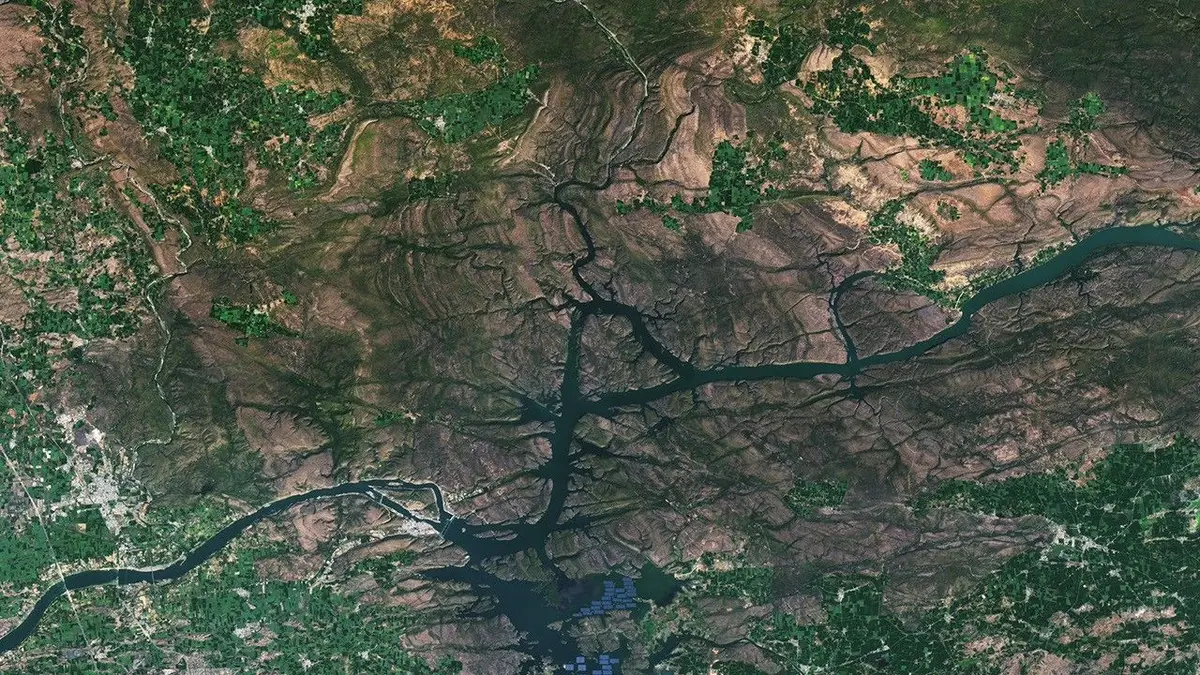
Floating plants use surfaces that do not compete with farming or cities: hydropower reservoirs (Chile has several large ones, as shown in our guide to Chile's reservoirs), lakes in abandoned mines, aquaculture ponds and drinking-water reservoirs. Water cools the panels, which slightly improves their output, and the shade reduces evaporation, an advantage in dry areas. On hydropower reservoirs such as Cirata or Sirindhorn, the same grid connection can be used, combining sun by day with water at night.
Costs are higher than on land because of the floats and anchoring, and plants at sea face waves and corrosion. That is why most remain in calm waters. To compare them with solar plants on land, see our ranking of countries with the most solar power.
No floating plant comes close yet to the largest land-based solar plants, which exceed 3,000 MW in China. You can compare them in the ranking of the largest solar plant in the world.
Does your company develop solar projects or work with reservoirs and water? Reach Energía Futura's readers.
See advertising optionsMW, MWp and MWac: why figures are not always comparable
Solar plants are measured in two ways. MWp (megawatts peak) is the panels' direct-current power; MWac is what the inverters deliver to the grid as alternating current, which is always less. At Cirata, for example, 192 MWp of panels equal 145 MWac, 24% less. When a source says just "MW", it does not always make clear which of the two it means, so small differences between plants in the ranking should be read with care.
Methodology
We include only operating floating plants whose capacity and date appear in an identifiable, dated source: operator announcements, governments or trade media (pv magazine, PV Tech, Offshore Energy, RenewEconomy, CGTN and PSU Watch). We use the figure each source gives, in MW or MWp; where a source gives both, we show both. For Omkareshwar we report the whole park's operating capacity according to the Government of India in January 2025, which may have grown since. Map locations are approximate (city or reservoir). The list is not exhaustive and will be updated at this same URL.
How to cite this data
Energía Futura (2026). "The largest floating solar plant in the world 2026: ranking of the biggest floating PV plants". Updated on 22 November 2026. energiafutura.cl/en/news/the-largest-floating-solar-plant-in-the-world-2026-ranking-of-the-biggest-floating-pv-plants. Data: operators, Government of India and trade press.
Frequently asked questions
What is the largest floating solar plant in the world?
Fuyang, in Anhui, China: 650 MW, fully operating since December 2023, owned by China Three Gorges.
What is the largest floating solar plant outside China?
Changhua, in Taiwan: 373 MWac, owned by HEXA Renewables.
What is the largest floating solar plant in Europe?
Les Îlots Blandin, in France, with 74.3 MWp, connected in 2025.
Is Dongying's 1 GW plant floating?
No. Its platforms rest on 11,736 steel piles: it is a fixed offshore solar plant.
Are there floating solar plants in Chile?
There are no large-scale ones in operation; experiences so far have been small pilots.