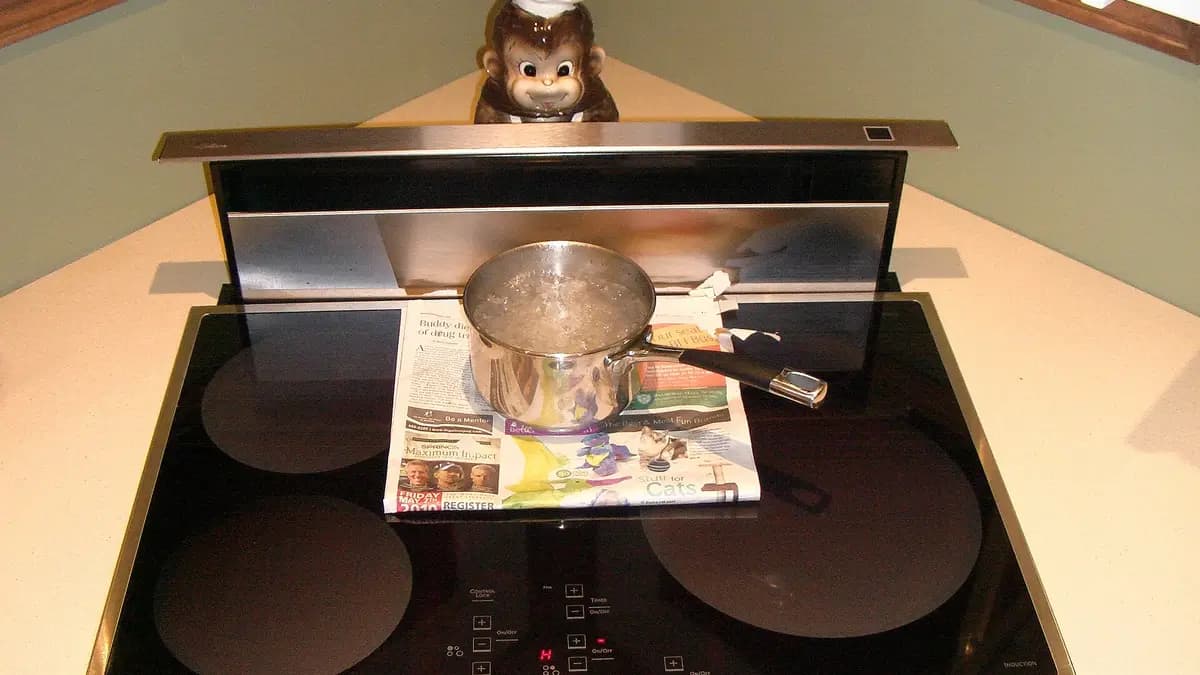
An electric cooktop has zones of 1,000 to 2,000 W each, and its cost depends on the technology. Boiling a litre of water costs about CLP 30 on an induction hob and CLP 32 to 34 on a resistance or ceramic hob, with electricity at CLP 255.27 per kWh (CGE's BT1 residential rate in Chile since October 2026). With bottled liquefied petroleum gas (LPG), the same task costs about CLP 31 to 39, depending on the burner's efficiency. In other words, cooking with electricity already costs the same as or less than gas in Chile.
In this guide we compare how much each type of electric cooktop uses, how much it costs per month in Chilean pesos and what to consider before switching from gas, from pots and pans to the electrical installation.
Types of electric cooktop and their efficiency
Not all electric cooktops heat the same way. Efficiency measures what share of the energy actually reaches the pot and the food; the rest is lost heating the air, the surface or the kitchen. According to the US ENERGY STAR programme, these are the typical efficiencies:
| Type of cooktop | How it heats | Typical efficiency | Power per zone |
|---|---|---|---|
| Induction | A magnetic field directly heats the base of the pot | About 85% | 1,400 to 2,000 W (more with boost) |
| Ceramic or resistance | A heating element warms the surface, which passes the heat to the pot | 75% to 80% | 1,000 to 2,000 W |
| Cast-iron electric plate | Heating element under a metal disc | Lower than ceramic | 1,000 to 1,500 W |
| Gas (for comparison) | Flame under the pot | About 32% | — |
Source: ENERGY STAR (induction, resistance and gas efficiencies); typical power ratings declared by manufacturers. ENERGY STAR estimates that induction is between 5% and 10% more efficient than resistance and about three times more efficient than gas.
Induction is the most efficient and also the fastest: it boils water in less time than a ceramic hob or gas. The surface also gets less hot, because the heat is generated in the pot. Traditional resistance plates, such as two-plate electric stoves, are cheaper, but they take longer to heat up and to cool down.
How much an electric cooktop costs in Chilean pesos
For comparison, the simplest example is boiling a litre of water from 15 °C to 100 °C. Physics says that takes about 0.1 kWh of useful heat. Depending on each cooktop's efficiency, the energy you pay for changes:
| Cooktop | Energy to boil 1 litre | Cost |
|---|---|---|
| Induction (85%) | 0.116 kWh | about CLP 30 |
| Ceramic or resistance (75% to 80%) | 0.124 to 0.132 kWh | CLP 32 to 34 |
| Bottled LPG (32%) | 0.309 kWh of gas | about CLP 39 |
| Bottled LPG with an efficient burner (40%) | 0.247 kWh of gas | about CLP 31 |
Energía Futura calculations. Electricity: CLP 255.27 per kWh. Gas: 15 kg cylinder at CLP 24,000 to 26,000 (voucher prices in force since 15 October 2026), about CLP 127 per kWh of gas, with a calorific value of 13.1 kWh per kilo (IPCC default value). The 40% is an assumption for burners in good condition.
The result is surprising: although a kWh of electricity costs twice as much as a kWh of gas, an induction hob uses almost three times more of the energy. That is why, at current prices, cooking with induction costs the same as or less than bottled gas. If the price of gas rises, as in the recent fuel price increases, electricity's advantage grows.
The monthly cost of cooking with electricity
Actual consumption depends on what and how much you cook. As a reference, a 1,500 W zone running on average at 60% of its power for one hour a day uses 0.9 kWh a day:
| Cooktop use | Consumption per month | Cost per month |
|---|---|---|
| Light use: 30 minutes a day | 13.5 kWh | about CLP 3,450 |
| Medium use: 1 hour a day | 27 kWh | about CLP 6,890 |
| Heavy use: 2 hours a day (large family) | 54 kWh | about CLP 13,780 |
Energía Futura calculations with a 1,500 W zone at 60% average power and electricity at CLP 255.27 per kWh. It is an example: long stews on low heat use less per hour; frying and boiling at full power, more.
For many tasks, other appliances use less than the cooktop: the kettle for heating water, the microwave for reheating and the air fryer for small portions. How much each one saves compared with the cooktop and the oven is in the air fryer guide.
Electric cooktop or gas: what makes sense in Chile
In running costs, induction already competes with gas. But switching involves other factors:
- Purchase price: an induction hob costs more than a gas cooktop or a ceramic hob of the same size. Single-zone portable induction cookers are the cheapest way to try it.
- Pots and pans: induction only works with cookware that has a magnetic base, such as cast iron or suitable stainless steel. The test is simple: if a magnet sticks to the base, it works.
- Electrical installation: a four-zone hob can declare a maximum power of more than 7 kW. It needs a dedicated circuit, with the right cable and protection, and it is worth checking with an electrician authorised by the SEC (Chile's electricity and fuels regulator) whether the home's supply connection can handle it.
- Power cuts: with gas you can cook without electricity; with an electric cooktop, you cannot. In areas with frequent cuts, a portable gas stove as a backup is useful.
- Safety and indoor air: an electric cooktop has no flame or combustion inside the home, and induction cools down quickly.
For a flat without piped gas, induction also avoids buying and changing cylinders. For a home with piped natural gas, whose price per kWh differs from bottled gas, the comparison has to be made with the gas distributor's tariff. The price per kWh of electricity by municipality is in the guide to the price per kWh in Chile.
How to spend less when cooking with electricity
- Use the zone that matches the pot size. A small pot on a large zone wastes heat, especially on ceramic hobs.
- Cover your pots. Boiling with a lid greatly reduces time and energy.
- Use residual heat. Ceramic hobs and cast-iron plates keep heating for a few minutes after being switched off.
- Heat water in the kettle and pour it into the pot: it is faster and more efficient than doing it on the cooktop, as shown in the electric kettle guide.
- Use a pressure cooker for beans, chickpeas and tough cuts of meat: it cuts cooking time by half or more.
- Keep pot bases and the surface clean, so that contact with the pot is even.
Does an electric cooktop push up the bill much?
For a household that cooks one hour a day, an electric cooktop adds about 27 kWh a month, about CLP 6,900. That is a significant part of the bill, but it is offset by what is no longer spent on gas: at current prices, a 15 kg cylinder costs between CLP 24,000 and 26,000 and, with the same use, lasts several weeks. The final bill depends on how much you cook and on the price of each type of energy in your municipality.
Electrifying the kitchen is part of a broader trend: Chile generates two thirds of its electricity from renewable sources, while LPG is largely imported. Every kitchen that switches to induction reduces the household's emissions, especially as the power grid becomes cleaner.
And portable induction cookers
Single-zone induction cookers, which plug into any socket, are a cheap way to try the technology or to complement a gas cooktop. They usually have between 1,800 and 2,000 W and the same efficiency as a built-in hob. As they use almost all the power a household socket allows, it is best not to plug other high-consumption appliances, such as the kettle or the oven, into the same circuit at the same time.
Do you sell induction cooktops or energy-efficient appliances? Reach Energía Futura's readers.
See advertising optionsFrequently asked questions
How much electricity does an electric cooktop use?
Each zone uses between 1,000 and 2,000 W. One hour of cooking a day adds up to about 27 kWh a month, about CLP 6,900 with electricity at CLP 255.27 per kWh.
Which is cheaper, cooking with gas or with electricity?
At October 2026 prices, induction costs the same as or slightly less than bottled LPG, because it uses almost three times more of the energy.
Does induction use less than a ceramic hob?
Yes, between 5% and 10% less, according to ENERGY STAR, and it heats faster.
Which pots work on induction?
Those with a magnetic base. If a magnet sticks to the base of the pot, it works on an induction hob.