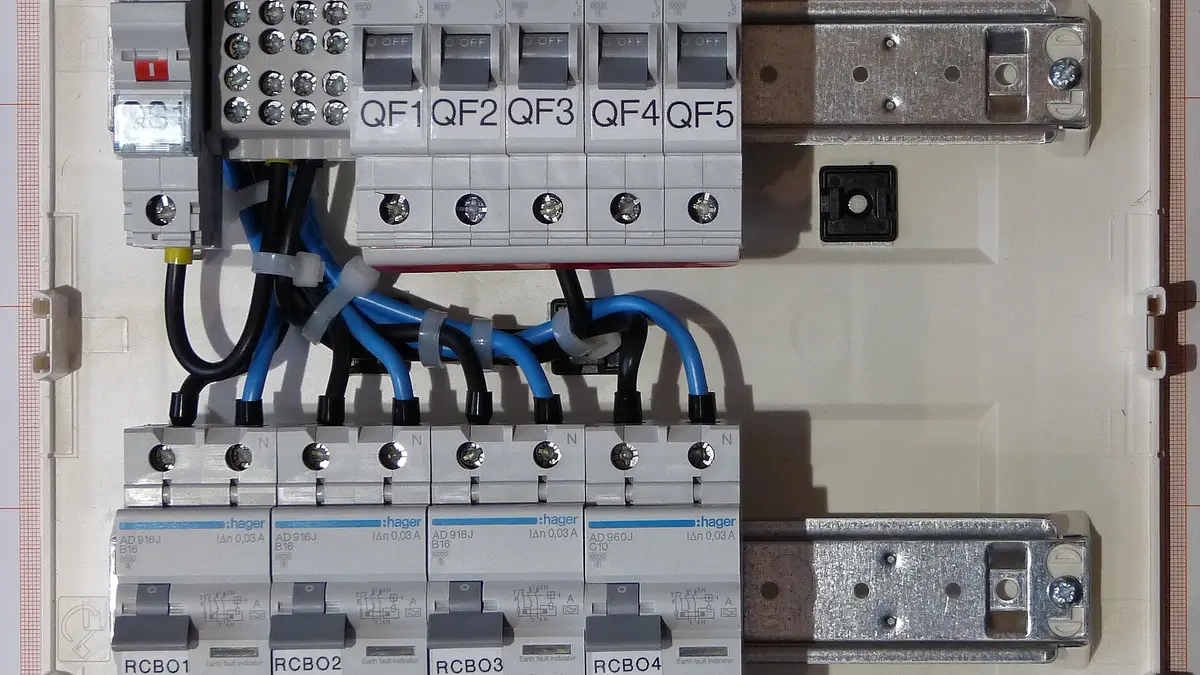
The electrical panel (called *tablero eléctrico* in Chile) is the box where power arrives from the meter and from which it is distributed, protected, to each circuit in the home. Inside are the circuit breakers, which trip when a circuit is overloaded or short-circuited, and the residual current device (RCD), which trips when current leaks in a way that could electrocute someone. In Chile, the rules for building one are set out in the RIC technical codes of the Superintendency of Electricity and Fuels (SEC), issued on 30 December 2020.
Under code RIC No. 10, a home of 30 m² or more must have at least 3 circuits, all protected by an RCD of 30 mA or less, plus a dedicated 16 A circuit for the kitchen or laundry sockets. The parts for a four-circuit panel start at CLP 47,720 at Sodimac, not counting labour.
View the data as a table
| Maximum RCD sensitivity | 30 mA |
| Minimum circuits | 3 |
| Dedicated kitchen or laundry circuit | 16 A |
| Spare room for expansion | 25% |
What a home electrical panel is and what it does
All the power a home uses goes through the panel first. Its job is twofold: to split electricity into separate circuits (lights, sockets, kitchen) and to protect each of them, so that a fault in the oven doesn't leave the bedroom in the dark or, worse, end in a fire or an electric shock.
In Chilean homes the norm is a single-phase 220 V panel in a plastic or metal enclosure of 4 to 18 modules. Each module is the space a single-pole breaker takes up on the DIN rail, the metal track the protective devices clip onto. A two-pole RCD takes up two modules.
Code RIC No. 02, which covers panels, requires each one to carry the manufacturer's mark, voltage, rated current and IP protection rating; a legend identifying each circuit by number and function; and the single-line diagram fixed inside the cover. Indoor panels must be at least IP41, and in new installations the enclosure must leave 25% spare space for future expansion. Switches must sit between 0.45 and 2 metres above the floor.
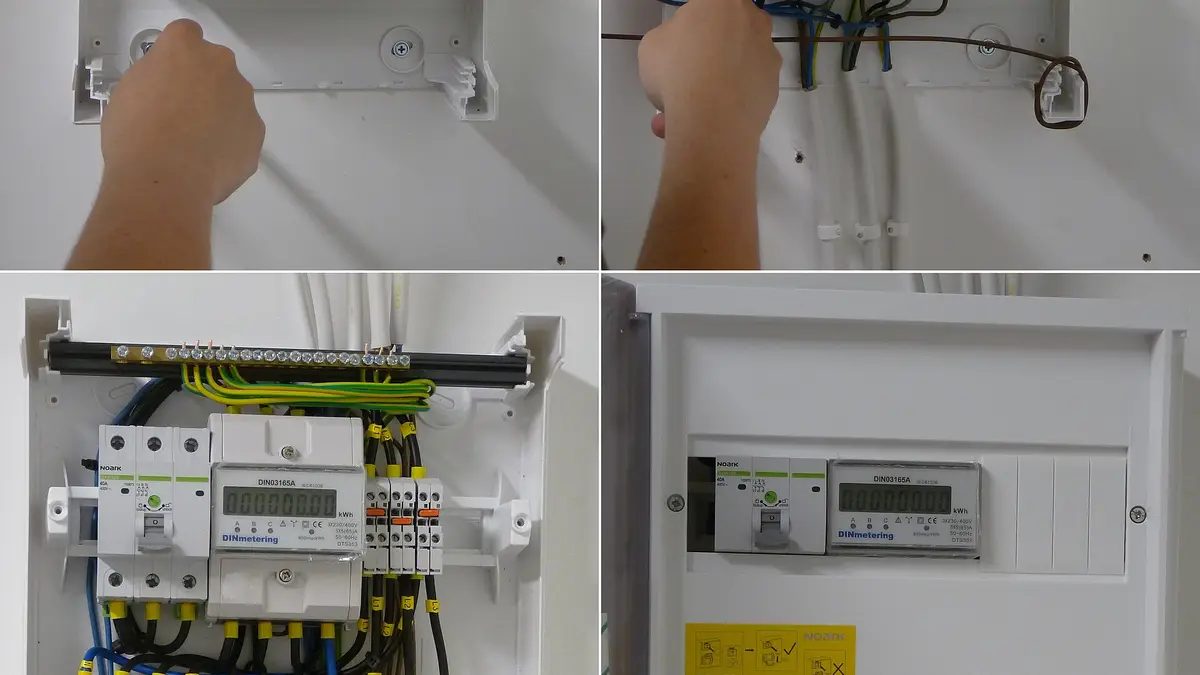
Parts of an electrical panel: breakers, RCDs and earth
- Main breaker: cuts all live conductors, including neutral (all-pole disconnection). It is first in line and its rating depends on the service connection. RIC No. 10 sets a minimum 25 A protection for homes.
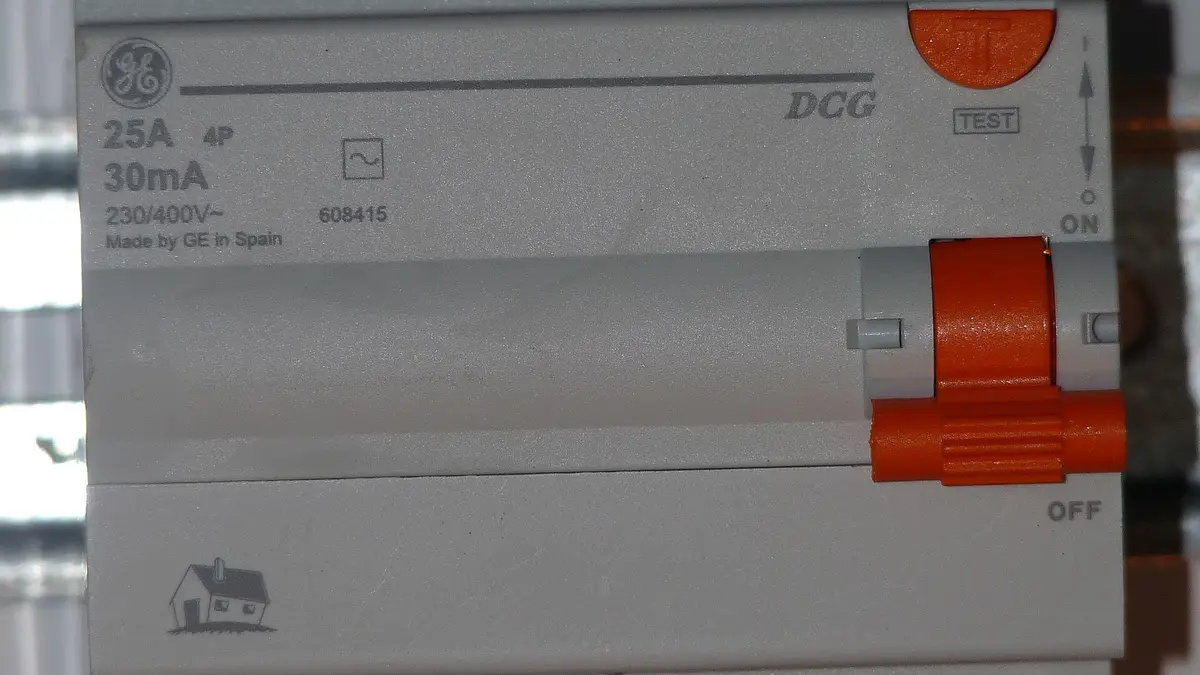
- Residual current device: compares the current going in with the current coming out. If some is missing, it is leaking to earth, sometimes through a person, and the RCD trips within milliseconds. To protect people, its sensitivity must be 30 mA or less.
- Circuit breakers: one per circuit. They trip on overload (too many appliances) or short circuit. They are chosen by rating: 10 A for lighting and 16 A for sockets is the usual combination in homes.
- Neutral and earth bars: collect the neutral and protective conductors. RIC No. 10 requires the TN-S earthing system in homes, with a separate protective conductor.
- Enclosure and cover: labelled circuit by circuit, so you know what to switch off in an emergency.
One point often misunderstood: a breaker does not protect people. It protects the cables. A current of a few tens of milliamperes through someone's body can be fatal, and it comes nowhere near tripping a 16 A breaker, which reacts to amperes. That is why an RCD is mandatory on every lighting and socket circuit under the RIC codes, and why it is worth pressing its 'T' or 'Test' button once a month.
RIC No. 10 adds three practical rules: no more than 3 circuits may hang from a single RCD; if one RCD covers several circuits, it may not cover 100% of the installation; and protective devices must not be used as switches to turn appliances on and off. So a four-circuit home in practice needs two RCDs.
How many breakers a home electrical panel needs under the rules
The minimum rule in RIC No. 10 is simple: 2 circuits for homes under 30 m² and 3 for those of 30 m² or more, with at least one dedicated 16 A circuit for the kitchen or laundry sockets. If there is an electric oven or cooker, another independent circuit of at least 16 A is added. The same applies if you ever fit an induction hob, whose circuit is sized to the power stated by the manufacturer.
How many sockets or lights fit on each circuit is regulated too. A circuit's capacity is the power it will be asked to supply plus 10%, and the points connected to it may not add up to more than 90% of the breaker's rating. For the calculation, each socket counts as 250 W and each light point as 100 W if the lamp is unknown.
| Breaker | Circuit power at 220 V | 90% usable | 250 W sockets | 100 W light points |
|---|---|---|---|---|
| 10 A | 2,200 W | 1,980 W | 7 | 19 |
| 16 A | 3,520 W | 3,168 W | 12 | 31 |
| 20 A | 4,400 W | 3,960 W | 15 | 39 |
Source: Energía Futura calculation using sections 5.1.4.4 to 5.1.4.6 of SEC code RIC No. 10. A double or triple socket counts as a single 250 W point. The final rating also depends on the cable cross-section, which another code (RIC No. 04) sets.
In practice, a 70 m² home with a gas cooker usually ends up with four circuits: one 10 A lighting circuit, one 16 A circuit for bedroom and living-room sockets, one dedicated 16 A kitchen circuit and another for the laundry or an electric oven. The code also requires at least one double or triple socket for every 8 metres of perimeter in bedrooms and living rooms, and three in the kitchen. If the home will add an electric car charger, code RIC No. 15 requires a circuit of its own.
Price of a home electrical panel in Chile
On 24 November 2026 we checked regular prices at Sodimac. A 12-module enclosure costs from CLP 12,990 (Lexo, IP41) to CLP 21,990 (Schneider Electric); 4-module ones start at CLP 5,990. A 10, 16 or 20 A breaker ranges from CLP 2,290 (Lexo) to CLP 6,990 (Legrand, curve C), and a 25 A RCD from CLP 9,790 to CLP 23,690.
| Part | Budget option (Lexo) | Brand option (Schneider Electric) |
|---|---|---|
| 12-module enclosure | CLP 12,990 | CLP 21,990 |
| 2 × 25 A RCDs | CLP 19,580 | CLP 37,300 |
| 4 × 10-20 A breakers | CLP 9,160 | CLP 13,160 |
| Subtotal | CLP 41,730 | CLP 72,450 |
Source: Sodimac regular prices on 24 November 2026. The budget option still needs a main breaker (a Lexo 25 A 1P+N costs CLP 5,990), bringing it to CLP 47,720. Cables, bars, conduit and the electrician's labour are not included; labour varies by city and by the state of the wiring.
View the data as a table
| 12-module enclosure | 2 RCDs 25 A | 4 circuit breakers | |
|---|---|---|---|
| Lexo | CLP 12,990 | CLP 19,580 | CLP 9,160 |
| Schneider Electric | CLP 21,990 | CLP 37,300 | CLP 13,160 |
| Surface panel, 1-4 ways | MEC | CLP 5,990 |
| Surface panel, 4 modules | Legrand | CLP 12,990 |
| Surface panel, 12 modules, IP41 | Lexo | CLP 12,990 |
| Flush panel, 12 modules, IP41 | Lexo | CLP 13,990 |
| Flush panel, 18 modules, IP41 | Lexo | CLP 18,990 |
| Surface panel, 12 modules | Schneider Electric | CLP 21,990 |
| Flush panel, 8 modules | Legrand | CLP 26,990 |
| 10, 16 or 20 A breaker | Lexo | CLP 2,290 |
| 10, 16 or 20 A breaker (Easy9) | Schneider Electric | CLP 3,290 |
| 10, 16 or 20 A breaker, curve C | Bticino | CLP 4,390 |
| 10, 16 or 20 A breaker, curve C | Legrand | CLP 6,990 |
| 25 A 1P+N breaker | Lexo | CLP 5,990 |
| 25 A RCD | Lexo | CLP 9,790 |
| 25 A RCD (Easy9) | Schneider Electric | CLP 18,650 |
| 25 A RCD | Bticino | CLP 19,990 |
| 25 A RCD | Legrand | CLP 23,690 |
| 40 A RCD | Legrand | CLP 64,990 |
Who may install or modify it: SEC electricians and the TE1 declaration
Installing or modifying a panel must be done by an electrician authorised by the SEC, with a valid licence. Licences run from class A to D depending on the type and size of installation each electrician may carry out. The requirements are set out on the ChileAtiende page.
Once the work is done, the electrician declares the installation to the SEC on form TE1 through the e-Declarador system. That certificate is what the distribution company asks for before a new connection or a capacity increase, and what proves in a sale or an insurance claim that the wiring meets the rules. Replacing a burnt-out breaker with an identical one is maintenance; replacing the panel, adding circuits or raising the rating is a modification that must be declared.
- 2003NCh Elec. 4/2003'Norma 4' governs low-voltage consumer installations for almost two decades.
- 31 Jan 2019Decree 8 is signedNew safety regulation for electricity consumer installations.
- 5 Mar 2020Published in the Official GazetteThe regulation replaces Norma 4.
- 30 Dec 2020SEC issues the RIC codesExempt Resolution 33,877: 19 technical codes, including No. 02 on panels and No. 10 on general-use installations.
Signs your wiring needs a check
- A breaker keeps tripping with the same appliances: the circuit is overloaded or there is an insulation fault.
- The RCD trips for no obvious reason, especially when it rains: there is damp or a leak in an outdoor socket or appliance.
- A burning smell, black marks or a hot cover: switch off the main breaker and call an electrician.
- There is no RCD, or the panel still has screw-in fuses: the wiring predates current rules.
- Unlabelled circuits: in an emergency nobody knows what to switch off.
Checking the panel is also an efficiency measure: an overloaded circuit heats its cables and wastes energy as losses. To see how much each appliance weighs on the bill, read how much electricity a house uses in Chile each month and which circuits carry that load.
Does your company sell electrical supplies or carry out certified installations? Reach Energía Futura's readers.
See advertising optionsFrequently asked questions
What is the difference between a circuit breaker and an RCD?
A breaker protects the cables: it trips on overload or short circuit. An RCD protects people: it trips when it detects an earth leakage of 30 mA or more. A home needs both.
How many breakers should a home panel have?
One per circuit. The code requires at least 3 circuits in homes of 30 m² or more, and in practice a mid-sized house has 4 to 6, plus the main breaker.
What breaker rating is used for sockets?
Usually 16 A for sockets and 10 A for lighting. The kitchen or laundry circuit must be at least 16 A, under RIC No. 10.
How much does a home electrical panel cost?
Parts for four circuits start at CLP 47,720 with budget brands, main breaker included, and at CLP 72,450 without it using Schneider Electric, at Sodimac prices in November 2026. Labour comes on top.
Can I replace the panel myself?
No. It must be done by an SEC-authorised electrician, who also declares the work on form TE1. Without that declaration the installation is not regularised.