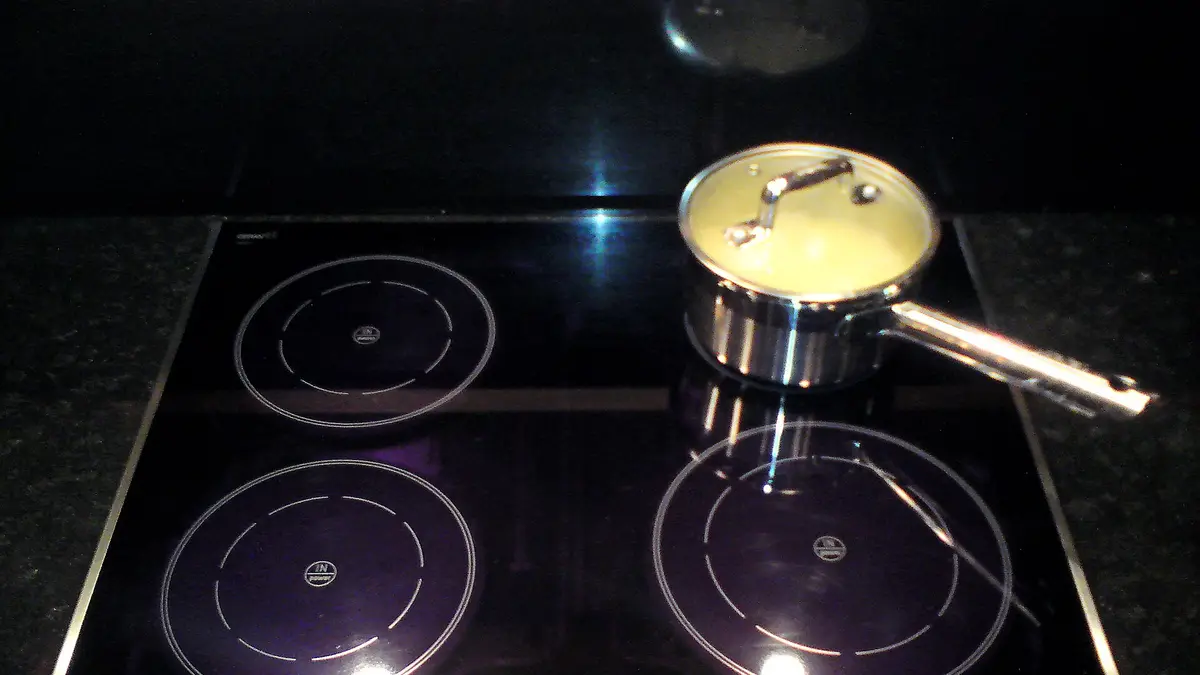
A four-zone induction cooktop has a total rated power of 5,000 to 6,200 W, but it is almost never used in full: one or two zones are usually on, and almost always below their maximum. Cooking one hour a day at an average of 1,500 W uses 45 kWh a month, about CLP 11,487 with residential electricity at CLP 255.27 per kWh (CGE, BT1 tariff, October 2026).
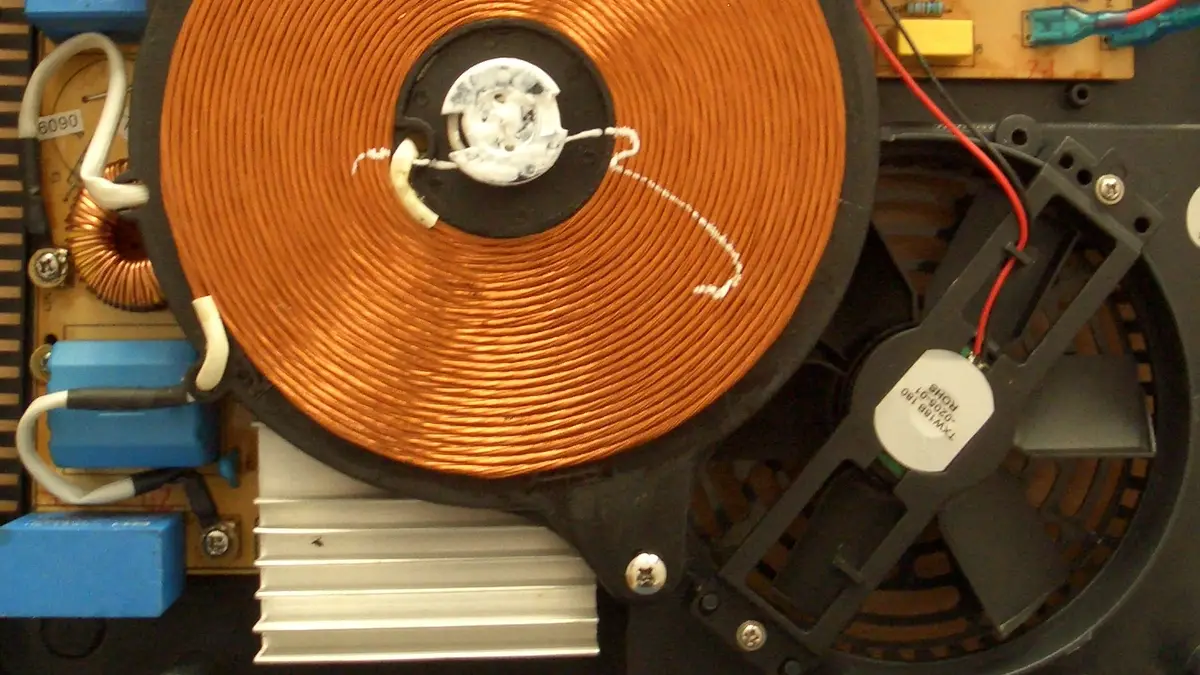
Induction is the most efficient way to cook with electricity: it heats the pot directly with a magnetic field, without heating the cooktop first. According to ENERGY STAR, the US Environmental Protection Agency's efficiency label, an induction cooktop is 5% to 10% more efficient than a conventional electric resistance one and about three times more efficient than a gas stove, as reported by Efficiency Vermont. In this guide we calculate how much it consumes, what it costs in pesos, which pots work and what it costs in Chile.
View the data as a table
| Power of a 4-zone hob | 6,200 W |
| Boiling 1 litre of water | $30 |
| One hour a day, per month | $11,487 |
| Cheapest built-in hob | $129,990 |
How much an induction cooktop consumes
The power shown in the spec sheet is the maximum with all zones on at full power. The four-zone Sindelen CEI-4602NG is rated 6,200 W, according to Solotodo; the three-zone FDV Inducción 3 Black 2.0, 5,200 W according to its spec sheet, and the two-zone Electrolux IE2TP, 3,500 W according to Electrolux. Single-zone portable plates are around 2,000 W.
| Model | Zones | Total power | Price at Falabella (Nov 14, 2026) |
|---|---|---|---|
| RAF portable | 1 | 2,000 W | CLP 30,990 |
| Electrolux IE2TP | 2 | 3,500 W | CLP 159,990 |
| FDV Inducción 3 Black 2.0 | 3 | 5,200 W | CLP 299,990 |
| Sindelen CEI-4602NG | 4 | 6,200 W | CLP 219,990 |
Sources: manufacturers' and Solotodo spec sheets; lowest prices listed at Falabella on November 14, 2026.
Many cooktops have a booster or PowerBoost function, which takes a zone to its maximum for a few minutes to boil faster. It uses more per minute, but the water boils sooner, so the total energy to bring a litre to the boil changes little. What raises consumption most is leaving pots uncovered or using a pot much smaller than the zone.
What an induction cooktop costs in pesos
Heating a litre of water from 15 °C to 100 °C requires, by physics, 0.099 kWh: about CLP 25. With a pot's normal losses, in practice it is closer to 0.12 kWh, about CLP 30. For comparison, an electric kettle uses a similar amount, as we show in the guide to the electric kettle.
For the monthly cost, what matters is how many minutes a day you cook and at what power. With an average of 1,500 W, equivalent to one large zone at high power or two zones at medium power, the cost is as follows:
| Daily use | Monthly consumption | Monthly cost (CLP 255.27/kWh) |
|---|---|---|
| 30 minutes | 22.5 kWh | CLP 5,744 |
| 1 hour | 45 kWh | CLP 11,487 |
| 1.5 hours | 67.5 kWh | CLP 17,231 |
| 2 hours | 90 kWh | CLP 22,974 |
Energía Futura calculations with an average power of 1,500 W, 30 days and electricity at CLP 255.27 per kWh (CGE, BT1). The formula for any appliance is in how to calculate electricity consumption.
When the comparison is with gas, the result depends on the price of the cylinder and the efficiency of each stove. We did the full comparison between cooking with electricity and with gas in Chile in the guide to the electric cooker.
Which pots work: the magnet test
Induction only works with pots that have a ferromagnetic base, that is, one that attracts a magnet. The test is simple: if a magnet sticks firmly to the bottom of the pot, it works. If it does not stick or sticks weakly, the cooktop will not detect it or will heat it poorly. Many pots carry a coil symbol or the word «induction» on the base.
| Material | Works on induction? | Comment |
|---|---|---|
| Cast iron | Yes | Heats evenly; heavy |
| Enamelled steel | Yes | Iron base with a coating |
| Stainless steel with magnetic base | Yes | Check with a magnet: not all stainless steel is magnetic |
| Aluminium with steel base (diffuser base) | Yes | Common in sets labelled «induction-ready» |
| Aluminium without magnetic base | No | Not detected by the cooktop |
| Copper | No | Unless it has a steel base |
| Glass and ceramic | No | Unless they have a steel base |
The base must be flat and about the same size as the zone. At Falabella, on November 14, a 14-piece induction-ready stainless steel set cost CLP 29,990; a 12-piece granite set, CLP 54,990; an 8-litre Tramontina stainless steel pot, CLP 123,990, and an 8-litre pressure cooker with an induction base, from CLP 54,990.
- Use pots the size of the zone: a small pot on a large zone wastes energy or is not detected.
- Cover your pots: water boils sooner and uses less.
- Use residual heat: turn the zone off a minute or two early; the pot keeps cooking.
- Use the timer: most cooktops switch the zone off when the time is up.
- Clean the surface when cold: glass-ceramic scratches with metal scourers.
Pros and cons compared with gas and glass-ceramic
- More efficient: 5% to 10% more than an electric resistance cooktop and about three times more than gas, according to ENERGY STAR.
- Faster: with booster, a zone can boil water in a few minutes.
- Safer: there is no flame or gas leak, and the surface only gets hot through contact with the pot; almost all have a child lock and automatic shut-off.
- No combustion inside the house: it does not produce carbon monoxide or other gases from burning gas.
- Easy to clean: the surface is flat and spills do not burn on as quickly.
- Against: it needs compatible pots, suitable wiring for three-zone or larger models, and it does not work during a power cut.
That last point matters in areas with frequent outages: a gas stove keeps working without electricity. For anyone cooking with gas who wants to try induction without replacing the whole cooker, a single-zone portable plate, from about CLP 31,000, is the cheapest way to start.
Does your company sell cookers, cookware or efficient appliances? Reach Energía Futura's readers.
See advertising formatsInstallation: the outlet and the breaker
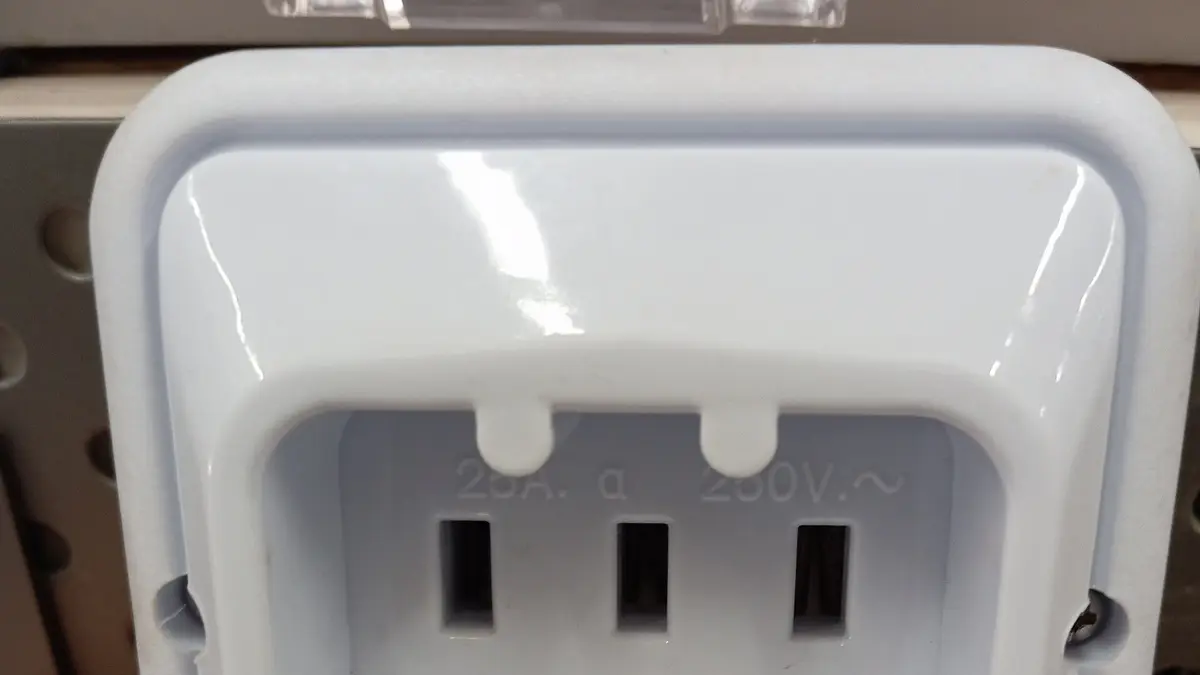
A 6,200 W cooktop at 220 V can draw up to 28 amps with all zones at full power. That is more than the 10 or 16 amp breakers that usually protect outlet circuits can handle. That is why three- and four-zone cooktops are connected to a dedicated circuit, with a cable of suitable cross-section and its own breaker. It must be done by an electrician authorized by Chile's SEC.
Single-zone portable plates, of about 2,000 W (9 amps), can be plugged into a normal outlet, as long as they do not share the circuit with another high-consumption appliance such as a kettle or heater.
Induction cooktop prices in Chile
At Falabella, on November 14, 2026, single-zone portable plates started at CLP 30,990; two-zone built-in cooktops, at CLP 129,990 (Sindelen CEI-4252NG); three-zone ones, at CLP 154,990 (Predicta PDENI030), and four-zone ones, at CLP 174,990 (Predicta PDENI040). Five-zone models ranged from CLP 354,990 to CLP 569,990, and a Bosch cooktop with built-in extractor reached CLP 2,999,990.
| RAF portátil 2000W | 1 | 30,990 | 2,000 |
| FDV Temis | 1 | 54,990 | No data |
| Sindelen CEI-4252NG | 2 | 129,990 | No data |
| Electrolux IE2TP | 2 | 159,990 | 3,500 |
| Predicta PDENI030 | 3 | 154,990 | No data |
| Sindelen CEI-4342NG | 3 | 179,990 | No data |
| FDV Inducción 3 Black 2.0 | 3 | 299,990 | 5,200 |
| Predicta PDENI040 | 4 | 174,990 | No data |
| Sindelen CEI-4602NG | 4 | 219,990 | 6,200 |
| Electrolux IE4TW | 4 | 219,990 | No data |
| FDV Magno 4Q 60 cm | 4 | 229,990 | No data |
| Electrolux IE6LP | 4 | 369,990 | No data |
| Predicta PDENI050 | 5 | 354,990 | No data |
| FDV Deluxe 5 focos | 5 | 569,990 | No data |
When choosing, look at the number and size of the zones, whether it has a booster, a timer per zone, child lock and pan detection, which turns the zone off if the pot is removed. Total power also matters for the installation: a 3,500 W model asks less of the panel than a 6,200 W one.
Frequently asked questions
How much power does an induction cooktop use?
Four-zone models are rated between 5,000 and 6,200 W in total, but only a fraction is used. One hour a day at a 1,500 W average is 45 kWh a month.
How much does an induction cooktop cost per month in Chile?
About CLP 11,487 a month cooking one hour a day at a 1,500 W average, with electricity at CLP 255.27 per kWh. With two hours a day, about CLP 22,974.
Which pots work on an induction cooktop?
Those with a ferromagnetic base: cast iron, enamelled steel, and stainless steel or aluminium with a magnetic base. If a magnet sticks firmly to the bottom, the pot works.
Does induction use more than glass-ceramic?
No. According to ENERGY STAR, induction is 5% to 10% more efficient than an electric resistance cooktop, because it heats the pot directly.
Can an induction cooktop be plugged into a normal outlet?
Only single-zone portable plates, of about 2,000 W. Three- or four-zone cooktops need a dedicated circuit installed by an electrician authorized by the SEC.