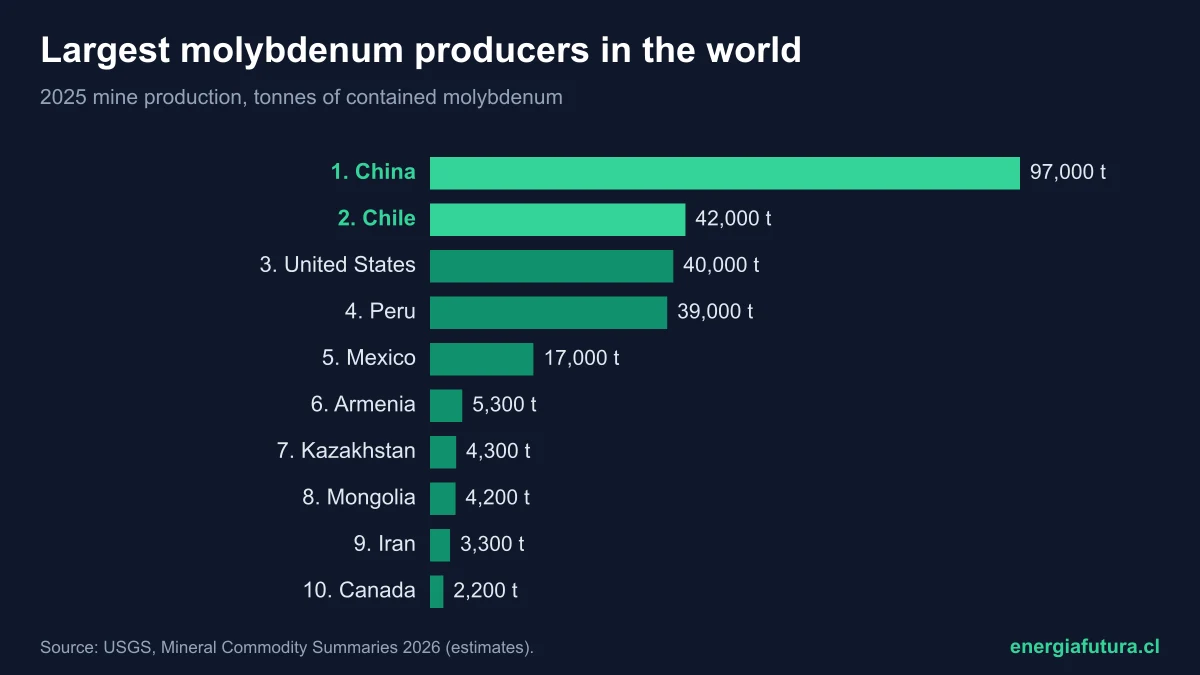
Updated on November 4, 2026. China is the world's largest molybdenum producer, with estimated mine production of 97,000 tonnes in 2025, around 37% of the world total of 260,000 tonnes, according to the molybdenum summary of the US Geological Survey (USGS), Mineral Commodity Summaries 2026, published in February. Chile is second with 42,000 tonnes (16.2%), ahead of the United States (40,000) and Peru (39,000).
Molybdenum is a metal that hardens steel and makes it resistant to heat and corrosion. It is used in stainless and high-strength steels, in refinery catalysts and in energy transition equipment. The USGS expects consumption to stay strong as countries keep investing in renewable energy infrastructure. In Chile, almost all molybdenum is a by-product of copper. This data sheet covers the production ranking, reserves, prices and Chile's place.
Ranking of the largest molybdenum producers in the world in 2025
The table ranks countries by 2025 mine production, in tonnes of contained molybdenum. 2025 figures are USGS estimates; the 2024 column shows who grew.
| Rank | Country | Production 2024 (t) | Production 2025e (t) | Share of 2025 total |
|---|---|---|---|---|
| 1 | China | 100,000 | 97,000 | 37.3% |
| 2 | Chile | 38,500 | 42,000 | 16.2% |
| 3 | United States | 34,000 | 40,000 | 15.4% |
| 4 | Peru | 41,900 | 39,000 | 15.0% |
| 5 | Mexico | 16,200 | 17,000 | 6.5% |
| 6 | Armenia | 8,200 | 5,300 | 2.0% |
| 7 | Kazakhstan | 4,080 | 4,300 | 1.7% |
| 8 | Mongolia | 3,110 | 4,200 | 1.6% |
| 9 | Iran | 2,900 | 3,300 | 1.3% |
| 10 | Canada | 1,540 | 2,200 | 0.8% |
| 11 | Uzbekistan | 2,100 | 2,000 | 0.8% |
| 12 | Russia | 1,500 | 1,300 | 0.5% |
| 13 | Australia | 600 | 1,000 | 0.4% |
| — | World total | 256,000 | 260,000 | 100% |
Source: USGS, Mineral Commodity Summaries 2026. World production rose 2% in 2025. China, Chile, the United States, Peru and Mexico account for 90% of the total. In 2025 Chile overtook the United States and Peru to rank second; in 2024 Peru had been the second-largest producer.
Chile, the world's second-largest molybdenum producer
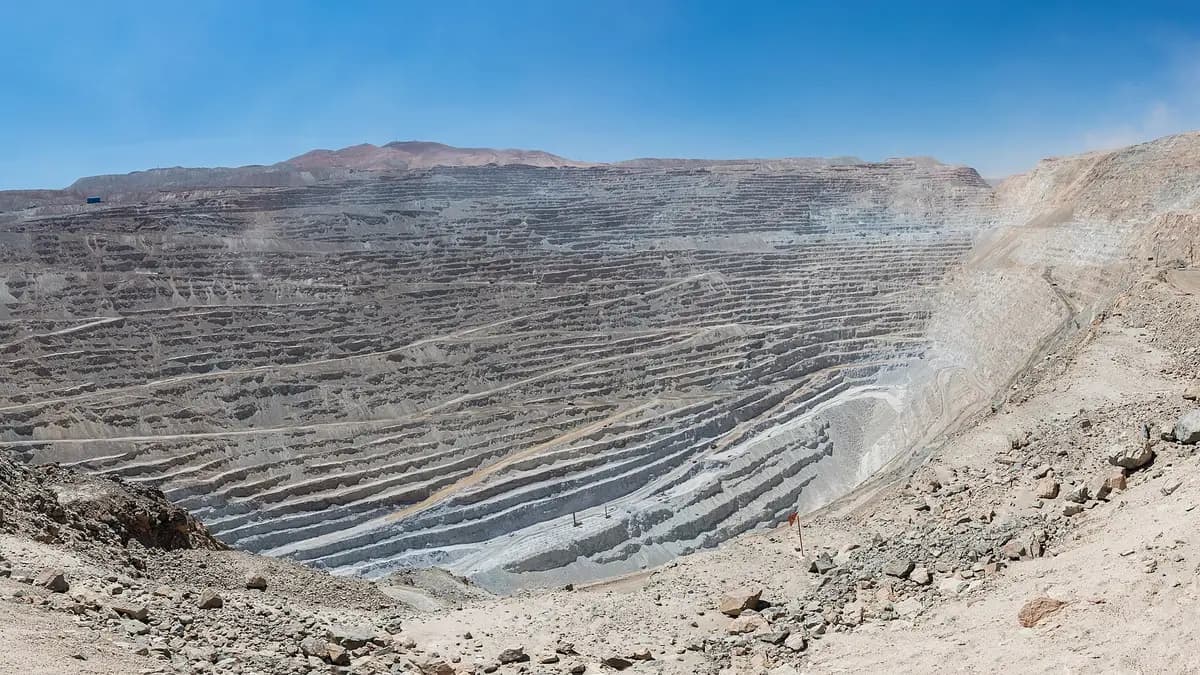
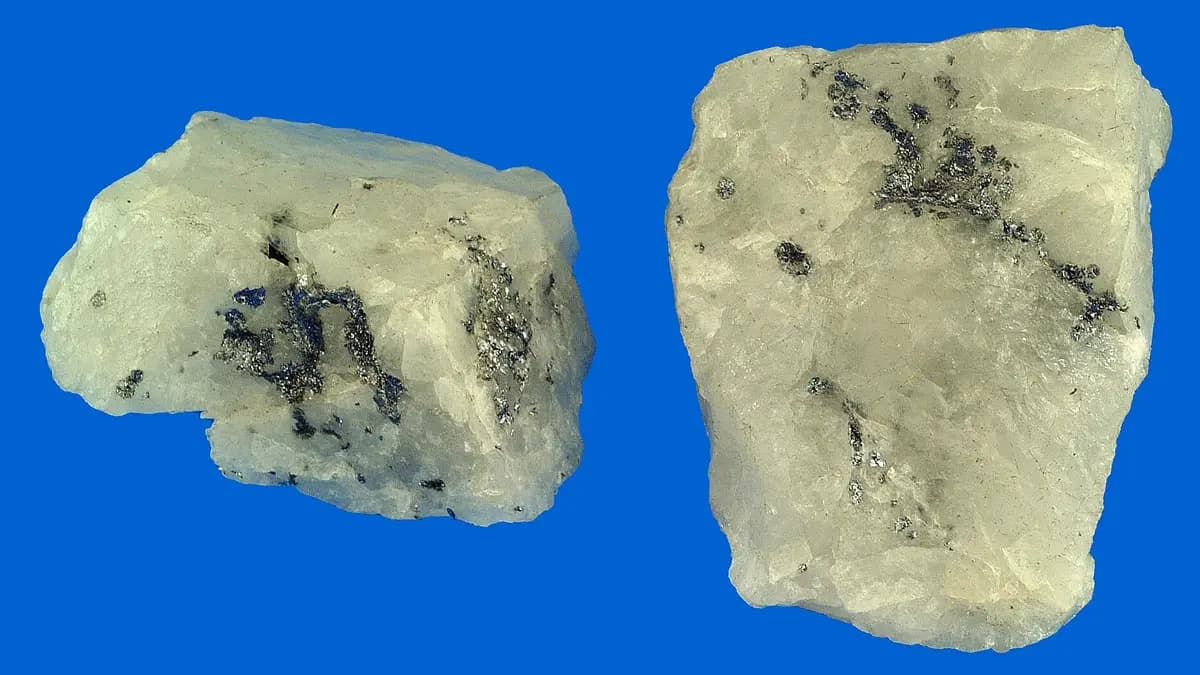
Chilean molybdenum comes from copper mines: it occurs as molybdenite in the same porphyry copper deposits and is separated in the flotation plant. According to the USGS, only China and the United States have primary molybdenum mines; all other countries, Chile included, obtain it as a copper by-product. National figures from Chile's copper commission Cochilco, cited by Plusmining, put Chile's output at 43,358 tonnes in 2025, up 12.7% on 2024.
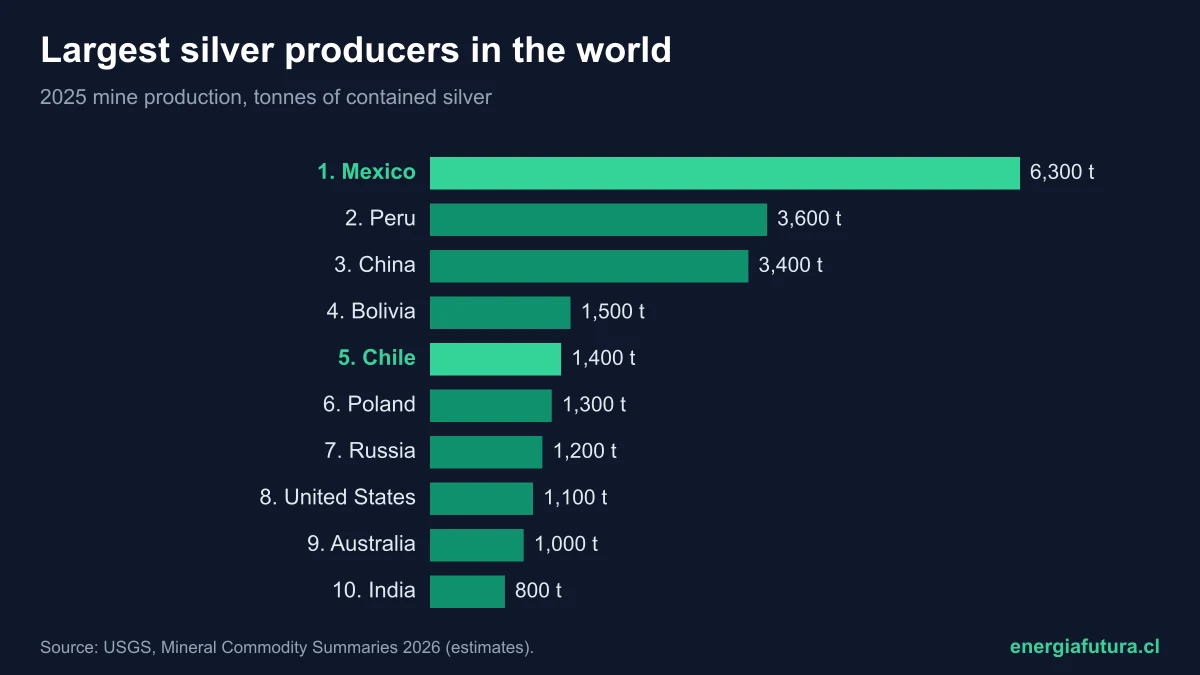
State-owned Codelco is the country's main producer. In 2024 it produced 16,000 tonnes, about 42% of Chilean molybdenum and 7% of world output, and shipped 60% to Japan, according to the company. The metal comes from divisions such as Chuquicamata, El Teniente and Andina, and from private mines such as Los Pelambres, Collahuasi and Centinela. Like silver, molybdenum is a by-product that adds value to Chilean copper; in the ranking of silver producers Chile is fifth.
| Chile indicator | Value | Source |
|---|---|---|
| 2025 production (USGS estimate) | 42,000 t | USGS MCS 2026 |
| 2025 production (Cochilco) | 43,358 t | Cochilco via Plusmining |
| Growth in 2025 vs. 2024 | +12.7% | Cochilco via Plusmining |
| World rank 2025 | 2nd | USGS MCS 2026 |
| Reserves | 2.6 million t | USGS MCS 2026 |
| Codelco production 2024 | 16,000 t (42% of the country) | Codelco |
| Exports 2024 | US$2.54 billion | Diario Financiero |
Molybdenum reserves by country
The USGS estimates world molybdenum reserves at 17 million tonnes, about 65 times 2025 production. China has the largest, with 7.8 million, followed by the United States (3.5 million) and Chile (2.6 million). For Chile, the USGS revised the figure using company and government data.
| Country | Reserves (thousand t) | Share of total |
|---|---|---|
| China | 7,800 | 45.9% |
| United States | 3,500 | 20.6% |
| Chile | 2,600 | 15.3% |
| Russia | 1,100 | 6.5% |
| Peru | 1,000 | 5.9% |
| Australia | 760 | 4.5% |
| Armenia | 150 | 0.9% |
| Mexico | 130 | 0.8% |
| North Korea | 78 | 0.5% |
| Canada | 64 | 0.4% |
| World total | 17,000 | 100% |
Source: USGS, Mineral Commodity Summaries 2026. Identified resources are much larger: about 5.4 million tonnes in the United States and 20 million in the rest of the world, according to the same report.
Does your company work in mining, metals or energy? Reach Energía Futura's readers.
See advertising optionsMolybdenum price
The average US price of molybdic oxide was about US$51 per kilogram in 2025, 7% higher than in 2024, according to the USGS. The five-year high was in 2023, at US$54.32. For copper producers, molybdenum is extra revenue that improves the profitability of every tonne processed: the USGS notes that many miners have upgraded plants to recover more molybdenite from their deposits.
| Year | Average molybdic oxide price (US$ per kg) |
|---|---|
| 2021 | 35.62 |
| 2022 | 41.72 |
| 2023 | 54.32 |
| 2024 | 47.72 |
| 2025e | 51 |
Source: USGS, Mineral Commodity Summaries 2026. In February 2025, China imposed export controls on molybdenum powders, prompting the United States and other countries to seek alternative suppliers. Chile is the main source of US molybdenum imports, with 36% of the total in 2021-2024, and supplies 74% of the ferromolybdenum the country buys.
Peru, the United States and Mexico: the other big producers
The United States produced about 40,000 tonnes in 2025, up 18%, from two primary molybdenum mines in Colorado and seven copper mines that recover it as a by-product in Arizona, Montana, Nevada and Utah, according to the USGS. Along with China, it is the only country with mines whose main product is molybdenum. A Canadian company plans to restart an idled mine in Idaho in the second half of 2027.
Peru fell from 41,900 to 39,000 tonnes and lost second place to Chile. Like Chile's, its output comes from large copper mines in the south of the country. Mexico rose to 17,000 tonnes, also as a copper by-product. The three countries in the Americas (Chile, Peru and Mexico) account for about 38% of world production, more than China.
Molybdenum and the energy transition
Molybdenum is not in batteries or panels, but it is in the steel that underpins the transition: stainless and high-strength steels for wind turbine structures, geothermal plants, desalination plants, nuclear equipment and pipelines. A small amount greatly improves steel's resistance to corrosion and high temperatures. It is also recycled: the USGS estimates that molybdenum returning as steel scrap can reach 30% of apparent supply in the United States.
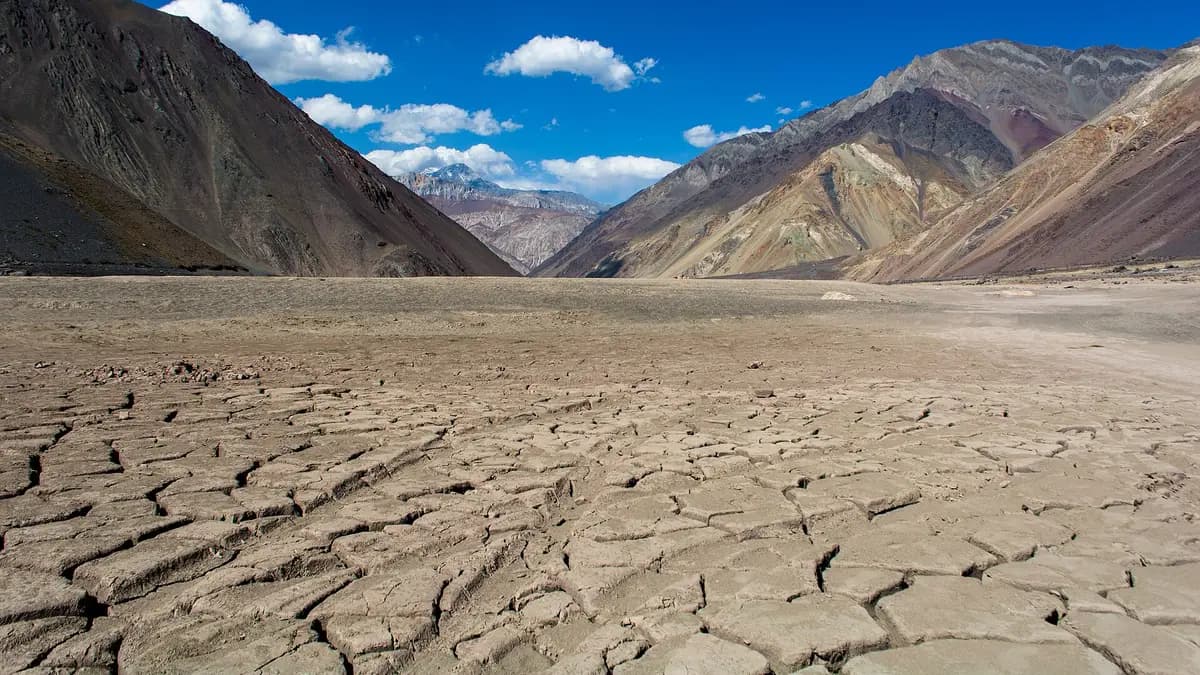
For Chile, molybdenum strengthens the copper-based mining strategy: it is a valuable by-product that does not require opening new mines. Copper production, by contrast, faces declining ore grades and risks such as drought, as we explained when reviewing the largest copper mine in the world.
The footprint of that molybdenum depends largely on the energy used by copper mines. Because the metal is separated in the same flotation plants, it benefits from Chilean mining's renewable electricity contracts, which already cover most of the sector's power use, as we detailed in the carbon footprint of Chilean copper.
How to cite this data
Energía Futura (2026). "Largest molybdenum producers in the world 2026: ranking by country, reserves and Chile's place". Updated on November 4, 2026. energiafutura.cl/en/news/largest-molybdenum-producers-in-the-world-2026-ranking-by-country-reserves-and-chile. Data: USGS, Mineral Commodity Summaries 2026; Cochilco; Codelco.
Frequently asked questions
Which country is the largest molybdenum producer?
China, with about 97,000 tonnes in 2025, 37.3% of the world total, according to the USGS.
Where does Chile rank?
Second, with 42,000 tonnes in 2025 according to the USGS (43,358 according to Cochilco), ahead of the United States and Peru.
Where does Chilean molybdenum come from?
From copper mines: it is a by-product separated in flotation plants. Codelco produces about 42% of the national total.
How large are Chile's molybdenum reserves?
2.6 million tonnes, 15.3% of the world total and third place, behind China and the United States.
What is molybdenum used for?
Mainly as an alloying agent in steel and cast iron, and in catalysts, lubricants and pigments. It is key in steels for energy, chemicals and infrastructure.