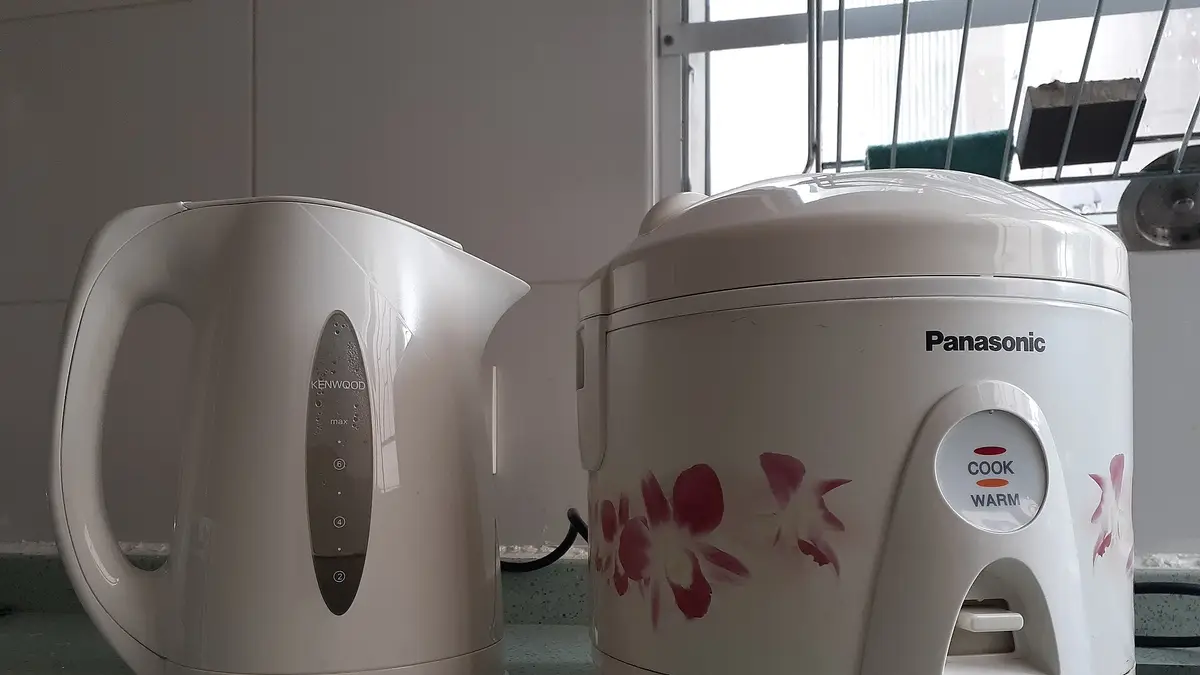
An electric rice cooker draws between 440 and 700 W in the best-selling models in Chile, and cooking a batch of rice takes 20 to 30 minutes at full power. That works out to between 0.15 and 0.3 kWh per batch, or between CLP 39 and 75, with power at CLP 255.27 per kWh (CGE's BT1 residential rate in Chile since October 2026). Used daily, it adds up to between CLP 1,200 and 2,300 a month, plus whatever the keep-warm function uses. Retailers sell models from CLP 23,990.
This guide calculates how much electricity a rice cooker uses, what each batch and each month costs in pesos, how much the keep-warm function uses and whether it beats cooking rice in an ordinary pot on a gas or induction stove.
How much electricity a rice cooker uses
An electric rice cooker is a pot with a heating element in the base and a thermostat. It heats at full power while there is liquid water, which cannot go above 100 °C. When the rice absorbs the water, the temperature of the base rises and the thermostat ends cooking and switches to keep warm, at much lower power. In Chile, the term «olla arrocera» is also used for aluminium pots for cooking rice on the stove, which are not electric, so check the listing. These are electric models listed on Paris.cl on 29 October 2026:
| Model | Capacity | Power | Price |
|---|---|---|---|
| Sindelen OA-400NG | 1.8 litres (5 to 6 cups) | 440 W | CLP 23,990 |
| Sindelen OA-500 | 3 litres | 650 W | CLP 26,990 |
| Thomas TH-38iF (multifunction) | 1.8 litres | 700 W | CLP 35,990 |
| RAF multifunction | 5 litres | 900 W | CLP 38,490 |
| Oster Diamond Force (multifunction) | 7 cups | 500 W | CLP 53,890 |
Power and capacity from the names and listings published in Paris.cl's search, checked on 29 October 2026. Prices change with promotions; the Oster model is sold by a third-party store on the platform.
For a measured figure, Japan's Tiger publishes the consumption of its JRT-A100 rice cooker, 1 litre and 1,080 W, using Japan's standard method: 154 Wh per cooking cycle and 16.5 Wh per hour in keep-warm mode, at its factory setting, according to its official spec sheet. In other words, although its power is high, the energy for a full cycle is similar to that of a 440 W cooker running for about 20 minutes.
Rice cooker running cost in Chilean pesos
The cost of a batch is power times the time the element works at full load. That time depends on the amount of rice and water: a full pot takes longer than one with two cups. The table uses 25 minutes as the reference for basic cookers and Tiger's measured figure for comparison:
| Rice cooker | Energy per batch | Cost per batch | Monthly cost (15 batches) | Monthly cost (30 batches) |
|---|---|---|---|---|
| Tiger JRT-A100 (measured) | 0.154 kWh | CLP 39 | CLP 590 | CLP 1,180 |
| 440 W, 25 minutes | 0.183 kWh | CLP 47 | CLP 700 | CLP 1,400 |
| 650 W, 25 minutes | 0.271 kWh | CLP 69 | CLP 1,040 | CLP 2,070 |
| 700 W, 25 minutes | 0.292 kWh | CLP 75 | CLP 1,120 | CLP 2,230 |
Energía Futura calculations with power at CLP 255.27 per kWh, rounded. The 25 minutes at full power is an assumption for a medium batch; with less rice, the thermostat cuts out sooner and the cost falls. The price per kWh varies by municipality, as shown in the price of a kWh in Chile by municipality and distributor.
For perspective: a 440 W cooker used every day adds up to about 5.5 kWh a month, around 3% of the 180 kWh a month that Chile's National Energy Commission uses as a reference for a typical household. In Japan, where almost every home has one, a study by Tsuda and Sato published in the Journal of Life Cycle Assessment, Japan in 2012 estimated their consumption at about 63 kWh a year per household, around 1.2% of that country's household electricity in 2008.
How much keeping the rice warm costs
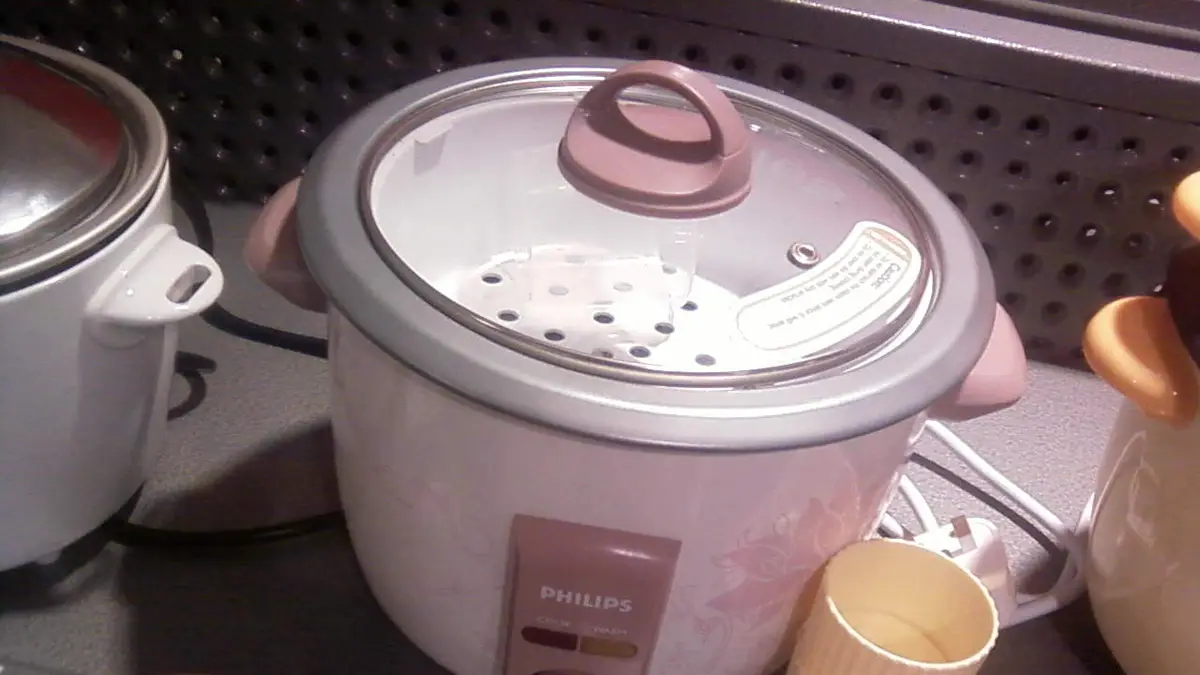
The keep-warm function is convenient, but it is the one that can inflate the cost if left on for hours. In the Tiger measured in Japan it is 16.5 Wh per hour, about CLP 4 an hour. Basic cookers, without insulation or electronic control, use more: between 30 and 45 W according to estimates from Indian maker Crompton, published in its rice cooker consumption guide.
| Time on keep warm | Well-insulated cooker (16.5 W) | Basic cooker (40 W, estimated) | Per month, every day (basic cooker) |
|---|---|---|---|
| 1 hour | CLP 4 | CLP 10 | CLP 306 |
| 3 hours | CLP 13 | CLP 31 | CLP 919 |
| 8 hours | CLP 34 | CLP 82 | CLP 2,450 |
| 24 hours | CLP 101 | CLP 245 | CLP 7,350 |
Energía Futura calculations with power at CLP 255.27 per kWh and 30-day months, rounded. The 40 W is a midpoint of the range Crompton reports, not a measurement of a model sold in Chile.
The conclusion is clear: keeping rice warm for a couple of hours costs little, but leaving the cooker on all day can cost more than cooking. A basic cooker forgotten on keep warm 24 hours a day, every day, would cost about CLP 7,350 a month, more than three times what cooking rice daily costs. Rice that spends many hours lukewarm also loses quality and, for food safety reasons, should not be kept that way for long.
Rice cooker vs. gas or induction stove: which is better
To cook rice in an ordinary pot, the water has to be brought to the boil and then kept on a low heat for about 15 to 20 minutes. The cost comparison, for a batch for four people, looks like this:
| Method | Assumption | Energy | Approximate cost |
|---|---|---|---|
| Electric rice cooker | Medium batch, without keep warm | 0.15 to 0.29 kWh | CLP 39 to 75 |
| Induction hob | Boil, then 15 minutes at low power | about 0.19 kWh | about CLP 50 |
| Bottled LPG stove | Boil at 32% efficiency and 15 minutes on a low flame | about 0.46 kWh of gas | about CLP 58 |
Energía Futura estimates. Electricity at CLP 255.27 per kWh. Bottled LPG at about CLP 127 per kWh (15 kg cylinder at CLP 24,000-26,000 with the subsidy coupon in force since 15 October 2026, and 13.1 kWh per kilo). The induction (85%) and gas (32%) efficiencies are the ENERGY STAR figures used in our guide to electric cooktops versus gas; the times and the low-flame power are assumptions.
On cost, the three methods sit in the same range: between CLP 40 and 75 per batch. A rice cooker does not save much energy compared with the stove, but it has other advantages: it needs no watching, the rice does not burn, it frees up a burner and uses no gas in the home. A small 440 W cooker uses less than a gas stove with an inefficient burner; a large, half-empty one can use a little more.

Which one to choose: size, functions and lid
- The right size: for one or two people, a 1 to 1.8 litre model (about 5 to 6 cups of cooked rice) is enough. A large one used with little rice heats more metal and water than needed.
- Simple or multifunction: simple models (cook and keep warm) are the cheapest. Multifunction ones add sautéing, steaming, slow cooking or pressure; they are worth it if they replace other preparations.
- Non-stick bowl and a lid that seals well: a tight lid reduces evaporation, cooks more evenly and uses less on keep warm.
- Automatic shut-off or a timer for the keep-warm mode, so it is not left on all day.
- SEC Seal: like every electrical appliance sold in Chile, it must carry the safety certification and the SEC Seal with a QR code.
For reheating cooked rice, the rice cooker is not the best tool: warming a portion in the microwave uses less than switching the cooker on again. In our guide to how much a microwave uses we calculate the cost per minute of use.
How to spend less when cooking rice
- Use the exact water measure the cooker indicates: extra water lengthens the time at full power.
- Soak the rice for a few minutes beforehand, which shortens cooking.
- Unplug it when done if the rice will be served right away, or use keep warm only until the meal.
- Cook enough for two days: one large batch uses less than two small ones, and rice keeps in the fridge.
- Use the steaming tray, if it has one, to cook vegetables at the same time as the rice.
Does your company sell energy-efficient kitchen appliances? Reach Energía Futura's readers.
See advertising formatsFrequently asked questions
How much electricity does a rice cooker use?
The best sellers in Chile draw between 440 and 700 W. A batch of rice uses between 0.15 and 0.3 kWh, depending on size and the amount of rice.
How much does a rice cooker cost to run in Chilean pesos?
Between CLP 39 and 75 per batch, with power at CLP 255.27 per kWh. Used every day, between CLP 1,200 and 2,300 a month, not counting keep warm.
How much does the keep-warm mode use?
Between CLP 4 and 10 an hour, depending on the model. Leaving it on all day can cost more than CLP 7,000 a month in a basic cooker.
Is it cheaper to cook rice in a rice cooker or on a gas stove?
They cost about the same: around CLP 39 to 75 in the cooker and about CLP 58 with bottled LPG, according to Energía Futura estimates. The cooker's advantage is that it needs no watching and the rice does not burn.
How much does a rice cooker cost in Chile?
From about CLP 24,000 for basic 1.8-litre models to more than CLP 50,000 for multifunction ones, according to prices listed on Paris.cl on 29 October 2026.