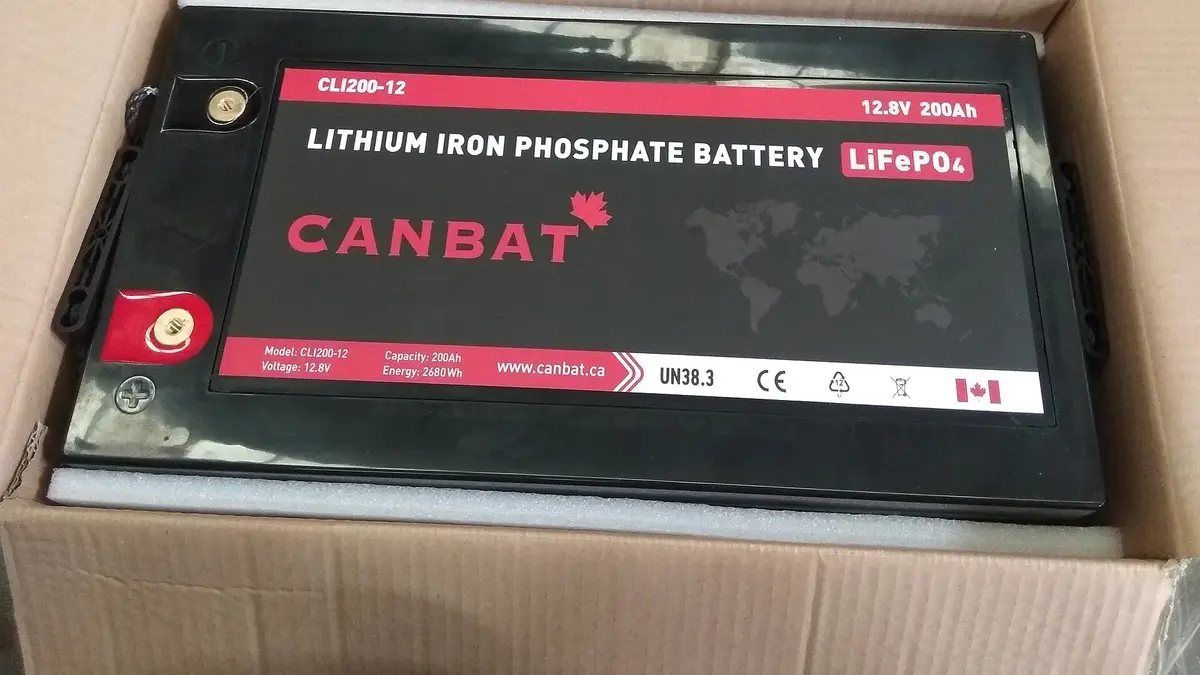
To choose a lithium battery you need two numbers: the voltage (12, 24 or 48 V) and the amp-hours (Ah). Multiplied, they give the energy it stores: a 12.8 V, 100 Ah lithium battery holds 1,280 Wh, enough to run a 12 V camping fridge for about 85 hours. As of 23 November 2026, one of that size costs from CLP 360,623 at Falabella in Chile.
Almost all lithium batteries sold for camping, campervans and solar systems are lithium iron phosphate (LiFePO4), a chemistry more stable than that of phones that lasts thousands of cycles. This guide explains when 12 V, 24 V or 48 V makes sense, how many Ah each use needs and compares the prices of 20 models.
View the data as a table
| Energy in a 12.8 V, 100 Ah battery | 1,280 Wh |
| Lowest price at Falabella | CLP 360,623 |
| Lowest cost per kWh | CLP 232,422 |
What the volts and Ah of a lithium battery mean
Voltage is the «pressure» of the electricity and determines which equipment the battery works with. LiFePO4 batteries are sold at nominal voltages of 12.8 V, 25.6 V and 51.2 V, which in practice are called 12, 24 and 48 V because they replace lead batteries of those voltages. Inside they are 3.2 V cells connected in series: 4 for 12 V, 8 for 24 V and 16 for 48 V.
Ah indicate how much current the battery delivers and for how long: 100 Ah is 100 amps for one hour or 5 amps for 20 hours. But Ah alone cannot be compared across voltages. For that you use energy in Wh or kWh: voltage × Ah. A 12.8 V, 200 Ah battery and a 25.6 V, 100 Ah battery store the same: 2,560 Wh.
| Battery | Nominal voltage | Ah | Energy | 3.2 V cells |
|---|---|---|---|---|
| 12 V | 12.8 V | 100 Ah | 1,280 Wh | 4 in series |
| 12 V | 12.8 V | 200 Ah | 2,560 Wh | 4 in series |
| 24 V | 25.6 V | 100 Ah | 2,560 Wh | 8 in series |
| 48 V | 51.2 V | 100 Ah | 5,120 Wh | 16 in series |
12V, 24V or 48V lithium battery: which to choose
The rule of thumb is more power, more voltage. The reason is current: to deliver the same power, a 48 V battery moves a quarter of the amps of a 12 V one. For 2,000 W, a 12 V battery delivers about 156 A, a 24 V one about 78 A and a 48 V one about 39 A. Less current means thinner cables, less heat and lower losses.
- 12 V: cars, pickups, campervans, boats, camping and small solar systems. It is the voltage of 12 V fridges, LED lights, campervan water pumps and small inverters. Best up to 1,000 to 1,500 W.
- 24 V: medium solar systems, cabins, large boats, electric wheelchairs and some trucks. A balance between compatibility and current.
- 48 V: home backup, solar systems with 3 to 10 kW hybrid inverters, golf carts and telecom equipment. It is the standard for rack-mounted home batteries.
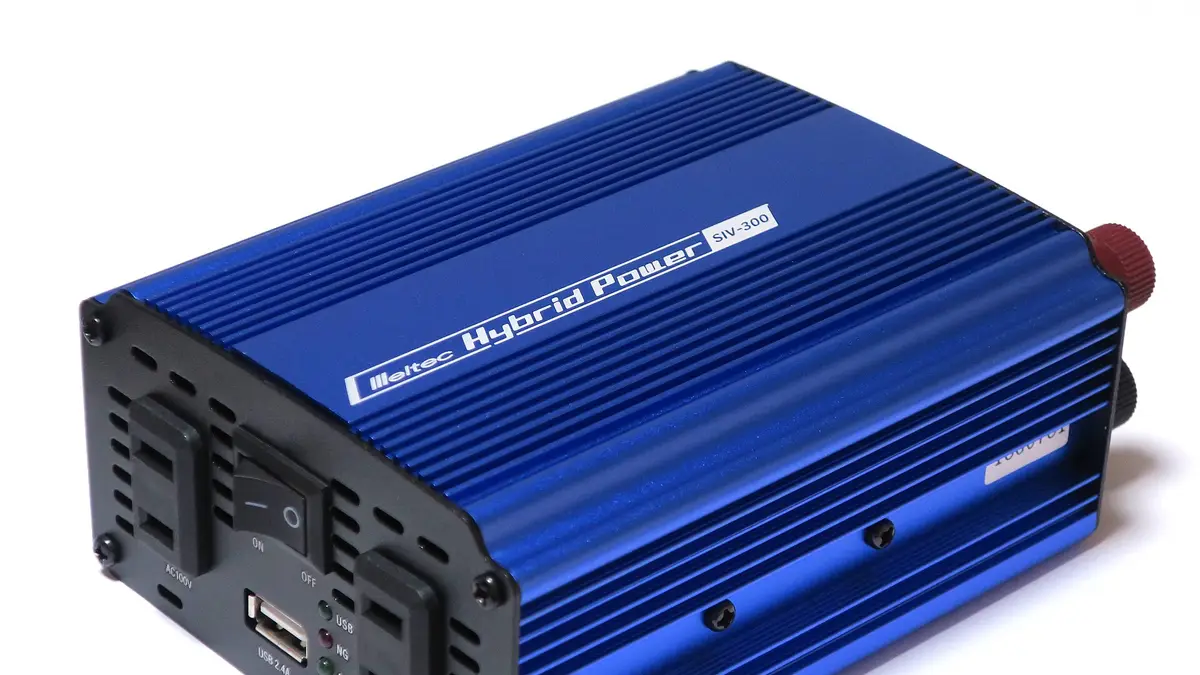
The rest of the system decides the voltage: the inverter and the charge controller must match the battery. If you already have a 12 V inverter, the battery has to be 12 V. How to choose that unit is covered in our guide to the 12V to 220V power inverter.
How many Ah you need: runtime by appliance
To work out the Ah, add up what your appliances use in a day, in Wh, and divide by the voltage. It is best to use only 80% of the capacity to extend battery life, and to add 10% for losses when appliances run on 220 V through an inverter.
An example for a weekend in a campervan: a 12 V fridge (about 12 W on average) running 24 hours, four 5 W LED lights for 5 hours, and charging two phones and a laptop. That comes to about 490 Wh a day: roughly 38 Ah at 12.8 V. For two days without sun or a plug, a 100 Ah battery (about 80 Ah usable) is just enough; for a margin, a 150 Ah one. The consumption of a portable fridge is in our electric cooler guide.
| Use | Approximate daily consumption | Suggested battery |
|---|---|---|
| Weekend camping: lights and phones | 100 to 200 Wh | 12 V, 20 to 30 Ah |
| Campervan with a 12 V fridge | 400 to 600 Wh | 12 V, 100 Ah |
| Cabin with lights, router, TV and pump | 1,000 to 2,000 Wh | 12 V, 200 Ah or 24 V, 100 Ah |
| Home backup with a hybrid inverter | 3,000 to 6,000 Wh | 48 V, 100 Ah or more |
Source: Energía Futura calculation using 80% of capacity. Consumption depends on the equipment; measure yours before buying.
Lithium battery prices in Chile
On 23 November 2026 we reviewed the 12.8, 25.6 and 51.2 V LiFePO4 batteries sold by Falabella, at their online price. They range from CLP 79,990 for a 12 V, 10 Ah unit to CLP 1,714,003 for a 48 V, 100 Ah one.
| Goldenmate 12V 10Ah | 12.8 V | 10 | 0.13 | 79,990 | 624,922 |
| ERYY 12V 20Ah | 12.8 V | 20 | 0.26 | 107,990 | 421,836 |
| QP 12,8V 30Ah | 12.8 V | 30 | 0.38 | 237,983 | 619,747 |
| QP 12,8V 50Ah | 12.8 V | 50 | 0.64 | 339,983 | 531,223 |
| Taiyo 12,8V 100Ah | 12.8 V | 100 | 1.28 | 360,623 | 281,737 |
| Dyness AR1.2 12,8V 100Ah | 12.8 V | 100 | 1.28 | 491,215 | 383,762 |
| Ritar 12,8V 100Ah | 12.8 V | 100 | 1.28 | 493,371 | 385,446 |
| QP 12,8V 150Ah | 12.8 V | 150 | 1.92 | 679,983 | 354,158 |
| Crown Micro NEO 12,8V 200Ah | 12.8 V | 200 | 2.56 | 595,000 | 232,422 |
| Taiyo 12,8V 200Ah | 12.8 V | 200 | 2.56 | 711,229 | 277,824 |
| Ritar 12,8V 200Ah | 12.8 V | 200 | 2.56 | 851,262 | 332,524 |
| Ritar 12,8V 300Ah | 12.8 V | 300 | 3.84 | 1,155,985 | 301,038 |
| Soliot Epever 25,6V 100Ah | 25.6 V | 100 | 2.56 | 547,990 | 214,059 |
| Taiyo 25,6V 100Ah | 25.6 V | 100 | 2.56 | 750,652 | 293,223 |
| Ritar 25,6V 100Ah | 25.6 V | 100 | 2.56 | 788,095 | 307,850 |
| Felicity Solar 51,2V 100Ah | 51.2 V | 100 | 5.12 | 1,250,000 | 244,141 |
| Taiyo 51,2V 100Ah | 51.2 V | 100 | 5.12 | 1,403,325 | 274,087 |
| Ritar 51,2V 100Ah | 51.2 V | 100 | 5.12 | 1,469,948 | 287,099 |
| Deye 51,2V 100Ah | 51.2 V | 100 | 5.12 | 1,612,109 | 314,865 |
| Pylontech Fidus 51,2V 100Ah | 51.2 V | 100 | 5.12 | 1,714,003 | 334,766 |
The fair comparison is price per kWh. Small batteries are the most expensive per unit of energy: the 10 Ah one works out at CLP 624,922 per kWh. The 200 Ah ones drop to CLP 232,422 per kWh, and the 48 V ones sit between CLP 244,141 and CLP 334,766. Among models of the same size the gap is also large: a 12.8 V, 100 Ah battery ranges from CLP 360,623 to CLP 493,371.
View the data as a table
| Capacity (kWh) | Price (CLP) | |
|---|---|---|
| Goldenmate 12V 10Ah | 0 kWh | CLP 79,990 |
| ERYY 12V 20Ah | 0 kWh | CLP 107,990 |
| QP 12,8V 30Ah | 0 kWh | CLP 237,983 |
| QP 12,8V 50Ah | 1 kWh | CLP 339,983 |
| Taiyo 12,8V 100Ah | 1 kWh | CLP 360,623 |
| Dyness AR1.2 12,8V 100Ah | 1 kWh | CLP 491,215 |
| Ritar 12,8V 100Ah | 1 kWh | CLP 493,371 |
| QP 12,8V 150Ah | 2 kWh | CLP 679,983 |
| Crown Micro NEO 12,8V 200Ah | 3 kWh | CLP 595,000 |
| Taiyo 12,8V 200Ah | 3 kWh | CLP 711,229 |
| Ritar 12,8V 200Ah | 3 kWh | CLP 851,262 |
| Ritar 12,8V 300Ah | 4 kWh | CLP 1,155,985 |
| Soliot Epever 25,6V 100Ah | 3 kWh | CLP 547,990 |
| Taiyo 25,6V 100Ah | 3 kWh | CLP 750,652 |
| Ritar 25,6V 100Ah | 3 kWh | CLP 788,095 |
| Felicity Solar 51,2V 100Ah | 5 kWh | CLP 1,250,000 |
| Taiyo 51,2V 100Ah | 5 kWh | CLP 1,403,325 |
| Ritar 51,2V 100Ah | 5 kWh | CLP 1,469,948 |
| Deye 51,2V 100Ah | 5 kWh | CLP 1,612,109 |
| Pylontech Fidus 51,2V 100Ah | 5 kWh | CLP 1,714,003 |
Lithium or deep-cycle lead
At the same store, a 12 V, 100 Ah gel battery costs from CLP 129,990, almost a third of a lithium one. But lead should not be discharged below half to avoid shortening its life, so it delivers about 600 usable Wh, against about 1,024 Wh from a LiFePO4 of the same size used to 80%.
- Weight: a 100 Ah LiFePO4 weighs roughly half as much as an equivalent lead battery, key in campervans and boats.
- Cycles: LiFePO4 makers advertise thousands of cycles (Goldenmate states 5,000); lead batteries, far fewer.
- Steady voltage: lithium holds an almost flat voltage until the end, so the inverter does not cut out early.
- Charger: lithium needs a charger or controller with a LiFePO4 profile (14.4 to 14.6 V for a 12 V battery).
If use is occasional, such as a backup that is rarely discharged, lead may be enough. For daily use with solar panels, lithium usually works out cheaper in the long run, because it lasts more cycles and uses more of its capacity.

How to charge it with solar panels
A 12.8 V, 100 Ah battery is filled with about 1,300 Wh. A well-oriented 200 W panel delivers around 1,150 Wh a day in Santiago in December after losses, according to the European Commission's PVGIS, so two panels recover a full charge on a sunny day. In winter you need close to twice as many panels. For a ready-to-use unit, compare with a portable solar generator, which packs battery, inverter and controller in one box.
- Use an MPPT controller with a LiFePO4 profile.
- Do not charge below 0 °C: most LiFePO4 batteries have a management system (BMS) that blocks it.
- If you connect several in parallel or series, they should be the same model and age.
- For a fixed home system with a hybrid inverter, a battery of 48 V and 5 kWh or more is the usual choice.
If you only need power for a camping trip or the beach, a portable solar panel and a small 12 V battery may be all it takes.
Does your company sell batteries, inverters or solar systems? Reach Energía Futura's readers.
See advertising optionsFrequently asked questions
How long does a 12V 100Ah lithium battery last?
It stores 1,280 Wh. Used to 80%, it runs a 12 V camping fridge for about 85 hours, a router for about 92 hours or a 60 W laptop for about 15 hours through an inverter.
How much does a 12V 100Ah lithium battery cost in Chile?
As of 23 November 2026, at Falabella, between CLP 360,623 and CLP 493,371. A 200 Ah one starts at CLP 595,000.
Is a 12V or a 48V battery better?
It depends on the power: 12 V for cars, campervans and loads up to 1,000 to 1,500 W; 48 V for homes and multi-kW inverters, because it moves a quarter of the current.
How many Ah do I need?
Add up the Wh you use a day and divide by the voltage and by 0.8. For example, 490 Wh a day at 12.8 V gives about 48 Ah; a 100 Ah battery covers two days.
What does LiFePO4 mean?
Lithium iron phosphate: a lithium chemistry more stable under heat than that of phones, with 3.2 V cells and thousands of cycles of useful life.