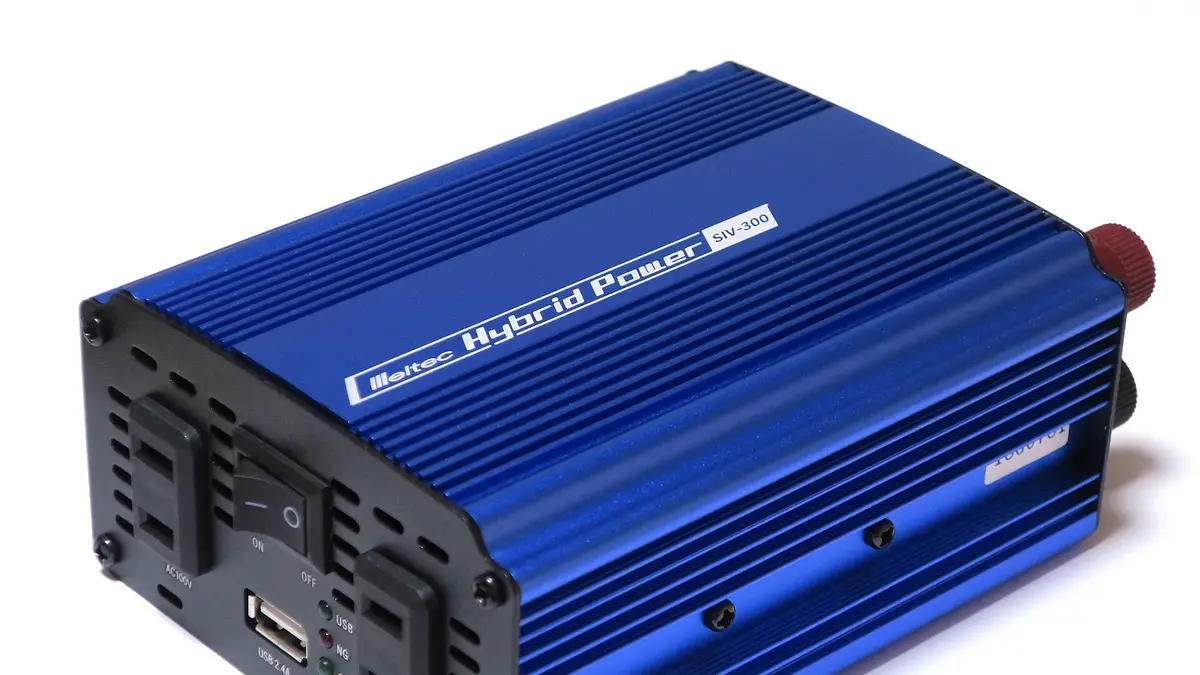
A power inverter converts the direct current of a 12 V battery (a car's, a camper's or a solar system's) into 220 V alternating current, the same as Chile's household sockets. It lets you charge a laptop on a trip, keep the router on during a power cut or run tools far from the grid. As of 20 November 2026, inverters in Chile ranged from CLP 37,990 (a 100 W Black+Decker at Sodimac) to CLP 790,000 (a 3,000 W pure sine wave unit at Falabella).
The key question is not only which inverter to buy, but how much energy the battery holds. A 60 Ah car battery stores 720 Wh, but to protect it you should only use half, and the inverter loses at least 15% in the conversion. That leaves about 306 Wh of usable energy: a 60 W laptop runs for about 5 hours. The calculations in this guide are Energía Futura's, based on those assumptions.
View the data as a table
| Stored in a 60 Ah car battery | 720 Wh |
| Usable at 220 V | 306 Wh |
| Hours of a 60 W laptop | 5.1 h |
What a power inverter is and how it works
Batteries deliver direct current: the voltage is fixed and the electricity always flows in the same direction. Chilean appliances, by contrast, are built for 220 V, 50 Hz alternating current, which reverses direction 50 times a second. The inverter makes that change in two steps: first it steps up the 12 V with a transformer or a high-frequency circuit, then it "chops" that current with transistors that reverse it at high speed to mimic the grid's waveform.
Some energy is lost as heat along the way. The listings of inverters sold by Falabella and Sodimac state efficiencies above 85%, and mid-sized models include a fan that switches on when the load exceeds about 30 W. That is why an inverter never delivers all the energy stored in the battery, and why it should sit in a ventilated spot.
Don't confuse it with the solar inverter of a rooftop system, which converts the panels' output and synchronises it with the grid. A 12 V to 220 V inverter is simpler: it works on its own, from a battery only. If you want a complete system for the home, see our guide to the emergency solar kit for power cuts.
Pure or modified sine wave: which power inverter to choose
This is the biggest difference between a cheap and an expensive inverter. A pure sine wave inverter delivers current identical to the socket's. A modified sine wave (or "square wave") unit approximates it in steps: it is cheaper, but some appliances run poorly on it, heat up or hum.
| Inverter type | What it delivers | Works well with | Best avoided with | Example price in Chile |
|---|---|---|---|---|
| Modified sine wave | Stepped waveform | Phone and laptop chargers, bulbs, simple tools, kettle | Motors (fridge, pump), medical equipment, some TVs, power-tool battery chargers | CLP 149,990 (1,000 W) |
| Pure sine wave | Waveform identical to the grid's | All of the above plus fridges, pumps, audio equipment, CPAP machines | Only the power limits | CLP 290,990 (1,500 W) |
Source: Falabella listings as of 20 November 2026. The recommended uses are a guide; always check the manual of the device you plan to plug in.
Rule of thumb: if you only want to charge your phone and laptop in the car, a modified sine wave unit is enough. If you will plug in anything with a motor or a sensitive device, pay extra for a pure sine wave model. Many listings do not state the waveform: in the price table we mark them as "not stated".
What inverter wattage to choose
The inverter's rating must exceed the sum of everything you will plug in at once, with a margin of at least 20%. Appliances with motors, such as a fridge or a water pump, can draw several times their rated power when starting; that is why inverters state a peak power, usually double the continuous rating (for example, 1,000 W continuous and 2,000 W peak).
| Use | Typical power of what you plug in | Recommended inverter |
|---|---|---|
| Charging phones, tablets and LED lights | 10 to 30 W | 100 to 150 W (cigarette-lighter socket) |
| Laptop, router and TV | 60 to 150 W | 300 to 400 W |
| Small tools, fan, games console | 200 to 500 W | 600 to 1,000 W (straight to the battery) |
| Fridge or water pump | 100 to 300 W, with higher start-up draw | 1,000 to 1,500 W pure sine wave |
| Kettle, hair dryer, microwave | 800 to 2,000 W | 2,000 W or more, with a large battery or the engine running |
Source: typical power ranges for each appliance and inverter listings from Falabella and Sodimac. To find out how much each device in your home uses, see our guide on how to calculate electricity consumption.
How long the battery lasts with an inverter
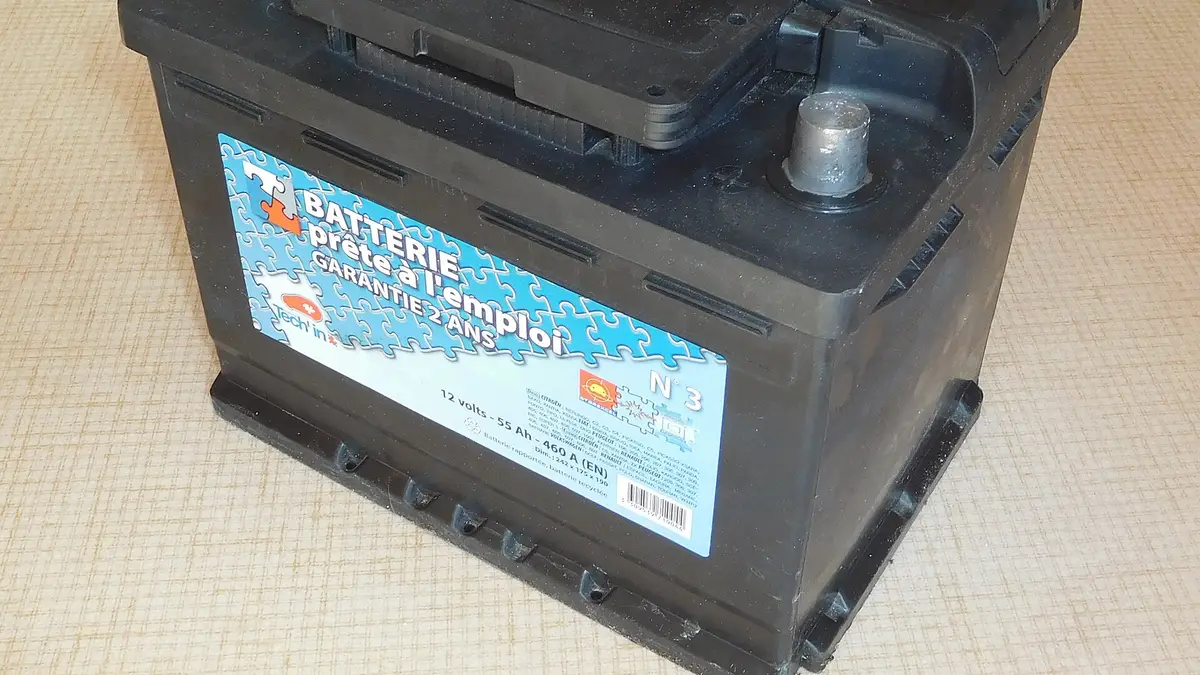
The maths is simple: usable battery energy ÷ appliance power = hours of use. A battery's energy is its voltage times its amp-hours: 12 V × 60 Ah = 720 Wh. Two things must be subtracted. First, a lead-acid battery (the kind in almost every car) is damaged if discharged below half, so only 50% should be used. Second, the inverter loses 15%.
A 60 Ah car battery leaves about 306 Wh. A 12.8 V, 100 Ah LiFePO4 lithium battery (1,280 Wh), which tolerates discharges of up to 90%, leaves about 979 Wh, three times as much. At Falabella a 60 Ah car battery cost between CLP 93,086 and CLP 123,900, and a 100 Ah lithium one about CLP 509,983.
| Appliance | Power | 60 Ah car battery (lead-acid) | 100 Ah lithium battery |
|---|---|---|---|
| Wi-Fi router | 10 W | 30.6 h | 97.9 h |
| Phone charging | 15 W | 20.4 h | 65.3 h |
| Fan | 50 W | 6.1 h | 19.6 h |
| Laptop | 60 W | 5.1 h | 16.3 h |
| LED TV | 70 W | 4.4 h | 14 h |
| Drip coffee maker | 800 W | 23 minutes | 1.2 h |
| Kettle | 2,000 W | 9 minutes (not recommended) | 29 minutes |
Source: Energía Futura calculation with 50% discharge for lead-acid, 90% for lithium and 85% inverter efficiency. Power figures are typical values; actual runtime depends on the battery's condition and the temperature.
There is another limit many people forget: current. To deliver 1,000 W at 220 V, the inverter draws almost 100 amps from the 12 V battery. That is why large inverters come with thick cables and clamps, and why they cannot be plugged into the cigarette-lighter socket.
Power inverter prices in Chile
We checked the 12 V to 220 V inverters sold by Falabella and Sodimac on 20 November 2026. Black+Decker models are the cheapest at low power; the generic 1,200 and 1,500 W units are the cheapest per watt, about CLP 100 per W, but several do not state the waveform. The price jump comes with pure sine wave: a 1,500 W pure sine wave unit costs CLP 290,990, almost double one without that specification.
| Black+Decker 100 W | Sodimac | 100 | 12 V | Not stated | 37,990 | 380 |
| Black+Decker 400 W | Sodimac | 400 | 12 V | Not stated | 59,990 | 150 |
| Black+Decker 750 W | Sodimac | 750 | 12 V | Not stated | 89,990 | 120 |
| Genérico 500 W PRO | Falabella | 500 | 12 V | Not stated | 100,990 | 202 |
| Genérico 1.000 W PRO X | Falabella | 1,000 | 12 V | Modified | 149,990 | 150 |
| Genérico 1.200 W PRO X | Falabella | 1,200 | 12 V | Not stated | 119,990 | 100 |
| Genérico 1.500 W PRO X | Falabella | 1,500 | 12 V | Not stated | 159,990 | 107 |
| Genérico 1.500 W profesional | Falabella | 1,500 | 12 V | Pure | 290,990 | 194 |
| Inversor cargador UPS 1.500 W | Falabella | 1,500 | 12 V | Modified | 356,000 | 237 |
| Epever 1.600 W | Falabella | 1,600 | 24 V | Pure | 329,990 | 206 |
| Genérico 3.000 W PSW | Falabella | 3,000 | 12 V | Pure | 790,000 | 263 |
View the data as a table
| Power (W) | Price (CLP) | |
|---|---|---|
| Black+Decker 100 W | 100 W | $37,990 |
| Black+Decker 400 W | 400 W | $59,990 |
| Black+Decker 750 W | 750 W | $89,990 |
| Genérico 500 W PRO | 500 W | $100,990 |
| Genérico 1.000 W PRO X | 1,000 W | $149,990 |
| Genérico 1.200 W PRO X | 1,200 W | $119,990 |
| Genérico 1.500 W PRO X | 1,500 W | $159,990 |
| Genérico 1.500 W profesional | 1,500 W | $290,990 |
| Inversor cargador UPS 1.500 W | 1,500 W | $356,000 |
| Epever 1.600 W | 1,600 W | $329,990 |
| Genérico 3.000 W PSW | 3,000 W | $790,000 |
Beware of offers promising 3,000 W for under CLP 70,000: the same search showed a "3,000 W pure sine wave solar inverter" at CLP 66,990, far below the rest. The ratings of such devices are often peak figures or simply exaggerated; compare the weight, cable thickness and warranty before buying.
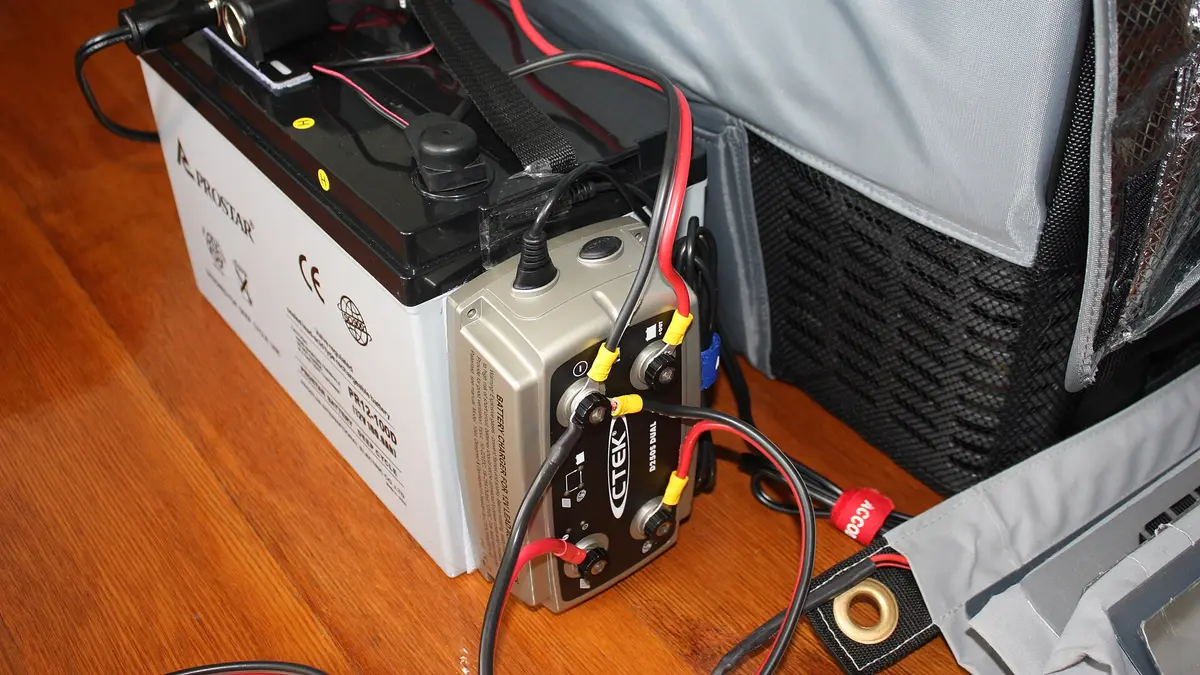
How to connect an inverter in the car without damaging the battery
- Up to about 150 W, into the cigarette-lighter socket: that circuit is usually protected by a 10 to 20 A fuse depending on the car. Check the manual before connecting anything larger.
- Above 150 W, straight to the battery with the cables and clamps supplied, as short as possible.
- With the engine running if you will use it for more than an hour: the alternator recharges the battery while the inverter draws power.
- Respect the low-voltage alarm: inverters shut down on their own at around 10 to 10.5 V so the battery is not left flat; do not disable it.
- Ventilation: don't cover it or leave it under a seat in direct sun; heat shortens its life.
- For frequent use, an auxiliary battery, deep-cycle or lithium, separate from the engine battery.
Does your company sell batteries, inverters or solar equipment? Reach Energía Futura's readers.
See advertising optionsInverter, power station or generator: which is better
An inverter is the cheapest way to get 220 V if you already have a battery. If you don't, a portable power station (a lithium battery with a built-in inverter) is more practical and quieter: at Falabella a 1,000 Wh unit cost CLP 529,990 on 20 November. To recharge it off-grid, pair it with a portable solar panel.
For high power over many hours, such as keeping a house running during a long outage, a generator is still the most direct option, although it is noisy and burns fuel. The inverter wins for short, quiet uses: charging devices, lighting and keeping the internet connection on.
Frequently asked questions
What is a 12V to 220V power inverter?
A device that turns a battery's 12 V direct current into 220 V alternating current, so you can use household appliances in the car, in a camper or during a power cut.
How much does a power inverter cost in Chile?
As of 20 November 2026, from CLP 37,990 (100 W) to CLP 790,000 (3,000 W pure sine wave). A 1,000 to 1,500 W unit costs between CLP 119,990 and CLP 290,990.
How long does a car battery last with an inverter?
With a 60 Ah battery discharged no more than halfway, a 60 W laptop runs for about 5 hours and a 10 W router for about 30 hours.
Can I run a fridge on an inverter?
Yes, with a pure sine wave inverter of at least 1,000 W to handle the motor's start-up, and a good-capacity battery, ideally lithium.
What happens if I plug in a device that exceeds the inverter's power?
Inverters have overload protection: they shut down and an alarm sounds. If it happens repeatedly, the unit can be damaged.
Does an inverter drain the battery with nothing plugged in?
Yes, a little. That is why you should switch it off or unplug it when not in use, especially with the engine off.