Solar lights are the cheapest way to light a garden, a terrace or a front yard without cables or an electricity bill: a stake light costs from CLP 6,990, a 100-LED Christmas string from CLP 3,990 and a motion-sensor floodlight from CLP 13,990, according to prices listed on Falabella on 8 November 2026. What the labels do not say is how long they stay on, and that depends on where you live and the time of year.
In Santiago, a December night lasts about 9.6 hours and a June night 14.1 hours. With less sun to charge and more hours of darkness, a solar light that stays on until dawn in summer can run out of battery by midnight in winter. This guide explains how they work, how many hours they last in five Chilean cities according to a simulation built on European Commission solar radiation data, which type suits each use and what lies behind floodlights that promise "1000 W".
View the data as a table
| 100-LED solar Christmas string | $3,990 |
| Garden stake light | $6,990 |
| Motion-sensor floodlight | $13,990 |
| Hours of darkness in Santiago in June | 14.1 h |
How solar lights work
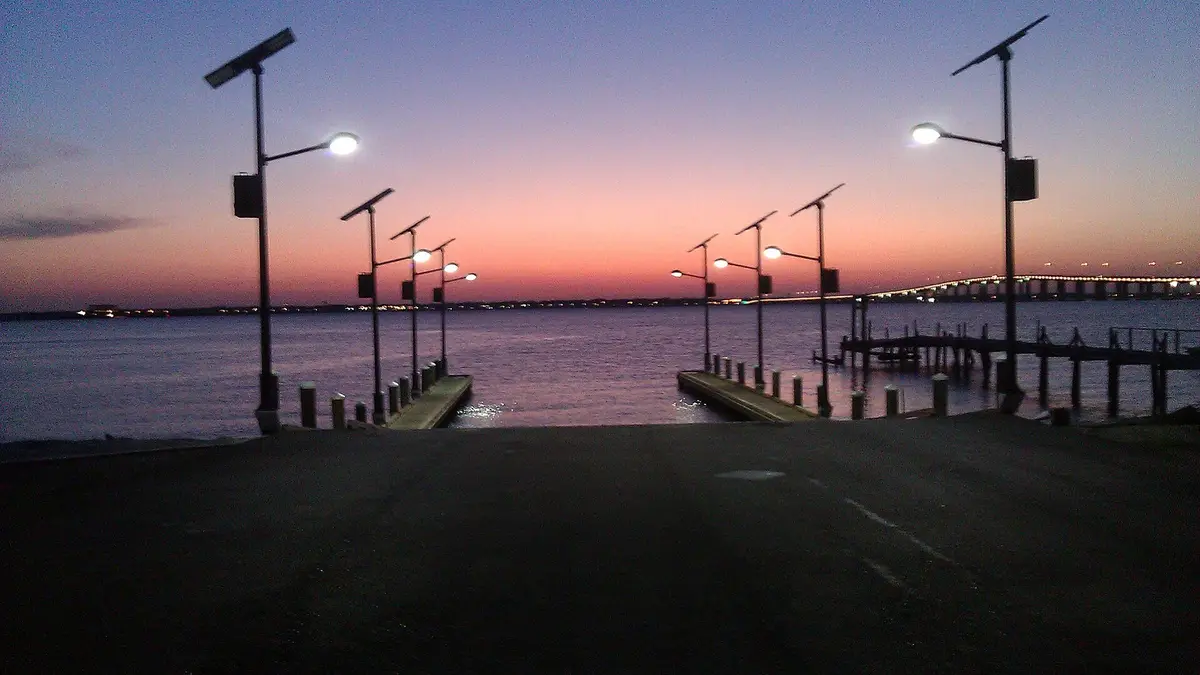
Every solar light has four parts: a small photovoltaic panel, a rechargeable battery, one or more LEDs and a light sensor (photocell) that decides when to switch on. During the day, the panel turns light into electricity and charges the battery. When the sensor detects darkness, it stops charging and powers the LEDs with the stored energy. At dawn, the cycle reverses.
- Panel: on garden stakes it is a plate a few centimeters wide; on security floodlights it is usually separate, connected by a cable, so it can sit in the sun while the light stays in the shade.
- Battery: the cheapest use nickel rechargeable cells (AA or AAA); better models use lithium cells. It is the part that wears out first, so it should be replaceable.
- LEDs: they use little energy and provide the light. More LEDs do not mean more hours: with the same battery, more LEDs run out sooner.
- Sensor: the photocell switches the light on at night; on models with a motion sensor (PIR), the light stays dim or off and turns bright when someone passes, which stretches the battery a lot.
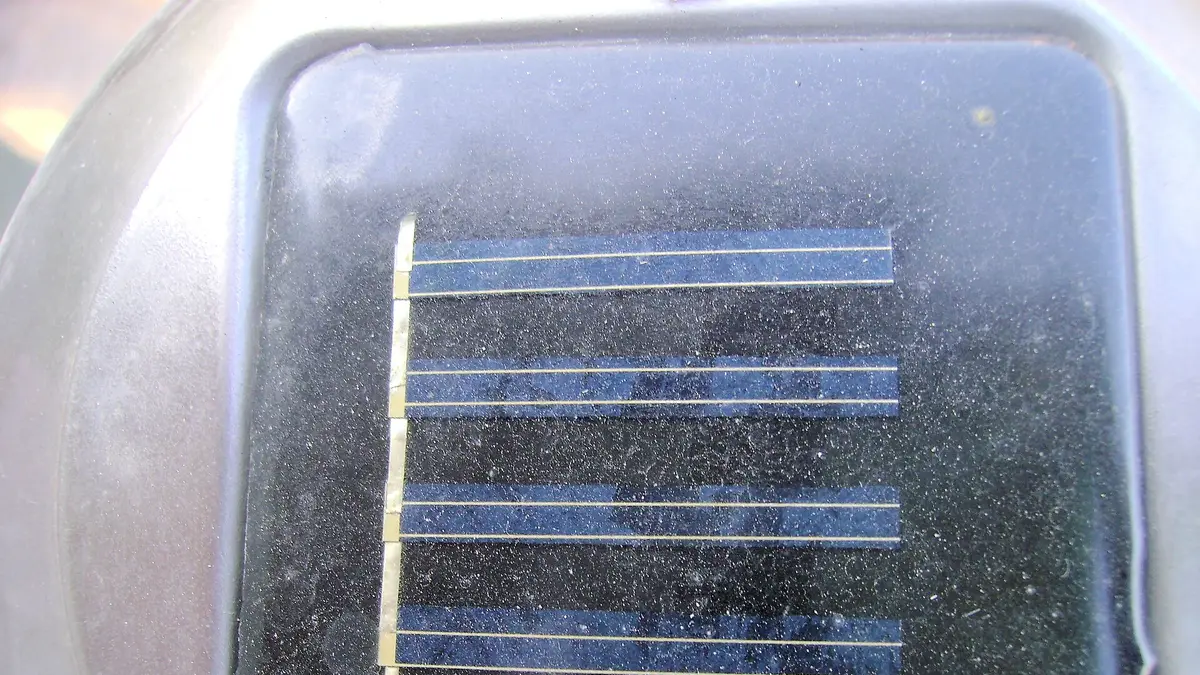
The key is panel size. Panels are rated under a standard irradiance of 1,000 W per square meter, and silicon panels convert about a fifth of it into electricity. A 10 x 10 centimeter panel (0.01 m²) therefore delivers around 2 W in full sun; a 20 x 30 centimeter panel, about 12 W. No household solar light can power a 1,000 W bulb all night: it would need a panel several square meters in size and a battery as large as a car's.
How many hours solar lights last in Chile
To see how a solar light performs in each city, Energía Futura simulated a typical security floodlight (5 W panel, 20 Wh battery and 10 Wh of use per night, equivalent to a 2 W LED on for five hours) with PVGIS, the European Commission Joint Research Centre tool that uses satellite radiation data from 2005 to 2023. The panel faced north, tilted 35 degrees.
| City | Night in June | Night in December | Days with a flat battery in June | Days with a flat battery per year |
|---|---|---|---|---|
| Antofagasta | 13.3 h | 10.4 h | 0% | 0.1% |
| Santiago | 14.1 h | 9.6 h | 16.8% | 4.3% |
| Concepción | 14.4 h | 9.3 h | 34.0% | 9.7% |
| Puerto Montt | 14.8 h | 8.8 h | 65.3% | 21.5% |
| Punta Arenas | 16.5 h | 7.0 h | 96.3% | 31.1% |
Source: Energía Futura simulation with PVGIS (5 W panel, 20 Wh battery, 10 Wh a day) and an astronomical calculation of night length at the solstices. Percentages show the share of days on which the battery reached its discharge limit.
View the data as a table
| Antofagasta | 0.1% |
| Santiago | 4.3% |
| Concepción | 9.7% |
| Puerto Montt | 21.5% |
| Punta Arenas | 31.1% |
The results show two Chiles. In Antofagasta, the same light almost never runs flat. In Santiago it fails on one in six June days, and in Concepción on one in three. Further south, a solar light becomes a seasonal device: in Puerto Montt it runs out on two in three June days and in Punta Arenas on almost all of them. Between October and February, however, it performs well across most of the country.
View the data as a table
| Antofagasta | Santiago | Concepción | Puerto Montt | Punta Arenas | |
|---|---|---|---|---|---|
| Jan | 0% | 0% | 0% | 1% | 1% |
| Feb | 0% | 0% | 0% | 2% | 3% |
| Mar | 0% | 0% | 0% | 4% | 18% |
| Apr | 0% | 2% | 4% | 19% | 35% |
| May | 0% | 8% | 19% | 44% | 68% |
| Jun | 0% | 17% | 34% | 65% | 96% |
| Jul | 0% | 12% | 33% | 58% | 85% |
| Aug | 0% | 9% | 18% | 37% | 43% |
| Sep | 0% | 3% | 7% | 15% | 19% |
| Oct | 0% | 1% | 1% | 5% | 3% |
| Nov | 0% | 0% | 0% | 5% | 0% |
| Dec | 0% | 0% | 0% | 2% | 1% |
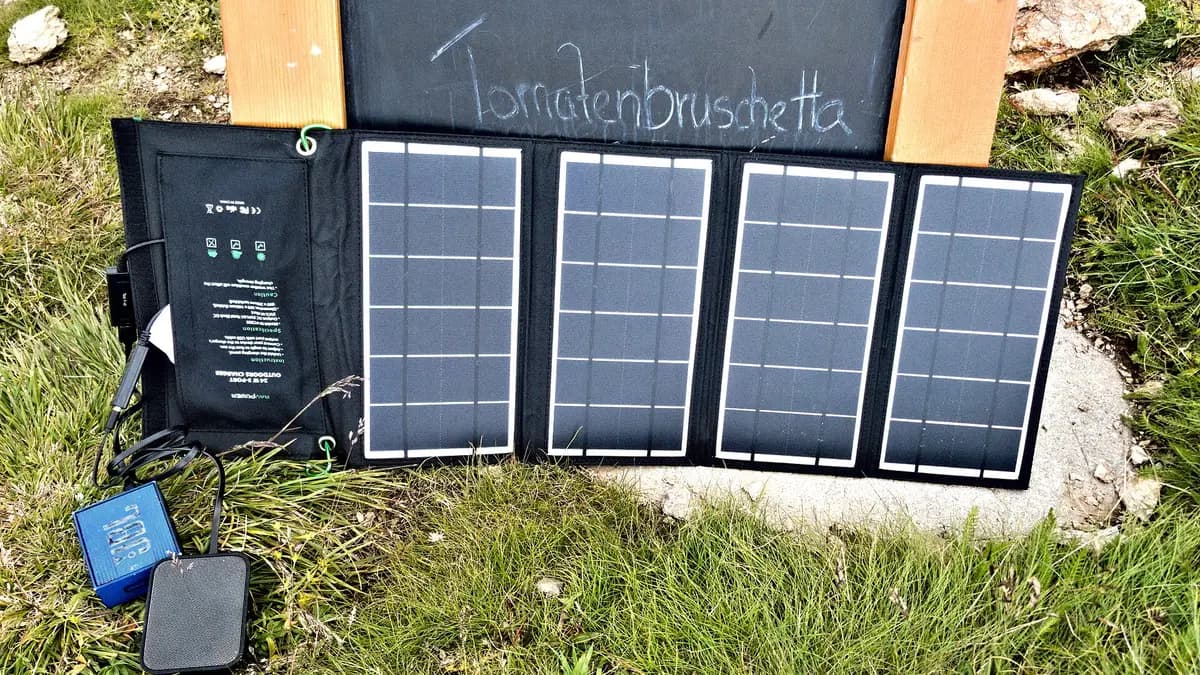
The simulation assumes a clean, well-oriented panel. In practice, a light under an eave, among shrubs or covered in dust performs much worse. For anyone who needs more serious backup power, such as charging phones or a lamp during a blackout, a portable solar panel generates dozens of times more energy than a garden light.
Types and which one to choose
Not all solar lights do the same job. Garden lights decorate and mark paths; security lights brighten an entrance when someone walks by; strings add atmosphere to terraces and trees, and Christmas lights are strings with shapes or colors for December. This table sums up the lowest prices seen on 8 November 2026.
| Type | What it is for | From | What to check |
|---|---|---|---|
| Garden stake | Marking paths and borders | CLP 6,990 (single); CLP 9,490 pack of 6 | Replaceable battery and IP65 rating |
| String or curtain | Terraces, barbecue areas, trees | CLP 3,990 (20 m, 200 LEDs) | Cable length to the panel |
| Christmas | Outdoor tree, fences, balcony | CLP 3,990 (10 m, 100 LEDs) | Flashing modes and warm or colored light |
| Motion-sensor floodlight | Entrances, driveways, passages | CLP 13,990 | Dim mode plus motion activation |
| Floodlight with separate panel | Large yards, rural plots | CLP 12,990 | Real panel watts and capacity in Wh |
For a garden, buy packs of stakes with warm light and IP65 protection (dust-tight and resistant to water jets under international standard IEC 60529). For security, the motion sensor matters most: since the light only turns bright for a few seconds, the battery lasts several nights even in winter. For Christmas, solar strings avoid outdoor extension cords, although they give less light than plug-in ones.
Solar Christmas lights: what to know
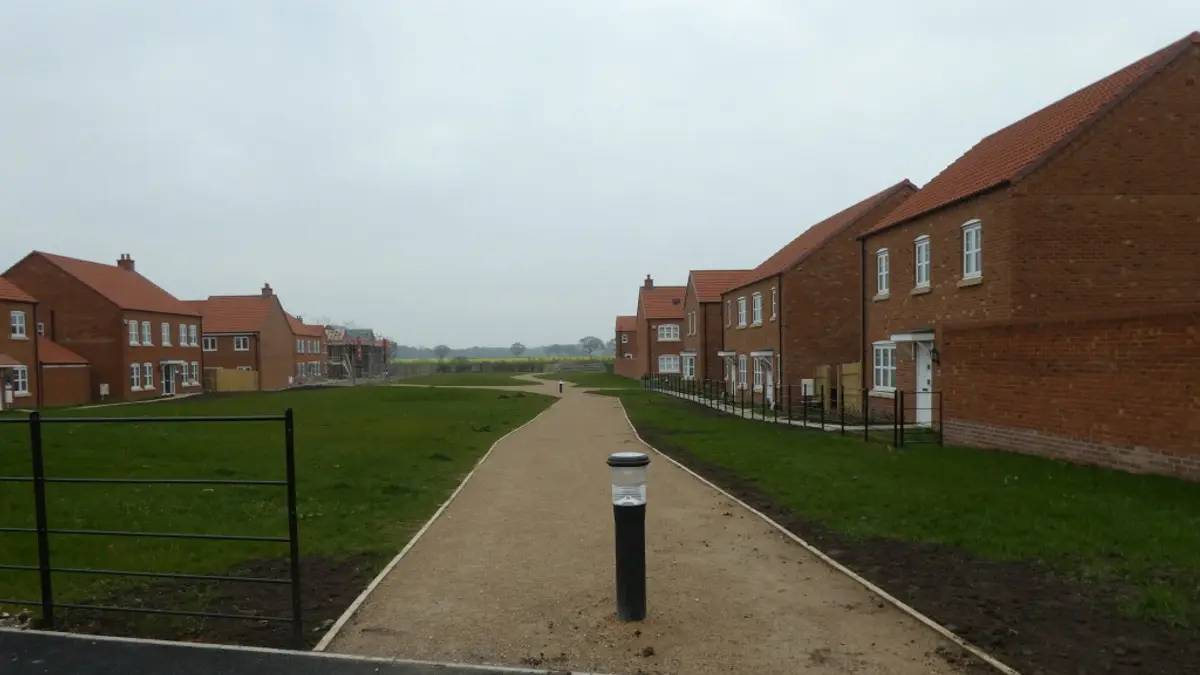
Solar Christmas lights are at their best precisely when they are used most: in December, nights are the shortest of the year and the sun is at its highest. In Santiago, a well-placed solar string usually lasts all night at Christmas. Their limit is brightness: 100 or 200 LEDs powered by a small panel give a dimmer light than a plug-in string.
Anyone who prefers plug-in lights can check how much they add to the bill in our guide to Christmas lights: how much electricity they use and what they cost. With LEDs the cost is low, but they need extension cords and rain-protected outdoor sockets.
Do you sell solar lighting or sustainable home products? Reach Energía Futura's readers.
See advertising optionsThe myth of "1000 W" solar floodlights
Stores are full of 300, 800 or 1000 W solar floodlights priced between CLP 12,990 and CLP 24,990. That figure does not describe real power. Given panel physics, a floodlight with a panel of about 30 x 20 centimeters receives at best around 10 to 15 W, and its battery stores tens of Wh, not thousands. The advertised wattage is usually a marketing equivalence, not an electrical rating.
| What the label says | What to check | Why |
|---|---|---|
| "1000 W" | Panel watts (Wp) | Shows how much energy it can recover per day |
| "High power" | Battery capacity in mAh and voltage, or in Wh | Defines how many hours it lights |
| "Lumens" | Lumens in normal mode, not maximum | Maximum mode lasts a few minutes |
| "Waterproof" | IP65 or IP66 rating | Ensures it withstands rain |
| "Long-lasting" | Replaceable battery | It is the first part to wear out |
A quick way to compare is to multiply the battery's mAh by its voltage and divide by 1,000 to get Wh. A 3.2 V, 6,000 mAh lithium battery stores about 19 Wh: enough for a 2 W LED for about nine hours. If the maker reports neither panel watts nor battery size, it is hard to know how long it will shine.
| Garden stake light (single) | Lamparashome | Stake | 6,990 |
| Pack of 6 garden solar lights | Lamparashome | Stake | 9,490 |
| Pack of 8 carved stake lights | Supercenter | Stake | 12,990 |
| 10 m string, 100 multicolor LEDs | IRM | Christmas | 3,990 |
| 20 m fairy string, 200 LEDs | IRM | String | 3,990 |
| 20 m Christmas string, 200 LEDs | Supercenter | Christmas | 5,990 |
| 20 m Christmas rope light, 200 LEDs | IRM | Christmas | 7,990 |
| Set of 10 Christmas-tree stakes | Generic | Christmas | 7,990 |
| 10 m string, 10 bulbs | Supercenter | String | 14,990 |
| 500-LED solar lights | Dear Santa | Christmas | 20,990 |
| Sensor light, 3 heads | Maxwell | Motion sensor | 13,990 |
| Sensor light, 4 heads | Maxwell | Motion sensor | 16,990 |
| Set of 4 wall lights with sensor | Maxwell | Motion sensor | 15,990 |
| "300 W" floodlight with panel and remote | Metex | Floodlight, separate panel | 12,990 |
| "800 W" floodlight, separate panel | Generic | Floodlight, separate panel | 24,990 |
| "1000 W" floodlight IP66 | Tasbel | Floodlight, separate panel | 24,990 |
| Pack of 3 "1000 W" sensor floodlights | Tasbel | Motion sensor | 42,990 |
How to make them last longer
- Point the panel north, with no shade between 10 a.m. and 4 p.m. In the southern hemisphere, the winter sun is low and to the north.
- Clean the panel every few weeks: dust and leaves reduce charging.
- Use the sensor mode in winter: lighting only when there is movement multiplies autonomy.
- Replace the battery every one or two years if the light switches off earlier than usual.
- Switch them off for a few days if you travel or after several cloudy days, so the battery can fully charge.
- Keep them away from other lights: a street lamp can fool the sensor and keep them off.
In rainy areas of the south, where a solar light loses strength between April and September, an alternative is to pair it with a small backup system. Our guide to the emergency solar kit explains what it includes and what one able to keep lights and phones running during a blackout costs.
Frequently asked questions
How many hours do solar lights stay on?
It depends on the battery and the day's charge. In summer, a well-placed light lasts all night in almost all of Chile. In winter, in Santiago it runs out on about 17% of June days and in Puerto Montt on 65%, according to the PVGIS simulation.
How much do solar lights cost in Chile?
On Falabella, on 8 November 2026, a 100-LED string started at CLP 3,990, a stake light at CLP 6,990 and a motion-sensor floodlight at CLP 13,990.
Do solar lights work on cloudy days?
Yes, but they charge less. After several cloudy days in a row, the battery may not fill up and the light switches off earlier.
Does a 1000 W solar floodlight give the light of a 1000 W bulb?
No. The panel on those floodlights delivers around 10 to 15 W in full sun. The 1000 W figure is marketing.
How often should the battery be replaced?
When the light starts switching off much earlier than at first, usually after one or two years of use. Choose models with a replaceable battery.