A 100 W portable solar panel costs between CLP 159,990 and CLP 265,000 in Chile, according to prices published on Falabella on 5 November 2026, and generates an average of about 0.5 kWh a day in Santiago: 0.59 kWh in January and 0.35 kWh in June, according to the PVGIS simulator of the European Commission's Joint Research Centre. That is enough energy to charge dozens of phones, a laptop several times or top up part of a power station.
This guide brings together the prices of 40 to 400 W panels sold in Chile, how much they generate in eight cities month by month, how long they take to charge a portable power station, and what to check when choosing one for camping, a camper van or as a backup during power cuts.
View the data as a table
| Energy per day, annual average | 0.50 kWh |
| In January | 0.59 kWh |
| In June | 0.35 kWh |
| In a year | 183 kWh |
What a portable solar panel is
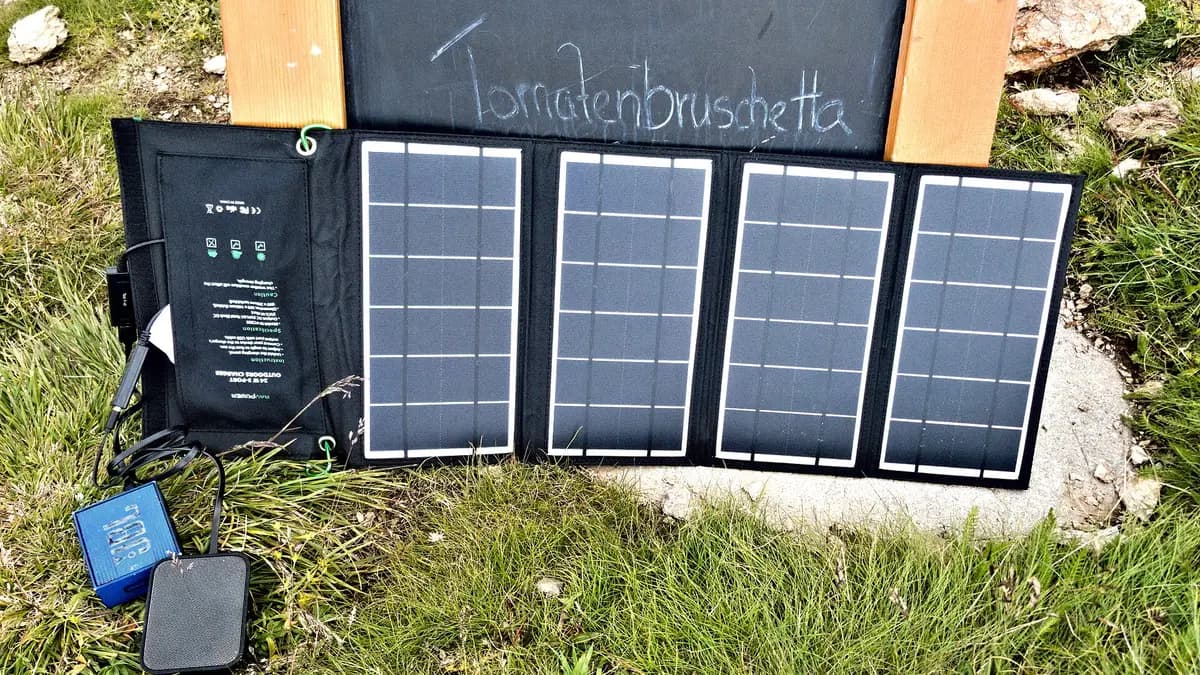
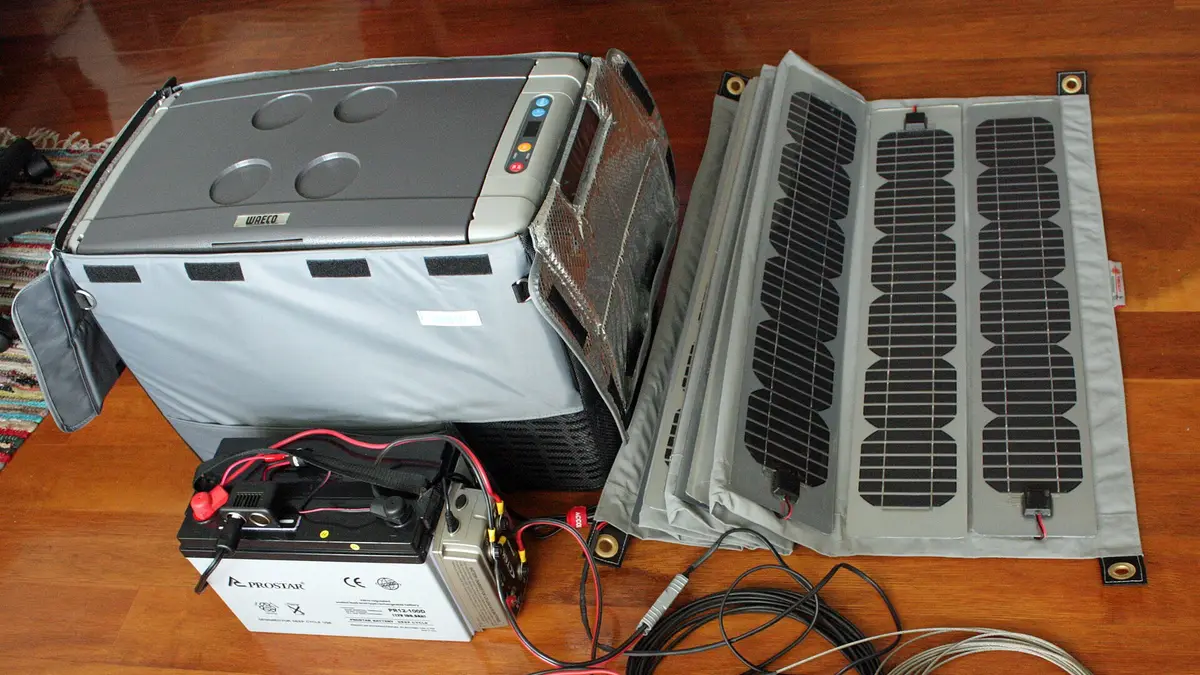
It is a lightweight photovoltaic panel, usually foldable into 2 to 4 sections, with legs or eyelets to point it at the sun. Small ones, from 6 to 40 W, have a USB output and charge phones directly. Those from 60 to 400 W have an MC4 or XT60 connector and plug into a portable power station (a lithium battery with sockets) or a charge controller and a battery. They do not produce electricity at night or store energy: they need a battery to use it later.
If what you need is home backup, the key piece is the power station, and the panel is the way to recharge it off-grid. We explain it in detail in the emergency solar kit, including how many hours each appliance lasts.
Portable solar panel prices in Chile
Prices rise with power, but the price per watt falls: 40 to 100 W panels cost between CLP 1,600 and CLP 2,650 per watt, and 200 to 400 W ones between CLP 1,375 and CLP 1,814. These are the models published on 5 November 2026:
| Panel | Power | Price | Price per watt |
|---|---|---|---|
| Generic USB 20 W, 18 V | 20 W | CLP 37,990 | CLP 1,900 |
| Generic USB 30 W, 18 V | 30 W | CLP 46,990 | CLP 1,566 |
| Terra Force foldable | 40 W | CLP 99,990 | CLP 2,500 |
| Terra Force foldable | 60 W | CLP 119,990 | CLP 2,000 |
| Kinergy | 100 W | CLP 159,990 | CLP 1,600 |
| Terra Force foldable | 100 W | CLP 179,990 | CLP 1,800 |
| Oukitel | 100 W | CLP 199,990 | CLP 2,000 |
| Skytech monocrystalline | 100 W | CLP 265,000 | CLP 2,650 |
| Bluetti foldable | 130 W | CLP 229,990 | CLP 1,769 |
| Oukitel | 200 W | CLP 299,990 | CLP 1,500 |
| Bluetti foldable | 220 W | CLP 398,990 | CLP 1,814 |
| Oukitel | 400 W | CLP 549,990 | CLP 1,375 |
Sources: Falabella and Bluetti Energy Chile's store on Falabella, sale prices as of 5 November 2026. Price per watt calculated by Energía Futura. Prices change frequently.
Cheaper generic panels often state a peak power that is hard to reach in practice. Brands that publish a full data sheet, with open-circuit voltage, current and cell type, make it easier to check that the panel matches your station.
| Terra Force 40W | 40 | 99,990 | 2,500 |
| Terra Force 60W | 60 | 119,990 | 2,000 |
| Terra Force 100W | 100 | 179,990 | 1,800 |
| Kinergy 100W | 100 | 159,990 | 1,600 |
| Oukitel 100W | 100 | 199,990 | 2,000 |
| Skytech 100W | 100 | 265,000 | 2,650 |
| Bluetti 130W | 130 | 229,990 | 1,769 |
| Oukitel 200W | 200 | 299,990 | 1,500 |
| Bluetti 220W | 220 | 398,990 | 1,814 |
| Oukitel 400W | 400 | 549,990 | 1,375 |
View the data as a table
| Power (W) | Price (CLP thousand) | |
|---|---|---|
| Terra Force 40W | 40 W | 100 |
| Terra Force 60W | 60 W | 120 |
| Terra Force 100W | 100 W | 180 |
| Kinergy 100W | 100 W | 160 |
| Oukitel 100W | 100 W | 200 |
| Skytech 100W | 100 W | 265 |
| Bluetti 130W | 130 W | 230 |
| Oukitel 200W | 200 W | 300 |
| Bluetti 220W | 220 W | 399 |
| Oukitel 400W | 400 W | 550 |
Many are sold as a kit with a power station. Bluetti offers its 1,024 Wh Elite 100 V2 for CLP 699,990 on its own, CLP 859,990 with a 100 W panel and CLP 1,069,990 with a 220 W one; the 288 Wh Elite 30 V2 costs CLP 269,990 alone and CLP 369,990 with a 60 W panel. Buying the kit can be cheaper than buying separately.
How much a portable solar panel generates in Chile
Energía Futura simulated in PVGIS a fixed 100 W panel, tilted 30° to the north with 14% losses, in eight cities. The north generates more, with less difference between seasons: Antofagasta averages 0.54 kWh a day and barely drops in winter. In Santiago the average is 0.50 kWh, and in Punta Arenas, 0.31 kWh, with only 0.12 kWh in June.
| City | Daily average | January | June | Per year |
|---|---|---|---|---|
| Arica | 0.49 kWh | 0.44 | 0.46 | 180 kWh |
| Antofagasta | 0.54 kWh | 0.54 | 0.48 | 198 kWh |
| La Serena | 0.51 kWh | 0.56 | 0.39 | 185 kWh |
| Santiago | 0.50 kWh | 0.59 | 0.35 | 183 kWh |
| Concepción | 0.46 kWh | 0.61 | 0.25 | 168 kWh |
| Temuco | 0.40 kWh | 0.57 | 0.19 | 145 kWh |
| Puerto Montt | 0.36 kWh | 0.53 | 0.17 | 132 kWh |
| Punta Arenas | 0.31 kWh | 0.45 | 0.12 | 113 kWh |
Source: PVGIS, ERA5 radiation database, queried on 5 November 2026. For a 200 W panel, multiply by two. In real use, a poorly oriented or shaded panel yields less; one turned towards the sun during the day, somewhat more.
View the data as a table
| kWh per day | |
|---|---|
| Arica | 0.49 kWh |
| Antofagasta | 0.54 kWh |
| La Serena | 0.51 kWh |
| Santiago | 0.50 kWh |
| Concepción | 0.46 kWh |
| Temuco | 0.40 kWh |
| Puerto Montt | 0.36 kWh |
| Punta Arenas | 0.31 kWh |
View the data as a table
| Santiago | Antofagasta | Puerto Montt | Punta Arenas | |
|---|---|---|---|---|
| Jan | 0.59 | 0.54 | 0.53 | 0.45 |
| Feb | 0.59 | 0.57 | 0.50 | 0.40 |
| Mar | 0.57 | 0.57 | 0.41 | 0.30 |
| Apr | 0.50 | 0.52 | 0.30 | 0.23 |
| May | 0.40 | 0.50 | 0.21 | 0.16 |
| Jun | 0.35 | 0.48 | 0.17 | 0.12 |
| Jul | 0.38 | 0.50 | 0.20 | 0.14 |
| Aug | 0.44 | 0.55 | 0.25 | 0.23 |
| Sep | 0.51 | 0.58 | 0.36 | 0.31 |
| Oct | 0.54 | 0.59 | 0.42 | 0.42 |
| Nov | 0.57 | 0.57 | 0.46 | 0.48 |
| Dec | 0.59 | 0.55 | 0.50 | 0.48 |
Northern Chile has some of the best solar radiation in the world, the same that explains the country's place in the world ranking of countries by solar power. For a portable panel, it means that in Atacama or Antofagasta it yields almost as much in winter as in summer.
How long it takes to charge a power station
Using PVGIS data, a 200 W panel in Santiago generates about 1.18 kWh on a January day and about 0.70 kWh in June. Charging a 1,024 Wh station therefore takes about one sunny day in summer and a day and a half in winter. With a 100 W panel, twice as long. A 288 Wh station refills in one day with a 60 to 100 W panel almost all year round in central and northern Chile.
| Panel in Santiago | Energy on a January day | Energy on a June day | Days to charge 1,024 Wh (Jan / Jun) |
|---|---|---|---|
| 60 W | 0.35 kWh | 0.21 kWh | 2.9 / 4.9 |
| 100 W | 0.59 kWh | 0.35 kWh | 1.7 / 2.9 |
| 200 W | 1.18 kWh | 0.70 kWh | 0.9 / 1.5 |
| 400 W | 2.36 kWh | 1.40 kWh | 0.4 / 0.7 |
Energía Futura calculations with PVGIS (fixed panel at 30°, 14% losses), scaled by power. They do not include battery charging losses of 5% to 10%. A phone has a battery of about 15 to 20 Wh, so a 100 W panel can charge more than 20 phones on a summer day.
Does a portable solar panel save on the electricity bill?
Not much. A 100 W panel in Santiago generates about 183 kWh a year, worth about CLP 46,700 at CLP 255.27 per kWh if all the energy were used, which is hard because it is only used when deployed. Its value lies in autonomy: providing energy where there is no grid or when it goes down. To save on the bill, a fixed grid-connected rooftop system is the better option.
To make it last, store it dry and folded, clean the surface with a damp cloth and do not bend it outside its folds. All panels slowly lose power over the years, and portable ones, because of use, rubbing and folding, tend to age faster than rooftop panels.
Do you sell panels, batteries or power stations? Reach Energía Futura's readers.
See advertising formatsWhich portable solar panel to choose
- Phones and lights only: a 20 to 40 W USB panel is enough and costs under CLP 100,000.
- Weekend camping with a 300 Wh station: a 60 to 130 W panel.
- Camper van or backup with a 1,000 Wh station or larger: 200 W or more, or two panels in parallel if the station allows it.
- Compatibility: check the connector (MC4, XT60, Anderson) and that the panel's open-circuit voltage is within your station's solar input range.
- Durability: look for IP65 protection or higher if you will use it outdoors; foldable panels with ETFE coating last longer.
A portable panel does not replace a rooftop solar system: a 3 kWp residential system generates about 30 times more. But compared with a petrol generator, it makes no noise and emits no fumes. If you are comparing backup options, see what it costs to run an electric generator at home.
Frequently asked questions
How much does a portable solar panel cost in Chile?
From about CLP 38,000 for 20 W USB panels; 100 W panels cost between CLP 159,990 and CLP 265,000, and 200 to 400 W ones between CLP 299,990 and CLP 549,990 (prices as of 5 November 2026).
How much does a 100 W portable solar panel generate?
In Santiago, about 0.50 kWh a day on average: 0.59 kWh in January and 0.35 kWh in June, according to PVGIS. In Antofagasta, 0.54 kWh; in Punta Arenas, 0.31 kWh.
Can a portable solar panel be connected directly to an appliance?
Only those with a USB output charge phones directly. For 220 V sockets you need a power station or a battery with an inverter.
Does a portable solar panel work on cloudy days?
Yes, but it generates much less: under overcast skies it can drop to a fraction of its power. That is why in southern Chile its winter output falls to half or less.
What power do I need to charge a 1,000 Wh station?
A 200 W panel charges it in about one sunny summer day in Santiago and a day and a half in winter. With 100 W, twice as long.