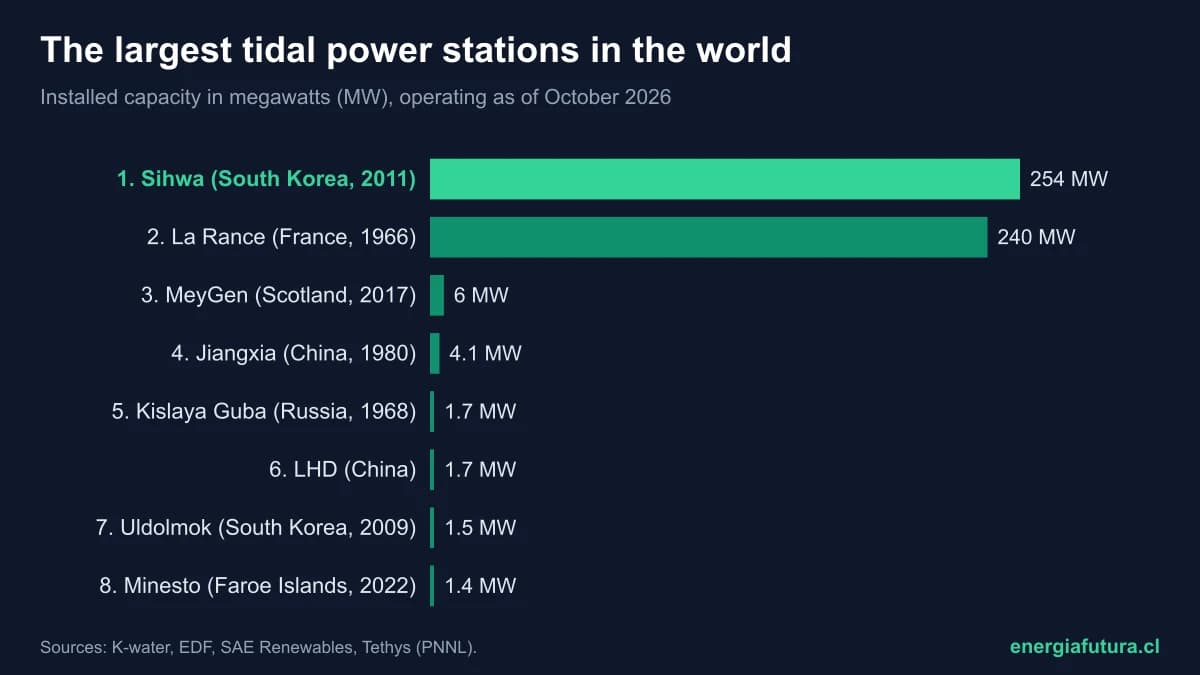
Updated on 30 October 2026. The largest tidal power station in the world is Sihwa, in Gyeonggi Province, South Korea, with installed capacity of 254 MW and output of about 552 GWh a year, according to the state water company K-water, which has operated it since 2011. It is followed by the La Rance plant in France, with 240 MW, which was the largest in the world for 45 years.
Together the two add up to 494 MW, and the rest of the sector is tiny: the third plant in operation, MeyGen in Scotland, has 6 MW. Tidal energy is one of the most predictable renewable sources, because tides can be calculated years in advance, but also one of the slowest-growing because of its high costs and the scarcity of suitable sites.
Ranking of the largest tidal power stations in the world
The table includes tidal power plants operating as of October 2026, ranked by installed capacity. Two technologies are mixed: barrage plants (Sihwa, La Rance, Jiangxia, Kislaya Guba), which impound water and run it through turbines when the tide turns, like a dam, and tidal stream plants (MeyGen, Uldolmok, Minesto), which place underwater turbines in channels with strong currents, like wind turbines under the sea.
| # | Plant | Country | Capacity | Technology | Operating since |
|---|---|---|---|---|---|
| 1 | Sihwa | South Korea | 254 MW | Barrage, 10 turbines of 25.4 MW | 2011 |
| 2 | La Rance | France | 240 MW | Barrage, 24 turbines of 10 MW | 1966 |
| 3 | MeyGen | United Kingdom (Scotland) | 6 MW | Tidal stream, 4 turbines of 1.5 MW | 2017 |
| 4 | Jiangxia | China | 4.1 MW | Barrage, 6 turbines | 1980 |
| 5 | Kislaya Guba | Russia | 1.7 MW | Barrage | 1968 |
| 6 | LHD | China | 1.7 MW | Tidal stream | No data |
| 7 | Uldolmok | South Korea | 1.5 MW | Tidal stream | 2009 |
| 8 | Minesto Vestmannasund | Faroe Islands | 1.4 MW | Underwater kites | 2022 |
Sources: K-water (Sihwa), EDF (La Rance), REN21 and SAE Renewables (MeyGen) and the Tethys project database of the Pacific Northwest National Laboratory (PNNL) for the smaller plants, accessed on 30 October 2026. Test sites such as EMEC in Orkney, where prototypes from different companies operate, and closed plants are not included.
Sihwa, the largest tidal power station in the world
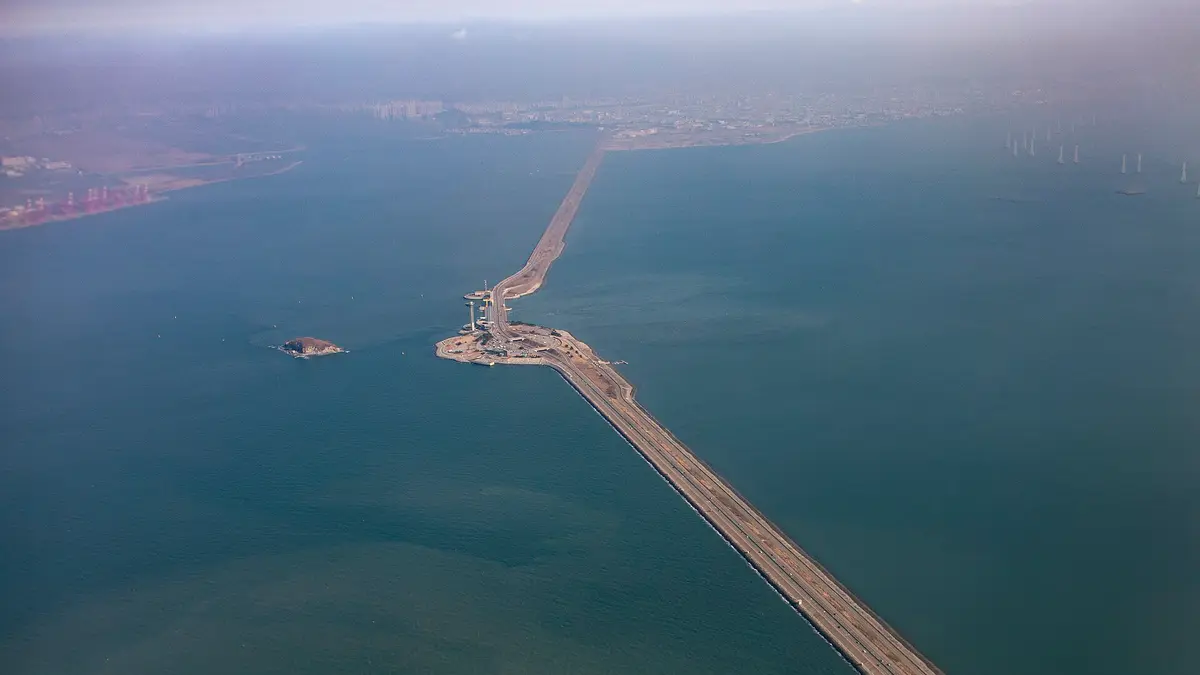
The Sihwa plant is built on a sea wall that closed off Lake Sihwa in the 1990s, southwest of Seoul. The closure degraded the lake's water quality, and the plant, opened in 2011, made it possible to circulate seawater daily again while generating electricity. It has 10 bulb turbines of 25.4 MW and generates only when the tide flows into the lake, a one-way generation scheme.
K-water reports annual generation of 552 GWh. According to material from the same company cited by the Water Environment Federation, that avoids about 315,000 tonnes of CO₂ a year and is equivalent to about 862,000 barrels of oil. Its capacity factor is around 25%, low compared with a solar plant in northern Chile, but with the advantage that its output is known precisely in advance.
La Rance, France's pioneer
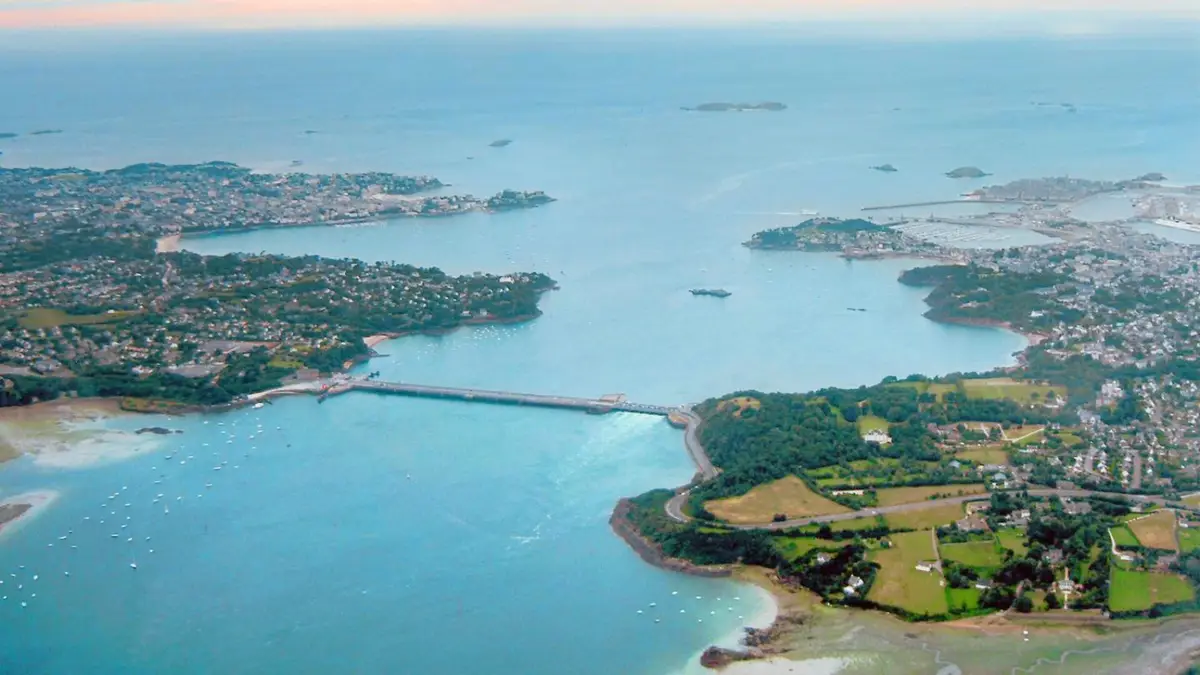
The La Rance plant, in the estuary of the river of the same name between Dinard and Saint-Malo in Brittany, entered service in 1966 and was the world's first large-scale tidal power station. It has 24 bulb units of 10 MW and, according to EDF, produces about 500 GWh a year. In 2018 it generated 502 GWh, according to the same company. Unlike Sihwa, it can generate on both the incoming and the outgoing tide.
Its long service life, 60 years in 2026, is one of the arguments in favour of tidal barrages: like large dams, they cost a lot up front but last for decades. The comparison with hydropower is direct; the world's largest, the Three Gorges Dam, has almost 90 times Sihwa's capacity, as shown in the ranking of the largest hydroelectric power stations in the world.
Does your company work in renewable energy, marine energy or coastal infrastructure? Reach Energía Futura's readers.
See advertising optionsMeyGen and tidal stream turbines
MeyGen, in the Pentland Firth strait in northern Scotland, is the world's largest tidal stream project, according to the REN21 ocean power report. It operates four 1.5 MW turbines and is consented for up to 86 MW, with potential expansion to as much as 398 MW. In February 2023 it became the first tidal turbine array to exceed 50 GWh of total generation.
According to Ocean Energy Europe figures released by the operator, MeyGen generated 13.1 GWh in 2025, more than 80% of the 16.2 GWh produced by the entire tidal stream sector worldwide. These are small figures: Sihwa generates about 40 times more than MeyGen in a year. Compared with wind the gap is even wider: the complexes at the top of the ranking of the largest wind farms in the world are measured in thousands of megawatts.
| Plant | Approximate annual generation | Source |
|---|---|---|
| Sihwa (South Korea) | 552 GWh | K-water |
| La Rance (France) | 500 GWh | EDF |
| MeyGen (Scotland) | 13.1 GWh (2025) | Ocean Energy Europe, via the operator |
| Entire tidal stream sector | 16.2 GWh (2025) | Ocean Energy Europe, via the operator |
The largest tidal power stations in the pipeline
There are very large projects on the drawing board, although several have not moved for decades. The most immediate is Morlais, off Anglesey (Wales), a demonstration zone consented in 2021 for up to 240 MW of tidal stream turbines, whose first device was expected in 2026. Proposed projects include:
| Project | Country | Proposed capacity | Status |
|---|---|---|---|
| Penzhin | Russia | 89,100 MW | Proposed, no progress |
| Mezenskaya | Russia | 24,000 MW | Proposed, no progress |
| Severn Barrage | United Kingdom | 8,640 MW | Proposed, rejected several times |
| Incheon | South Korea | 818 to 1,320 MW | Proposed |
| Garorim Bay | South Korea | 520 MW | Proposed |
| Swansea Bay Tidal Lagoon | United Kingdom | 320 MW | Proposed |
| Morlais | United Kingdom (Wales) | Up to 240 MW | Consented since 2021 |
Source: Tethys project database (PNNL) and public records for each project. None of the proposed projects has confirmed construction as of October 2026.
Chile's potential: the Chacao Channel
Chile has no tidal power stations in operation. A government-commissioned study, funded by the Inter-American Development Bank and prepared by consultancy Garrad Hassan in 2009, estimated that the gross tidal resource in the Chacao Channel, between the mainland and Chiloé, reaches 600 to 800 MW, as reported by La Tercera. The same study put the gross wave resource at 164.9 GW.
In 2015 the MERIC research centre was created with support from the Ministry of Energy and Corfo, and it has studied the potential of the Chacao Channel. In April 2021 it installed off Las Cruces, in the Valparaíso Region, the country's first full-scale wave energy converter, according to the Ministry of Energy. Today, Chile's renewable expansion remains concentrated in solar and wind, as shown in the ranking of countries with the most renewable electricity.
Ranking methodology
The ranking includes tidal power plants (barrage and tidal stream) in commercial or demonstration operation as of October 2026, with installed capacity reported by operators or by PNNL's Tethys project database. Test sites with several prototypes, such as EMEC, and closed plants, such as Annapolis Royal (Canada, 20 MW, 1984-2019), which was the third largest in the world, are excluded. Wave energy is not included. Generation figures vary from year to year. This ranking will be updated on this same page.
Frequently asked questions
What is the largest tidal power station in the world?
Sihwa, in South Korea, with 254 MW, operating since 2011. It generates about 552 GWh a year, according to K-water.
What was the first tidal power station in the world?
La Rance, in France, which entered service in 1966 and has 240 MW. It was the largest in the world until 2011.
Does Chile have tidal power stations?
No. A 2009 study estimated a gross resource of 600 to 800 MW in the Chacao Channel, and the MERIC centre has researched marine energy since 2015, but there are no projects in operation.
What is the difference between a tidal barrage and a tidal stream plant?
A barrage impounds water behind a wall and runs it through turbines when the tide turns, like a dam. A tidal stream plant installs underwater turbines in channels with strong currents, without closing off the bay.
How to cite this data
Energía Futura (2026). The largest tidal power station in the world 2026: ranking of the biggest tidal power plants. With data from K-water, EDF, REN21, Ocean Energy Europe and Tethys (PNNL), accessed on 30 October 2026. Available at https://energiafutura.cl/en/news/the-largest-tidal-power-station-in-the-world-2026-ranking-of-the-biggest-tidal-power-plants. The cover chart may be reproduced by citing Energía Futura and linking to this page.