The price of diesel in Chile will fall by 142 pesos per litre and stay frozen until 31 March 2027 if Congress approves the bill the government promised trucking associations to end this week's strike. Gasoline will drop by 39 pesos per litre. The Senate called a special session on Monday 16 November at 17:00 to vote on it, Revista Electricidad reported on 13 November.
The agreement was signed on the night of Thursday 12 November at La Moneda, the same day a new increase of 41.9 pesos per litre for diesel and 38.7 pesos for gasoline took effect. The government put the fiscal cost of the package at US$900 million over 2026 and 2027, almost double the first figure it had given, according to RDN.
View the data as a table
| Diesel cut | $142 per litre |
| Gasoline cut | $39 per litre |
| Estimated fiscal cost | US$900 million |
How much the price of diesel and gasoline will fall
The cut has two parts. First, this week's increase is reversed: 42 pesos per litre for diesel and 39 for gasoline. Second, diesel falls by another 100 pesos, bringing the total cut to about 142 pesos per litre for the fuel trucks use most, according to the details published by Emol based on government information. The cut will apply once the law is published.
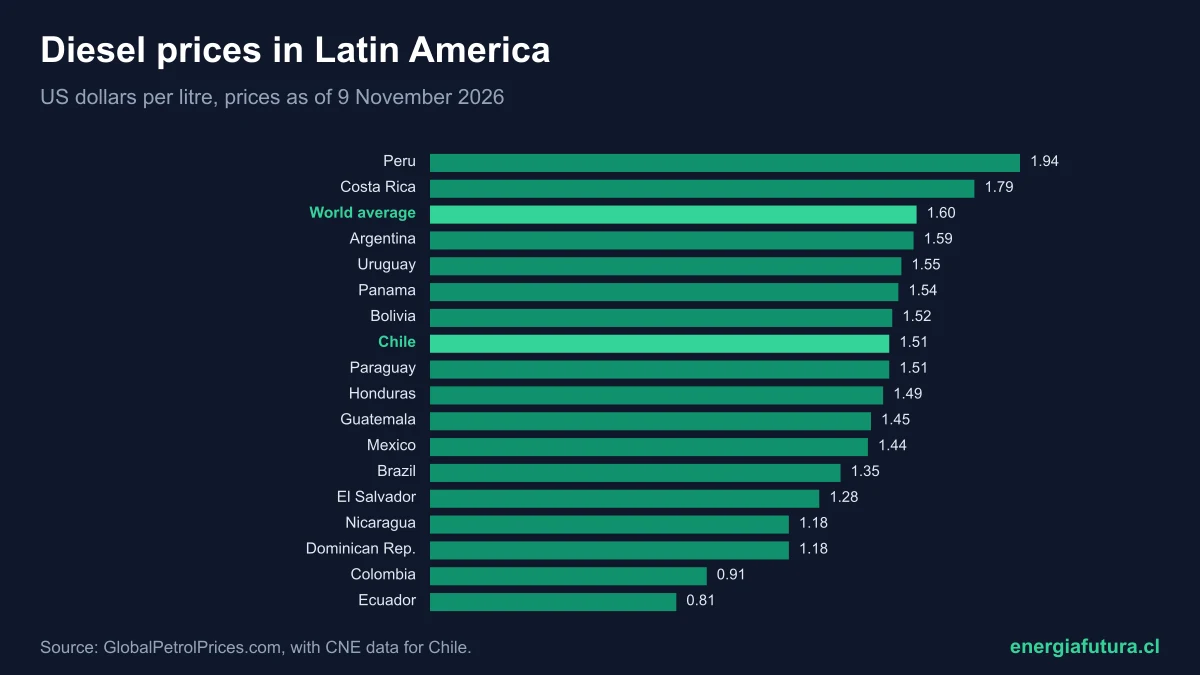
To put it in perspective: diesel averaged 1,488.83 pesos per litre on 9 November, according to GlobalPetrolPrices data drawn from Chile's National Energy Commission (CNE). After the 12 November rise it was around 1,530 pesos, and the 142-peso cut would take it back to roughly 1,390 pesos. These are averages; each station sets its own price from the wholesale price. How that compares with the rest of the region is shown in our ranking of diesel prices in Latin America.
| Fuel | 12 November rise | Cut under the deal | Net effect |
|---|---|---|---|
| Diesel | +41.9 pesos per litre | −142 pesos per litre | −100 pesos per litre versus the price before the rise |
| Gasoline 93 | +38.7 pesos per litre | −39 pesos per litre | Back to the price before the rise |
| Gasoline 97 | +38.7 pesos per litre | −39 pesos per litre | Back to the price before the rise |
Source: government memo and 12 November 2026 agreement, via Emol and RDN. The 12 November figures come from ENAP's weekly report; the 142-peso cut is the rounded figure given by the government (41.9 + 100).
The price of diesel will be frozen until 31 March
The second pillar is a freeze. Until 31 March 2027, fuel prices can only stay the same or fall. If they fall and then rise again, that increase is allowed, but the price can never exceed a ceiling: the 12 November price minus 142 pesos per litre for diesel and minus 39 for gasoline. After that date the Fuel Price Stabilisation Mechanism (Mepco), which adjusts prices every three weeks, will resume.
The freeze follows a string of increases. Between late July and 22 October diesel had risen by 401.4 pesos per litre, as we reported in our story on the fifth consecutive fuel price rise, and on 12 November it added another 41.9. Finance Minister Jorge Quiroz has blamed the increases on higher international diesel prices caused by wars and the loss of refining capacity worldwide.
- 22 OctDiesel rises $91.5Up $401.4 since July.
- 12 NovNew rise and dealDiesel +$41.9 and gasoline +$38.7; that night, a deal at La Moneda.
- 13 NovUS$900 million costThe Finance Ministry revises its initial US$500 million estimate.
- 16 Nov, 17:00Special Senate session
- 31 Mar 2027Freeze endsThe Mepco mechanism resumes.
A bigger refund of the diesel excise tax
The third point raises the refund of the diesel excise tax for freight companies during 2027. The tax is a fixed amount per litre and truckers have recovered part of it since 2000. Under the deal, companies with annual sales of up to 6,000 UF (about 248 million pesos) will recover 90%; those selling between 6,000 and 20,000 UF (about 826 million pesos), 65%; and the largest, 50%, according to Emol.
- Buses: the toll refund rises from 35% to 70%.
- Negative tax: truckers will no longer have to pay the excise tax through Form 29 when it is negative; a compensation account is created instead.
- Timing: the higher refund rate applies during 2027.
The agreement was signed by the main trucking confederations, including CNTC, CNDC, ChileTransporte, Fuerza del Norte and Centro Sur, according to RDN. The Senate Transport Committee, chaired by Senator Camila Flores, offered to process the bill as quickly as possible.
Does your company sell fuel, manage fleets or electrify freight transport? Reach Energía Futura's readers.
See advertising optionsThe fiscal cost: from US$500 million to US$900 million
The cost estimate changed in less than 24 hours. After the signing, Minister Quiroz spoke of an effort “in the order of 500 million dollars”. On Friday 13, government spokesman Gonzalo Arenas confirmed an estimate of US$900 million and warned it was approximate because it depends on international oil prices. Deputy Finance Minister Sebastián Vallebona said about US$500 million corresponds to this year and that, adding next year, the figure would reach some US$900 million, according to Emol.
| Measure | What changes | Until when |
|---|---|---|
| Diesel cut | −142 pesos per litre | From publication of the law |
| Gasoline cut | −39 pesos per litre | From publication of the law |
| Freeze | Prices can only stay flat or fall, with a ceiling | 31 March 2027 |
| Diesel excise refund | 90%, 65% or 50% by sales | During 2027 |
| Bus tolls | Refund up from 35% to 70% | As set by the bill |
| Estimated fiscal cost | US$900 million | 2026 and 2027 |
Source: government agreement with freight associations (12 November 2026), via Emol and RDN.
Economists are divided. Claudio Agostini, of Universidad Adolfo Ibáñez, called it “a kind of reverse bencinazo” and criticised the fact that nobody knows what it will cost. Álvaro García, of Universidad de los Andes, told Radio Universidad de Chile that the deal “stresses” the government's aim of fiscal consolidation. Quiroz said the cost is “affordable” and within fiscal targets.
What happens to the price of diesel after March
When the freeze ends, Mepco will again move prices in line with international benchmarks. If oil and diesel remain expensive, the gap absorbed by the state could be passed on at the pump in the following weeks. If they fall, the adjustment will be smaller. That is why the final cost of the deal is an estimate, not a closed figure.
The measure also reopens the debate on the excise tax and on how to protect households from expensive fuel. Before the 12 November rise, Chilean gasoline was already the fourth most expensive in the region, as shown in our ranking of gasoline prices in Latin America, which compares Chile's prices with its neighbours'.
Frequently asked questions
When will the price of diesel fall?
Once the law is approved and published. The Senate votes in a special session on Monday 16 November from 17:00, and Senate President Paulina Núñez said they expect to have the law ready on Tuesday.
How much will diesel fall?
About 142 pesos per litre: 41.9 reversing the 12 November rise plus another 100. Gasoline falls by 39 pesos per litre.
Until when are fuel prices frozen?
Until 31 March 2027. During that period prices can only stay flat or fall and can never exceed the ceiling set in the agreement.
How much does the deal cost the treasury?
The government estimates US$900 million over 2026 and 2027 and warns that the final amount depends on international oil prices.