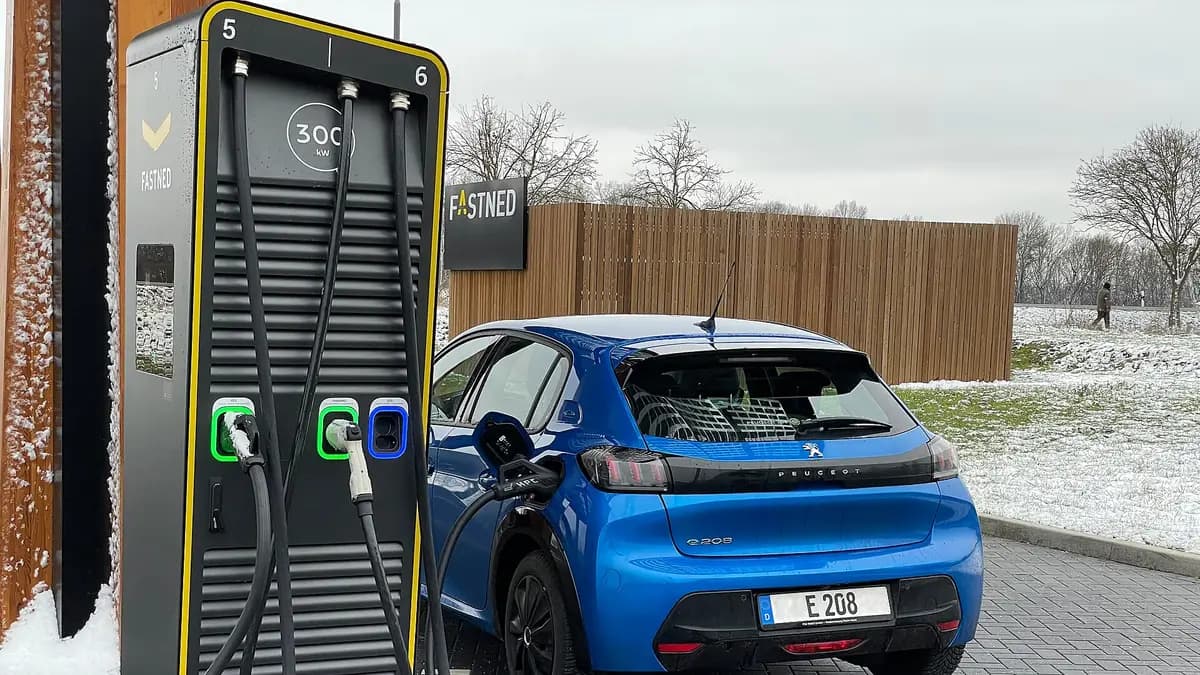
EV fast charging is coming to five urban areas in northern and central Chile that currently have few or no public options. On October 26, 2026, Chile's Energy Sustainability Agency (AgenciaSE) approved the award of five zones in the +Carga Rápida GEF 7 2026 call: Tocopilla, Taltal, Chañaral, Curicó and San Felipe-Los Andes, the Energy Sustainability Agency announced on October 28.
The three northern zones went to Copec S.A. and the two central zones to Empresa Nacional de Energía Enex S.A. The chargers will be open to the public, and the projects include free charging energy that the Agency can allocate to local users such as taxis and shared taxis (colectivos). The operators must also share their operating data with the Agency, which will use it to improve public support programs.
The news was also reported by Revista Electricidad on October 29. Neither the Agency nor the companies have yet disclosed the exact power, the number of chargers per city or the start-up date of each site.
Where EV fast charging is coming: the five awarded zones
The call prioritized mid-sized cities and road corridors where EV drivers currently have few places to recharge. In the north, Tocopilla and Taltal are on the coast of the Antofagasta Region and Chañaral is in the Atacama Region. In central Chile, Curicó sits on the Ruta 5 Sur highway and San Felipe-Los Andes is on the corridor to the Los Libertadores International Pass, the main land crossing into Argentina.
| Urban zone | Region | Awarded operator | Why it matters |
|---|---|---|---|
| Tocopilla | Antofagasta | Copec S.A. | Coastal city between Antofagasta and Iquique |
| Taltal | Antofagasta | Copec S.A. | Southern coast of the region, route to Atacama |
| Chañaral | Atacama | Copec S.A. | Port on the Ruta 5 Norte |
| Curicó | Maule | Enex S.A. | On the Ruta 5 Sur |
| San Felipe-Los Andes | Valparaíso | Enex S.A. | Corridor to the Los Libertadores Pass |
Source: Energy Sustainability Agency, October 28, 2026. The last column summarizes the Agency's description and the geographic location of each city.
Referring to the northern cities, the Agency said that "each new fast-charging point opens routes that until now were hard to travel in an electric vehicle." It also stressed that "public-private collaboration is the way for the charging network to reach more regions of the country."
How the +Carga Rápida GEF 7 2026 call works
The call opened in June 2026 to co-finance publicly accessible fast chargers, according to the announcement by the GEF 7 Electromobility project. Charging operators could apply for one or more zones from a list of 79 urban zones of high strategic value.
The call had a maximum budget of CLP 120 million (about US$130,000), with a cap of CLP 30 million or CLP 20 million per zone, depending on the urban area. Each project had to include at least one public DC charging point of 50 kW or more. Applications closed on July 28, 2026.
| Call condition | Figure |
|---|---|
| Maximum total budget | CLP 120 million |
| Maximum contribution per zone | CLP 30 million or CLP 20 million, depending on the zone |
| Minimum power | At least one DC point of 50 kW or more |
| Access | Public |
| Eligible zones | 79 urban zones |
| Application deadline | July 28, 2026 |
| Zones awarded | 5 (October 26, 2026) |
| Local benefit | Free charging energy for taxis and shared taxis, allocated by the Agency |
Source: GEF 7 Electromobility project (June 9, 2026) and Energy Sustainability Agency (October 28, 2026). The dollar figure is an approximate conversion by Energía Futura. Public funding covers only part of the cost; the rest is invested by the operators, which have not disclosed the amount.

What the GEF 7 Electromobility project is
The call is part of the GEF 7 Electromobility Project, funded by the Global Environment Facility (GEF), implemented by UN Environment and executed in Chile by AgenciaSE. When it started in 2022, the project focused on Antofagasta, Talca and Puerto Montt, with calls to co-finance chargers and electric taxis and shared taxis.
The previous edition of the +Carga Rápida program, inaugurated in October 2023, added 16 fast chargers of 60 to 120 kW from Arica to Punta Arenas, with the goal of giving every region at least one. In that phase, Enex committed to 20 charging points and Copec to 12, according to the Energy Sustainability Agency. Both companies won again in the new award.
The Agency also supports the electrification of smaller public transport in the north. A few days ago, Iquique and Alto Hospicio signed an agreement for 18 electric taxis with funding from the Collahuasi Foundation, the kind of user who could now receive free energy at the new fast-charging sites.
Chile's EV fast charging network in figures
Chile went from 24 chargers in 2018 to 5,245 operating units in 2025, according to the 2026 National Report on Electric Vehicle Charging Infrastructure by the Superintendency of Electricity and Fuels (SEC), cited by Reporte Minero. Of these, 4,015 are private, mostly at homes, and 1,230 are public.
The public network has 1,112 slow AC charging points, 457 fast DC points and 167 ultra-fast DC points. A single charger can have several points or connectors, which is why the number of points exceeds the number of units. The Santiago Metropolitan Region has 3,827 chargers, public and private, and every region has at least some public coverage.
| Indicator (SEC, 2025) | Figure |
|---|---|
| Total operating chargers | 5,245 |
| Private chargers | 4,015 (76.5%) |
| Public chargers | 1,230 (23.5%) |
| Public slow charging points (AC) | 1,112 |
| Public fast charging points (DC) | 457 |
| Public ultra-fast points (DC) | 167 |
| CCS2 share in fast charging | 74.36% |
| Chargers in the Metropolitan Region | 3,827 |
Source: SEC, 2026 National Report on Electric Vehicle Charging Infrastructure, via Reporte Minero (September 9, 2026). The public network provides about 50% of the country's installed charging power, even though it has less than a quarter of the units.
Charging demand is growing with sales. In September, sales of electric and plug-in hybrid cars grew 144.6% in 2026 and reached 6.3% of the market, according to ANAC, a jump that increases pressure for more charging points outside Santiago.
Why EV fast charging in mid-sized cities is key for 2035
Chile aims for 100% of light and medium vehicle sales to be zero-emission by 2035. The National Electromobility Strategy 2030 puts charging infrastructure at its core and relies on the Public Charging Infrastructure Master Plan, which identifies where chargers are missing, AgenciaSE noted.
The energy case is strong: transport accounts for 33.7% of the country's energy consumption and depends on imported fossil fuels for 98.8% of it, according to the Agency. Every car that goes electric replaces imported gasoline or diesel with electricity, which in Chile comes largely from renewable sources.
For drivers, the lack of fast charging in mid-sized cities is one of the main barriers to traveling by EV outside the big cities. A 50 kW point can recharge a good part of a compact car's battery in less than an hour, allowing long stretches of northern Chile to be covered with planned stops. Anyone thinking of buying one can check the cheapest electric cars in Chile in 2026 and their range.
Some details are still pending. The Agency has not said how many chargers each city will get, their final power, the exact location (service stations or other sites), how much Copec and Enex will invest, or the opening date. Energía Futura will update this story when they are published.
Does your company install, operate or sell EV chargers? Reach Energía Futura's readers.
See advertising optionsFrequently asked questions
Where will new public fast charging be installed?
In Tocopilla and Taltal (Antofagasta Region), Chañaral (Atacama), Curicó (Maule) and San Felipe-Los Andes (Valparaíso), according to AgenciaSE's award of October 26, 2026.
Which companies will operate the chargers?
Copec S.A. in the three northern zones and Enex S.A. in Curicó and San Felipe-Los Andes.
How powerful will the fast chargers be?
The rules require at least one DC charging point of 50 kW or more per project. The final power of each unit has not been disclosed.
Will charging be free?
Not for everyone. The projects include an amount of free energy that the Agency can allocate to local users such as taxis and shared taxis. Other users will pay the operator's rate.
When will they be operating?
The Agency has not announced start-up dates. The award was approved on October 26, 2026.