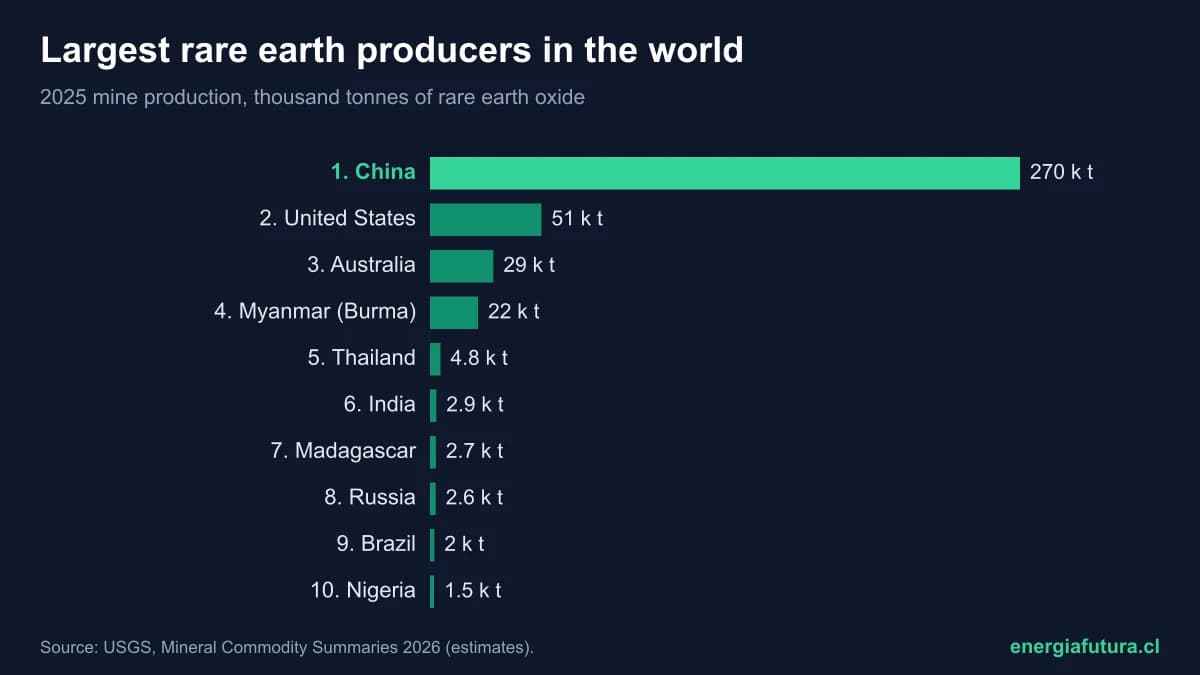
Updated on 30 October 2026. China is the largest rare earth producer in the world, with estimated mine production of 270,000 tonnes of rare earth oxides in 2025, 69% of the world total of 390,000 tonnes, according to the rare earths chapter of the US Geological Survey (USGS) Mineral Commodity Summaries 2026, published in February 2026. Far behind come the United States, with 51,000 tonnes, Australia, with 29,000, and Myanmar (Burma), with 22,000.
Rare earths are a group of 17 elements (the lanthanides plus yttrium and scandium) that the energy transition needs above all to make permanent magnets of neodymium, iron and boron. Those magnets go into the motors of most electric cars and into the generators of many large wind turbines. The USGS notes that magnets are now the leading global use of rare earths.
Chile does not appear in the ranking: it has no production or reported reserves in the USGS table. But the Penco Module project, owned by Aclara Resources in the Biobío Region, received environmental approval in June 2026 and aims to begin commissioning in mid-2028. This is the full ranking.
Ranking of the largest rare earth producers in the world in 2025
The table ranks countries by estimated 2025 mine production, measured in tonnes of rare earth oxide (REO), the unit the USGS uses to add up different elements. The percentage share is an Energía Futura calculation based on the rounded world total.
| # | Country | 2024 production (t) | 2025 production (t) | 2025 share |
|---|---|---|---|---|
| 1 | China | 270,000 | 270,000 | 69.2% |
| 2 | United States | 45,500 | 51,000 | 13.1% |
| 3 | Australia | 29,000 | 29,000 | 7.4% |
| 4 | Myanmar (Burma) | 27,000* | 22,000* | 5.6% |
| 5 | Thailand | 2,100* | 4,800* | 1.2% |
| 6 | India | 2,900 | 2,900 | 0.7% |
| 7 | Madagascar | 1,400* | 2,700* | 0.7% |
| 8 | Russia | 2,600 | 2,600 | 0.7% |
| 9 | Brazil | 560 | 2,000 | 0.5% |
| 10 | Nigeria | 1,500 | 1,500 | 0.4% |
| — | World total | 380,000 | 390,000 | 100% |
Source: USGS, Mineral Commodity Summaries 2026, estimated figures. (*) For Myanmar, Thailand and Madagascar, the USGS estimates production from China's import data, because those countries do not publish their own statistics. Vietnam (150 t) and Malaysia (110 t) complete the list with smaller volumes.
World production grew only 2.6% in 2025, from 380,000 to 390,000 tonnes. China held steady and the United States rose 12%, thanks to the Mountain Pass mine in California, the country's only industrial-scale rare earth operation. The biggest jumps in relative terms came from Brazil, which went from 560 to 2,000 tonnes, and Thailand, which more than doubled its output. Myanmar, by contrast, fell about 19%.
Rare earth reserves by country: China, Brazil and Australia
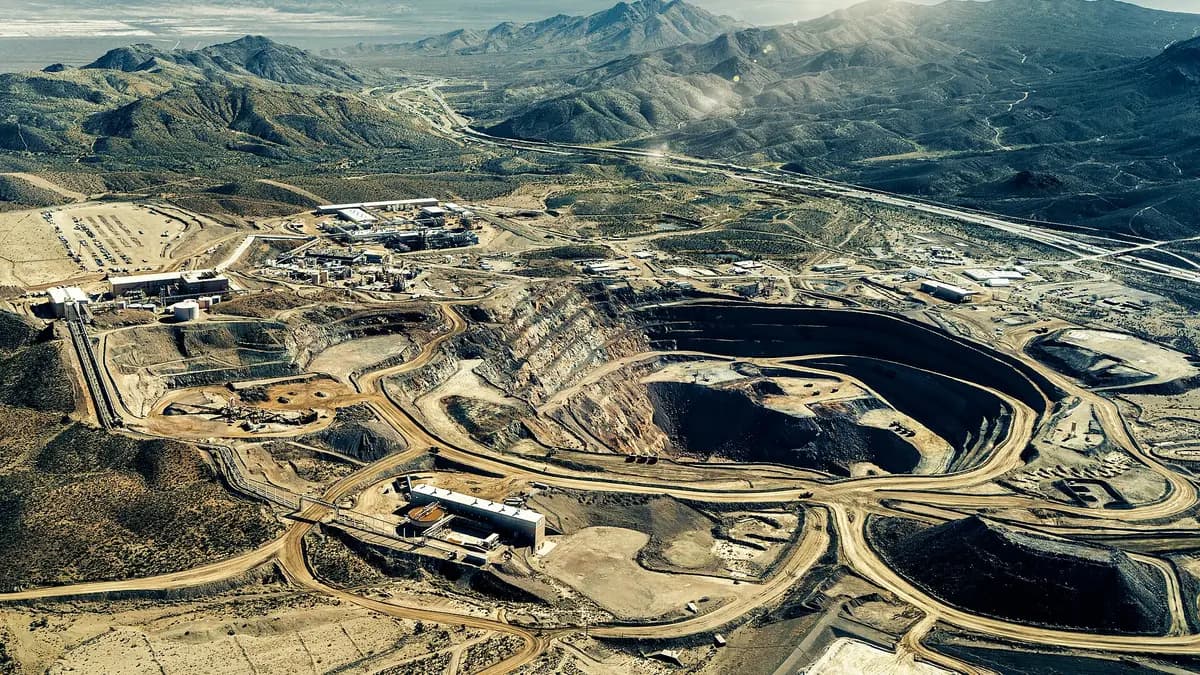
Reserves are the ore that can be mined profitably with current technology and prices. The USGS estimates that the world has more than 75 million tonnes of rare earth reserves, and that China holds 44 million, about 59%. In second place is Brazil, with 11 million tonnes, a figure that contrasts with its still marginal production.
| # | Country | Reserves (t of oxides) | Approximate share |
|---|---|---|---|
| 1 | China | 44,000,000 | 58.7% |
| 2 | Brazil | 11,000,000 | 14.7% |
| 3 | Australia | 6,300,000* | 8.4% |
| 4 | Russia | 3,800,000 | 5.1% |
| 5 | Vietnam | 3,500,000 | 4.7% |
| 6 | United States | 1,900,000 | 2.5% |
| 7 | Greenland | 1,500,000 | 2.0% |
| 8 | Tanzania | 890,000 | 1.2% |
| 9 | South Africa | 860,000 | 1.1% |
| 10 | Canada | 830,000 | 1.1% |
| — | World total | More than 75,000,000 | 100% |
Source: USGS, Mineral Commodity Summaries 2026. (*) For Australia, JORC-compliant reserves are 3.3 million tonnes. Shares are an Energía Futura calculation over 75 million tonnes, so they are slightly overstated: the USGS only says the total is above that figure. Myanmar, India, Madagascar, Thailand and Nigeria have no reported reserves.
Comparing production with reserves shows where future supply could come from. At the 2025 pace, China's reserves would last about 160 years, while Brazil's, at its current output, would last thousands of years: in other words, the country has plenty of room to grow. This is a simple Energía Futura calculation that does not account for new discoveries or price changes. Chile holds a very different position in other transition minerals: it has the largest copper and lithium reserves on the planet, as shown in the ranking of the largest copper producers in the world.
Does your company work in sustainable mining, critical minerals or clean energy? Reach Energía Futura's readers.
See advertising optionsWhy China dominates rare earth producers
China's dominance is even greater in the stage that adds the most value: separation and refining of the elements. According to the International Energy Agency (IEA) Global Critical Minerals Outlook 2025, China leads refining for 19 of the 20 energy-related strategic minerals it analyses, with an average share of about 70%, and in rare earths its share is around 90%. That means much of the ore mined in other countries, such as Myanmar, ends up being processed in China.
That control became a trade policy tool. The USGS summarises that in April 2025 China tightened export controls on seven rare earths (samarium, gadolinium, terbium, dysprosium, lutetium, scandium and yttrium) and in October 2025 added five more (europium, holmium, erbium, thulium and ytterbium). In November 2025 it suspended the October controls for one year, while the April controls stayed in force, although with general licences for some exporters.
The elements under the strictest controls are the so-called heavy rare earths, such as dysprosium and terbium, which are added to magnets so they withstand high temperatures, a key condition in electric motors. That is why the United States, the European Union, Japan and Australia are looking for projects outside China, and why production in Brazil, Thailand and Madagascar is starting to move.
Rare earth prices in 2025
Prices of the oxides used in magnets rebounded in 2025 after two years of decline, although they remain far below the 2022 peak. These are the average figures published by the USGS, with data from Argus Media:
| Product (minimum purity) | 2022 (US$/kg) | 2024 (US$/kg) | 2025 (US$/kg) |
|---|---|---|---|
| Neodymium-praseodymium (NdPr) oxide, 99% | 124 | 55 | 69 |
| Neodymium oxide, 99.5% | 134 | 56 | 73 |
| Praseodymium oxide, 99.99% | 128 | 56 | 74 |
| Cerium oxide, 99.5% | 1.45 | 1.21 | 1.71 |
| Lanthanum oxide, 99.5% | 1.39 | 0.97 | 1.00 |
Source: USGS, Mineral Commodity Summaries 2026, FOB prices from Argus Non-Ferrous Markets; 2025 figures are estimates. NdPr, the blend most used in magnets, rose 25% from 2024 but costs 44% less than in 2022.
Where Chile stands: the Penco rare earth project
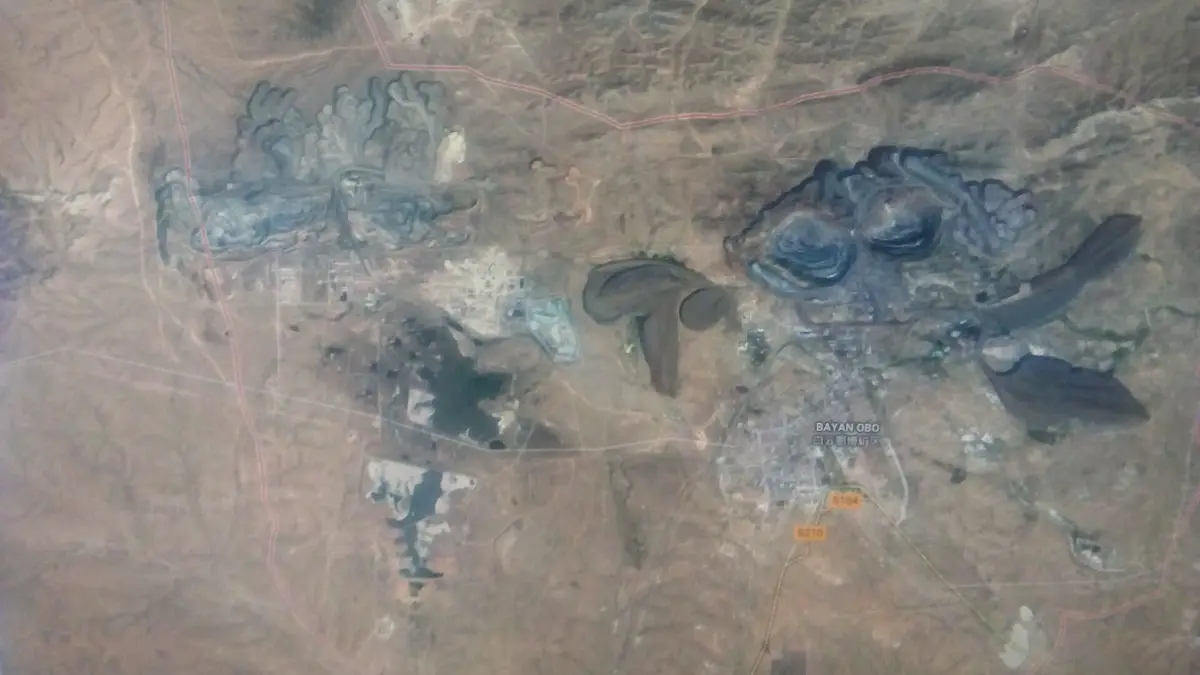
Chile does not produce rare earths, but it has a project with environmental approval. The Biobío Region Environmental Evaluation Commission unanimously approved Aclara Resources' Penco Module in June 2026, according to Energiminas. The project would extract rare earths from ionic clays, a type of deposit in which the elements are attached to the clay and recovered by washing with salts, without blasting or grinding.
According to published information, the plant could process up to 320 tonnes of clay per hour to produce a high-purity rare earth carbonate, with an emphasis on heavy rare earths. The project, located about 15 kilometres from Concepción, involved an investment of US$130 million, according to InvestChile. Aclara expects to complete the feasibility study in the fourth quarter of 2026 and begin commissioning in mid-2028, subject to those milestones. The approval came after the company withdrew and reworked an earlier version of the environmental impact study.
If it goes ahead, Chile would add a third transition mineral to its portfolio, alongside copper and lithium. In lithium, the country already holds a dominant position in reserves, as detailed in the world ranking of lithium reserves. In rare earths it would start from zero and with small volumes compared with China.
What rare earths are used for in clean energy
Most of the value of rare earths lies in four elements: neodymium and praseodymium, which form the base of magnets, and dysprosium and terbium, which make them heat-resistant. Their main uses in the energy transition are:
- Electric car motors: most manufacturers use permanent magnet synchronous motors, which are more efficient and compact.
- Wind turbines: direct-drive turbines, common offshore, use generators with large neodymium magnets. This is the case for several of the machines in the ranking of the largest wind turbines in the world.
- Other uses: catalysts (the leading use in the United States), nickel-metal hydride batteries, glass, ceramics and alloys, according to the USGS.
Recycling remains marginal: the USGS notes that only limited quantities of rare earths are recovered from batteries, permanent magnets and fluorescent lamps.
Ranking methodology
Production and reserves data come from the rare earths chapter of the USGS Mineral Commodity Summaries 2026, published in February 2026 and accessed on 30 October 2026. Figures are expressed in tonnes of rare earth oxide and include the lanthanides and yttrium but exclude most scandium. 2025 figures are estimates; those for some countries are calculated from Chinese import data. Percentages and reserve lifetimes are Energía Futura calculations. China's share of refining comes from the IEA. This ranking will be updated on this same page when the USGS publishes the 2027 edition.
Frequently asked questions
Which country is the largest rare earth producer in the world?
China, with 270,000 tonnes in 2025, 69% of world mine production, according to the USGS. It also accounts for about 90% of refining, according to the IEA.
Which country has the most rare earth reserves?
China, with 44 million tonnes, followed by Brazil, with 11 million, and Australia, with 6.3 million.
Does Chile produce rare earths?
No. Chile has no production or reserves reported by the USGS. Aclara Resources' Penco Module project in Biobío has had environmental approval since June 2026 and aims to begin commissioning in mid-2028.
How much rare earth is produced in the world?
About 390,000 tonnes of rare earth oxides in 2025, compared with 380,000 in 2024, according to USGS estimates.
How to cite this data
Energía Futura (2026). Largest rare earth producers in the world 2026: ranking of countries, reserves and where Chile stands. With data from the USGS (Mineral Commodity Summaries 2026) and the IEA, accessed on 30 October 2026. Available at https://energiafutura.cl/en/news/largest-rare-earth-producers-in-the-world-2026-ranking-of-countries-reserves-and-chile. The cover chart may be reproduced by citing Energía Futura and linking to this page.