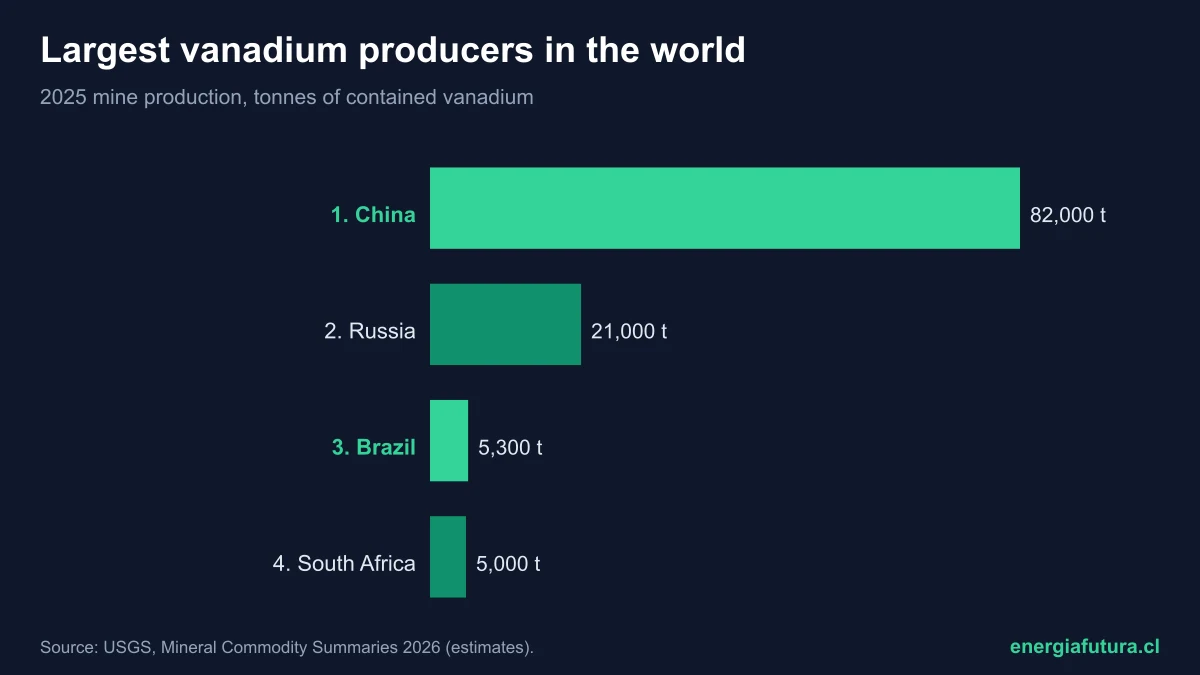
Updated on 6 November 2026. China is the world's largest vanadium producer: in 2025 it produced about 82,000 tonnes of contained vanadium, about 75% of the world total of 110,000 tonnes, according to the US Geological Survey (USGS) vanadium summary, Mineral Commodity Summaries 2026, published in February. Russia is second, with 21,000 tonnes, and Brazil moved into third place, with 5,300, ahead of South Africa, which fell to 5,000.
Vanadium is mainly used to harden steel: in the United States, more than 90% of consumption is metallurgical, according to the USGS. But its role in the energy transition is growing because of vanadium redox flow batteries, which store energy from solar and wind farms for several hours. This data sheet gathers the production ranking, the trend since 2020, reserves, prices and its use in energy storage.
View the data as a table
| World production 2025 | 110,000 t |
| China's share | 74.5% |
| World reserves | 21 million t |
| Vanadium pentoxide in China, 2025 | US$5.02/lb |
Ranking of the largest vanadium producers in the world in 2025
The table ranks countries by 2025 mine production, in tonnes of contained vanadium. Only four countries produce mined vanadium in significant amounts; the United States and Australia recorded no mine production in 2024 or 2025. The 2025 figures are USGS estimates.
| Rank | Country | 2024 production (t) | 2025e production (t) | Share of 2025 total |
|---|---|---|---|---|
| 1 | China | 84,000 (est.) | 82,000 | 74.5% |
| 2 | Russia | 21,000 (est.) | 21,000 | 19.1% |
| 3 | Brazil | 5,190 | 5,300 | 4.8% |
| 4 | South Africa | 8,050 | 5,000 | 4.5% |
| World total (rounded) | 118,000 | 110,000 | 100% |
Source: USGS, Mineral Commodity Summaries 2026. Percentages calculated by Energía Futura on the USGS rounded total; because of that rounding, the sum of the countries (113,300 t) slightly exceeds the total. The USGS sharply revised China's 2024 production upwards based on a government report, which explains that year's jump.
Most vanadium does not come from dedicated mines: in China it is obtained as a co-product of steelmaking, by processing vanadium-bearing titanomagnetite ores, according to the USGS. That is why its output closely tracks Chinese steel. It is also recovered from oil refining residues, ash and spent catalysts, which the USGS counts as secondary production.
View the data as a table
| t | |
|---|---|
| People's Republic of China | 82,000 t |
| Russia | 21,000 t |
| Brazil | 5,300 t |
| South Africa | 5,000 t |
China, Russia, Brazil and South Africa: the vanadium producers
China has dominated for years with about 70,000 tonnes a year, which rose to 84,000 in 2024 after the USGS revision. Russia remains stable at around 20,000 to 21,000 tonnes. The most striking change is lower down: South Africa, which produced about 8,800 tonnes in 2021, fell to 5,000 in 2025.
South Africa's decline is largely explained by Bushveld Minerals: its South African subsidiaries, owners of the Vametco operation, entered business rescue at the end of 2024, the plant went into an extended maintenance shutdown and in April 2025 the parent company sought the appointment of liquidators, according to Creamer Media. Brazil, with Largo's Maracás Menchen mine in Bahia, thus became the world's third producer and the only one in Latin America.
| Year | China | Russia | South Africa | Brazil | World total |
|---|---|---|---|---|---|
| 2020 | 70,000 | 19,500 | 8,580 | 6,620 | 105,000 |
| 2021 | 70,300 | 20,100 | 8,800 | 5,780 | 105,000 |
| 2022 | 66,900 | 20,000 | 8,870 | 5,840 | 102,000 |
| 2023 | 70,000 | 20,000 | 8,670 | 5,420 | 104,000 |
| 2024 | 84,000 | 21,000 | 8,050 | 5,190 | 118,000 |
| 2025e | 82,000 | 21,000 | 5,000 | 5,300 | 110,000 |
Source: USGS, Mineral Commodity Summaries, 2022 to 2026 editions, in tonnes of contained vanadium. Each year uses the latest figure published; several for China and Russia are estimates.
View the data as a table
| Russia | South Africa | Brazil | |
|---|---|---|---|
| 2020 | 19,500 | 8,580 | 6,620 |
| 2021 | 20,100 | 8,800 | 5,780 |
| 2022 | 20,000 | 8,870 | 5,840 |
| 2023 | 20,000 | 8,670 | 5,420 |
| 2024 | 21,000 | 8,050 | 5,190 |
| 2025 | 21,000 | 5,000 | 5,300 |
View the data as a table
| 2020 | 2021 | 2022 | 2023 | 2024 | 2025 | |
|---|---|---|---|---|---|---|
| China | 70,000 | 70,300 | 66,900 | 70,000 | 84,000 | 82,000 |
| Russia | 19,500 | 20,100 | 20,000 | 20,000 | 21,000 | 21,000 |
| South Africa | 8,580 | 8,800 | 8,870 | 8,670 | 8,050 | 5,000 |
| Brazil | 6,620 | 5,780 | 5,840 | 5,420 | 5,190 | 5,300 |
Vanadium reserves by country
The USGS estimates world vanadium reserves at 21 million tonnes, about 190 times 2025 production, and resources at more than 63 million tonnes. Australia leads reserves with 10 million, although it does not produce: those compliant with Australia's JORC code are 2.3 million. It is followed by China (5.8 million), Russia (5 million) and South Africa (520,000).
| Country | Reserves (thousand t) | Share of total |
|---|---|---|
| Australia | 10,000 | 47.6% |
| China | 5,800 | 27.6% |
| Russia | 5,000 | 23.8% |
| South Africa | 520 | 2.5% |
| Brazil | 94 | 0.4% |
| United States | 50 | 0.2% |
| World total | 21,000 | 100% |
Source: USGS, Mineral Commodity Summaries 2026. The USGS revised reserves for Australia, Brazil, China, South Africa and the United States based on company and government reports. Percentages calculated by Energía Futura. Australia has projects under development to produce vanadium, but recorded no mine production in 2024 or 2025. Brazil is the reverse case: it produces a lot from small reserves, since its 94,000 tonnes are equivalent to about 18 years of its current output.
Vanadium price
The average price of vanadium pentoxide (V2O5, 98%) in China was US$5.02 per pound in 2025, against US$5.44 in 2024 and US$9.29 in 2022, according to the USGS with Argus Media data. In other words, it nearly halved in three years. Ferrovanadium in the United States, by contrast, rose from US$13.05 to US$14.14 per pound.
| Year | Vanadium pentoxide in China (US$ per pound) |
|---|---|
| 2021 | 8.17 |
| 2022 | 9.29 |
| 2023 | 7.50 |
| 2024 | 5.44 |
| 2025e | 5.02 |
View the data as a table
| Average price | |
|---|---|
| 2021 | US$8.17 |
| 2022 | US$9.29 |
| 2023 | US$7.50 |
| 2024 | US$5.44 |
| 2025 | US$5.02 |
Trade also moved the market in 2025. From 6 August 2025 the United States imposed a 50% tariff on many imports from Brazil, including high-purity vanadium (but not ferrovanadium), and a major Brazilian producer sought an exemption after suffering delays and defaults on its contracts, citing the importance of its product for the aerospace and defence industries, according to the USGS. US net import reliance was 41% of apparent consumption in 2025, against 61% in 2021.
Source: USGS, Mineral Commodity Summaries 2026. Like most ferroalloys, vanadium depends on the steel market, especially China's. Low prices hit high-cost producers, such as the South African ones.
Does your company work in energy storage or critical minerals? Reach Energía Futura's readers.
See advertising formatsVanadium and flow batteries: its role in storage
A vanadium redox flow battery stores energy in two tanks of liquid electrolyte containing vanadium in different oxidation states, which circulate through a cell. Its capacity is expanded by adding electrolyte, not cells, and it does not degrade like lithium: the USGS highlights its operational safety, long cycle life and suitability for storing energy for several hours. Its drawbacks, according to the same report, are high capital costs and the limited availability of high-purity vanadium.
Besides steel and batteries, vanadium has no acceptable substitute in titanium alloys for the aerospace industry, according to the USGS, and it is used as a catalyst to produce maleic anhydride and sulfuric acid. In steel, by contrast, it can be partly replaced by manganese, molybdenum, niobium, titanium or tungsten. That difference explains why demand for high-purity vanadium, the kind aircraft and flow batteries need, is tighter than for vanadium used in steel.
The largest example is in China: the Jimusar project in Xinjiang, with 200 MW and 1,000 MWh and five hours of duration, reached full operation on 31 December 2025 with Rongke Power batteries, according to ESS News. It is the first flow battery to reach gigawatt-hour scale. Even so, the largest systems in the world are still lithium-based, as we show in the largest battery in the world.
Vanadium thus joins the list of transition metals with concentrated production, such as South Africa's manganese, which we analysed in the largest manganese producers, and Indonesia's nickel, which we reviewed in the largest nickel producers. Chile does not appear among USGS producers. The United States, with no active mines since 2020, imports vanadium pentoxide mainly from Brazil (47%) and South Africa (43%).
For grid operators, the appeal of vanadium flow batteries lies in duration rather than size. Lithium batteries dominate fast, short discharges, while flow batteries are designed for longer ones, such as the five hours at Jimusar, which suits regions with large solar surpluses during the day that need to be shifted to the evening. Whether they spread beyond China will depend on the cost of high-purity vanadium, which, as the price table shows, has fallen sharply since 2022, and on competition from other grid-scale storage chemistries, which the USGS also mentions in its report.
- Dec 2024Bushveld in business rescueIts South African subsidiaries, owners of Vametco, enter business rescue and the plant halts for maintenance.
- Apr 2025Bushveld seeks liquidatorsThe parent concludes it cannot pay its debts.
- Dec 2025Jimusar, 1,000 MWh of vanadium flowThe 200 MW battery in Xinjiang reaches full operation on 31 December.
- Feb 2026USGS: Brazil passes South AfricaEstimated South African output falls to 5,000 t in 2025.
How to cite this data
Energía Futura (2026). "Largest vanadium producers in the world 2026: country ranking, reserves and role in flow batteries". Updated on 6 November 2026. energiafutura.cl/en/news/largest-vanadium-producers-in-the-world-2026-country-ranking-reserves-and-role-in-flow-batteries. Data: USGS, Mineral Commodity Summaries 2022-2026; Argus Media; ESS News.
Frequently asked questions
Which country is the largest vanadium producer?
China, with about 82,000 tonnes of contained vanadium in 2025, about 75% of the world total, according to the USGS.
How much vanadium is produced in the world?
About 110,000 tonnes in 2025, against 118,000 in 2024.
Which country has the largest vanadium reserves?
Australia, with 10 million tonnes, followed by China (5.8 million) and Russia (5 million).
What is vanadium used for?
Mainly to make high-strength steel, and also in titanium alloys for aerospace, in catalysts and in flow batteries for energy storage.
Which Latin American country produces vanadium?
Brazil, third in the world with 5,300 tonnes in 2025.