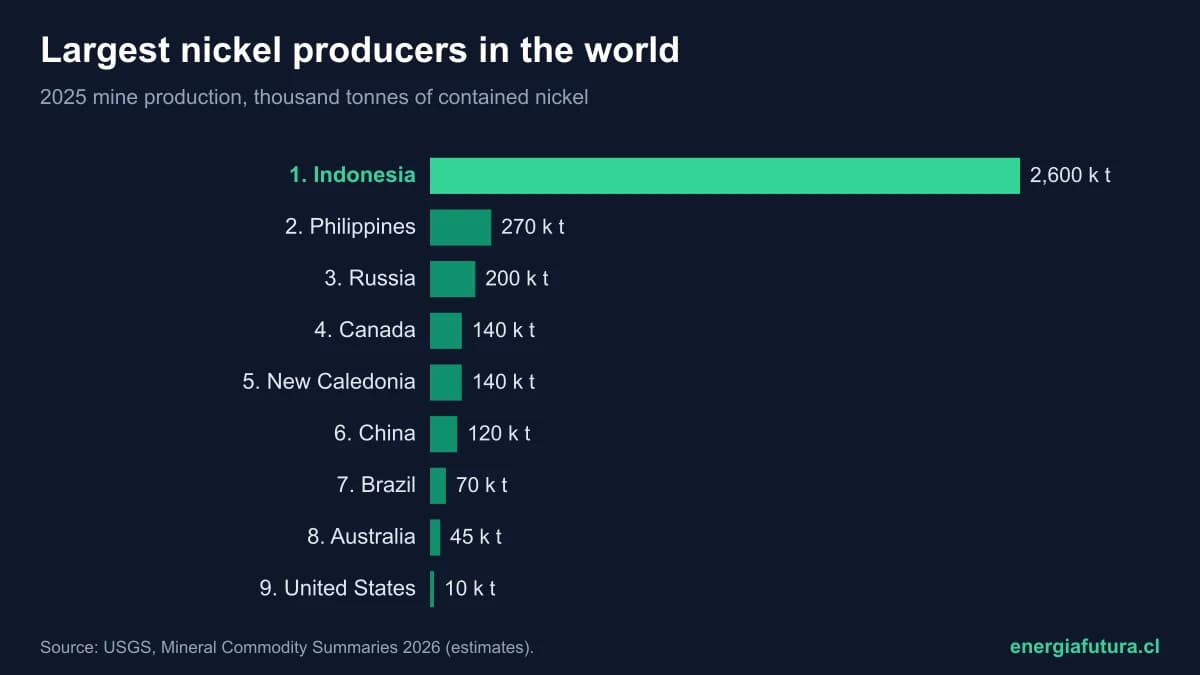
Updated November 2, 2026. Indonesia is the world's largest nickel producer, with estimated mine production of 2.6 million tonnes of contained nickel in 2025, about 67% of the world total of 3.9 million tonnes, according to the nickel summary of the US Geological Survey (USGS), Mineral Commodity Summaries 2026, published in February. The Philippines is second, with 270,000 tonnes (6.9%), and Russia third, with 200,000 (5.1%).
Nickel is a key metal for stainless steel, which takes most of production, and for lithium-ion batteries with NMC and NCA chemistries, used in many electric cars because nickel raises energy density. World production grew 5% in 2025, and almost all of the increase came from Indonesia.
Chile is not on the list: it has no nickel production reported in the USGS table. Its role in batteries comes through lithium and copper, not nickel.
Ranking: the largest nickel producers in the world in 2025
| Rank | Country | 2024 production (t) | 2025 production (t) | 2025 share |
|---|---|---|---|---|
| 1 | Indonesia | 2,310,000 | 2,600,000 | 66.7% |
| 2 | Philippines | 354,000 | 270,000 | 6.9% |
| 3 | Russia | 205,000 | 200,000 | 5.1% |
| 4 | Canada | 125,000 | 140,000 | 3.6% |
| 4 | New Caledonia (France) | 116,000 | 140,000 | 3.6% |
| 6 | China | 115,000 | 120,000 | 3.1% |
| 7 | Brazil | 67,500 | 70,000 | 1.8% |
| 8 | Australia | 98,000 | 45,000 | 1.2% |
| 9 | United States | 7,490 | 10,000 | 0.3% |
| — | Other countries | 308,000 | 290,000 | 7.4% |
| — | World total | 3,710,000 | 3,900,000 | 100% |
Source: USGS, Mineral Commodity Summaries 2026 (2025 figures estimated, in tonnes of contained nickel; China's 2024 figure is also estimated). Share calculated by Energía Futura on the rounded world total.
Concentration is huge: Indonesia produces almost ten times as much nickel as the Philippines, second on the list, and more than all other countries combined. Between 2024 and 2025 it added 290,000 tonnes, more than any other country produces in a full year.
Indonesia, the world's largest nickel producer
Indonesia's output rose 13% in 2025, according to the USGS, as new plants kept ramping up. The surge began with the Indonesian government's decision to ban exports of unprocessed nickel ore from 2020 to force refining at home, which attracted investment, mainly from Chinese companies, in smelters and high-pressure acid leach (HPAL) plants.
HPAL plants process laterites, a shallow tropical deposit type, and produce a battery-grade intermediate. The same process yields cobalt as a by-product, which is why Indonesia also became the world's second-largest cobalt producer, as shown in our ranking of the largest cobalt producers.
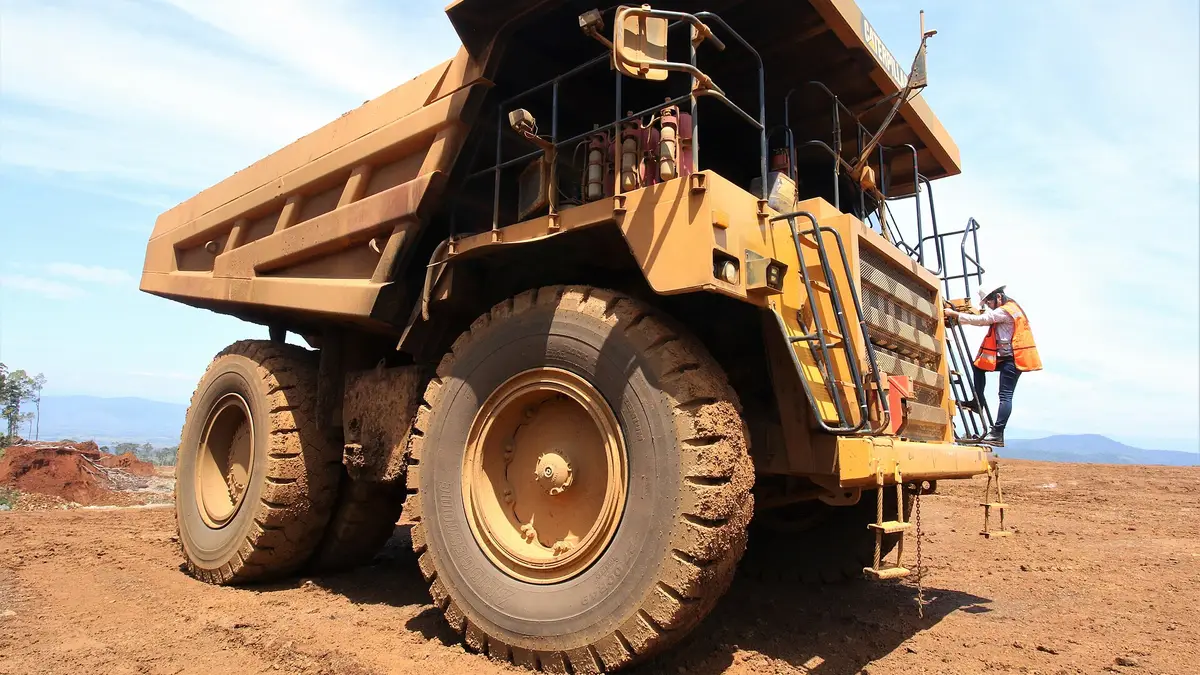
The environmental cost of that growth is part of the debate: laterite mining involves clearing large areas of tropical forest, and many Indonesian processing plants run on coal power in industrial parks, raising the carbon footprint of the nickel that ends up in batteries.
The decliners: Australia and the Philippines
The other side of Indonesia's expansion is prices. Nickel averaged about US$15,000 per tonne on the London Metal Exchange in 2025, 11% less than in 2024 and far below US$25,815 in 2022, according to the USGS. The global market has been in surplus since 2022, according to the International Nickel Study Group.
| Year | Average LME price (US$/t) | Primary nickel market surplus (t) |
|---|---|---|
| 2021 | 18,476 | — |
| 2022 | 25,815 | 98,500 |
| 2023 | 21,495 | 170,000 |
| 2024 | 16,812 | 182,000 |
| 2025 | 15,000 (estimated) | 189,000 (January to September) |
Source: USGS, Mineral Commodity Summaries 2026, with International Nickel Study Group data for the market balance. The 2025 surplus covers the first nine months, against 107,000 tonnes in the same period of 2024.
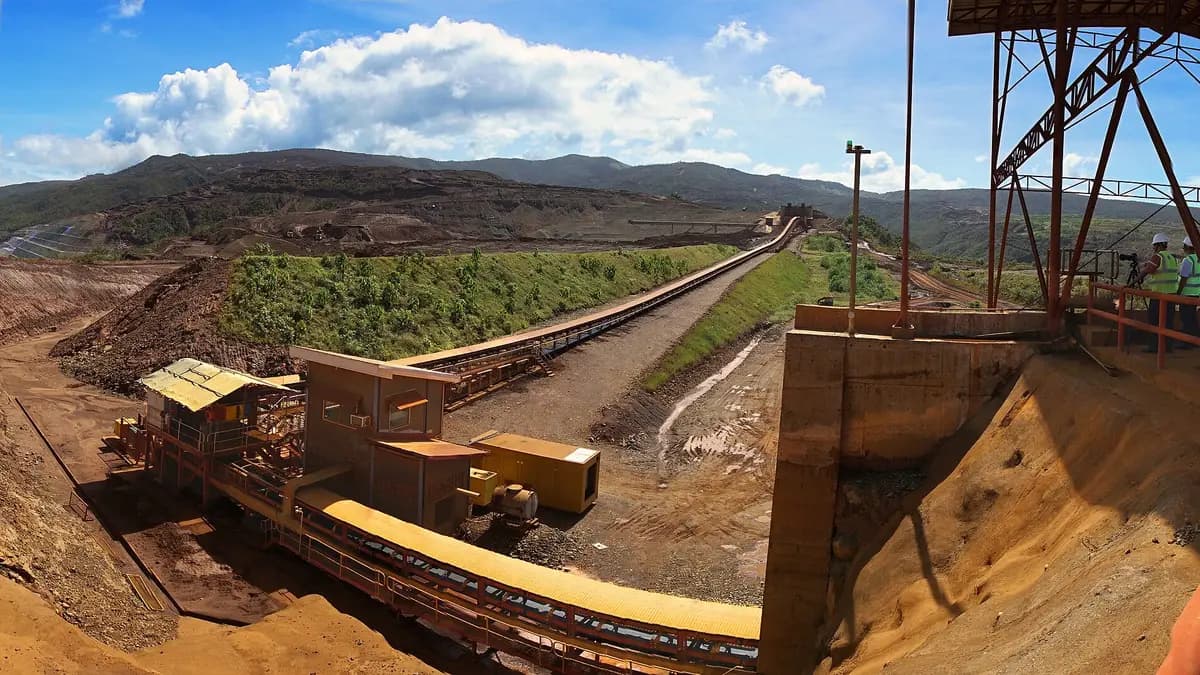
At those prices, Australia cut output by 54%, from 98,000 to 45,000 tonnes, after several companies placed mines on care and maintenance. In the Philippines, production fell 24% on cuts at several mines, and Palawan province announced a 50-year ban on new mining permits, which does not affect existing operations. Canada and New Caledonia, by contrast, grew: the first thanks to a mine expansion and the second by operating without the interruptions of 2024.
Nickel reserves: where tomorrow's nickel is
World nickel reserves exceed 140 million tonnes, and almost half are in Indonesia. Australia is second, with 25 million, although the USGS notes that only 11 million meet the Australian JORC standard. Brazil is third, with 16 million.
| Rank | Country | Nickel reserves (t) | Share |
|---|---|---|---|
| 1 | Indonesia | 62,000,000 | 44.3% |
| 2 | Australia | 25,000,000 | 17.9% |
| 3 | Brazil | 16,000,000 | 11.4% |
| 4 | Russia | 8,300,000 | 5.9% |
| 5 | New Caledonia | 7,100,000 | 5.1% |
| 6 | Philippines | 4,800,000 | 3.4% |
| 7 | China | 4,400,000 | 3.1% |
| 8 | Canada | 2,200,000 | 1.6% |
| 9 | United States | 340,000 | 0.2% |
| — | Other countries | more than 9,100,000 | 6.5% |
| — | World total | more than 140,000,000 | 100% |
Source: USGS, Mineral Commodity Summaries 2026. Share calculated by Energía Futura on 140 million tonnes. Land-based nickel resources exceed 350 million tonnes: 54% in laterites and 35% in magmatic sulfide deposits. A 2022 USGS study estimates about 4.5 billion tonnes of nickel in seabed nodules and crusts.
The United States and the race for nickel
The US case shows how much the West depends on a few producers. Its only operating nickel mine, Eagle, in Michigan, produced about 10,000 tonnes in 2025, and the concentrate was exported for smelting in Canada and elsewhere: the country's last primary nickel refinery, Port Nickel, in Louisiana, closed in 1985. Excluding scrap, its import reliance is nearly total, according to the USGS.
| US indicator (2025) | Value |
|---|---|
| Mine production | 10,000 t |
| Primary nickel imports | 100,000 t |
| Total apparent consumption | 220,000 t |
| Nickel recovered from scrap | About 60% of apparent consumption |
| Net import reliance (including scrap) | 41% |
| Main source of imported primary nickel (2021-2024) | Canada, 44% |
Source: USGS, Mineral Commodity Summaries 2026 (estimated figures). In April 2025, Executive Order 14285 called for developing seabed mineral deposits to secure critical minerals such as nickel, and several companies applied to explore areas with polymetallic nodules. There are also mine projects in Alaska, Michigan, Minnesota, Nevada and Oregon, and three companies are considering refineries in Missouri, Oklahoma and Texas.
Recycling is the other big source: most secondary nickel comes from stainless steel scrap, remelted to make new steel. As the first generations of electric car batteries reach end of life, nickel from NMC cathodes will join that loop.
What the nickel ranking means for Chile
Chile does not produce nickel, but it competes in the same battery minerals market. NMC (nickel, manganese and cobalt) and NCA chemistries depend on nickel, while LFP (lithium iron phosphate) batteries, gaining ground in cars and storage, do not use it. In both cases lithium is essential, and there Chile is the world's second-largest producer, as our ranking of the largest lithium producers shows.
Falling nickel prices also help explain the rise of LFP batteries, which do not need it and are cheaper. That chemistry dominates large stationary storage projects, as our ranking of the largest battery in the world shows.
How to cite this data
How to cite this data: "Indonesia was the world's largest nickel producer in 2025, with 2.6 million tonnes, 67% of the world total (USGS, Mineral Commodity Summaries 2026)". Source: Energía Futura, https://energiafutura.cl/en/news/largest-nickel-producers-in-the-world-2026-ranking-by-country-reserves-and-chile. We update this ranking at the same address when the USGS publishes new figures.
Does your company work in critical minerals, batteries or recycling? Reach Energía Futura's readers.
See advertising optionsFrequently asked questions about the largest nickel producers
Which is the largest nickel producer in the world?
Indonesia, with about 2.6 million tonnes in 2025, roughly 67% of the world total, according to the USGS.
Does Chile produce nickel?
No. Chile does not appear in the USGS nickel production table. Its contribution to batteries is lithium and copper.
Which country has the largest nickel reserves?
Indonesia, with 62 million tonnes, followed by Australia (25 million) and Brazil (16 million).
What is nickel used for?
Mainly in stainless steel and alloys, and increasingly in NMC and NCA lithium-ion batteries for electric cars.