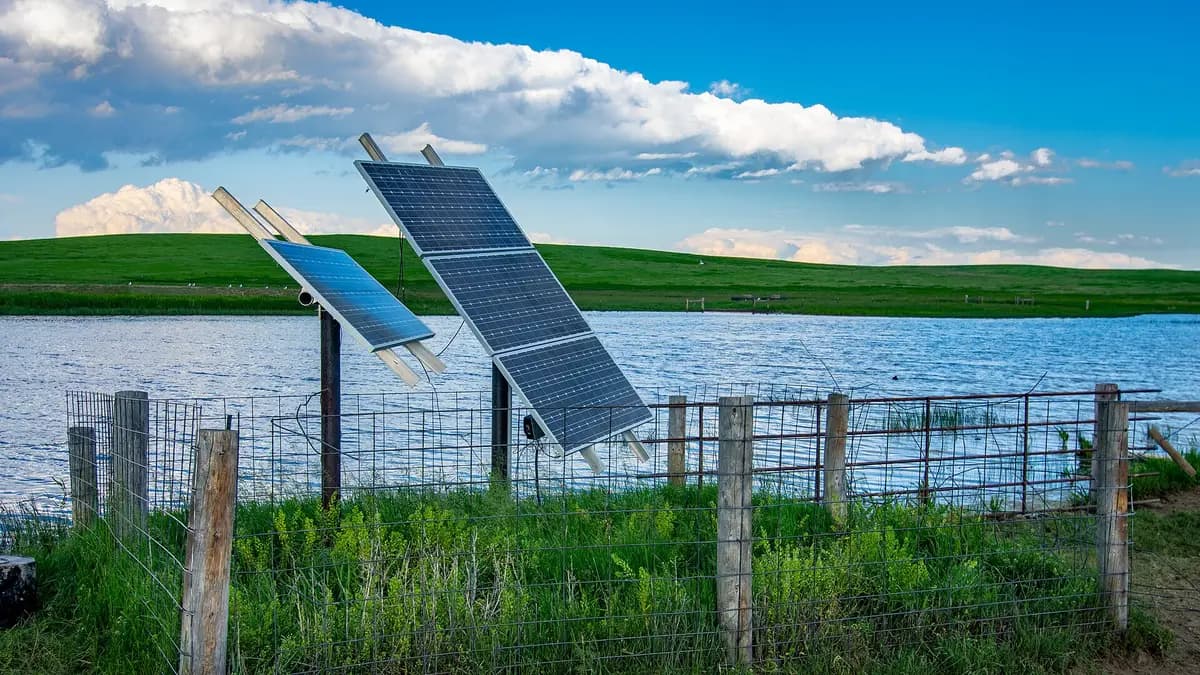
A solar water pump runs directly on photovoltaic panels, with no grid connection or fuel. It is the most common way to draw water from wells, boreholes and canals on rural plots and farms without electricity. The panel it needs depends on how much water you want to move and how high: lifting 5,000 litres a day by 20 metres takes about 120 W of panel in January in Santiago, and the same energy taken from the grid would cost about CLP 5,200 a month.
This guide explains how a solar water pump works, how to size the panel by flow, head and city, how much it saves compared with a grid-connected pump, and prices in Chile as of 17 November 2026, from CLP 9,990 for small fountain pumps to CLP 668,990 for a 600 W submersible well pump.
View the data as a table
| Panel for 5,000 litres a day at 20 m | 118 W |
| Savings versus the grid | $5,217 |
| Energy to lift 1 m³ by 1 m | 2.725 Wh |
How a solar water pump works
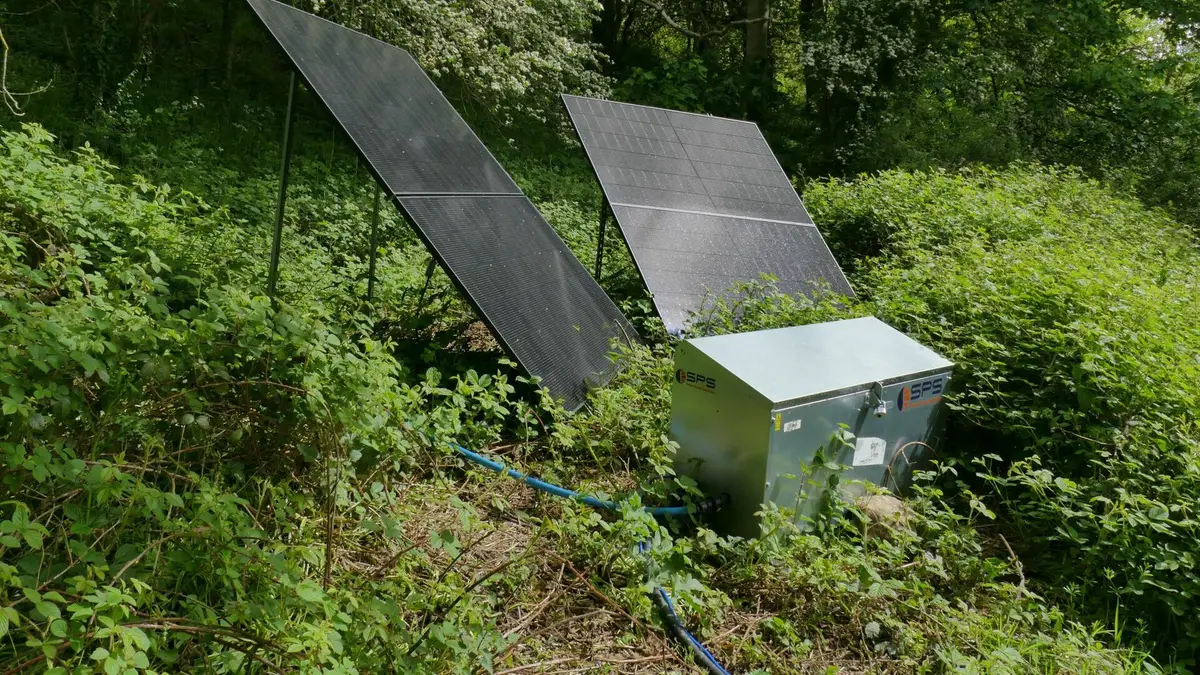
The system has three parts: the solar panels, a controller and the pump. The panels generate direct current; the controller adjusts it so the pump keeps running as the sunlight changes, and the pump (almost always with a brushless DC motor) moves the water. In larger systems, a drive converts the current to run AC pumps.
Most irrigation systems do not use batteries: the pump works while the sun shines and fills an elevated tank, which stores water for the night or cloudy days. Storing water is cheaper and lasts longer than storing electricity. An extra advantage: irrigation is needed mainly in summer, exactly when there is most sun.
| Type of solar pump | Use | Typical head |
|---|---|---|
| Submersible | Deep wells and boreholes | From 10 to over 100 metres |
| Surface (centrifugal or peripheral) | Canals, springs, tanks, pressurising | Up to 30 to 50 metres |
| Fountain and pool pumps | Recirculating decorative water or filtering | Less than 5 metres |
Source: Energía Futura based on product listings on Sodimac.cl and Falabella.com as of 17 November 2026. The exact maximum head is given by each manufacturer in the pump curve.
What panel a solar water pump needs
The energy needed to lift water follows a physical formula: raising 1 cubic metre (1,000 litres) by 1 metre takes 2.725 Wh. Because small pumps lose part of the energy, we assume an overall efficiency of 40%. Daily energy is therefore 2.725 × cubic metres × metres of head ÷ 0.4. Head includes the water depth in the well, the rise to the tank and friction losses in the pipes.
That figure is then divided by what 1 watt of panel generates on site, which we calculated with the European Commission's PVGIS for a north-facing panel tilted at the latitude. In Santiago, each watt of panel generates 5.76 Wh a day in January and 3.58 Wh in June; in Temuco, 5.37 and 2.08.
| Use | Water per day | Head | Daily energy | Panel in Santiago (January) | Panel in Temuco (January) |
|---|---|---|---|---|---|
| Family garden | 1,000 litres | 10 m | 68 Wh | 12 W | 13 W |
| Tank and livestock | 5,000 litres | 20 m | 681 Wh | 118 W | 127 W |
| Smallholding irrigation | 20,000 litres | 30 m | 4,088 Wh | 710 W | 761 W |
Source: Energía Futura calculation with 2.725 Wh per cubic metre per metre of head, 40% pump efficiency and output from PVGIS 5.3 (14% losses). In practice a 20% to 30% margin is added for dust, heat and piping. If the system must work in winter, size it for the weakest month: in Santiago, the 5,000-litre tank would need about 190 W in June.
How much a solar water pump saves compared with the grid
The saving is the electricity you no longer buy. With CGE's October 2026 BT1 residential tariff of CLP 255.27 per kWh, the 5,000-litre daily tank at 20 metres would use about 20.4 kWh a month, around CLP 5,217. Irrigating 20,000 litres at 30 metres would take about 122.6 kWh, around CLP 31,302 a month. Over a six-month irrigation season, savings reach CLP 31,650 and CLP 189,902 respectively.
The calculation assumes the same energy for a grid-connected electric pump. The comparison is most favourable for the solar water pump where there is no grid: running a power line to a remote well can cost more than the entire solar system, and the alternative, a petrol or diesel motor pump, adds fuel and maintenance. You can check the price per kWh in your area in our guide to the price of electricity in Chile.
| Use | kWh per month | Grid cost per month | 6-month season |
|---|---|---|---|
| Family garden (1 m³ at 10 m) | 2.0 | CLP 522 | CLP 3,165 |
| Tank (5 m³ at 20 m) | 20.4 | CLP 5,217 | CLP 31,650 |
| Smallholding irrigation (20 m³ at 30 m) | 122.6 | CLP 31,302 | CLP 189,902 |
Source: Energía Futura calculation with CGE's October 2026 BT1 tariff (CLP 255.27 per kWh). Other distributors and rural cooperatives charge different rates.
Does your company sell pumps, panels or solar irrigation systems? Reach Energía Futura's readers.
See advertising optionsSolar water pump prices in Chile
On Sodimac.cl, as of 17 November 2026, the Flowmak brand offers solar pumps for wells, surface use and pools between CLP 280,140 and CLP 668,990. Falabella.com mostly lists small 12-volt kits for fountains, ponds and drip irrigation, from CLP 9,990. Listings do not always say whether the price includes the panels, so check before buying.
| Product | Type | Price |
|---|---|---|
| JT-500 pump 12 V, 600 l/h, 5 m | Small surface | CLP 9,990 |
| Fountain pump with 14 W panel | Submersible for fountains | CLP 12,390 |
| Solar water pump kit, 50 W panel, 800 l/h, 12 V | Kit with panel | CLP 32,990 |
| Flowmak solar peripheral pump | Surface, pressurising | CLP 280,140 |
| Flowmak solar centrifugal pump | Surface, irrigation | CLP 349,580 |
| Flowmak solar pool pump | Pool filtering | CLP 454,930 |
| Flowmak 3SC3.8-72V, 600 W | Submersible well pump | CLP 668,990 |
Source: prices listed on Sodimac.cl and Falabella.com on 17 November 2026 (lowest available price). A complete well system adds panels, mounting, controller, cables, level sensor and tank.
Submersible or surface solar water pump: which to choose
A submersible solar water pump sits inside the well, below the water level, and pushes water upwards. It is the only option when the water is more than 7 to 8 metres deep, because a surface pump cannot suck from further down. A surface pump is installed next to a canal, spring or tank and is easier to maintain. To choose the size, it helps to compare with what a grid-connected water pump uses.
- Deep well or borehole: submersible, with a sensor that switches it off if the level drops.
- Canal, spring or tank: surface pump with a filter on the suction side.
- Drip irrigation: a pump that delivers the system's pressure, not just flow.
- For winter: size the panel for June or add a small battery.
- Fountains and pools: 12 V kits with a panel included, only for recirculating water.

Support for a solar water pump on the farm
In Chile, the Irrigation Law (Law 18,450) subsidises irrigation works by farmers and water user associations, including those using renewable energy. Law 21,597 extended it to 2030. According to a National Irrigation Commission presentation from November 2025, between 2022 and 2025 the law funded 8,900 projects and installed 5,500 kW of electrical capacity in 1,900 projects. The agricultural development agency INDAP also runs programmes for small farmers.
Applying requires a project prepared by a registered consultant, with calculations for the well, pump, panels and tank. If you also want to use surplus panel output at home, the reference is a home solar kit.
Frequently asked questions
Does a solar water pump work at night?
Only if it has a battery. Most irrigation systems work during the day and store water in a tank for use at night.
How many panels does a solar water pump need?
It depends on the water and the head. For 5,000 litres a day at 20 metres in Santiago, about 120 W in January is enough (one small panel), and for 20,000 litres at 30 metres, about 710 W (two panels of 400 W or more), using Energía Futura's assumptions and PVGIS data.
How much does a solar water pump cost in Chile?
As of 17 November 2026, from CLP 9,990 for 12 V fountain pumps and between CLP 280,140 and CLP 668,990 for Flowmak solar pumps on Sodimac.cl, excluding panels and installation when not included.
Which solar pump works for a deep well?
A submersible pump, because surface pumps cannot draw water from more than 7 or 8 metres down.
How much does a solar water pump save?
For a tank of 5,000 litres a day at 20 metres, about CLP 5,217 a month compared with the grid, at CGE's October 2026 tariff. Where there is no grid, the main saving is not having to run a power line or buy fuel.
Are there subsidies for solar irrigation pumps?
Yes: the Irrigation Law run by the National Irrigation Commission subsidises irrigation projects using renewable energy until 2030, and INDAP has programmes for small farmers.