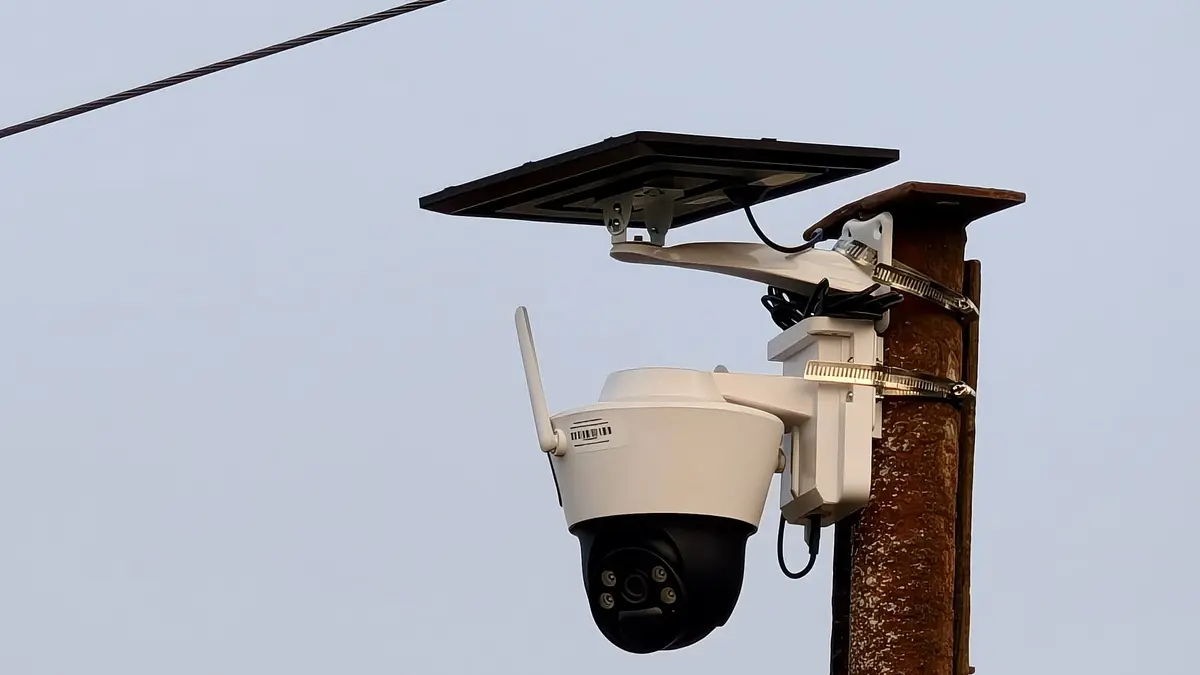
A solar security camera is a battery-powered camera recharged by a small photovoltaic panel of 3 to 10 watts. It needs no socket and no cables back to the house: it can be mounted on a pole, a gate or a rural plot and connects over wifi or with a 4G SIM card. The panel is more than enough for most uses: a well-oriented 5 W panel generates about 18 Wh a day in Santiago in June and about 29 Wh in January, according to the European Commission's solar calculator PVGIS, while a camera that only records when it detects motion uses a fraction of that.
This guide explains how a solar security camera works, how much energy its panel generates month by month in seven Chilean cities, whether 4G or wifi is the better choice, which battery and panel to pick, and prices in Chile as of 17 November 2026, ranging from CLP 34,990 for generic models to CLP 189,990 for brand-name 4G kits.
View the data as a table
| 5 W panel in Santiago, June | 17.9 Wh/day |
| 5 W panel in Santiago, January | 28.8 Wh/day |
| Price from | $34,990 |
| Brand-name 4G kits, up to | $189,990 |
How a solar security camera works
A solar security camera has four parts: the camera itself (with motion sensor, night vision and microphone), a rechargeable lithium battery, a solar panel that charges it during the day and a connection module using wifi or the mobile network. During the day the panel tops up the battery; at night the camera runs on the stored energy.
The key to its low consumption is that almost all battery cameras do not record all the time. They spend most of the day asleep and wake up through a passive infrared (PIR) sensor when they detect a moving heat source: they record a clip, save it to a microSD card or the cloud and send an alert to the phone. Battery life therefore depends on how many seconds they record per day. TP-Link, for example, says its Tapo C425 lasts up to 300 days on one charge when recording 230 seconds a day, and 180 days at 360 seconds.
Cameras that record continuously around the clock use far more energy and need much larger panels and batteries than a home kit. Before buying, check whether the camera supports continuous recording and which power system the manufacturer recommends for it.
| Component | What it does | Typical range in Chile |
|---|---|---|
| Solar panel | Recharges the battery during the day | 3 to 10 W (USB-C or micro USB) |
| Lithium battery | Runs the camera at night and on cloudy days | 5,000 to 10,400 mAh |
| PIR sensor | Wakes the camera when it detects motion | 8 to 12 m range |
| Connection | Sends alerts and video to the phone | 2.4 GHz wifi or 4G LTE with SIM |
| Storage | Saves the clips | microSD card or cloud subscription |
Source: product listings on Falabella.com and Sodimac.cl as of 17 November 2026 and the Reolink and TP-Link websites. Ranges are those of the models reviewed, not the whole market.
How much energy a solar security camera panel generates in Chile
To check whether the panel is enough, we used PVGIS, the tool of the European Commission's Joint Research Centre, to calculate how much energy 1 watt of panel produces per day, month by month, in seven Chilean cities. We assumed a north-facing panel tilted at an angle equal to the latitude, with 14% losses, the system default. The result is multiplied by the panel's rating.
Under those assumptions, a 5 W panel in Santiago generates about 28.8 Wh a day in January and 17.9 Wh in June, the worst month. In Antofagasta the gap between summer and winter is minimal (28.7 and 22.9 Wh), while in Puerto Montt the panel drops to 9.6 Wh in June and in Punta Arenas to 8.1 Wh. Even in the south, the panel still delivers several times what a motion-triggered camera uses.
View the data as a table
| Antofagasta | Santiago | Concepción | Puerto Montt | Punta Arenas | |
|---|---|---|---|---|---|
| Jan | 28.7 | 28.8 | 29.1 | 25.0 | 20.3 |
| Feb | 29.2 | 29.4 | 29.0 | 24.0 | 19.3 |
| Mar | 28.6 | 28.8 | 27.1 | 20.9 | 15.9 |
| Apr | 25.8 | 25.5 | 22.3 | 15.9 | 13.2 |
| May | 23.9 | 20.4 | 16.3 | 11.6 | 10.0 |
| Jun | 23.0 | 17.9 | 13.1 | 9.6 | 8.1 |
| Jul | 23.8 | 19.6 | 14.9 | 10.8 | 9.4 |
| Aug | 26.6 | 22.3 | 17.9 | 13.5 | 13.8 |
| Sep | 29.1 | 25.5 | 23.5 | 18.7 | 16.9 |
| Oct | 30.1 | 27.0 | 26.6 | 21.0 | 20.6 |
| Nov | 29.9 | 27.8 | 28.5 | 22.1 | 22.0 |
| Dec | 29.0 | 28.7 | 28.5 | 23.4 | 21.1 |
| City | 5 W panel in January | 5 W panel in June | Annual output per watt |
|---|---|---|---|
| Antofagasta | 28.7 Wh/day | 22.9 Wh/day | 1.99 kWh |
| La Serena | 27.9 Wh/day | 19.7 Wh/day | 1.85 kWh |
| Santiago | 28.8 Wh/day | 17.9 Wh/day | 1.83 kWh |
| Concepción | 29.0 Wh/day | 13.1 Wh/day | 1.68 kWh |
| Temuco | 26.9 Wh/day | 10.4 Wh/day | 1.44 kWh |
| Puerto Montt | 25.0 Wh/day | 9.6 Wh/day | 1.31 kWh |
| Punta Arenas | 20.3 Wh/day | 8.1 Wh/day | 1.16 kWh |
Source: Energía Futura calculation with PVGIS 5.3 (European Commission, JRC), accessed 17 November 2026; north-facing panel, tilt equal to latitude, 14% losses. Small panels may yield less because of charging electronics, shade and dust.
View the data as a table
| June | |
|---|---|
| Antofagasta | 23.0 Wh/day |
| La Serena | 19.7 Wh/day |
| Santiago | 17.9 Wh/day |
| Concepción | 13.1 Wh/day |
| Temuco | 10.4 Wh/day |
| Puerto Montt | 9.6 Wh/day |
| Punta Arenas | 8.1 Wh/day |
How much does the camera use? Manufacturers rarely publish consumption in watts; they quote battery life instead. If a 6,000 mAh battery like the one in the Reolink Argus 3 Pro (about 21.6 Wh, assuming 3.6 volts) were drained over a month of heavy use, the camera would use about 0.72 Wh a day: one twentieth of what a 5 W panel generates in Santiago in winter. Reolink actually pairs that camera with a panel of just 3 W. The same applies to solar lights: the problem is almost never the panel's power but where it is installed.
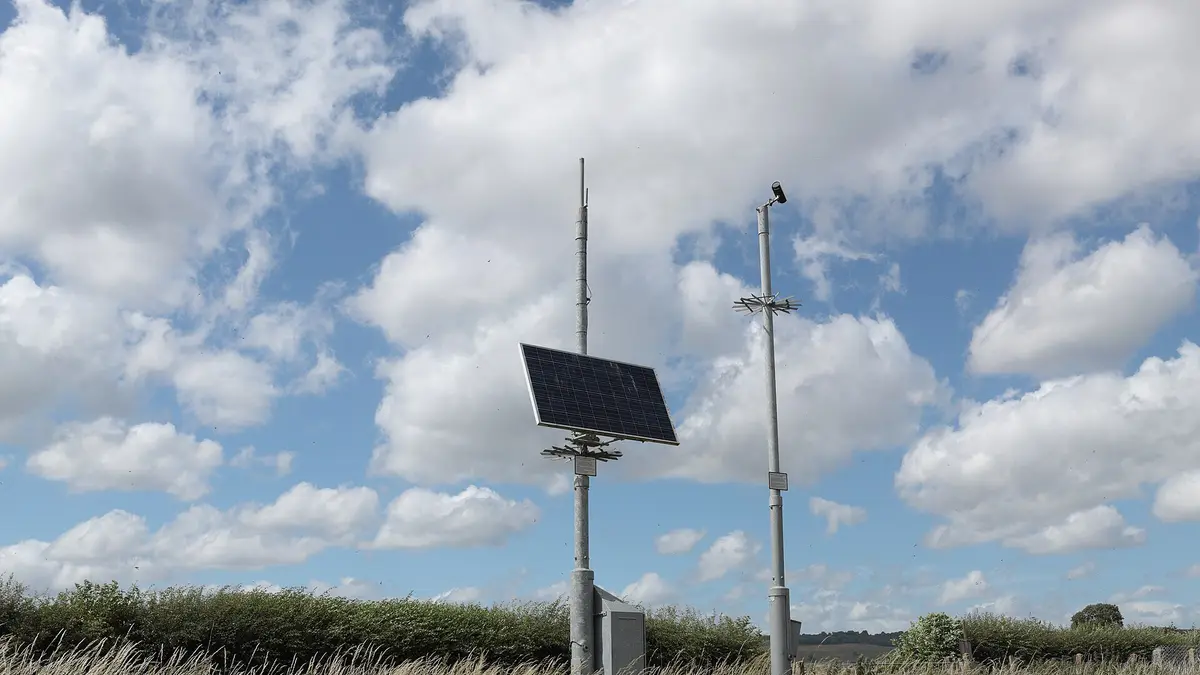
Solar camera with a 4G SIM or wifi: which to choose
The difference between a 4G solar camera and a wifi one is how it connects to the internet. A wifi camera must be within range of the home network, usually less than 30 to 50 metres from the router with no thick walls in between. It is the option for the front garden, the backyard or the entrance of a gated community.
A solar camera with a SIM card uses the mobile network, just like a phone. It works where there is no wifi or electricity: rural plots, construction sites, warehouses, farms, cabins or jetties. It has two extra costs: the monthly data plan and somewhat higher energy use, because the cellular modem consumes more than wifi. Before buying, check that the camera supports the 4G bands of Chilean carriers and that there is good signal on site.
| Criterion | Wifi | 4G SIM |
|---|---|---|
| Where it works | House, yard, front garden, gated community | Plot, building site, farm, warehouse without internet |
| Monthly cost | CLP 0 (uses home wifi) | Carrier data plan |
| Energy use | Lower | Higher due to the cellular modem |
| Key requirement | Stable wifi signal at the spot | Good 4G coverage and compatible bands |
| Price in Chile (17 Nov 2026) | CLP 34,990 to 104,990 | CLP 49,990 to 189,990 |
Source: Energía Futura with prices from Falabella.com and Sodimac.cl as of 17 November 2026 (lowest available price, which may be a sale or card price).
Does your company sell solar equipment, cameras or security solutions? Reach Energía Futura's readers.
See advertising optionsSolar security camera prices in Chile
On Falabella.com and Sodimac.cl, as of 17 November 2026, generic wifi solar security cameras start at about CLP 34,990. Kits from well-known brands such as Reolink, TP-Link Tapo, Eufy and Ezviz cost between CLP 79,990 and CLP 189,990. Stand-alone solar panels for cameras cost between CLP 21,990 and CLP 39,990.
| Model | Connection | Power | Price |
|---|---|---|---|
| Generic Ip1080 360° | Wifi | Solar panel | CLP 34,990 |
| Zeker 4MP with panel | Wifi | Solar panel | CLP 59,990 |
| Zeker 4G 4MP PTZ | 4G (SIM not included) | 5 W panel + 9,200 mAh battery | CLP 74,990 |
| TP-Link Tapo 2K + panel | Wifi | 10 W USB-C panel | CLP 79,990 |
| Eufy SoloCam S220 | Wifi | Built-in panel | CLP 94,990 |
| Ezviz EB3 4G + panel | 4G | Solar panel | CLP 99,990 |
| Reolink Argus 3 Pro + panel | 2.4 and 5 GHz wifi | 6 W panel + 6,000 mAh battery | CLP 104,990 |
| Ezviz EB8 Pro 4K | 4G and wifi | Solar panel | CLP 182,990 |
| Reolink 4G Go PT Plus + panel | 4G | Solar panel | CLP 189,990 |
Source: prices listed on Falabella.com on 17 November 2026; the Argus 3 Pro's 6,000 mAh battery is as stated by Reolink. Beware of dummy solar cameras, sold from CLP 11,990: they are a housing with a light that imitates a camera and do not record.
How to choose a solar security camera
- Connection: wifi if the camera is close to the router; 4G SIM if it is far away or somewhere without internet.
- Battery: 6,000 mAh or more for central and southern Chile, where winter brings several cloudy days in a row.
- Panel: 5 W or more if the camera is south of Concepción or records many times a day.
- Resolution: 2K or 4 MP lets you make out faces and licence plates; 1080p is enough to see movement.
- Colour night vision: uses spotlights that drain the battery faster; black-and-white infrared uses less.
- Storage: local microSD so you do not depend on a cloud subscription.
- Protection: at least IP65 against rain and dust.
If you also want backup for your router or electric gate during a power cut, a solar camera is not enough: for that you need a portable solar panel with a power station or a home battery system.
Installation: where to put the panel
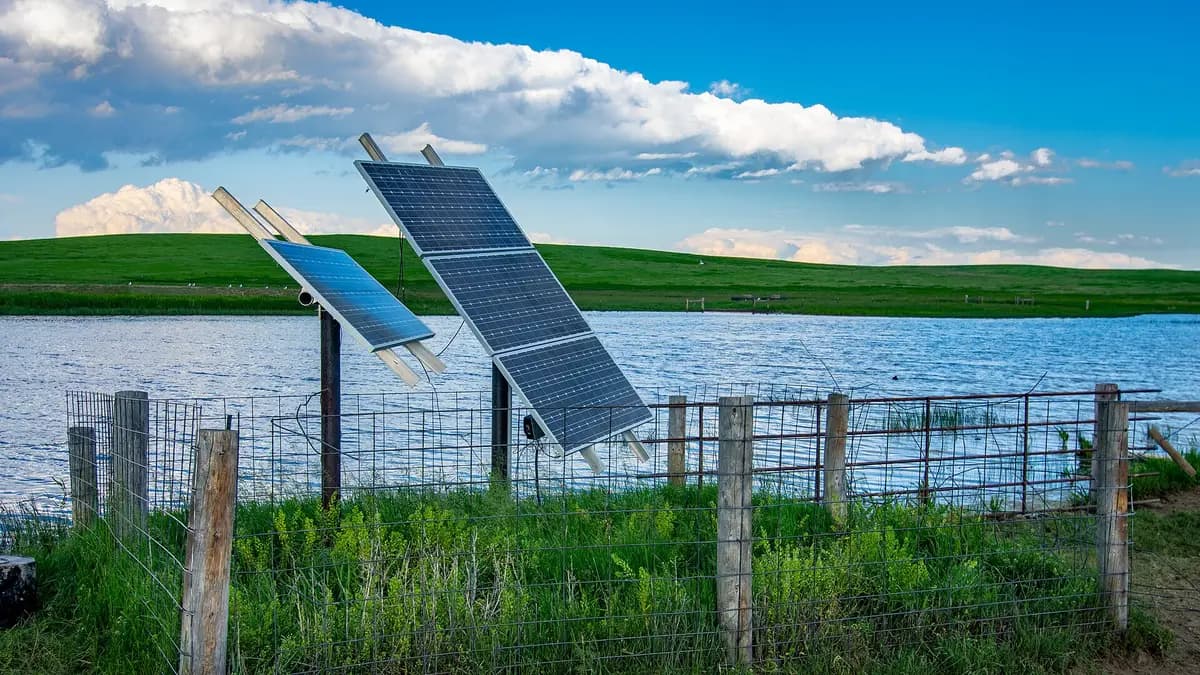
In Chile, as in the rest of the southern hemisphere, the panel must face north and be tilted more steeply in the south of the country to catch the low winter sun. Most importantly, it must be free of shade between 10 am and 4 pm: a tree or an eave can cut the charge to a fraction. That is why almost every kit has the panel separate from the camera, with a 3 to 4.5 metre cable, so the camera can go where it is needed and the panel where the sun reaches.
Clean the panel from time to time, especially in the north and in dusty areas, and check the battery percentage in the app during the first winter. If it falls day after day, lower the sensor sensitivity, shorten the clips or add a second panel. For something bigger, such as powering lights or a fridge, the reference is a home solar kit.
Frequently asked questions
How long does a solar security camera battery last without sun?
It depends on use. With a full battery, a camera that only records on motion can go several weeks without sun: TP-Link quotes up to 300 days for its Tapo C425 with 230 seconds of recording a day, without a panel.
Does a solar camera work in winter in southern Chile?
Yes, if the panel is not shaded. In June a 5 W panel generates about 9.6 Wh a day in Puerto Montt and 8.1 Wh in Punta Arenas, according to PVGIS, more than a motion-triggered camera uses. On very cloudy days the battery covers the gap.
What does a solar camera with a SIM mean?
It uses a SIM card to connect to a mobile carrier's 4G network, with no wifi needed. It requires a data plan and good signal on site.
How much does a solar security camera cost in Chile?
As of 17 November 2026, from CLP 34,990 for generic wifi models and between CLP 79,990 and CLP 189,990 for brand-name kits on Falabella.com.
Can it record 24 hours a day on solar power?
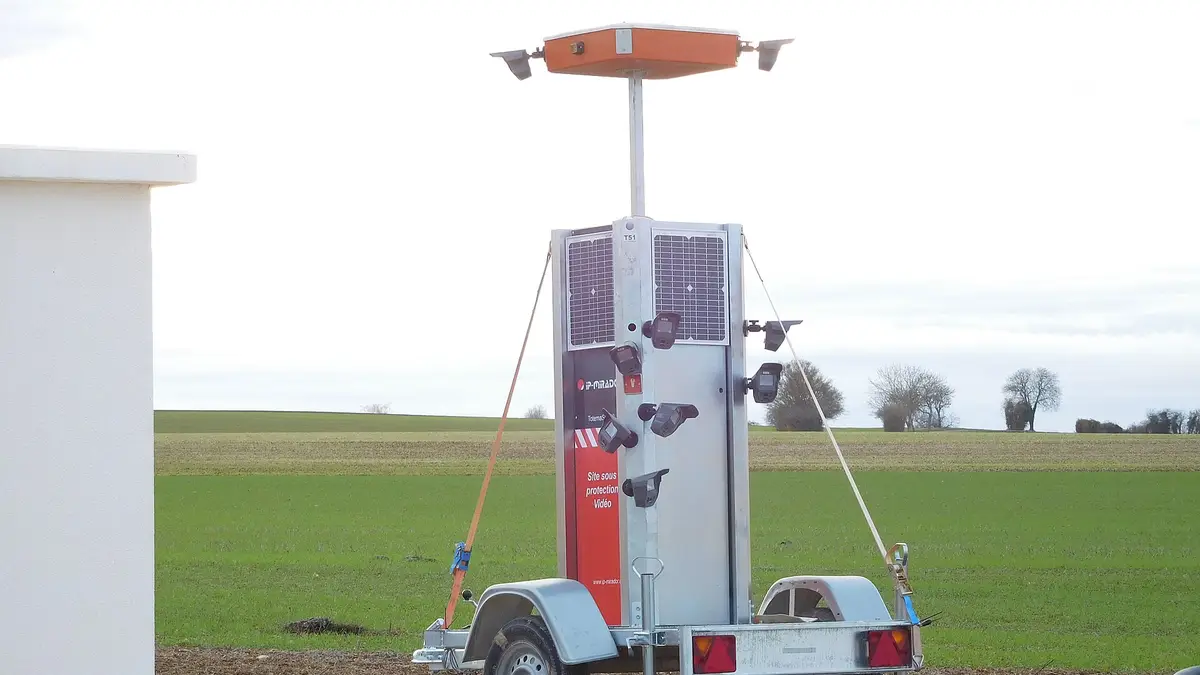
Home battery cameras are not designed for continuous recording. That requires systems with much larger panels and batteries, such as building-site surveillance towers.
Which way should the camera panel face in Chile?
North, without shade at midday and tilted at roughly the local latitude: about 33° in Santiago and about 41° in Puerto Montt.